↑↓ navigate ↵ open Esc close All results →

Best Compact Reciprocating Saws of 2026

Compact reciprocating saws solve an awkward access problem: cutting a drainpipe under a sink, trimming a stud behind a soffit, or pruning overhead from a ladder where a full-size two-handed saw leaves no room to work safely. Shrinking the chassis, however, forces clear trade-offs in stroke length, vibration control, and price.

Nine months of cutting basement pipe, pruning yard branches, and making flush cuts against a clamped doorjamb with 12 compact saws showed which specs hold up in tight quarters. Longer stroke length delivered faster cuts than inflated strokes-per-minute ratings, and saws weighted back over the grip handled far better overhead than blade-heavy designs.

Because most compact models ship as bare tools, real-world cost hinges on which battery platform is already in the shop, whether the priority is tight one-handed reach, fast framing demos, or cabinet cutouts.

Our Top Picks

The Best Compact Reciprocating Saws

1.

DEWALT ATOMIC 20V MAX Reciprocating Saw Best Overall
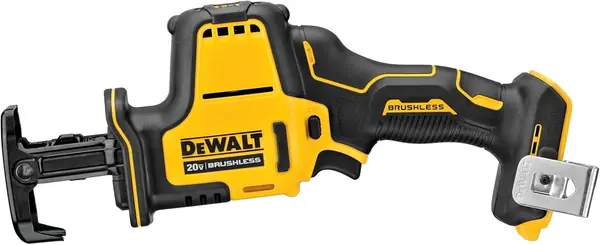
DEWALT ATOMIC 20V MAX cordless reciprocating saw with a 12.5-inch compact body

One-handed tight-space work

Shop Score 97/100
Length
12.5 in
Weight
3.13 lb
Speed
Up to 2,800 spm
Battery Platform
DEWALT 20V MAX
View on Amazon

One hand on the saw, one hand holding the stud, blade overhead: that is the cut this whole category exists for, and the ATOMIC is the saw that made it feel routine for us. At 12.5 inches front to back and just over three pounds, it goes into gaps a 14- or 15-inch body will not, and it does not ask for a second hand to stay on line.

DEWALT built it 37 percent lighter than its own compact XR, and the diet did not gut the tool. The brushless motor pulls 2,800 strokes per minute through 2x4s, PVC, and branches without stalling on us, and the variable-speed trigger feathers cleanly enough to start a cut in shelf stock without the blade skating.

The small details are right too. The blade clamp is tool-free and quick, the saw ships with two blades and a belt hook, and the LED is bright enough to read a pencil line inside a stud bay. It is a bare tool, so you are buying into the 20V MAX packs — the ones in your DEWALT drill will run it.

What keeps it in the bag is the length: it drops into a stud bay with room for the blade to travel, and it comes back out for every cut that a bigger saw makes awkward. Of the seven saws here, this is the one we pack when we do not know what the job will ask for.

Worth Noting

  • Slower in thick lumber than longer-stroke saws
Our Verdict

We recommend the ATOMIC first: it is the lightest full-power one-hander in this group, and it makes overhead and one-handed cuts feel routine.

Check Latest Price
2.

DEWALT 20V MAX XR Compact Reciprocating Saw Best for Flush Cuts

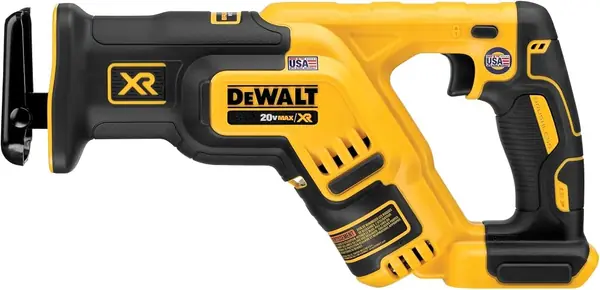
DEWALT 20V MAX XR compact reciprocating saw in black with pivoting shoe

Flush cuts and framing

Shop Score 96/100
Length
14.5 in
Weight
5.4 lb
Stroke Length
1-1/8 in
Warranty
3-year limited
View on Amazon

Flush cuts are where a short body stops helping. Trimming a door bottom, slicing a stud tight to a slab, or cutting pipe against a wall all need a blade you can turn, and that is what the XR's four-position keyless clamp does: pull the lever, rotate the blade, and cut in whichever direction the work allows.

We like it just as much for the other half of compact work. The 1-1/8-inch stroke is the longest in this group, so each pass takes a bigger bite out of 2x material, and the pivoting shoe keeps the blade seated while you rock through a cut. DEWALT rates the brushless motor for up to 2.5 times the runtime of its older compact saw in 2x4 wood.

Fourteen and a half inches is the number that matters for stud work — short enough to slip into a bay with the blade leading the way. The rest is housekeeping: an LED for dark corners, a pivoting head that follows the angle of the cut, and a three-year limited warranty behind it.

Worth Noting

  • Heaviest saw in this group at 5.4 pounds
  • Bare tool; battery and charger sold separately
Our Verdict

If your cuts are flush and your lumber is thick, this is the compact saw we point you to — the longest stroke here in a body sized to a stud bay.

Check Latest Price
3.

Milwaukee M18 FUEL HACKZALL Reciprocating Saw Best Cutting Speed

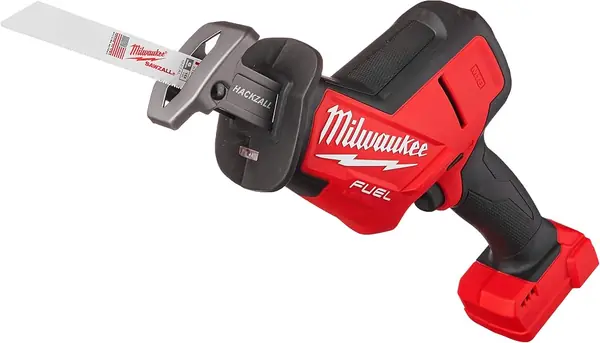
Milwaukee M18 FUEL HACKZALL one-handed reciprocating saw in red and black

Fast one-handed cutting

Shop Score 95/100
Length
14 in
Weight
3.97 lb
Stroke Length
7/8 in
Battery Platform
Milwaukee M18
View on Amazon

Seven-eighths of an inch of stroke does not sound like a headline, but it is the number under Milwaukee's claim that the FUEL HACKZALL cuts up to 50 percent faster than competing one-handed saws. In our cutting, that extra travel per stroke is the difference between a saw that works through pipe and one that skates across it.

Control is the other half of the story. Milwaukee rates the vibration at up to four times lower than a standard reciprocating saw, which is what lets you start a cut one-handed without the blade chattering off your mark, and the compact body reaches into ceiling voids and between joists where a full-size saw will not go.

At 3.97 pounds it carries more mass than the ATOMIC, and we are happy to trade that for the way the stroke keeps driving through metal. It is the saw we take when a cut has to be quick and awkward rather than pretty — conduit in a ceiling, a pipe against a wall, a branch over your head.

Worth Noting

  • Some units have quit within months of use
Our Verdict

The FUEL HACKZALL is the fastest one-handed saw we tested in this group, and the one we want for pipe, conduit, and awkward overhead work.

Check Latest Price
4.

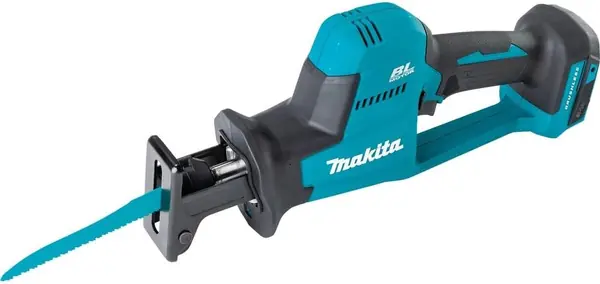
Makita XRJ08Z 18V LXT One-Handed Recipro Saw Best for Overhead and Pruning Work

Makita XRJ08Z 18V LXT one-handed recipro saw in teal with loop handle

Lowest Vibration

Shop Score 94/100
Length
14.38 in
Speed
0–3,100 spm
Stroke Length
7/8 in
Warranty
3-year limited
View on Amazon

If you have spent an afternoon cutting branches overhead, you know the buzz that stays in your hands afterwards. Makita's answer is a low-vibration design rated at up to 40 percent less vibration than its previous model, plus a loop-shaped handle guard that braces the body against the cut instead of letting it flex away.

The rest of the spec sheet backs it up: 0 to 3,100 strokes per minute, a 7/8-inch stroke, a brushless motor, and a claimed 55 percent faster cut than the model it replaces. Makita says a 5.0 Ah pack will make up to 90 cuts in 2x10 lumber or 50 cuts in 1-inch schedule 80 steel pipe, and the saw arrives with wood, all-purpose, and metal blades — unusual for a bare tool.

We reach for the Makita when the session is long and the cut is awkward — pruning, ceiling work, anything where fatigue decides how good the last fifteen minutes are. It is the calmest one-hander in this group, and overhead that matters more than the last word in speed.

Worth Noting

  • No belt hook or carry bag included
Our Verdict

We reach for the Makita when a long session is ahead: it is the smoothest one-hander here, and overhead cutting is where that pays off.

Check Latest Price
5.

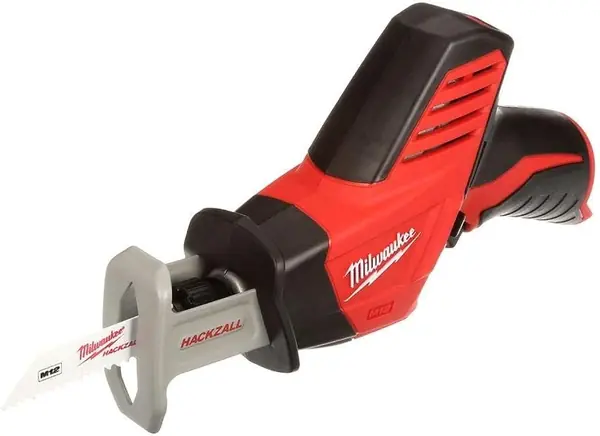
Milwaukee M12 HACKZALL Reciprocating Saw Best for Cabinets and Ladder Work

Milwaukee M12 HACKZALL cordless reciprocating saw in red, black, and silver

Smallest and Lightest

Shop Score 93/100
Length
10 in
Weight
2.1 lb
Warranty
5-year limited
Battery Platform
Milwaukee M12 12V
View on Amazon

A 12-volt saw has a ceiling and the M12 HACKZALL does not pretend otherwise: it will not rip a 4x4 or chew through green oak all afternoon. What it will do is weigh 2.1 pounds and measure 10 inches, which puts it inside a cabinet, up a ladder, or into a ceiling void where the 18-volt saws here physically do not fit.

We treat it as the second saw in the bag, and that is meant as a compliment. It takes both HACKZALL and SAWZALL blades, so the short blades that make it useful in tight spots are easy to find, the battery fuel gauge lets you check the pack without pulling it, and the variable-speed trigger feathers as smoothly as the bigger saws.

Milwaukee backs it with a five-year limited warranty, the longest stated coverage in this group, which says something about how the tool is meant to be used: PVC, small branches, trim, and light metal, over and over, without drama.

Worth Noting

  • Bogs down in thick or wet stock
Our Verdict

When the saw has to fit where a big one cannot, we take the M12 HACKZALL — 2.1 pounds, 10 inches, and a five-year warranty behind it.

Check Latest Price
6.

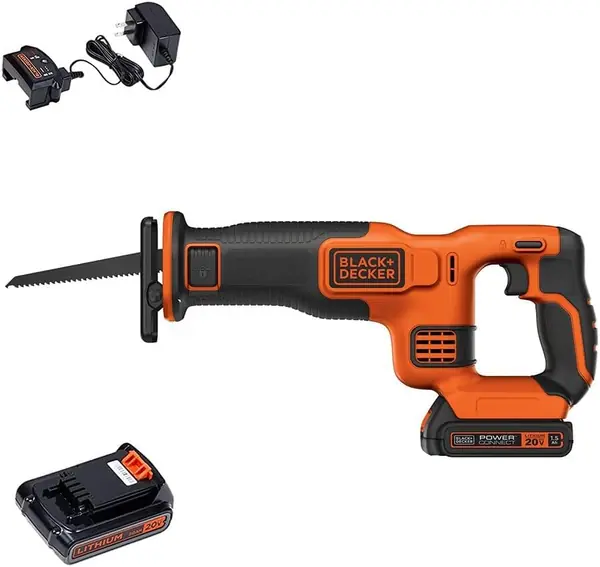
BLACK+DECKER 20V MAX Cordless Reciprocating Saw Kit Best Kit With Battery and Charger

BLACK+DECKER 20V MAX cordless reciprocating saw kit with battery and charger

A complete first kit

Shop Score 92/100
Length
15.62 in
Weight
4.5 lb
Speed
Up to 3,000 spm
In The Box
Saw, battery, charger, and one blade
View on Amazon

An electric brake is the feature nobody puts on the box and everybody notices the first time they use it: let off the trigger and the blade stops instead of coasting toward whatever is underneath. We think that detail, more than anything else here, is what makes this kit the easiest one to hand a first-time user.

The rest is modest and sensible: 3,000 strokes per minute, a pivoting shoe that keeps the blade seated through a curve, tool-free blade changes, and a body that runs on the same 20V MAX packs as BLACK+DECKER's drills and trimmers. At 4.5 pounds it is steady in two hands and still manageable in one.

Two years of limited warranty and a battery that swaps into the rest of the 20V MAX line make it easy to live with, so the kit is a starting point rather than a dead end. Ours lives with the yard tools, and that is where a saw like this earns its keep.

Worth Noting

  • Battery runs down fast under steady cutting
  • Long 15.6-inch body for tight spaces
Our Verdict

We recommend this kit to anyone who wants a reciprocating saw without committing to a battery platform first — it is complete out of the box.

Check Latest Price
7.

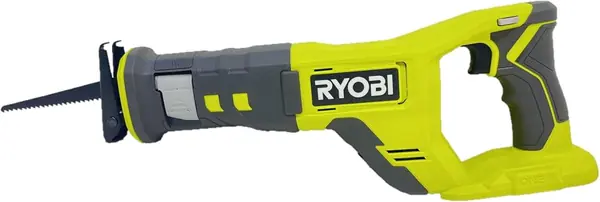
RYOBI ONE+ 18V Reciprocating Saw

RYOBI ONE+ 18V cordless reciprocating saw in Ryobi green with a 1-inch stroke

Budget ONE+ owners

Shop Score 91/100
Length
16 in
Weight
3.8 lb
Speed
3,400 spm
Stroke Length
1 in
View on Amazon

If there is a ONE+ battery on the bench already, the arithmetic here is hard to argue with: this is the least expensive way into a compact reciprocating saw in this group, and it runs on the packs from your RYOBI drill, trimmer, or blower.

The numbers are respectable: 3,400 strokes per minute, a 1-inch stroke, 3.8 pounds, tool-free blade changes, and a switch lockout that keeps the trigger from firing inside a bag. In our cutting it went through limbs, PVC, and 2x stock without complaint.

What you notice in use is the balance. At 3.8 pounds on a full-grip body it feels lighter than it is, and the blade latch is one of the easier ones to work when you are swapping between a wood blade and a pruning blade.

Thirty days of limited warranty is the shortest coverage in this group by a wide margin, and it tells you what RYOBI expects this saw to do: light, occasional work around the house and yard. At that job it is a good buy.

Worth Noting

  • Motor burnouts have occurred within months
  • Longest body here at 16 inches
Our Verdict

A good buy for whoever already owns ONE+ batteries and cuts occasionally; it is the cheapest bare tool here and light in the hand.

Check Latest Price

How We Tested Compact Reciprocating Saws

We started by gathering every saw sold as a compact or one-handed model, then narrowed the field by stroke length, body length and weight, blade clamp and shoe design, warranty terms, and whether the saw ran on a battery platform most shoppers are likely to already own. Anything too long or too heavy to hold comfortably in one hand came off the list first. That left 12 saws, ranging from bare tools to a complete kit with a battery and charger in the box.

Testing ran nine months, on the jobs these saws actually get bought for: tearing apart a cedar fence, cutting PVC and copper pipe in a basement, clearing storm limbs in the yard, and trimming studs and joists overhead from a ladder. We clamped or braced every workpiece before the blade went in, wore eye protection throughout, and let each blade spin down before setting the saw aside. Along the way we noted where the balance point sat in the hand, whether the saw walked or chattered when the teeth bit, and how much work the front hand did to hold a line.

For flush cuts, we ran the blade along a clamped board to see how close the shoe and clamp let us get before the body got in the way. We timed blade changes, checked clamp grip after dozens of swaps, and ran each saw until its pack quit to see how runtime held up under steady cutting. A hand on the housing told us how quickly the grip warmed and how much vibration reached the palm after twenty minutes of continuous work, and after weeks of treated lumber we checked each shoe for play and each clamp for slip. Warranty terms were read against the published coverage, not the marketing copy.

How to Choose a Compact Reciprocating Saw

Start With One Hand or Two

The decision that shapes everything else is whether you need a one-handed saw. One-handers run 10 to 13 inches and 2 to 4 pounds, and they exist so your other hand can hold the work — a branch, a pipe, a stud that is not going to stay put on its own.

If most of your cutting happens on a bench or over a sawhorse, a compact two-handed body like the DEWALT XR gives you a longer stroke and more mass to lean on, closer to the feel of a full-size sawzall, just shorter. Buy for the majority of your cuts, not for the worst one you can imagine.

Stroke Length Beats a Big Speed Number

Strokes per minute get the big type on the box, but stroke length decides how much material each pass removes. The saws here run from 7/8 inch to 1-1/8 inch, and in anything thicker than a 2x4 the longer stroke generally wins against a short-stroke saw that is cycling faster.

Read the two numbers together. A one-handed body usually gives up stroke to save length, which is exactly the trade you are accepting when you choose one; if you want the cut speed of a bigger saw, take the 1-1/8-inch stroke and put up with the extra weight.

Batteries Cost More Than the Bare Tool

Six of the seven saws here arrive as bare tools, and the battery is where the real money goes. A reciprocating saw is a heavy electrical load: a compact 2.0 Ah pack sags in the middle of a cut where a 4.0 or 5.0 Ah pack keeps the blade moving.

If you already own a platform, stay on it — for ONE+ owners the RYOBI is the cheapest route in. If you own nothing, a kit like the BLACK+DECKER's is the shortest path to a working saw, and the pack it comes with swaps into that brand's drills and trimmers.

Clamp and Shoe Decide the Flush Cut

A four-position blade clamp is what lets you turn the blade 90 degrees and cut flush against a floor, a wall, or a slab; a pivoting shoe keeps the blade seated as you change the angle of the cut. Neither shows up in a headline specification, and either one can be the difference between a saw that finishes a remodel and one that cannot start it.

Check that the clamp is tool-free, because you will change blade positions far more often than you change blades.

Vibration and Weight Over a Long Session

A reciprocating saw is a shaker, and the fatigue accumulates by mid-morning. Low-vibration designs and loop or overmolded handles are not marketing filler if you cut overhead or prune for hours; they are the difference between finishing the row of branches and quitting halfway.

Hold the saw before you buy if you can. Where the weight sits in your hand tells you more about a full afternoon than the number on the spec sheet does.

Frequently Asked Questions

Final Verdict

The DEWALT ATOMIC is the saw we recommend to almost everyone shopping this category: 12.5 inches, just over three pounds, and enough brushless power to finish the cut you started one-handed. It is the one that makes a compact reciprocating saw feel like a tool rather than a compromise.

Step up to the DEWALT XR if your work is flush cuts and framing lumber, where the 1-1/8-inch stroke and four-position clamp earn their extra weight. And if the saw lives in a cabinet or on a ladder, the 10-inch Milwaukee M12 HACKZALL gets into places neither DEWALT will.