↑↓ navigate ↵ open Esc close All results →

Best Reciprocating Saws of 2026

A reciprocating saw trades finesse for brute access, plunging straight into walls and nail-studded framing where other power saws cannot fit. That raw power creates a clear shop divide: a well-balanced saw finishes rough demolition in minutes with predictable tracking, whereas a cheap unit wanders off the cut line and transfers punishing vibration straight into your wrists.

Eight months of cutting with 12 corded, cordless, full-size, and one-handed saws underscored that bare-tool pricing hides the real commitment of adopting a battery ecosystem. On paper, buyers often fixate on strokes per minute, yet stroke length clears sawdust and speeds heavy cuts far better, and boxed battery runtime estimates drop quickly once a blade enters wet 4x4 timber.

Corded power that never waits on a charger, a compact one-handed body for overhead framing, and a convertible jigsaw-style unit for lighter trim all appear among these eight machines, offering enough cordless muscle to retire an extension cord on most jobs.

Our Top Picks

The Best Reciprocating Saws

1.

DEWALT 20V MAX XR Reciprocating Saw Best Overall
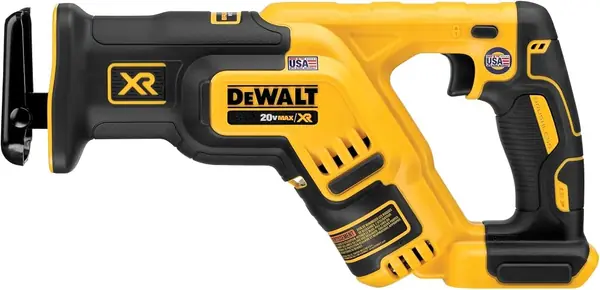
DEWALT 20V MAX XR compact reciprocating saw with black body and LED light

Framing and demolition

Shop Score 98/100
Weight
5.4 lb
Speed
0-2,900 spm
Stroke Length
1-1/8 in.
Overall Length
14.5 in.
View on Amazon

Fourteen and a half inches is the measurement that decides most of the cuts this saw is bought for. That's the full length of the DCS367B, short enough to drop the blade between studs, into a cabinet opening, or under a subfloor without wrestling a full-size body through the gap. A 1-1/8-inch stroke and 2,900 strokes per minute mean it doesn't pay for that compactness in speed.

In the hand it behaves like a bigger saw. The keyless clamp locks a blade in four positions for flush cuts, the LED lights the corner you're working in, and the variable-speed trigger gives you a slow start in drywall and full speed in framing lumber. Brace the shoe against the material and the cut stays smooth; let the saw bounce free and it reminds you it's a reciprocating saw.

It's a bare tool, so the real cost depends on what's already in your shop. Any DEWALT 20V MAX pack runs it, and DEWALT rates the brushless motor at up to 2.5 times the runtime of its older saws on a 5.0Ah battery. Our advice is to pair it with a 5.0Ah pack rather than the 2.0Ah battery that came with your drill.

What puts it first is the range. The Makita XRJ05Z has a longer stroke for thick stock, the Milwaukee Hackzall is easier to point overhead, and the corded DWE305 never asks for a charge, but this is the one saw here that handles stud bays and a deck teardown without a second trip to the truck. It is the most expensive saw in this group, and we think the compactness earns the difference.

Worth Noting

  • Bare tool; battery and charger sold separately
  • Vibrates when the shoe isn't braced
Our Verdict

We recommend this one first: it cuts like a full-size saw but measures 14.5 inches, so it works in stud bays and still handles a deck teardown.

Check Latest Price
2.

DEWALT DWE305 Corded Reciprocating Saw Best Corded

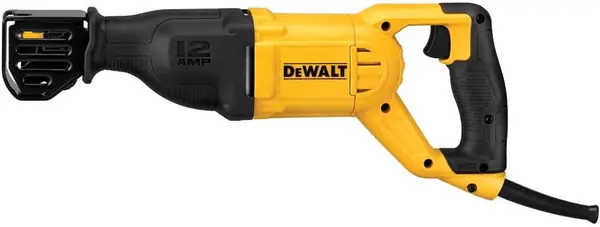
DEWALT 12-amp corded reciprocating saw in yellow with keyless blade clamp

Corded demolition work

Shop Score 97/100
Weight
8 lb
Speed
0-2,900 spm
Stroke Length
1-1/8 in.
Amperage
12 A
View on Amazon

Twelve amps, no battery, no charger, no platform to buy into. The DWE305 is the saw we point people toward when their cutting happens within reach of an outlet: a day of deck demolition, a stack of pressure-treated 6x6s, a garage full of shelving. The motor doesn't fade the way a cordless saw does when a small pack runs down, and it holds that pace all afternoon.

The rest of it is refreshingly plain. A keyless lever clamp takes blades in four positions, so you can rotate the blade flat and cut flush to a floor or a wall rather than reaching for a second tool. The 1-1/8-inch stroke matches DEWALT's cordless saws, and the variable-speed trigger runs from a careful start to a full 2,900 strokes per minute.

The cord is the trade, and it's worth being honest about. Dragging an extension cord through a finished room is exactly the annoyance that sells cordless saws. But it's also why corded saws stay on job sites: the power never tapers, the saw doesn't care how cold the morning is, and you never stop to swap a pack. For a woodworker with outlets on every shop wall, that's a fair trade and then some, because there is nothing to maintain but the blade.

Worth Noting

  • Corded, so you need an outlet nearby
Our Verdict

Buy the DWE305 if your cutting happens near an outlet: 12 amps, no recharging, and one of the more affordable saws in this group.

Check Latest Price
3.

Milwaukee M18 FUEL Hackzall Best One-Handed

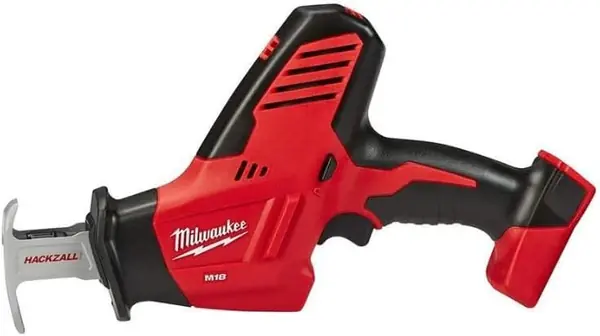
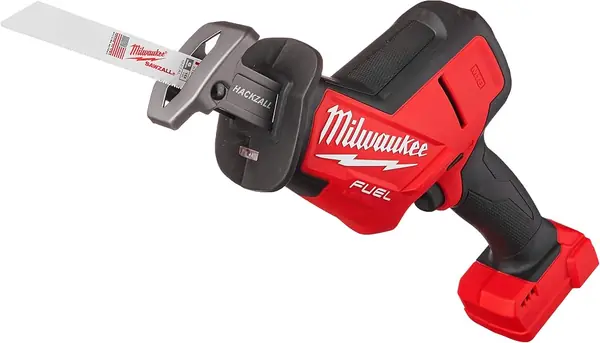
Milwaukee M18 FUEL Hackzall one-handed reciprocating saw in red and black

Overhead one-handed cuts

Shop Score 96/100
Weight
3.97 lb
Stroke Length
7/8 in.
Included
Bare tool
Battery Platform
Milwaukee M18
View on Amazon

Some cuts only give you one hand. Reach overhead into a soffit, lean out of a scuttle, or balance on a ladder with your other hand on a rail, and a two-handed saw becomes a problem. The M18 FUEL Hackzall is built for exactly that: 3.97 pounds, a body you can choke up on, and a 7/8-inch stroke that keeps the blade tracking instead of skating.

The brushless motor and Milwaukee's REDLINK electronics make it feel calmer than its size suggests. It starts without a jolt, the vibration is low enough that a long trimming session doesn't leave your hands buzzing, and blade changes are quick enough that you'll actually swap to the right blade instead of forcing the wrong one. A 5.0Ah pack gives it a solid working session in brush and pipe.

In thick material it gives ground. The 7/8-inch stroke removes less per pass than the 1-1/8- and 1-1/4-inch saws here, so a 6x6 or a stump takes longer, and we're happy to make that trade for control. Between this and the cheaper M18 2625-20, the extra money buys the brushless motor and a much smoother cut, and for overhead work or cabinet cuts we take the FUEL every time.

Worth Noting

  • Durability under daily trade use is uneven
Our Verdict

For overhead, upside-down, or one-handed cutting, this is the saw we hand people: 3.97 pounds, low vibration, and real power for its size.

Check Latest Price
4.

Makita 18V LXT Brushless Recipro Saw Best for Controlled Cuts

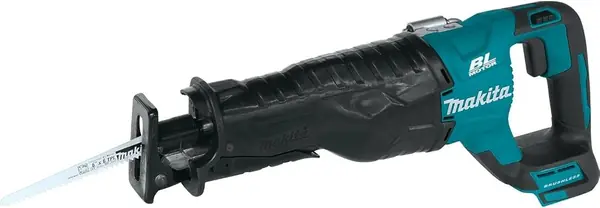
Makita 18V LXT brushless recipro saw in blue with tool-less blade clamp

Smooth controlled cutting

Shop Score 95/100
Weight
8.2 lb with battery
Speed
0-2,300 (low) / 0-3,000 (high) spm
Stroke Length
1-1/4 in.
Length
17-1/4 in.
View on Amazon

One and a quarter inches of stroke is the longest throw in this group, and it's the reason the XRJ05Z moves through thick stock so cleanly. The two-speed selector is the other half of it: low tops out around 2,300 strokes per minute for pipe, plastic, and anything that wants a gentle start, while high runs to 3,000 for framing.

It is a two-handed saw, and unapologetically so. At 8.2 pounds with a battery and 17-1/4 inches long, it wants a firm grip and some elbow room. The rafter hook earns its keep on a ladder, the light on the front covers a dark corner, and the tool-less clamp spits a blade out fast enough that you'll change to the right one instead of forcing the wrong one.

Control is where we noticed the difference. The trigger ramps up rather than slamming on, so starting a cut in PVC or copper doesn't skate the blade across the surface, and the adjustable shoe keeps the blade supported as the teeth wear. In a material that punishes a jumpy start, that matters more than another half-inch of stroke.

This is a Makita owner's saw. If you already have 18V LXT packs, it's the smoothest-cutting cordless here and the one we hand to anyone cutting all day in wood. If you're starting from nothing, the DEWALT DCS367B is the better all-around buy: nearly three inches shorter and far easier to fit into a stud bay.

Worth Noting

  • Two-handed 17-1/4-inch body limits tight work
Our Verdict

If you already own Makita 18V packs, this is the smoothest-cutting cordless saw here, so long as you can give it two hands and open space.

Check Latest Price
5.

Milwaukee M18 Reciprocating Saw 2625-20 Best Budget Cordless

Milwaukee M18 reciprocating saw in red and black with compact body

Budget M18 owners

Shop Score 94/100
Weight
4.3 lb
Included
Bare tool
Warranty
5-year limited
Voltage
18V
View on Amazon

If the M18 batteries are already on the shelf, the 2625-20 is the least expensive way to put a cordless Milwaukee saw in the truck. It's 4.3 pounds, it sits in one hand comfortably, and it runs on the same packs as your drill and impact driver, so there's no new platform to feed.

The motor is brushed rather than brushless, and that's the trade in plain terms: you save money up front and give up some runtime per charge along with the smoother electronics of the FUEL saw. In wood, PVC, and light metal it doesn't feel short of power, and it handles demolition, pruning, and pipe without complaint, but a long afternoon of cutting reminds you which generation you bought.

A five-year limited warranty is the detail that makes this an easy recommendation, because Milwaukee is standing behind a saw that costs less than most of the bare tools here. We think of it as the second saw: the one that lives in the garage for the once-a-month job, the branch that came down, the shelf that has to come out. If it's going to run weekly, step up to the FUEL Hackzall.

Worth Noting

  • Longevity under heavy use is uneven
Our Verdict

Already on the M18 platform? This is the least expensive way to add a reciprocating saw, and at 4.3 pounds it's easy to carry.

Check Latest Price
6.

BLACK+DECKER 20V MAX Reciprocating Saw Kit Best Budget Kit

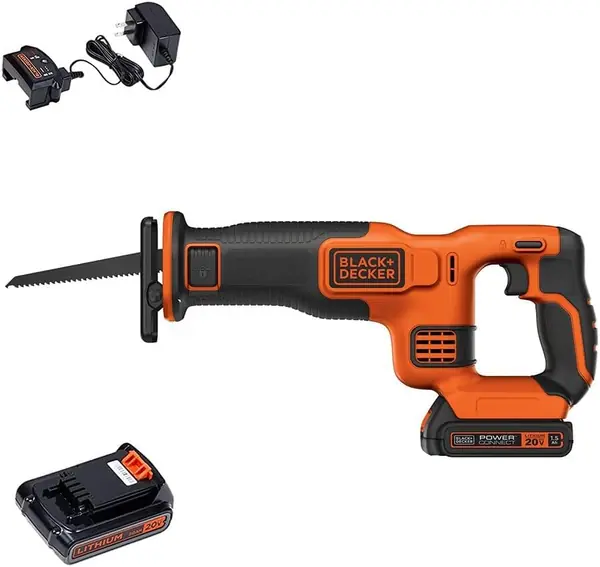
BLACK+DECKER 20V MAX cordless reciprocating saw kit with battery and charger

First-time saw buyers

Shop Score 93/100
Weight
4.5 lb
Speed
0-3,000 spm
Included
20V battery, charger, blade
Warranty
2-year limited
View on Amazon

Out of the box, this saw cuts. That's the whole case for the BDCR20C: a 20V battery, a charger, and a blade arrive with the tool, so there's no platform to buy into and nothing else to order before you trim your first branch.

Nothing about it feels disposable. The 4.5-pound body is easy to hold out at arm's length, the pivoting shoe helps the blade follow a line instead of wandering off it, and the electric brake stops the blade the moment you release the trigger. We didn't expect much from a brake on a saw at this end of the range, and it turns out to be the detail that makes the whole thing feel less like a hazard. Blade changes take seconds without a tool.

Its limits are about endurance rather than ability. For limbs up to about 2-1/2 inches, plywood, drywall, and the odd piece of PVC, it does the work without complaint, and it's light enough to carry around a yard all afternoon. Treat it as a homeowner's saw that lives on a shelf in the garage and it will earn that shelf space.

Worth Noting

  • Battery drains fast under continuous cutting
  • Less power in thick hardwood than brushless saws
Our Verdict

The cheapest complete kit here: battery, charger, and blade included, so a first-time buyer can be cutting the same afternoon.

Check Latest Price
7.

Makita 18V LXT Recipro Saw XRJ04Z Best for Value-Minded Makita Owners

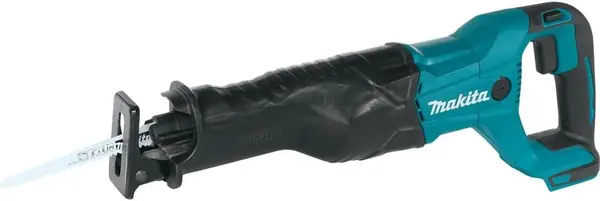
Makita 18V LXT cordless recipro saw in blue with two-finger trigger

Value-minded Makita owners

Shop Score 92/100
Weight
8.3 lb with battery
Speed
0-2,800 spm
Stroke Length
1-1/4 in.
Length
19-1/8 in.
View on Amazon

Makita gets a 1-1/4-inch stroke out of this recipro saw, the same throw as the brushless version and a quarter inch more than the DEWALT compacts. In softwood, brush, and studs, that's most of what makes a saw feel fast, and it's the reason this one keeps up with tools costing noticeably more.

What you don't get is the brushless motor or the two-speed selector. We still like it as the value pick of the Makita pair: the two-finger trigger is comfortable over a long session, the tool-less clamp takes a blade without hunting for a key, and the spring in the change mechanism pushes a hot blade away from your fingers instead of into them.

It's a big saw at 19-1/8 inches long, so treat it as a two-handed tool that lives on a bench or a tailgate rather than in a cabinet. For a Makita household that wants one cordless saw for pruning, demolition, and the occasional pipe, it does nearly everything the brushless version does, with less finesse at the trigger and more weight in the hand.

Worth Noting

  • Heavy at 8.3 pounds with a battery
Our Verdict

Makita owners who don't need brushless should start here: the 1-1/4-inch stroke does the work for less money.

Check Latest Price
8.

WORX 20V PowerShare 2-in-1 Saw Best for Trim and Pruning

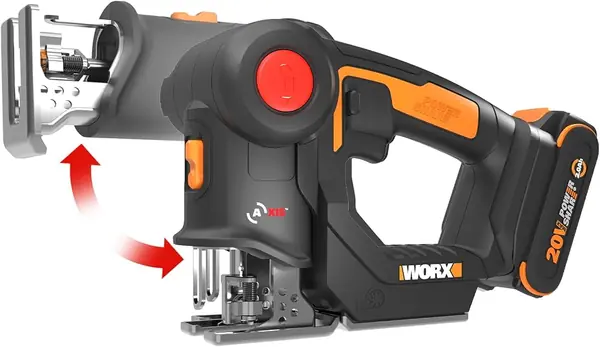
WORX 20V PowerShare 2-in-1 cordless reciprocating saw and jigsaw with pivoting head

Trim and pruning

Shop Score 91/100
Weight
4.2 lb with battery
Included
Charger and four blades
Modes
Reciprocating and jigsaw
Battery
20V PowerShare, included
View on Amazon

The head pivots, and that's the whole idea. Lock it in one position and the WX550L is a reciprocating saw; lock it in the other and the blade stands up like a jigsaw, which is the mode a woodworker will actually reach for on curved cuts in plywood and trim.

We like it as a second saw for someone who does trim and yard work in the same afternoon. It's 4.2 pounds with the battery in place, the PowerShare pack will run other WORX tools you own, and the kit arrives with a charger and four blades, so there's nothing to add before the first cut. Flipping between modes takes a moment, not a toolbox.

What it isn't is a demolition saw, and we treat the jigsaw mode as a convenience rather than a replacement for a real jigsaw. For pruning, trim, and the occasional curved cut in softwood, it earns its shelf space, especially if the alternative is buying two separate tools for those jobs.

Worth Noting

  • Short stroke limits it to trim and pruning
Our Verdict

Two tools in one box: the pivoting head makes it a jigsaw when you need curves, and the kit arrives ready to run.

Check Latest Price

How We Picked and Tested Reciprocating Saws

We started by pulling spec sheets for 30-odd saws and narrowing on the things that actually change a cut: stroke length, weight, blade clamp design, shoe adjustment, and whether the saw sells as a bare tool or a kit. From that field we bought 12 — corded and cordless, one-handed and full-size — and put them to work for eight months on a deck teardown, a basement bathroom rough-in, and the usual parade of weekend repairs.

Every saw cut the same 2x10 framing stock, schedule-40 PVC, and threaded rod. We timed each cut, noted whether the blade ran true or wandered off the line, and counted cuts per charge on the cordless models until the pack quit — a number that never matched the marketing once we moved from pine to pressure-treated.

We also made overhead cuts between joists, plunge cuts into drywall, and flush cuts against a subfloor, weighing and measuring each saw first, because a 4-pound body and an 8-pound one are different tools by the tenth cut of the afternoon. Blade changes were timed with work gloves on, and every change started with the battery out or the cord unplugged. Stock was clamped or braced before the trigger was pulled, and we wore eye and hearing protection the whole way through, since these saws throw chips and run loud enough to end a conversation.

Durability got judged the boring way: repeated heavy use, then a close look at how the clamps, shoes, and cords held up. Value meant total cost of ownership, and a bare tool is only a bargain if you already own that platform's batteries.

How to Choose a Reciprocating Saw

Corded or Cordless Comes First

Cordless saws have taken over job sites, but the corded DEWALT DWE305 still makes sense for anyone cutting near power: no packs to buy, no runtime to manage, and 12 amps that never taper. The catch is the obvious one — an extension cord across a finished room is a nuisance, and no amount of power fixes it.

If you go cordless, work out the real entry price before you compare saws. The trap is the bare-tool listing: the saw is often the cheap part, and two batteries plus a charger can cost more than the tool. That's why a complete kit like the BLACK+DECKER BDCR20C is the cheaper way to start and can be the more expensive way to stay if you later move to a bigger platform.

Stroke Length Sets the Pace

In this group the stroke runs from 7/8 inch on the Milwaukee Hackzall to 1-1/4 inches on the Makitas, and it's the closest thing to a speed rating you can read off a spec sheet. A longer stroke clears more material with every pass, which is why the 1-1/8- and 1-1/4-inch saws feel quicker in framing lumber and thick stock.

Short strokes aren't a penalty everywhere. In pipe, plastic, and thin metal, the shorter throw of a one-handed saw wanders less and stays on a marked line more easily, which is why so many plumbers carry one instead of a full-size Sawzall. Match the stroke to the material you cut most, not to the biggest number on the box.

Weight and Length: One Hand or Two

The saws here run from about four pounds to more than eight, and that spread decides how you'll use one. Under roughly five pounds you can cut overhead or one-handed on a ladder; eight pounds wants two hands and steady footing, and it will outlast your arms long before the battery quits.

Length matters as much as weight, and it's the number shoppers skip. A 14.5-inch saw drops into a stud bay; a 19-inch saw doesn't, and no technique fixes that. Measure the tightest cavity you plan to cut in — under a sink, inside a cabinet, between framing — before you fall for a bigger motor.

Blades and Clamps Do the Real Work

Every saw here takes standard reciprocating blades, and the blade you fit matters more than the difference between most of these tools. A coarse blade clears green wood and demolition debris, a fine bi-metal blade cuts pipe and sheet metal, and a pruning blade turns any of them into a brush saw. Budget for two or three blades with the saw.

Look for a tool-free clamp, and if you'll cut flush to a floor or wall, a four-position clamp that lets you rotate the blade flat. A pivoting shoe is worth having too: it keeps the blade supported as the teeth wear and gives you some control over depth of cut.

Frequently Asked Questions

Final Verdict

We recommend the DEWALT DCS367B as the saw most people should buy. It cuts like a full-size reciprocating saw but measures 14.5 inches, so it fits between studs and into cabinet openings, and the 1-1/8-inch stroke means you aren't trading speed for that compactness.

If your work happens next to an outlet, the corded DEWALT DWE305 gives you 12 amps and no recharging for less money. And if the cut is overhead or one-handed, the Milwaukee Hackzall at 3.97 pounds is the one to carry up the ladder.