↑↓ navigate ↵ open Esc close All results →

Best Makita Circular Saws of 2026

Choosing inside Makita's circular saw lineup starts with a straightforward shop trade-off: blade size and power against weight and the batteries already on the shelf. A saw that runs on 18V LXT or 12V CXT packs you own saves money upfront, while mismatched balance or an undersized base lets a rip wander across expensive plywood or bind mid-cut and kick back.

Nine corded and cordless models—ranging from a 3-3/8-inch trim saw to a 10-1/4-inch beam saw—went through nine months of ripping plywood on sawhorses, framing deck joists, and making overhead cuts in a basement. Each saw was weighed with a battery installed, and track-compatible bases ran down guide rails to check for lateral rock.

Keeping both hands steady on the saw through a long afternoon of rips matters more than peak specs, and the six models ranked below split cleanly by battery platform, cut capacity, and kit value.

Our Top Picks

The Best Makita Circular Saws

1.

Makita 5007MG Magnesium Circular Saw Best Overall
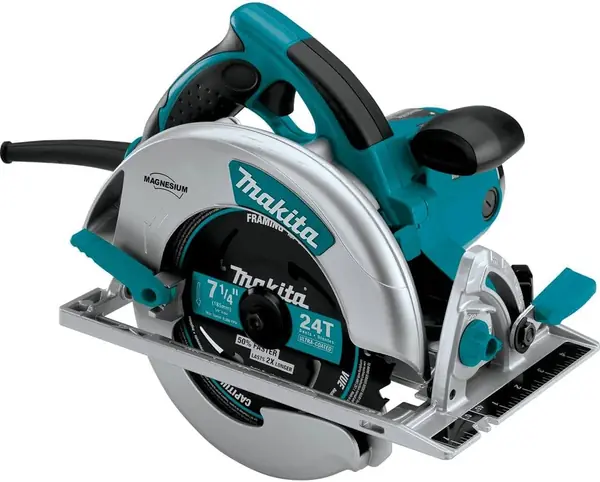
Makita 5007MG 7-1/4-inch magnesium circular saw in teal with blade and case

All-around woodworking

Shop Score 96/100
Max Depth At 90°
2-1/2 inches
Blade Size
7-1/4 inches
Bevel Range
0° to 56°
Weight
10.6 lb
View on Amazon

Lifting the 5007MG out of its case, the first thing we noticed was how little it felt like a 15-amp saw. The magnesium base and guards hold it to 10.6 pounds, which matters when you're carrying it up a ladder or holding it steady through a long rip. We think it's the most useful all-around corded saw in this group because it doesn't make you choose between power and portability.

The 15-amp motor turns the 7-1/4-inch blade at 5,800 rpm, and the 2-1/2-inch depth at 90 degrees handles 2x framing lumber with room to spare. We paid close attention to the bevel scale because 0 to 56 degrees is wider than most of these saws offer; the positive stops at 22.5 and 45 degrees make common angles quick to set. The oversized numbers and ruler markings are genuinely readable, which is not always true on a saw that has been riding in a truck bed.

Two LEDs and a dust blower are the details we appreciate most. The blower clears sawdust off the cut line, and the lights help when you're working in a garage corner or under a deck. The saw comes with a 24-tooth carbide blade, a rip fence, a hex wrench, and a hard case, so it's ready to work and easier to store between jobs.

The one boundary is the cord. If your cuts are spread across a jobsite or you're working above your head, the 18V XSS02Z is the better fit. For a shop or a remodeling project with an outlet within reach, the 5007MG is the one we plug in first.

Worth Noting

  • Power cord limits mobility across spread-out jobsites or overhead cuts
Our Verdict

The 5007MG is our all-around corded pick: a 15-amp motor and 2-1/2-inch depth in a 10.6-pound magnesium body that's easy to carry.

Check Latest Price
2.

Makita XSS02Z Cordless Circular Saw Best 18V Cordless

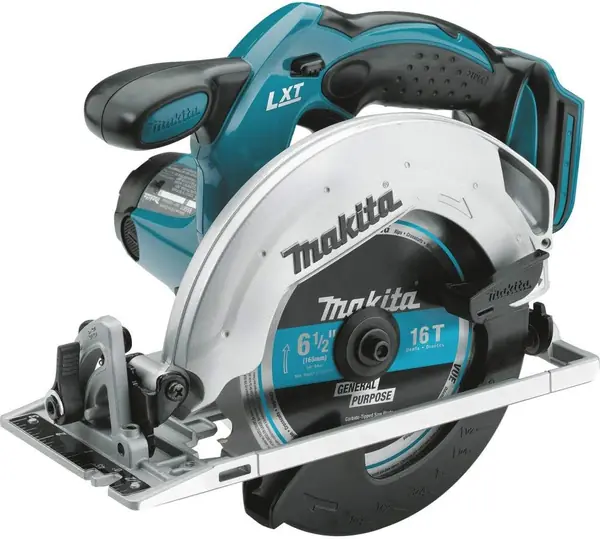
Makita XSS02Z 18V LXT 6-1/2-inch cordless circular saw in teal

Overhead cordless cuts

Shop Score 95/100
Max Depth At 90°
2-1/4 inches
Blade Size
6-1/2 inches
Battery Platform
18V LXT
Weight With Battery
7.3 lb
View on Amazon

A 6-1/2-inch blade usually signals a trim saw, but the XSS02Z will cut 2x material at 45 degrees, which is the number that matters when you're framing a small wall or trimming out a shed. At 7.3 pounds with a battery, it's light enough to carry up a ladder and steady enough to follow a speed square through plywood.

We reach for this one when the work is overhead or far from an outlet. The 18V LXT motor spins at 3,700 rpm, and the 2-1/4-inch depth at 90 degrees is enough for common 2x stock; the 0-to-50-degree bevel gives you more range than the compact size suggests. The base is machined aluminum, and the depth and bevel levers are easy to reach without moving your hand far from the trigger.

What we noticed most was the balance: the battery sits under the rear handle, so the saw doesn't feel nose-heavy when you set it down on a sheet. Battery life is the variable to plan around—a long run of rips will drain a pack faster than a few crosscuts, so bring a spare if the work is steady. It isn't the saw for heavy timber, but for crosscuts, punch-outs, and quick jobs, the lighter package is why it stays in the bag.

Worth Noting

  • Batteries and charger not included
Our Verdict

We reach for the XSS02Z when the cut is overhead or away from an outlet, since its 6-1/2-inch blade still handles 2x material at 45 degrees.

Check Latest Price
3.

Makita SP6000J1 Plunge Saw Kit Best Corded Track Saw

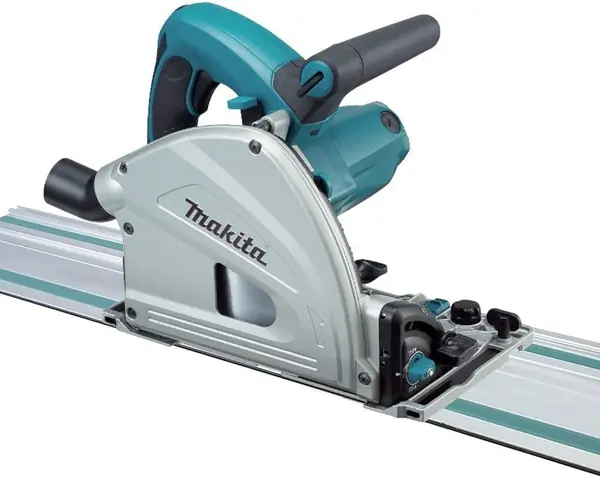
Makita SP6000J1 6-1/2-inch plunge circular saw kit with 55-inch guide rail

Sheet goods

Shop Score 94/100
Max Depth At 90°
2-3/16 inches
Bevel Range
-1° to 48°
Motor
12 amps, 5,200 rpm
Guide Rail
55 inches
View on Amazon

The 55-inch guide rail is the reason to look at the SP6000J1: it lets the saw travel on a straight edge across a full sheet of plywood instead of fighting a chalk line and a straightedge clamp. The kit packages the rail, saw, 48-tooth blade, and stackable case together, so you're not hunting for the track separately.

The 12-amp motor and electronic speed control keep the blade moving through plywood and MDF without the bogging you feel in a lighter saw. The 2-3/16-inch depth at 90 degrees is enough for 1-3/4-inch material, and the -1-to-48-degree bevel with positive stops at 22.5 and 45 degrees covers the angles cabinet work actually uses. The plunge action lets you set the saw on the rail and drop the blade into the sheet with both hands on the handles.

We choose the SP6000J1 for sheet goods because the rail makes straight cuts repeatable, and the finish on veneered plywood is clean enough to skip a second pass with a router. The trade-off is that the rail needs a clean, flat surface; dust or a warped bench can let it shift, so wipe the track and clamp it for finish cuts. If you need the same cuts without a cord, the XPS01PTJ is the alternative, but this kit is the more complete package.

Worth Noting

  • Guide rail can shift on dusty or warped surfaces without clamping
  • Corded operation tethers you near an outlet
Our Verdict

We choose the SP6000J1 for sheet goods because the included 55-inch rail turns a 12-amp saw into a clean, track-guided cutting system.

Check Latest Price
4.

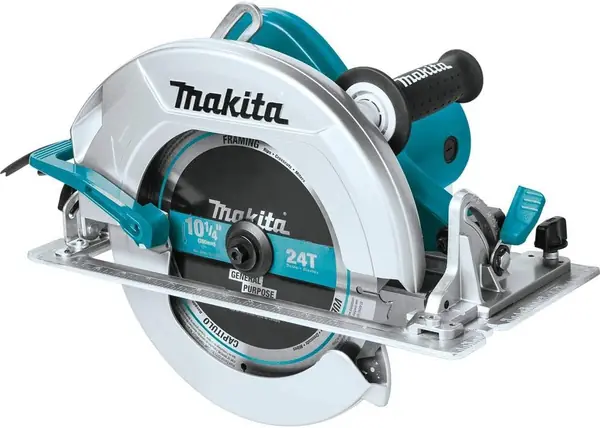
Makita HS0600 Circular Saw Best for Thick Lumber

Makita HS0600 10-1/4-inch circular saw in blue with 24-tooth blade

Timber and beams

Shop Score 93/100
Max Depth At 90°
3-13/16 inches
Blade Size
10-1/4 inches
Motor
15 amps, 4,300 rpm
Max Depth At 45°
2-11/16 inches
View on Amazon

A 4x4 in one pass is the whole point of the HS0600, and it's the reason this 10-1/4-inch saw belongs in a framer's truck rather than every woodworker's shop. The 15-amp motor turns the big blade at 4,300 rpm, and the 3-13/16-inch depth at 90 degrees clears thick beams and engineered lumber that a 7-1/4-inch saw can't handle. At 45 degrees it still cuts 2-11/16 inches, which covers beveled beam work without flipping the stock. We keep this one for timber and heavy stock, not for trim.

The auxiliary front and top handles give you a second grip when you're leaning over a beam, and the large adjustment knobs are easy to work with gloves on. The base is big and stable on a sawhorse, and the blade wrench stores on the saw. The cut quality on 4x material is the payoff: with a sharp 24-tooth blade, it leaves a straight, clean cut in softwood and works through oak without stalling. If your work is mostly 2x framing and plywood, the 5007MG is easier to handle; the HS0600 earns its place when the material is too thick for a standard saw.

Worth Noting

  • 15.2-lb weight makes overhead work tiring
Our Verdict

We keep the HS0600 for timber and beams: its 10-1/4-inch blade cuts 4x stock in one pass, a job the smaller saws here can't do.

Check Latest Price
5.

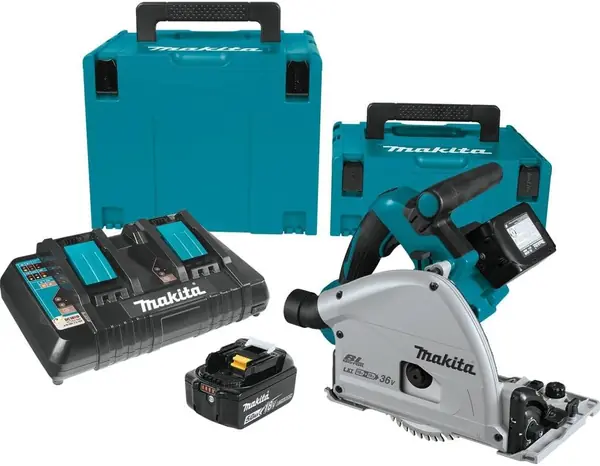
Makita XPS01PTJ Plunge Saw Kit Best Cordless Plunge Saw

Makita XPS01PTJ 36V brushless 6-1/2-inch plunge saw kit with two batteries

Cordless track work

Shop Score 92/100
Max Depth At 90°
2-3/16 inches
Bevel Range
-1° to 48°
Battery Platform
36V X2 LXT
Speed
2,500-6,300 rpm
View on Amazon

Two 18V LXT batteries feed the XPS01PTJ's 36V brushless motor, which is how Makita gets cordless plunge-saw performance without a cord trailing across a sheet. The saw runs from 2,500 to 6,300 rpm with automatic speed change, so it can slow into a dense cut and pick up speed in soft plywood.

The 6-1/2-inch blade leaves 2-3/16 inches of depth at 90 degrees, and the -1-to-48-degree bevel lets you undercut a scribe or match a cabinet angle. The soft start and electric brake are the features we appreciate most in a plunge saw, because they make it easier to start a cut without a jump and stop the blade quickly when you set the saw down. The 55-tooth blade in the kit is aimed at smooth work in plywood and melamine.

We recommend the XPS01PTJ to crews who want track-saw accuracy without a cord. The two 5.0Ah batteries and charger are included, and the brushless motor makes the most of them; on a day of sheet-goods cuts, that combination is the reason to pay for the premium kit. If you work in one shop and don't need cordless freedom, the corded SP6000J1 is the more complete kit.

Worth Noting

  • Guide rail sold separately
Our Verdict

Our pick for cordless track-saw work is the XPS01PTJ, provided you add a guide rail to the kit.

Check Latest Price
6.

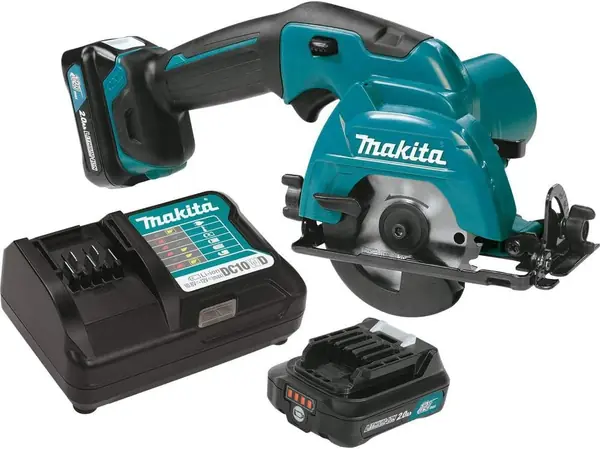
Makita SH02R1 Compact Circular Saw Best for Trim and Paneling

Makita SH02R1 12V max CXT 3-3/8-inch circular saw kit with two batteries

Trim and paneling

Shop Score 91/100
Max Depth At 90°
1 inch
Blade Size
3-3/8 inches
Max Depth At 45°
5/8 inch
Weight With Battery
3.5 lb
View on Amazon

One inch of cut depth sounds like a limitation until you look at the jobs this little saw is built for: plywood shelves, paneling, pegboard, melamine, and drywall. The SH02R1 weighs 3.5 pounds with a 12V max CXT battery, and its 3-3/8-inch blade is small enough to fit into places a full-size saw can't reach. The base tilts to 45 degrees for small bevels, and the kit comes with two batteries and a charger.

We like it as a trim and panel saw, not as a framing saw. The 1,500-rpm motor is geared for thin material, and the depth adjusts from 1 inch at 90 degrees to 5/8 inch at 45 degrees, so you can make clean cuts in cabinet backs and underlayment without dragging out a 7-1/4-inch saw. The limit is dimensional lumber: with 1 inch of depth at 90 degrees, it won't cut a 2x4 in one pass, and forcing it is the wrong use. Think of it as a specialized second saw rather than your only circular saw.

Worth Noting

  • One-inch max cut depth cannot sever a 2x4 in one pass
  • Limited to thin panels and trim rather than framing lumber
Our Verdict

We like the SH02R1 as a lightweight trim saw for paneling and plywood, not as a replacement for a full-size circular saw.

Check Latest Price

How We Tested Makita's Circular Saws

We started inside the Makita lineup rather than against a shelf of competitors, gathering corded and cordless saws with blades from 3-3/8 inches to 10-1/4 inches, sold both as kits and as bare tools. We narrowed by what actually decides a purchase: whether a saw ran on the 18V LXT or 12V CXT packs we already owned, depth of cut at 90 and 45 degrees, bevel stops, and what came in the box. Nine saws went into the test.

Testing ran nine months, across a garage shop, a deck rebuild, and a plywood-cutting weekend in the driveway. We ripped sheet goods on sawhorses, crosscut joists, went overhead on basement strapping, broke down 4x4s and laminated beams, and trimmed cabinet panels and door skins. Every cut was set up with the workpiece clamped or blocked so an offcut couldn't pinch the blade.

Rather than trust the spec sheet, we cut scrap and measured real depth at 90 and 45 degrees, then set bevels at 22.5 and 45 to see whether the stops held or crept. We checked the good face of veneered plywood for tear-out after every rip and noted which saws threw dust across our layout lines. The track-compatible saws ran on 55-inch and 39-inch rails, and we watched whether the base rocked, whether the saw drifted off the rubber strip, and whether we could see the blade meet the line.

Each saw was weighed with its battery in, then held at chest height to judge balance. Blade changes were timed with the tool unplugged or the pack removed, we confirmed the lower guard closed on its own after every cut, and eye and hearing protection stayed on throughout. The picks separated on predictability: a clean exit, a base that stays flat, and controls where your thumb expects them.

How to Choose a Makita Circular Saw

Start with blade size and depth of cut

Blade diameter sets the ceiling on depth, but the number that matters is maximum cut depth at 90 and 45 degrees. A 7-1/4-inch saw like the 5007MG cuts 2-1/2 inches at 90, enough for 2x framing; a 6-1/2-inch cordless saw lands around 2-1/4 inches and may need a pass from each side on thicker stock. The trap is assuming a bigger blade always means a deeper cut at a bevel—check the 45-degree figure if you cut 2x on an angle. For beams and 4x stock, the 10-1/4-inch HS0600 is the only saw here that clears them in one pass.

Choose corded or cordless around the work

Corded saws deliver steady power for long rips and are the simpler choice for a shop with outlets. Cordless saws trade some runtime for freedom, and the battery platform matters as much as the saw: an 18V LXT tool like the XSS02Z shares packs with a large line of Makita tools, while the 12V CXT SH02R1 uses a smaller battery family. The trap is the bare-tool listing. A saw sold without batteries or a charger can look cheaper until you add the packs you need, so compare the complete kit before you decide.

Decide whether a track saw belongs in your kit

A plunge saw on a guide rail—often called a track saw—is the cleanest way to break down plywood and MDF without a table saw. The rail supports the saw, keeps the cut straight, and reduces tear-out. If most of your work is sheet goods, the corded SP6000J1 kit includes a 55-inch rail and a stackable case; the cordless XPS01PTJ gives you the same style of cut without a cord but needs a rail added. The trap is buying a track saw without budgeting for the rail and clamps, or expecting a short rail to rip a full 8-foot sheet. Add a longer rail or a second connector if full-length rips are the job.

Weigh bevel range, weight, and control

Bevel range and positive stops decide how quickly you can set common angles. The 5007MG goes to 56 degrees with stops at 22.5 and 45; the HS0600 stops at 45 and still cuts 2-11/16 inches there. Weight is the other half of control. A 7-1/4-inch saw around 10 to 11 pounds is manageable for most framing, while a 15.2-pound beam saw is a two-handed tool that you set down between cuts. For overhead work, a compact 18V or 12V saw saves fatigue. We also look for readable depth and bevel scales, a dust blower or LEDs, and a lower guard that moves freely.

Frequently Asked Questions

Final Verdict

For most woodworkers, the Makita 5007MG is the circular saw we recommend first. It has the power and depth for framing and ripping, and the magnesium body keeps it light enough to carry and control. If your work is mostly sheet goods and you want track-guided cuts, the SP6000J1 is the better buy. If you need to cut away from an outlet, the XSS02Z is the one to pack.