↑↓ navigate ↵ open Esc close All results →

Best Corded Circular Saws of 2026

Corded circular saws trade cordless freedom for steady power that cuts through a stack of deck boards at 4 p.m. as cleanly as at 8 a.m. Even within corded models, though, heavy housings turn overhead cuts into a workout and poorly cut shoes hide the teeth right where accuracy matters most.

Putting 12 corded saws through eight months of backyard deck framing, garage plywood breakdowns, and sawhorse stud crosscuts highlighted practical ergonomics over feature lists. Clear blade visibility without craning over the motor housing, balanced weight across long afternoons, and a stamped or cast base that holds square under rough use mattered most.

Skipping gimmicks that rarely see shop time leaves room for straightforward saws that track a pencil line cleanly at a fair price.

Our Top Picks

The Best Corded Circular Saws

1.

DEWALT DWE575SB Circular Saw Best Overall
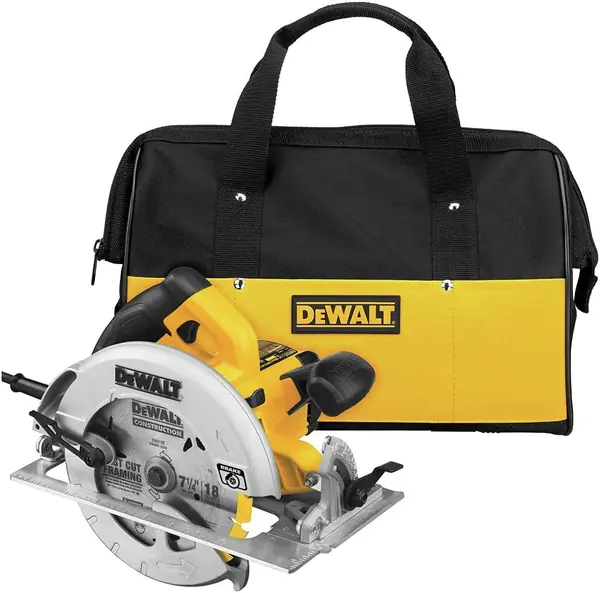
DEWALT DWE575SB yellow corded circular saw with 7-1/4 inch blade and metal base

All-around woodworking

Shop Score 96/100
Weight
8.8 lb
Blade Size
7-1/4 in
Depth At 90°
2-9/16 in
Bevel Capacity
57 degrees, stops at 45 and 22.5
View on Amazon

An electric brake is one of those features you stop noticing until you use a saw without one. On the DWE575SB the blade is already winding down by the time the saw reaches the bench, so setting it down between cuts stops being a small act of faith. That brake, plus 8.8 pounds and a 15-amp motor at 5,200 rpm, is why this is the saw we hand most people first: light enough to steer across a full sheet of plywood, and quiet-edged by the time you let go.

Depth and bevel capacity are where it separates from the cheaper sidewinders here. At 2-9/16 inches it has the deepest cut in this group, and its 57-degree bevel is the widest, both more than 3/4-inch plywood asks for and both welcome the day you are cutting a doubled edge or a steep trim bevel. The stops at 22.5 and 45 degrees land where they should, which is what keeps a quick bevel a quick bevel.

It ships with a carbide blade, a blade wrench, and a contractor bag, and there is no gear oil to check and no battery platform to buy into. For a shop where the saw comes out for a weekend and goes back on the shelf, that simplicity is worth as much as anything on the spec sheet.

Worth Noting

  • No laser or LED to mark the cut
Our Verdict

We recommend the DWE575SB to anyone who wants one corded saw for sheet goods, framing, and trim — light, braked, and the deepest cutter here.

Check Latest Price
2.

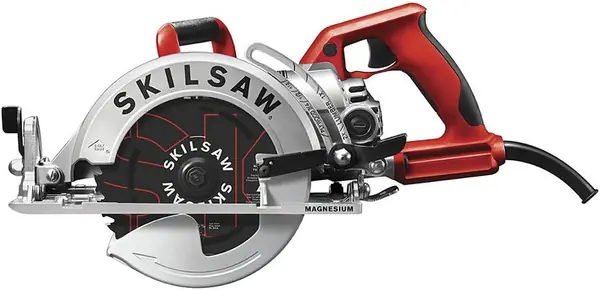
SKILSAW SPT77WML-01 Worm Drive Best Worm Drive

SKILSAW SPT77WML-01 silver magnesium worm drive circular saw with 7-1/4 inch blade

Heavy ripping

Shop Score 95/100
Weight
11.5 lb
Blade Size
7-1/4 in
Depth At 90°
2-3/8 in
Bevel Capacity
53 degrees
View on Amazon

Worm drives come with a reputation for two things: torque that won't quit and a weight that wears you out. The SPT77WML-01 is a magnesium take on the idea, and the torque is what you notice on a long rip — the blade holds its speed through wet 2x instead of fading halfway down the board.

The feature we kept coming back to is the depth adjustment. SKILSAW marks the lever for 1/4-inch ply, 1/2-inch ply, 3/4-inch ply, and 2x, so you drop the blade to the material in front of you instead of crouching to eyeball a quarter inch of tooth below the board. On a day of breaking down sheet goods that saves more bending than you expect, and it is the sort of detail that only proves itself after the saw has been in your hands for a while.

The 15-amp Dual-Field motor and magnesium housing are built to shed heat, and the 53-degree bevel with stops at 0 and 45 covers square cuts and siding bevels; it is a narrower range than the DEWALT's 57 degrees, which only matters if you cut steep angles. The blade sits on the left, so a right-handed operator looks straight down at the teeth meeting the line rather than leaning over the motor to see.

Worth Noting

  • 11.5 lb gets heavy overhead
Our Verdict

Buy this one if your cutting is long rips in wet or dense lumber and you want worm-drive torque without the classic worm-drive heft.

Check Latest Price
3.

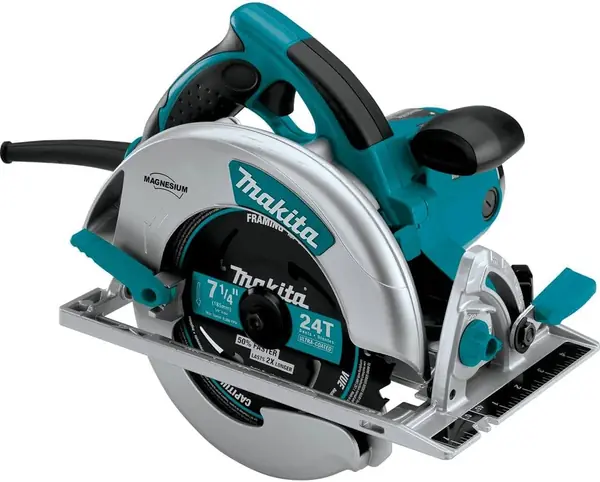
Makita 5007MG Circular Saw Best for Framing

Makita 5007MG teal magnesium circular saw with 7-1/4 inch blade and rip fence

Framing and decking

Shop Score 94/100
Weight
10.6 lb
Blade Size
7-1/4 in
Depth At 90°
2-1/2 in
Bevel Capacity
56 degrees
View on Amazon

Two LED lights and a dust blower sound like the sort of features that get added to a spec sheet and then forgotten. On the 5007MG they change how the saw behaves over the work: the blower keeps sawdust off the cut line and the lights throw a clean patch of light right where the teeth meet the wood, which matters most under a deck or in a garage corner late in the day.

We were also struck by how well the adjustments are laid out. The depth and bevel markings are oversized and readable with the saw on its side, the levers fall where your hand expects them, and 2-1/2 inches of depth at 90 degrees handles thick stock and any sheet goods you feed it. The 15-amp motor runs at 5,800 rpm, the fastest blade speed in this group, and the 56-degree bevel with stops at 22.5 and 45 covers the angles you actually cut.

The magnesium base and guards hold the weight to 10.6 pounds, and the saw arrives with a rip fence and a hard case, neither of which is a given at this level. Rigid, square, and sold with the accessories that usually cost extra — that combination is why this is our pick for framing and for anyone cutting dense engineered lumber.

Worth Noting

  • 10.6 lb is heavier than the lightest picks
Our Verdict

Our pick for framing and dense engineered lumber: the brightest sightline here, the fastest blade, and a rip fence in the box.

Check Latest Price
4.

SKIL 5280-01 Circular Saw Best Budget

SKIL 5280-01 corded circular saw with single beam laser guide and carry bag

First saw

Shop Score 93/100
Weight
8.7 lb
Blade Size
7-1/4 in
Depth At 90°
2-3/8 in
Laser Guide
Single beam
View on Amazon

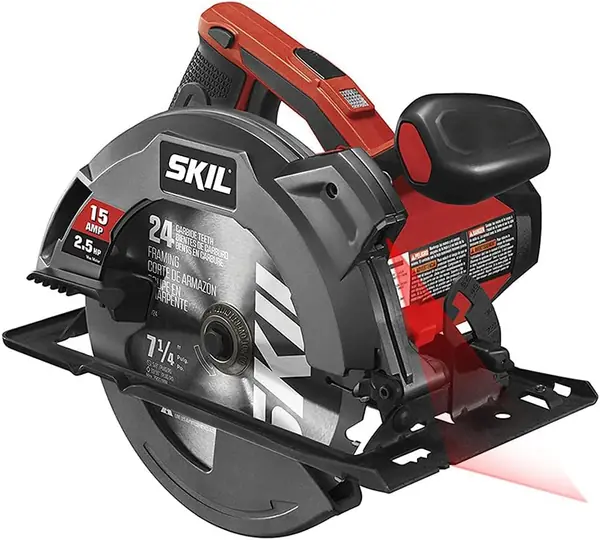
A laser on a circular saw is either a gimmick or the thing that finally gets you cutting on the right side of the pencil line. On the 5280 it earns its place: a single beam lays a line on the work ahead of the blade, so you see the cut before the teeth reach the wood. For someone new to the tool that is real help; for anyone else it is a fast confirmation before the saw commits.

The rest of the saw is more than the price suggests. The motor is a full 15 amps at 5,300 rpm, the base bevels to 51 degrees with a positive stop at 45, and depth of cut at 90 degrees is 2-3/8 inches, which handles 2x lumber and plywood without complaint. At 8.7 pounds it is the lightest saw in this group, and the dust blower and spindle lock are features you otherwise find on saws further up this list.

We recommend it to anyone buying a first circular saw or adding a second one for rough breakdown work. The 24-tooth carbide blade in the box is a framing blade; swap in a 40- or 60-tooth for plywood and the same saw leaves a clean edge, which is the single best upgrade you can make to any saw on this page.

Worth Noting

  • Durability under daily use is unproven
Our Verdict

For a first saw or a second one for rough work, we think the laser and the light 15-amp body make this the value pick of the group.

Check Latest Price
5.

CRAFTSMAN CMES510 Circular Saw Best Value for Home Projects

CRAFTSMAN CMES510 corded circular saw with magnesium shoe and 7-1/4 inch blade

Decks and fences

Shop Score 92/100
Weight
11.1 lb
Blade Size
7-1/4 in
Depth At 90°
2-1/8 in
Bevel Capacity
55 degrees, detents at 22.5 and 45
View on Amazon

At 2-1/8 inches, the CMES510's depth of cut at 90 degrees is the shallowest here by a good quarter inch. That is fine for 2x material and sheet goods, which is the work most of us actually do, and it is the number to check if you regularly cut thick glued-up panels or want a bevel through a deep board.

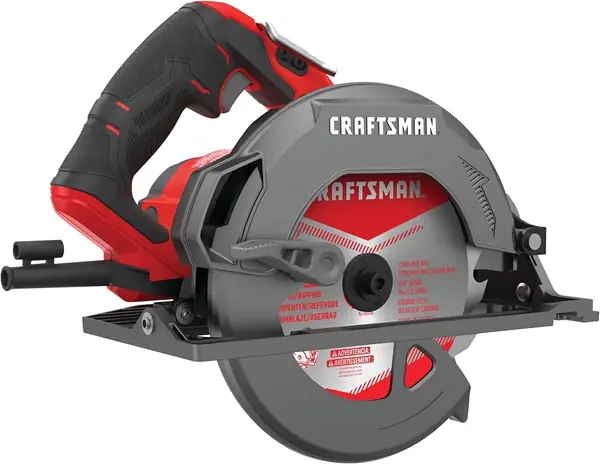
What you get for the money is a magnesium shoe, a 15-amp motor turning at 5,500 rpm, and a tool-free bevel that pivots to 55 degrees with detents at 22.5 and 45. The shoe is the part that matters: magnesium is stiff, it takes a knock without going out of square, and the detents land where they should, so you are not checking every bevel against a square.

We like this saw for a homeowner building a deck, a fence, or a run of shelving — the work where the tool gets used hard for a weekend and then sits for a month. It is a little heavier than the lightest saws here and a step behind the Makita on refinement, and none of that shows up in framing lumber. What does show up is the price, which sits between the budget saws and the professional ones.

Worth Noting

  • 2-1/8 in depth is the shallowest here
Our Verdict

A solid weekend saw for decks and fences — we like the magnesium shoe and the 55-degree bevel, as long as you don't need deep cuts.

Check Latest Price
6.

Bosch CS10 Circular Saw Best for Budget Ripping

Bosch CS10 black corded worm drive circular saw with magnesium footplate and bag

Budget ripping

Shop Score 91/100
Weight
10.2 lb
Blade Size
7-1/4 in
Depth At 90°
2-7/16 in
Bevel Capacity
56 degrees
View on Amazon

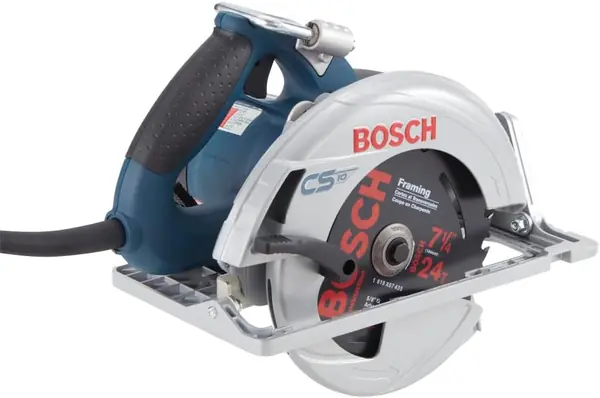
A worm drive at the money of a mid-level sidewinder is the CS10's whole argument. Bosch puts the gear train between the motor and the blade, as on the pricier worm drive in this group, and the payoff shows up in a long rip: the blade holds its speed through thick stock instead of bogging down halfway along the sheet.

The rest of the numbers hold up. There is 2-7/16 inches of depth at 90 degrees, a 56-degree bevel, and 10.2 pounds, which is lighter than the other worm drive here. Bosch also builds in the details that matter on a roof: a saw hook for hanging it between cuts, an anti-snag lower guard for small offcuts, and a removable end cap so the brushes can be replaced instead of the whole tool.

Where it gives ground is speed. At 4,400 rpm it is the slowest blade here, and you feel it in thin plywood and trim, where the faster saws zip through and this one takes its time. The 15 amps make up for some of that in thick material, so for a shop cutting mostly framing lumber and sheet goods the trade is a good one; for cabinet work and finish cuts, we point you to the Makita.

Worth Noting

  • 4,400 rpm speed cuts slower in thin plywood and trim
  • Better suited to framing lumber than fine cabinet work
Our Verdict

The cheapest way into worm-drive torque in this group, and we think it's the right saw if your work is framing lumber rather than finish cuts.

Check Latest Price

How We Tested Corded Circular Saws

We started by narrowing the field to full-size corded saws sold with standard framing blades, filtering out models with thin shoes, vague bevel scales, or a history of service complaints. We looked at both worm-drive and sidewinder saws, left- and right-blade layouts, and saws with lasers or other line aids, then bought 12 units at retail.

Testing ran for eight months, with each saw used on the same mix of work: crosscutting studs on sawhorses, ripping plywood on a garage floor, and cutting decking on a backyard build. We wore eye and hearing protection throughout, unplugged every saw before changing a blade or lifting the lower guard, and supported each workpiece so the kerf stayed open and never pinched the blade.

We scored cutting performance on how cleanly each saw tracked a pencil line, whether it bogged down in pressure-treated lumber, and how much tear-out showed on the exit side. We noted weight and balance by carrying each saw up a ladder and making one-handed cuts in scrap, then checked depth and bevel adjustments by setting them repeatedly to see whether the stops held. Shoe flatness got checked against a machined straightedge, and we tested whether the base shifted after a hard bump. For durability, we ran long rips until the motor was hot, then looked for scale creep, loose levers, and cord strain.

We also evaluated the everyday details that decide whether a saw stays on the bench: blade changes with the arbor lock, the visibility of the sightline, the reach of the controls, and whether the dust blower actually cleared the cut. At the end, we compared what each saw delivered against its asking price and kept the ones that earned their place. The saws that remain are the ones we reached for first, not just the ones with the longest feature list.

How to Choose a Corded Circular Saw

Worm Drive or Sidewinder

A sidewinder puts the motor in line with the blade, spins faster, and costs less. A worm drive routes power through a gear train and trades blade speed for torque that does not quit under load. In this group that means a sidewinder such as the DEWALT DWE575SB for sheet goods, trim, and general shop work, and a worm drive such as the SKILSAW SPT77WML-01 for long rips in wet or dense lumber.

The amp rating does not settle the choice: 15 amps at 4,400 rpm and 15 amps at 5,800 rpm are different tools with different jobs. Pick the drive type first, then compare the rest.

Depth of Cut and Bevel Range

Seven-and-a-quarter-inch saws here run from 2-1/8 to 2-9/16 inches of cut at 90 degrees. All of them clear a 2x on the flat; the spread matters when you tilt the base, because beveling eats capacity, and when you work thick stock. If you want margin, look for 2-3/8 inches or better.

Bevel range matters less than the stops. Forty-five degrees is the working angle for most trim and siding, and anything past 50 adds steep cuts. Positive stops at 22.5 and 45 are worth more than three extra degrees of swing.

Weight, Balance, and the Shoe

Weight is the specification you feel every minute. Our picks run from 8.7 to 11.5 pounds, and the gap shows up when you cut overhead or steer one-handed across a sheet. Heavier saws track better on long rips and feel steadier in thick material; lighter saws get picked up more often.

The shoe deserves the same attention. Magnesium and aluminum stay flat through knocks, and a base that is out of square sends every cut with it. Check the shoe against a straightedge before you trust the detents, including on a new saw.

Sights, Lights, and Cutting to a Line

A laser, a pair of LEDs, or a dust blower all serve one goal: seeing where the blade will go. They are genuinely useful, and none of them replaces a straightedge and two clamps when a cut has to be right. Treat the laser and the notch on the base as a starting point, not a guarantee.

Several saws here ship without a rip fence. Budget for one, because a fence is what turns a circular saw into a tool that can rip a straight edge down a full sheet.

The Blade in the Box

The blade that comes with a circular saw is a framing blade, usually 18 to 24 teeth, and it is fine for 2x lumber and rough work. It is not the blade for plywood, melamine, or finished trim, where it tears the surface and loads up.

A 40- or 60-tooth blade in the same saw leaves a clean edge and costs far less than moving up a tier in saws. We tell most buyers to set aside a little of the budget for one before they start shopping.

Frequently Asked Questions

Final Verdict

The DEWALT DWE575SB is the saw we recommend to almost anyone: light enough to run all afternoon, braked so it stops when you let go, and deep enough at 2-9/16 inches to handle thick stock in a single pass. If your work is decking, siding, and long rips in wet lumber, the worm-drive SKILSAW SPT77WML-01 is worth the extra weight on the saw.

On a tight budget, the SKIL 5280-01 makes the same cuts with a laser to help you start them.