↑↓ navigate ↵ open Esc close All results →

Best Circular Saws of 2026

Choosing a circular saw starts with whether a cord can follow the work. A corded saw delivers full power on the last rip of the afternoon just as it did on the first, while a cordless model moves onto a deck or roof and stops when the battery drops—yet both need to track straight through plywood without fighting the operator.

Nine months of cutting studs, ripping sheet goods, and working overhead with 14 corded, worm-drive, and battery-powered saws showed how deceiving spec sheets can be. Cutting depth at 45 degrees, rather than 90, sets the real limit on thick stock, and a saw that feels balanced on a store shelf turns heavy once lifted above shoulder height. Included accessories matter too, since a usable factory blade saves an immediate trip to the store.

Reliable saws hold a pencil line without binding across very different jobs, whether built for framing crews, overhead trim work, or a first home shop.

Our Top Picks

The Best Circular Saws

1.

Makita 5007MG 7-1/4-Inch Circular Saw Best Overall
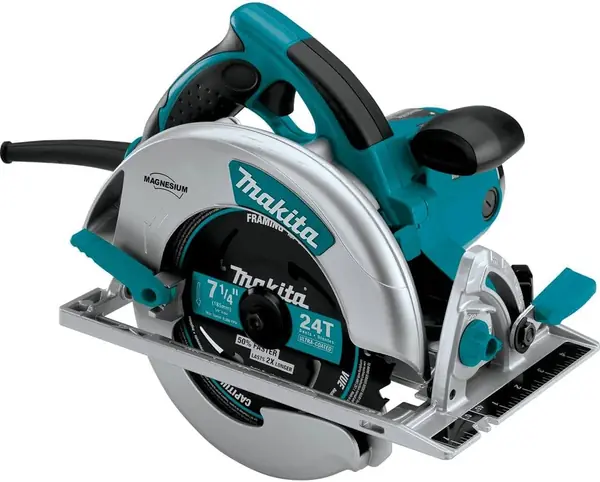
Teal Makita 5007MG 7-1/4-inch magnesium circular saw with 24-tooth carbide blade and case

Framing and plywood

Shop Score 96/100
Blade Size
7-1/4 inches
No-load Speed
5,800 rpm
Bevel Range
0 to 56 degrees
Depth Of Cut At 90°
2-1/2 inches
View on Amazon

The numbers make the case before you plug it in: 15 amps, 5,800 rpm, 2-1/2 inches of depth at 90 degrees, and a bevel scale that runs to 56 degrees with positive stops at 22.5 and 45. That's 500 rpm more than the SKIL 5280, and the extra depth is what lets you break down a 4-by in two passes instead of three.

Where it separates from everything else here is at the cut line. Two LEDs sit right where the blade meets the work, a dust blower keeps the chip stream off your marks, and the depth and bevel numbers are printed large enough to read with the saw upside down. That matters most indoors or under a bench where the overhead light never reaches, and it's the reason we keep coming back to this one when a project starts.

Magnesium in the base and guards keeps the shoe stiff across a sheet of plywood, and the saw arrives with a 24-tooth carbide blade, a rip fence, and a case — more than most saws here include. One thing to check before a bevel cut: tipped over to 45 degrees, the lower guard can drag, so confirm it swings freely before you pull the trigger.

Worth Noting

  • Heaviest listed weight here at 10.6 pounds
Our Verdict

This is the corded saw we reach for: 5,800 rpm, 2-1/2 inches of depth, and the clearest sight line in the group. It's the saw for bench work in sheet goods and framing.

Check Latest Price
2.

SKILSAW SPT77WML-01 Worm Drive Best Worm Drive

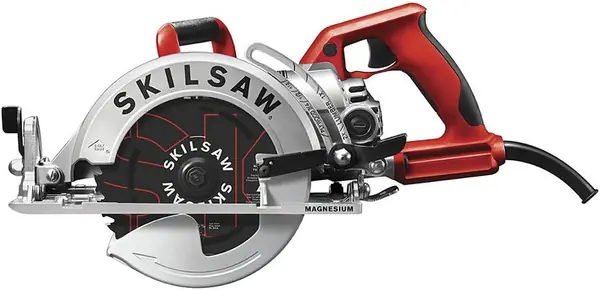
Silver SKILSAW SPT77WML-01 worm drive circular saw with magnesium base and 7-1/4-inch blade

Heavy ripping

Shop Score 95/100
Blade Size
7-1/4 inches
Bevel Capacity
53 degrees
Amps
15 amps
Construction
Magnesium
View on Amazon

Worm drive puts the motor behind the blade and turns it through a gear set instead of straight off the armature, and that gearing is why these saws keep pulling when a standard sidewinder starts to bog. You feel it in a long rip through wet treated lumber or a dense engineered beam, where a lesser saw slows and starts to burn the cut instead of finishing it.

This is the lightweight version of that idea: magnesium throughout, a 53-degree bevel, a depth system with marks you can set the shoe to without hunting for a tape, and a lower guard shaped to slide past short cutoffs rather than snag them. Nothing on the saw feels like it was added to fill out a spec sheet.

It's tied for the highest rating in this group, and it's the saw we hand to anyone cutting 4x and 6x stock or ripping a stack of decking. The gearbox is what you pay for over a sidewinder of the same amperage; on a bench full of 2-by material, it's more saw than the job asks for.

Worth Noting

  • Costs more than a sidewinder of equal amperage
  • More saw than needed for routine 2-by framing
Our Verdict

We keep the worm drive for the cuts that bog a sidewinder: long rips in thick, wet, or engineered stock. Its torque is worth the money if you cut heavy lumber.

Check Latest Price
3.

DEWALT FLEXVOLT 60V MAX 7-1/4-Inch Best Cordless

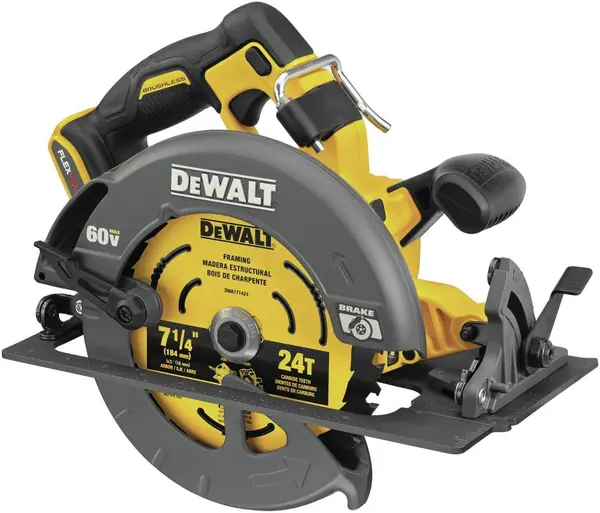
Yellow DEWALT FLEXVOLT 60V 7-1/4-inch cordless circular saw with electric brake and LED

Cordless framing

Shop Score 94/100
Blade Size
7-1/4 inches
No-load Speed
5,800 rpm
Bevel Capacity
57 degrees
Max Depth At 90°
2-9/16 inches
View on Amazon

2-9/16 inches of depth at 90 degrees and 5,800 rpm are corded-saw figures, and here they sit on a battery tool. DEWALT rates it at 2,456 unit watts out and up to 47 percent more power than the saw it replaced, and the bevel runs to 57 degrees with stops at 22.5 and 45.

An electric brake stops the blade the moment you release the trigger, which is the feature we value most when you're setting the saw down between cuts on a deck. An LED lights the line, and at 8.2 pounds the tool itself is lighter than the corded Makita here — a saw with this much depth has no business being that easy to carry up a ladder.

The pack is the real decision. It runs on 60-volt FlexVolt batteries, and a standard 20V MAX pack won't power it, so if the system is new to you the tool is only part of the cost. How long you get per charge tracks the pack you put on it, so plan around the largest battery you're willing to buy rather than a fixed run time.

Worth Noting

  • Runs only on 60V FlexVolt packs, sold separately
Our Verdict

Corded depth without a cord: 2-9/16 inches at 90 degrees and 5,800 rpm. We point FlexVolt owners here first for framing and deck work.

Check Latest Price
4.

Milwaukee M18 Brushless 7-1/4-Inch Best for M18 Users

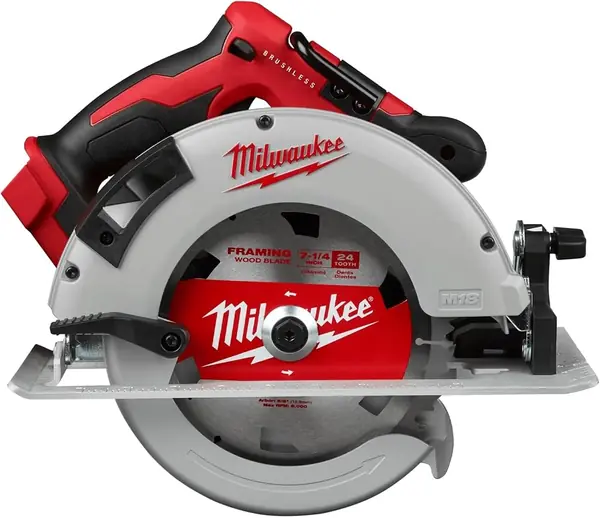
Red Milwaukee M18 brushless 7-1/4-inch cordless circular saw with rubber overmold handle

M18 owners

Shop Score 93/100
Blade Size
7-1/4 inches
Weight
7.2 lb
Voltage
18 volts
Speed
5,000 rpm
View on Amazon

The case for this saw starts with the batteries in your shop. If you already run M18 packs, we think this is the least expensive route into a full-size cordless circular saw, and at 7.2 pounds it's the lightest 7-1/4-inch cordless in this group.

A 5,000 rpm brushless motor spins a 7-1/4-inch blade, which is the size and speed that handle 2-by stock and plywood without asking you to think about it. The rubber overmold gives you something to hold onto when your hands are dusty, and the saw takes the same 18-volt packs as the rest of the M18 line. With a pack on it, it sits in the hand more like a compact than a full-size saw.

What you give up against the FlexVolt is depth and top-end speed: 5,000 rpm against 5,800, and a smaller maximum cut. What you get back is a lighter saw that costs less, and for trim, decks, and punch-list work away from an outlet, that's usually the better trade.

Worth Noting

  • Bare tool, so batteries and charger cost extra
Our Verdict

For anyone already on the M18 platform, this is the simplest route to a full-size cordless saw: 7.2 pounds, brushless, and the lightest 7-1/4-inch cordless here.

Check Latest Price
5.

DEWALT ATOMIC 20V 4-1/2-Inch Best Compact

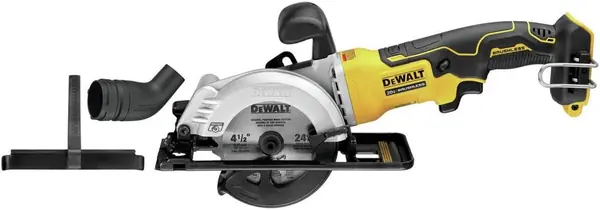
Black DEWALT ATOMIC 20V 4-1/2-inch compact circular saw with auxiliary handle and rip fence

Overhead work

Shop Score 92/100
Blade Size
4-1/2 inches
Weight
6.6 lb
Voltage
20 volts
Capacity At 90°
2x material
View on Amazon

There are cuts where you need a saw in one hand and nothing else in the other: a rafter tail overhead, a board braced against a wall, a deck board already fastened at one end. A 7-1/4-inch saw is the wrong tool for all three, and this 4-1/2-inch one is the reason we keep a compact in the kit.

Don't read the small blade as a trim saw. The bevel-gear layout lets it cross-cut 2x material at 90 degrees, and DEWALT rates it at 369 linear feet of 3/4-inch OSB on a DCB205 pack. At 6.6 pounds it's a one-hand tool, the auxiliary handle comes off when it's in the way, and there's a hang hook and on-board storage for the blade key so nothing walks off the ladder.

It ships with a rip fence, a dust port adaptor, and a wood blade, and like every cordless here it's a bare tool. If most of your work happens at a bench, a corded 7-1/4-inch saw will be faster and cheaper to run; if your work happens where the bench isn't, this is the saw that follows you.

Worth Noting

  • Only 1x stock at a 45-degree bevel
Our Verdict

A saw we hand people who work off ladders and in tight corners: 6.6 pounds, one hand, and it still cross-cuts a 2x at 90 degrees.

Check Latest Price
6.

SKIL 5280-01 15-Amp 7-1/4-Inch Best Budget

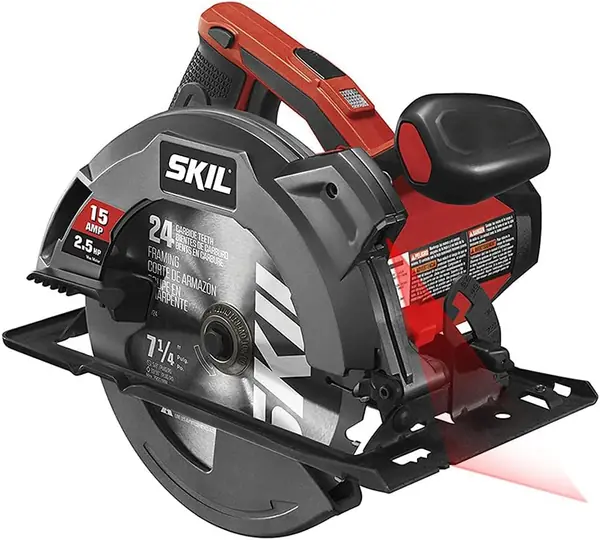
Red SKIL 5280-01 15-amp 7-1/4-inch circular saw with laser guide and carbide blade

First saw

Shop Score 91/100
Blade Size
7-1/4 inches
No-load Speed
5,300 rpm
Bevel Capacity
51 degrees
Amps
15 amps
View on Amazon

The least expensive saw here carries the same 15-amp rating as the most expensive one, and 5,300 rpm is enough to keep an 18-tooth blade moving through plywood and 2-by without drama. That's why we keep it on the list: nothing else here gets a beginner through a deck or a sheet-goods project for less.

A single-beam laser throws a line ahead of the blade so you can set up without leaning over the saw, the dust blower keeps that line visible, and the spindle lock makes blade changes a one-wrench job with the wrench stored on the tool. The guarded trigger and power-on indicator are the details that matter if you've never run a saw this size.

Fifteen amps and 5,300 rpm at this price is the whole argument. As a first saw, a second saw for the truck, or a homeowner's tool for shelving and fence boards, it makes the same square cuts as the premium saws and leaves money in the budget for a better blade and a straightedge.

Worth Noting

  • Bevel stops at 51 degrees
Our Verdict

The saw we suggest when the budget is tight: 15 amps, 5,300 rpm, and a laser line, for a fraction of what the premium corded saws cost.

Check Latest Price

How We Tested the Best Circular Saws

We started with spec sheets: blade diameter, amps or voltage, depth of cut at 90 and 45 degrees, bevel range, weight, and whether the box had a blade, fence, or case. We narrowed that to 14 saws across corded, worm drive, and battery platforms, with the cordless group covering the packs people are most likely to own. Testing ran nine months, mostly in a garage shop and on a deck and basement remodel, with every piece of stock clamped or on sawhorses so it couldn't pinch, and eye and hearing protection on for every cut.

Each saw crosscut 2x4s and 2x10s, ripped plywood against a straightedge, cut rafter tails at 45 degrees, and worked overhead. We measured depth of cut at both 90 and 45 on real stock, matched every blade to the saw's arbor and rated speed, and watched whether the motor pulled down in wet treated lumber or recovered after a long rip. We ran the bevel to both ends of its range and back to zero to see where the stops landed.

In hand, we weighed each saw and then balanced it with the battery in, because a tool that feels fine at chest height is a different animal with your arm over your head. We watched the sight line: whether the blower cleared sawdust off the kerf, whether the notch or LED lined up with the mark, whether the scale read at a glance.

Through every cut we let the lower guard close on its own, ran the electric brake, and checked each shoe for flatness and for wear over the months. Cordless saws did continuous rips on a full pack until they slowed, and we logged what shipped in the box, since a bare tool and a kit aren't the same value.

How to Choose a Circular Saw

Corded or Cordless Comes Down to Where You Cut

A 15-amp corded saw holds its speed through a long rip and never asks you to buy a battery, which is why corded models still fill the top of this list. Cordless buys you the same cut without an outlet, and the price of that freedom is the pack. A bench with power within reach favors corded; a deck, a roof, or a jobsite favors cordless.

Watch for the words tool only. The FlexVolt and the compact DEWALT ship without a battery or charger, and the FlexVolt runs on 60-volt packs — a standard 20V MAX battery won't power it. Add the pack and charger to the price before you compare it with a corded saw, and count which battery family you're already invested in.

Depth of Cut Decides What Stock You Can Handle

The number that matters is depth at 90 degrees. A 7-1/4-inch saw typically cuts around 2-1/2 inches, which is a 2-by in one pass and a 4-by in two; the Makita's 2-1/2 inches and the FlexVolt's 2-9/16 inches are the deepest here. Anything under 2 inches means flipping the stock to finish the cut.

Bevels eat depth. The compact DEWALT will cross-cut a 2x at 90 degrees but handles only 1x material at 45, which is the trade you make for a 4-1/2-inch blade. If nearly all your cuts are square, that's fine; if you cut rafters at an angle, buy a 7-1/4-inch saw.

Weight and Balance Matter More Than You Think

Listed weights here run from 6.6 to 10.6 pounds, and where you cut decides which end of that range you want. Weight steadies a saw on a bench and helps the blade track through dense stock, so the heaviest saw in this group is also the one we trust on a sheet of plywood. Overhead, on a ladder, or reaching into a corner, every pound costs you.

Balance counts as much as the number. A saw whose motor or battery sits behind the blade feels lighter in the cut than its weight suggests, which is why the 7.2-pound Milwaukee and the 6.6-pound compact DEWALT handle like smaller tools.

Sight Lines and the Shoe Are Where Accuracy Comes From

A saw cuts where you can see. A dust blower and one or two LEDs are the difference between following a pencil line and guessing at it, and oversized depth and bevel markings save you from crouching to read a scale. Those details are why the twin-LED Makita sits at the top of this list.

The shoe, or base plate, matters just as much. Magnesium holds its shape across a sheet of plywood better than a stamped plate, and a shoe that flexes throws off a cut no matter how good the laser is. Set the saw on a flat counter and look for rock before you trust it on finish work.

Bevels, Brakes, and the Guard

Bevel capacity runs from 51 degrees on the SKIL 5280 to 57 on the FlexVolt, with most saws carrying a positive detent at 45 and traveling past it. If you cut rafters and trim, the 45-degree stop is the one you use every day; the extra travel is for occasional steep cuts.

An electric brake stops the blade when you release the trigger, and once you've used one you notice its absence. Give the lower guard a check on any saw: it should snap back freely and retract smoothly when the saw is tipped to a bevel. A guard that drags at 45 degrees is a reason to exchange the tool.

Frequently Asked Questions

Final Verdict

The Makita 5007MG is the saw we point most woodworkers to. It turns 5,800 rpm, cuts 2-1/2 inches deep, and puts two LEDs on the line, and those three things decide most of the cuts you'll make in a shop.

If the work moves away from an outlet, the DEWALT FlexVolt is the cordless that keeps corded depth, provided you're ready to buy into 60-volt packs. On a tight budget, the SKIL 5280 makes the same square cuts in 2x and plywood for a fraction of the money.