↑↓ navigate ↵ open Esc close All results →

Best Left-Handed Circular Saws of 2026

Most circular saws are built for right-handed people, and the tell is where the blade sits. On a standard sidewinder it's to the right of the motor, so a left-handed operator spends the whole cut leaning across the tool to watch the line while the housing and the dust chute sit in the way. Left-blade and rear-handle designs move the blade back into your sightline, and the difference on a long rip is not subtle.

After eight months with 12 saws — ripping sheet goods on sawhorses, crosscutting stacked framing lumber, and running a few of them overhead — we can tell you which ones held a line and which ones wore us out. We also learned that weight is the specification shoppers underestimate most. A heavier saw pulls straighter through wet lumber, but by the twentieth cut your forearm knows exactly what you're carrying.

The six picks below cover framing, ripping, all-day cordless work, and a tight budget, and every one of them lets you see what you're cutting.

Our Top Picks

The Best Left-Handed Circular Saws

1.

SKILSAW SPT77WML-01 Best Overall
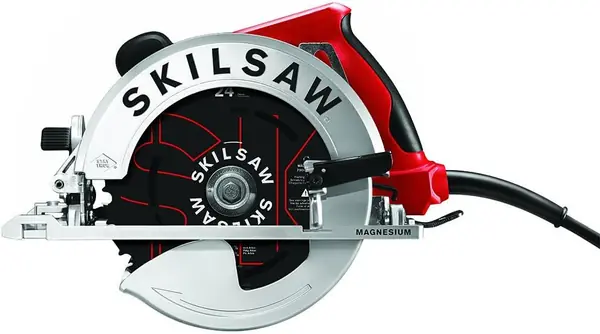
SKILSAW SPT77WML-01 silver worm drive circular saw with magnesium housing

Framing and ripping

Shop Score 95/100
Amps
15 A
Weight
11.5 lb
Bevel Capacity
53°
Blade Diameter
7-1/4 in.
View on Amazon

The first thing we noticed about the SKILSAW SPT77WML-01 is how little it asks of your arms between cuts. At 11.5 pounds, it is the lightest worm drive here, and that is the reason we make it our default: you get the left-side blade and rear-handle control of a framing saw without the heft that makes a long day feel longer. The magnesium housing also keeps the motor cooler, which matters when you are ripping a stack of sheets rather than making one trim cut.

The 15-amp Dual-Field motor has the torque we want for framing lumber, and the Cut Ready depth system lets you set common depths without hunting for a mark. A 2-3/8-inch cut at 90 degrees handles dimensional stock, while the 53-degree bevel adds useful room past 45 degrees for trim and rafters. We also appreciate the anti-snag lower guard when we are making small cutoffs; it moves without the hitch that can throw off your line.

Compared with the Makita 5377MG, this SKILSAW is easier to carry up a ladder and just as happy in a pile of 2x material. The trade-off is that it is still a worm drive, so it carries more rear-end weight than a sidewinder. If your work is mostly light trim, the SKIL SPT67M8-01 is the easier carry; for framing and ripping, this is the one we want in hand.

Worth Noting

  • Requires regular oil checks
Our Verdict

We recommend the SKILSAW SPT77WML-01 as the default left-blade worm drive for anyone who wants pro-level framing power without wrestling a heavier saw all day.

Check Latest Price
2.

DEWALT DCS577B Best Cordless

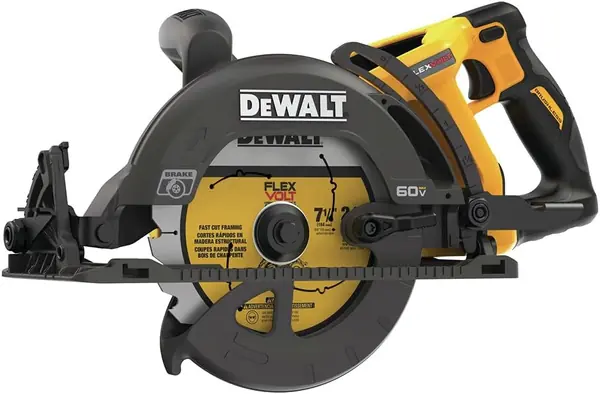
DEWALT DCS577B FLEXVOLT 60V cordless rear-handle circular saw with magnesium shoe

Cordless framing

Shop Score 94/100
Weight
10.9 lb
Battery
Tool only
Voltage
60 V
Max Depth At 90°
2-7/16 in.
View on Amazon

Cordless saws often ask you to trade away framing power, but the DEWALT DCS577B is built to make that trade as small as possible. The blade sits left of the motor and the handle at the rear, so your sightline down the cut stays open; the electronic brake is a welcome detail when you are moving between cuts. We were struck by how much it feels like a worm drive in hand, even though it runs on a battery.

The brushless 60V motor and 2-7/16-inch depth at 90 degrees put it in framing territory, and the magnesium shoe keeps the base flat as you move from sheet goods to 2x stock. Bevel stops at 45 and 22.5 degrees cover the angles we use most, and the 53-degree capacity gives some room beyond that. In our cuts, it did not feel like a saw that needed to be babied through thick material.

What decides it for us is the platform: this is the cordless rear-handle saw we recommend for framing and deck work on a DeWalt crew. The rafter hook is the detail we did not expect to use as often as we did; it makes setting the saw aside between cuts feel less like a balancing act.

Worth Noting

  • Bare tool; batteries sold separately
  • Heavy with a battery fitted
Our Verdict

Pick the DEWALT DCS577B for cordless framing power and a clear left-blade sightline, especially on a crew already standardized on DeWalt.

Check Latest Price
3.

Makita XSR01PT Best Cordless Kit

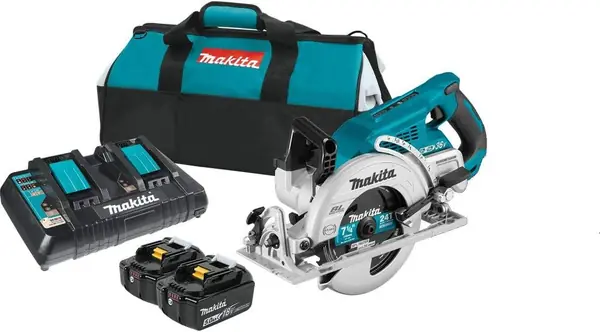
Makita XSR01PT 36V rear-handle circular saw kit with two batteries

All-day cordless work

Shop Score 93/100
Blade Diameter
7-1/4 in.
Battery
2 x 5.0Ah
Voltage
36 V
Speed
5,100 rpm
View on Amazon

The Makita XSR01PT arrives as a kit with two 5.0Ah batteries, and that is the point: you can put one on the charger and keep cutting rather than stopping to hunt for a spare. The rear handle and left-side blade give you the clear sightline of a worm-drive layout, but the saw is a rear-handle sidewinder at heart, with a brushless motor that spins at 5,100 rpm.

We think this is the cordless pick for someone who wants one box to cover a framing day. Makita claims up to 558 crosscuts per charge in 2x4 SPF and 291 in 2x10, and the two-battery X2 system delivers that power without a cord. The 7-1/4-inch blade and 36-volt setup handled the thick stock we tried; the automatic speed change is the kind of feature you notice when the saw keeps its footing in a long rip.

The kit is the complete route into this saw: two batteries, a charger, and a blade in one purchase. The 5.0Ah packs also fit the rest of Makita's 18V tools, so the kit buys into a system rather than one saw. We like that Makita did not make the rear handle a novelty; the controls fall where you expect, and the metal blade guard adds a sense of substance.

Worth Noting

  • Heavy with both batteries installed
Our Verdict

Choose the Makita XSR01PT kit when you want a complete two-battery cordless setup for all-day rear-handle framing.

Check Latest Price
4.

SKIL SPT67M8-01 Best Value

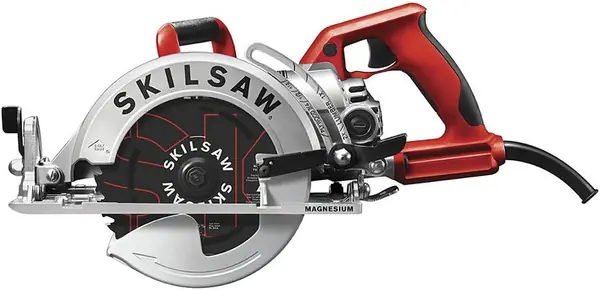
SKIL SPT67M8-01 left-blade sidewinder circular saw with magnesium construction

Value sidewinder

Shop Score 92/100
Amps
15 A
Bevel Capacity
56°
Blade Diameter
7-1/4 in.
Blade Orientation
Left
View on Amazon

The SKIL SPT67M8-01 is the saw we pick when the work is lighter and the day is longer. It is a left-blade sidewinder, not a worm drive, so the body is easier to swing through trim and sheet goods, and the blade sits where you can watch the line. The all-magnesium construction gives it a solid feel without the rear-heavy balance of the worm-drive saws here.

We think that makes it the value pick for a woodworker who wants left-handed visibility without paying for a framing saw. The 15-amp Dual-Field motor has enough torque for 2x stock and plywood, and the 56-degree bevel matches the widest in this group, which is useful for steep trim cuts. The blade guard and depth lever are straightforward, and the saw felt balanced enough to steer with one hand on simpler cuts.

It is not the saw for wet 4x4s or all-day framing; a worm drive will outmuscle it in the heaviest material. What we like is the honesty of the design: it does not pretend to be a framing saw, and it keeps the cost and the heft down for trim, shelving, and the occasional deck board. The 56-degree bevel is the detail that keeps it in our kit for stair stringers and angled trim.

Worth Noting

  • Not built for wet 4x4s or all-day heavy framing
Our Verdict

For left-blade visibility in a lighter sidewinder built for trim and general cutting, the SKIL SPT67M8-01 is the value pick.

Check Latest Price
5.

Makita 5377MG Best Low-Maintenance

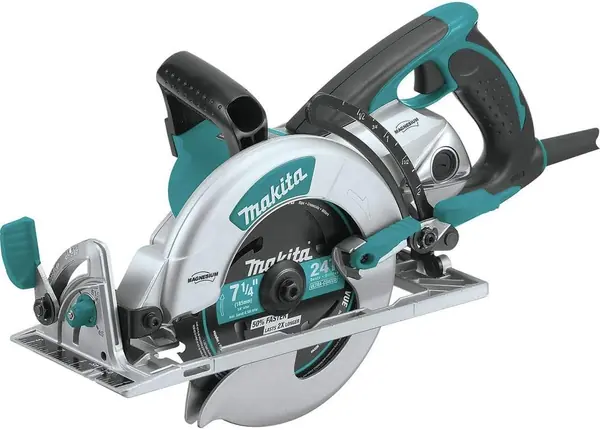
Makita 5377MG teal magnesium hypoid circular saw with 15-amp motor

Low-maintenance framing

Shop Score 91/100
Amps
15 A
Weight
13.2 lb
Bevel Capacity
51.5°
Max Depth At 90°
2-3/8 in.
View on Amazon

The Makita 5377MG's most interesting feature is one you do not have to think about: oil-bath technology. A built-in fan and sealed gear housing keep the hypoid gears coated, so you are not checking and topping off a reservoir the way you do with a conventional worm drive. For a saw that lives in a truck and gets used in bursts, that is a genuine convenience.

The 15-amp motor and hypoid gearing give it the torque we expect for framing, and the 2-3/8-inch depth at 90 degrees handles 2x material without drama. The 51.5-degree bevel has positive stops at 22.5 and 45, and the magnesium body gives the saw a solid, planted feel. We noticed the gear train runs quieter than a typical worm drive, with less of the whine that wears on you over a long day.

This is the saw we point to when maintenance is the deciding factor. It is a corded hypoid, so it wants an outlet, but the sealed oil bath and the positive detents make it a low-fuss choice for a shop or a framing crew that does not want to baby a worm drive. We also appreciate the heavy-duty sky hook for hanging it between cuts.

Worth Noting

  • Heavy for overhead cutting
Our Verdict

Framing crews that want worm-drive torque with sealed oil-bath gearing and less routine maintenance should look at the Makita 5377MG.

Check Latest Price
6.

Bosch CS10 Best for Budget Woodworking

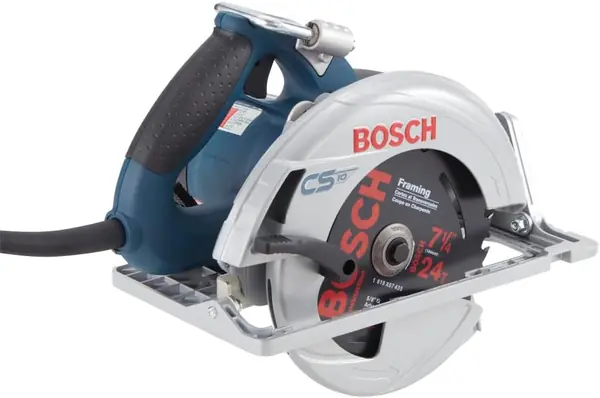
Bosch CS10 corded circular saw with magnesium footplate and carrying bag

Budget woodworking

Shop Score 90/100
Amps
15 A
Weight
10.2 lb
Bevel Capacity
56°
Blade Diameter
7-1/4 in.
View on Amazon

The Bosch CS10 is the budget entry here, and it is the one we suggest when you want a left-side blade without paying for a worm drive. The 15-amp motor, 10.2-pound body, and 56-degree bevel look good on paper, and the left-side blade design gives you a clear view of the cut line. We think it is a sensible first circular saw for a home shop.

The CS10 cuts like a sidewinder should: it has enough power for hardwood and plywood, and the bevel scale is easy to read for 45-degree miters. The magnesium footplate is a nice touch at this end of the range, and the saw hook keeps it off the bench between cuts. We did not expect the dust blower to be as useful as it is; it clears the line enough to see your mark.

Where it gives ground is in the details. The adjustment controls feel less refined than the Makita or DeWalt saws, and the saw is not the one we reach for when we have a full day of framing ahead. But for trim, shelving, and occasional deck boards, it covers the basics at the lowest price in this group.

Worth Noting

  • Feels heavier than expected for its size
Our Verdict

Home-shop woodworkers on a budget get a left-side blade and 15-amp power from the Bosch CS10.

Check Latest Price

How We Tested Left-Handed Circular Saws

We started with a spreadsheet of every 7-1/4-inch saw we could find with the blade on the left of the motor or a rear handle, worm-drive and hypoid designs included, then compared motor amperage or voltage, shoe material, bevel range, weight, and whether a cordless kit shipped with batteries. That narrowed the field to 12 saws, which we used for eight months.

Testing happened where saws actually get used: a backyard deck build, a garage floor covered in plywood on sawhorses, and several days of beam work where the saw spent more time overhead than flat. We made the same cuts from a left-handed stance with each one and noted how much of the blade and the pencil line we could actually see, and we cut through the same stack of framing lumber so the comparison stayed fair. Every saw was weighed on a kitchen scale, then hefted one-handed to judge where the balance point sat.

Cordless models ran until the battery quit, and we counted cuts in stacked 2x10s rather than trusting the gauge. We loosened and re-tightened every bevel and checked the angle against a square, swapped blades to see how easily the arbor and guard allowed it, and watched whether the lower guard snapped back on its own — we never held one open to make a cut easier. The worm-drive and hypoid saws got their oil checked before and after each session; the sealed ones needed nothing. Workpieces stayed clamped, batteries came out or cords came unplugged before every blade change, and eye and hearing protection stayed on all day.

How to Choose a Left-Handed Circular Saw

Start With Blade Side and Handle Layout

Left-handed circular saws are usually left-blade saws, and many are worm drives with the handle at the rear. We look first at the layout because it puts the blade where you can watch the line instead of leaning around the motor. A worm drive also carries its weight differently, so a saw that feels steady on a floor cut can feel nose-heavy on a ladder. Before you buy, picture your hand on the rear handle and your other hand on the front knob. The SKILSAW SPT77WML-01 is a worm drive; the Bosch CS10 is a lighter left-side sidewinder.

Decide Between Corded and Cordless

Corded saws give you constant power and no battery platform to buy into; cordless saws give you freedom from an outlet but add batteries, chargers, and a different weight balance. We think the platform question settles more cordless purchases than the saw specs do. The DEWALT DCS577B is a bare tool, so it makes sense if you already own FlexVolt batteries; the Makita XSR01PT is sold as a kit with two batteries. For a shop saw that stays near an outlet, corded is the simpler buy. For framing, decks, and remote work, decide which battery system you are already in before you fall for the saw.

Weigh Power Against Fatigue

Every saw here is a 7-1/4-inch model, but the weights run from 10.2 pounds to 13.2 pounds, and cordless weights often exclude the battery. That matters most when you are cutting overhead or working in tight spaces. We prioritize a saw that feels steady in the cut over one that simply has the biggest motor. A heavier worm drive or hypoid saw can feel planted in framing, while a lighter sidewinder is easier to steer through trim and sheet goods. Match the saw to the day you actually have, not the heaviest cut you might make once.

Match Depth and Bevel to Your Work

At 90 degrees, the saws here cut 2-3/8 to 2-7/16 inches deep, which covers 2x lumber. Once you tilt the base, usable depth drops, so check the capacity before you plan a beveled cut through a thick post. We check the depth scale at the angle we plan to use, not just at 90. Bevel ranges run from 51.5 to 56 degrees; the extra few degrees are useful for steep trim and stringer work. A magnesium shoe helps the base stay flat, and positive stops make 45-degree cuts repeatable. If your work is mostly square cuts, do not pay extra for a wider bevel you will not use.

Plan for Maintenance and Control

Worm-drive saws traditionally need their oil checked and topped off, while the Makita 5377MG uses a sealed oil bath that avoids that routine. That is a real convenience for a saw that lives in a truck, but it is not the only control detail that matters. We pay attention to an electronic brake, a lower guard that moves without snagging, and a dust blower that clears the line. The DEWALT and Makita cordless saws have brakes; the corded SKIL and Bosch saws rely on guard action and a clear sightline. Pick the controls you will notice every cut.

Frequently Asked Questions

Final Verdict

For most left-handed woodworkers, the SKILSAW SPT77WML-01 is the one we recommend. It is the lightest worm drive here, and that makes its 15-amp power and left-side sightline easier to live with on a full day of framing or ripping.

If you work away from outlets, the DEWALT DCS577B is the cordless saw we choose, as long as you are already set up on its battery platform. The Makita XSR01PT kit is the better one-box cordless answer when you need batteries included.