↑↓ navigate ↵ open Esc close All results →

Best Circular Saws for Timber Framing of 2026

Halfway through a 4x6 post, a circular saw makes clear whether it belongs on a timber frame. The blade slows, the motor labors, and the cut either stalls or forces a flip to finish from the opposite face, because heavy timber demands deeper passes, longer pulls, and frequent overhead work.

Cutting rafters, knee braces, headers, and 4x4 and 6x6 posts with eight saws over nine months separated capability from marketing quickly. Depth of cut comes first: most 7-1/4-inch saws clear a 2x cleanly but cannot bury a true 4x in a single pass—even a worm drive requires a larger blade or a two-pass cut.

Beyond capacity, blade-left sightlines, manageable weight overhead, accurate bevel stops, and battery platform compatibility decide how a saw handles day to day. Even a budget worm drive can justify its spot if it holds blade speed under load, delivers a straight, predictable kerf, and closes the lower guard cleanly behind the cut.

Our Top Picks

The Best Circular Saws for Timber Framing

1.

SKILSAW SPT77WML-01 Worm Drive Best Overall
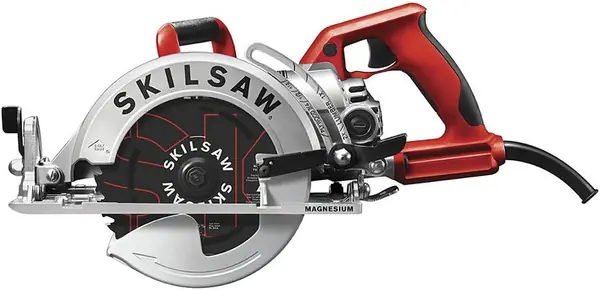
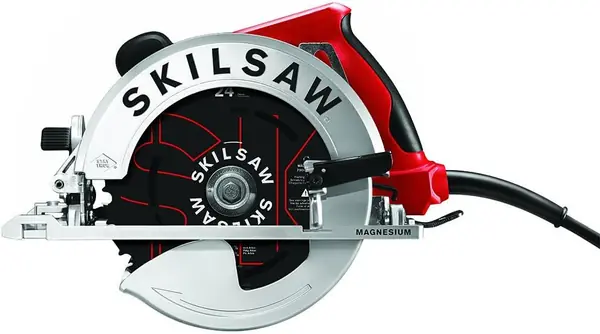
SKILSAW SPT77WML-01 worm-drive circular saw with silver magnesium body and rear handle

Heavy framing cuts

Shop Score 96/100
Weight
11.5 lb
Blade Size
7-1/4 inches
Max Depth At 90°
2-3/8 inches
Amps
15 A
View on Amazon

Worm drive is the traditional framing choice for a reason, and the SPT77WML-01 is the worm drive we trusted on long framing cuts. The 15-amp motor and left-side blade put the cut line in view while the saw pulls through long rips in 2x material; at 11.5 pounds it is light enough for a worm drive that we did not dread carrying it from stack to stack. The cut-ready depth lever clicks to common 1/4 ply, 1/2 ply, 3/4 ply, and 2x settings, which is the kind of small convenience that saves time when you are making the same cut all afternoon.

The 2-3/8-inch depth at 90 degrees covers standard 2x framing, and the 53-degree bevel with stops at 0 and 45 gives you rafter cuts without fussing. We paid attention to the base and guard because a framing saw lives on its foot: the magnesium housing and anti-snag lower guard felt solid, and the saw tracked cleanly in our cuts. It is not a 10-1/4-inch saw, so 4x4 posts still need a second pass or a bigger blade.

What sold us is the combination of torque and control. The worm drive does not feel frantic in wet or dense stock, and the rear handle gives us leverage when the cut gets long. For ground-level framing and deck work, we kept reaching for it over the lighter saws.

Worth Noting

  • Heavier than a sidewinder for overhead work
Our Verdict

For timber framing, the SPT77WML-01 is our first choice: worm-drive torque, left-blade visibility, and enough durability for repeated 2x cuts without the bulk of older worm drives.

Check Latest Price
2.

Makita 5007MG Magnesium Best Sidewinder

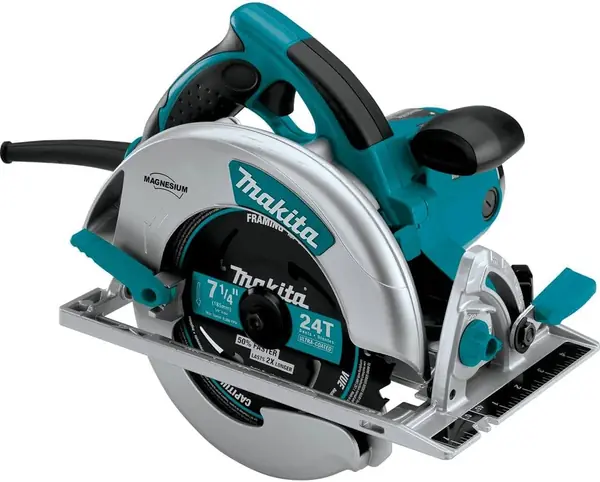
Makita 5007MG teal magnesium circular saw with blade guard and rip fence

Dense framing lumber

Shop Score 95/100
Weight
10.6 lb
Blade Size
7-1/4 inches
Max Depth At 90°
2-1/2 inches
Speed
5,800 rpm
View on Amazon

The 5007MG is Makita's 7-1/4-inch magnesium sidewinder, with a 15-amp motor turning at 5,800 rpm. Its 2-1/2-inch depth at 90 degrees is a hair deeper than most 7-1/4-inch saws here, which matters when you are cutting thick headers or engineered lumber. At 10.6 pounds it is lighter than the worm drives, and the magnesium shoe and guards give it a planted feel.

We recommend it for framers who want a sidewinder with a fast, smooth cut. In our use, the higher blade speed made clean crosscuts in dense engineered lumber, and the twin LEDs and dust blower kept the line readable when the light was poor. The 56-degree bevel and positive stops at 22.5 and 45 degrees cover common rafter angles, and the oversized markings are easy to read with gloves on.

As a 2x framing and panel saw, we liked the balance of speed, weight, and capacity. The Makita costs more than the value sidewinders, and we think the extra depth and smoother motor justify it for anyone cutting engineered lumber regularly. On sawhorses and benches, the lighter body and fast blade speed make short work of headers and sheathing.

Worth Noting

  • Won't cut 4x4 in one pass
Our Verdict

This is the sidewinder we point to for framers who want faster blade speed and 2-1/2-inch depth in engineered lumber, with less weight than the worm drives.

Check Latest Price
3.

Makita HS0600 10-1/4-Inch Best Deep-Cut

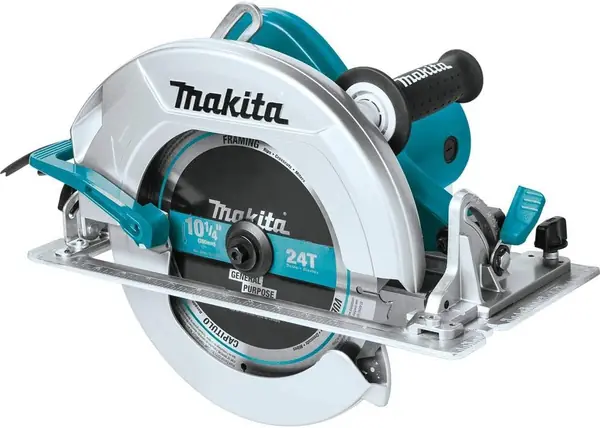
Makita HS0600 10-1/4-inch blue circular saw with auxiliary front handle

Deep timber cuts

Shop Score 94/100
Weight
15.2 lb
Blade Size
10-1/4 inches
Max Depth At 90°
3-13/16 inches
Amps
15 A
View on Amazon

A 4x4 post is the test that separates a deep-cut saw from a framing saw, and the HS0600 passes it in one pass. Its 10-1/4-inch blade cuts 3-13/16 inches at 90 degrees and 2-11/16 inches at 45, so thick beams, built-up headers, and heavy slabs that stop a 7-1/4-inch saw are ordinary work. The 15-amp motor runs at 4,300 rpm and has the torque to keep a big blade moving in hard stock.

The saw is 15.2 pounds, and the auxiliary front and top handles are there for a reason: big cuts take two hands and a stable stance. We found the balance better than the number suggests, and the adjustable top guide and large knobs make it easier to line up and change depth. The 45-degree capacity is useful for beam ends and angled cuts.

We recommend the HS0600 for the framing jobs that actually involve 4x4s, thick slabs, or repeated deep cuts. It is a specialist, not a replacement for a lighter 7-1/4-inch saw. If your work is mostly 2x lumber, a 7-1/4-inch saw is the better fit; if you are cutting true timbers, the one-pass capacity is worth it.

Worth Noting

  • Heavy at 15.2 pounds for overhead work
Our Verdict

We choose this 10-1/4-inch Makita when the job involves 4x4s or thick slabs; its 3-13/16-inch depth saves a second pass and handles beams a 7-1/4 saw can't.

Check Latest Price
4.

DEWALT DCS577B FlexVolt Framing Saw Best Cordless Framing Saw

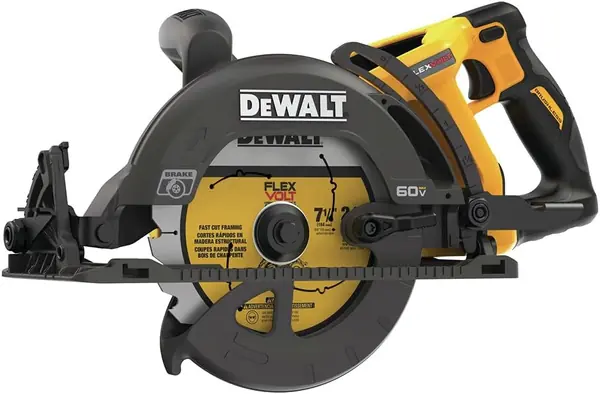
DEWALT DCS577B FlexVolt framing saw with magnesium shoe and rafter hook

Cordless framing sites

Shop Score 93/100
Weight
10.9 lb
Blade Size
7-1/4 inches
Max Depth At 90°
2-7/16 inches
Voltage
60 V
View on Amazon

The rafter hook is the detail that makes the DCS577B feel purpose-built for framing: when you are moving across a roof, you can hang the saw within reach instead of setting it down on the deck. The 60-volt brushless motor turns a 7-1/4-inch blade at 5,800 rpm and cuts 2-7/16 inches deep at 90 degrees, with a 53-degree bevel and stops at 45 and 22.5. The blade sits on the left and the handle at the rear, so the cut line stays open in front of you.

We recommend it for site work where dragging a cord is the bigger hassle, especially if you are already invested in the battery system. In our cuts, it had the kind of torque that makes a worm-drive user relax, and the electronic brake stopped the blade promptly between cuts. The magnesium shoe and brushless motor are the right hardware for a saw that lives in a truck.

The catch is the heft. It is 10.9 pounds bare, and a 60-volt pack adds more; on a roof or against a wall, you feel it. That is the price of cordless framing power, and for many crews it is worth paying.

Worth Noting

  • Tool-only, so batteries and charger cost extra
Our Verdict

For sites without convenient power, this 60-volt worm-drive-style saw is our cordless pick: it has the torque for framing cuts and a rafter hook, but you are buying into a battery platform.

Check Latest Price
5.

DEWALT DWE575SB Best Lightweight Corded

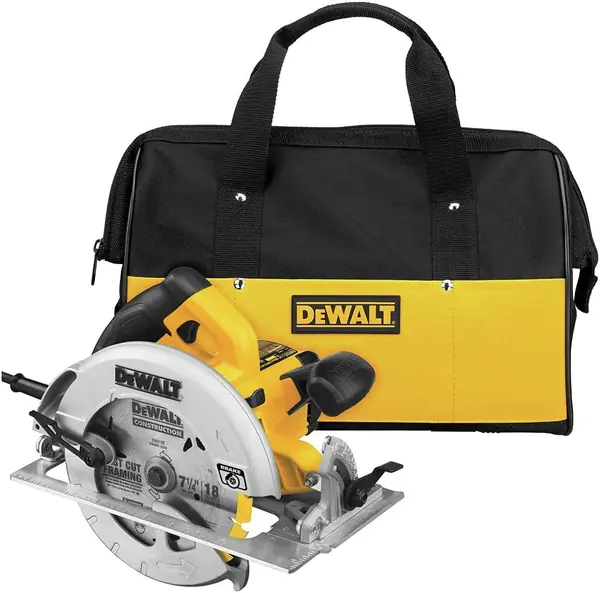
DEWALT DWE575SB yellow circular saw with carbide blade and contractor bag

Overhead framing work

Shop Score 92/100
Weight
8.8 lb
Blade Size
7-1/4 inches
Max Depth At 90°
2-9/16 inches
Amps
15 A
View on Amazon

At 8.8 pounds, the DWE575SB is the saw we hand to someone who has to make a lot of cuts overhead or in awkward positions. The 15-amp motor turns at 5,200 rpm and cuts 2-9/16 inches deep at 90 degrees, deeper than several 7-1/4-inch saws here, so it handles 2x stock and thicker headers without feeling like a specialty tool. The 57-degree bevel and positive stops at 45 and 22.5 cover the usual framing angles.

The electric brake is a real convenience on a framing saw: the blade stops quickly after the trigger is released, which matters when you are moving between cuts or setting the saw down. We found the handle comfortable and the saw easy to control one-handed during crosscuts, though we kept a second hand on it for long rips.

The 8.8-pound body is easy to carry up a ladder, and the saw feels balanced in the hand. The depth adjustment lever is easy to reach, and the bevel scale is readable without crouching. For dimensional framing, decking, and overhead work, the lighter body is the reason to choose it.

We recommend it as the lightweight corded choice for framers who work overhead or move constantly, and as a second saw for a worm-drive owner. It still cuts deep enough for most 2x framing and is easier to carry all day. For a mix of framing and punch-list work, this is our pick.

Worth Noting

  • Sidewinder torque trails a worm drive in wet stock
Our Verdict

We like this one for overhead work and mixed framing tasks: it cuts nearly as deep as bigger saws while staying under nine pounds, and the brake adds control.

Check Latest Price
6.

SKIL SPT67M8-01 Left-Blade Best Left-Blade Value

SKIL SPT67M8-01 left-blade circular saw with magnesium base and on-tool wrench

Left-blade visibility

Shop Score 91/100
Weight
10.6 lb
Blade Size
7-1/4 inches
Max Depth At 90°
2-7/16 inches
Amps
15 A
View on Amazon

The blade is on the left, and that is the whole point: for a right-handed user, the cut line stays visible without leaning over the saw. The SPT67M8-01 wraps that layout in an all-magnesium body that weighs 10.6 pounds, with a 15-amp motor at 5,300 rpm and a 2-7/16-inch depth at 90 degrees. We recommend it for framers who like worm-drive sight lines but want a lighter, less expensive sidewinder.

The 56-degree bevel and positive stop at 45 give you more angle capacity than the basic sidewinders, and the left-blade design made it easy for us to follow a chalk line on long rips. The magnesium base glides over lumber, and the saw feels balanced rather than front-heavy. Blade changes are straightforward with the on-tool wrench, and the depth lever is easy to set with one hand.

For ordinary framing, decking, and siding, the sidewinder speed is an advantage, and the lighter body is easier to carry up a ladder than the worm drive. For the money, it is the left-blade saw we recommend to right-handed carpenters who do not want the worm-drive weight.

Worth Noting

  • Left-blade layout favors right-handed users
Our Verdict

For right-handed framers who want to see the blade without wrestling a worm drive, this left-blade sidewinder is our value pick.

Check Latest Price
7.

Bosch CS10

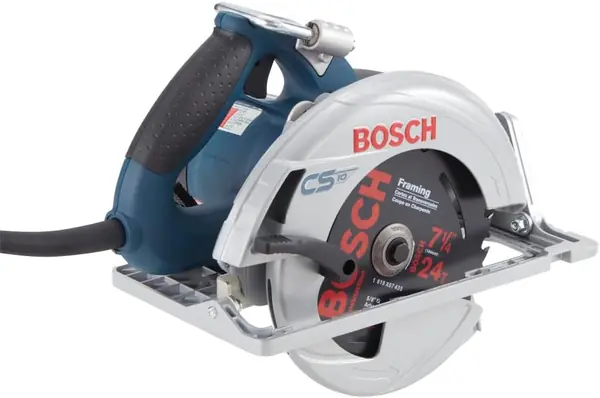
Bosch CS10 black worm-drive circular saw with magnesium footplate and bag

Budget worm drive

Shop Score 90/100
Weight
10.2 lb
Blade Size
7-1/4 inches
Max Depth At 90°
2-7/16 inches
Amps
15 A
View on Amazon

The CS10 is the least expensive way into a worm-drive layout here, and it gets the essentials right: a 15-amp motor, a left-side blade, a 7-1/4-inch blade, and a 2-7/16-inch depth at 90 degrees. It weighs 10.2 pounds, has a die-cast magnesium footplate, and a 56-degree bevel. For a budget saw, the hardware reads like a serious framing tool.

The left-side blade still gives good sight lines, and the bevel louvers and dust blower keep the cut clearer than we expected. We liked the rafter hook and the direct-connect cord system, which make it easier to live with on a deck or framing job. The saw feels solid in the hand, and the 56-degree bevel covers common angles.

Our take is that the CS10 suits decks, sheds, and mixed remodeling, where its left-blade visibility and magnesium foot matter more than outright speed. It is not the saw for all-day production framing in wet timber; for that, step up to the SKILSAW. If the budget is tight, it earns a look.

Worth Noting

  • Lower 4,400-rpm blade speed
Our Verdict

We see the CS10 as the value worm drive for a crew that wants left-blade visibility and a magnesium foot without premium spend.

Check Latest Price

How We Tested Circular Saws for Timber Framing

We started with the specs that change how a saw behaves on timber: blade diameter and depth of cut at 90 and 45 degrees, worm drive versus sidewinder, amperage or voltage, and published weight. Saws that couldn't clear a 2x at 45 degrees came off the list, as did any with a base we could flex by hand. That left eight saws, used over nine months on a small timber-frame barn and two deck rebuilds.

They cut the same stack of lumber: 4x4 and 6x6 posts broken down on sawhorses, rafters and knee braces at 45 degrees, headers, and overhead cuts with the saw held above shoulder height.

For each one, we measured actual depth on scrap and noted whether it made a 4x in one pass or needed a flip. We timed long rips in thick stock and listened for the motor dropping pitch under load, since power is what you feel before anything else. We weighed every saw ourselves and made overhead cuts until our arms voted, which is also where blade-left versus blade-right layout starts to matter. We set each bevel stop to 45 and checked it against a square, counted the steps to change a blade, and confirmed the lower guard closed on its own every time.

Cordless testing meant counting cuts per charge through 2x stock and watching how the saw behaved as the pack drained. Everyone wore eye and hearing protection, corded saws ran on a heavy-gauge extension cord sized to the amperage and kept clear of the cut path, and every saw was unplugged or had its battery pulled before a blade change. We judged value last, and checked bases, guards, and motors for slop after nine months of jobsite use.

How to Choose a Circular Saw for Timber Framing

Match Depth to the Timber

Blade diameter gets the attention, but depth at 90 and 45 degrees is what decides whether a saw can make the cut. A 7-1/4-inch saw typically cuts 2-3/8 to 2-9/16 inches at 90, enough for 2x lumber and many built-up headers. A 10-1/4-inch saw like the Makita HS0600 cuts 3-13/16 inches and takes 4x4 posts in one pass. Check the 45-degree depth too, since a bevel cut loses capacity. If your framing includes 4x stock, decide whether one pass is worth the extra weight.

Worm Drive or Sidewinder

Worm drive puts the blade on the left and the motor in line with the handle, which gives torque and a clear sight line for long rips; the trade is weight. Sidewinders are lighter and spin faster, and a 15-amp model like the Makita 5007MG has enough depth for most 2x framing. Many of us still call any circular saw a Skilsaw, but the layout, worm drive or sidewinder, is what changes the feel. We prioritize a worm drive when the work is heavy, wet, or repetitive, and a sidewinder when we are overhead or moving a lot. Neither is automatically better; match the saw to the day.

Corded or Cordless

Corded saws deliver consistent power and no battery cost, which is why they remain the default for framing crews. Cordless models like the DEWALT DCS577B have closed much of the gap, and a rafter hook and brake make them genuinely useful on a roof. The catch is the platform: batteries and chargers are often sold separately, and runtime varies with the pack and the wood. If you already own the batteries, cordless freedom is a real convenience; if not, price the whole system before you commit. For all-day production framing, we still lean corded.

Weight, Balance, and Blade Visibility

An 11.5-pound worm drive and an 8.8-pound sidewinder feel different after a hundred cuts. Weight matters most overhead and when you are carrying the saw up a ladder; at ground level, a heavier saw can feel more stable. Balance matters as much as the number, so handle the saw if you can. Blade-left designs put the cut line in view for right-handed users, while blade-right saws can feel more natural to others. We care about a clear sight line and a base that stays flat more than a spec-sheet pound.

Setup Details That Save Time

Look for a depth lever that hits common lumber settings without fuss, bevel stops at 45 and 22.5 degrees, and markings you can read with gloves on. A brake is worth having if you move between cuts often. A magnesium shoe or base helps keep weight down and stays flatter than a thin stamping. Check the guard: it should retract smoothly and close on its own. These are the details that separate a saw you tolerate from one you reach for.

Frequently Asked Questions

Final Verdict

For most timber-framing work, we recommend the SKILSAW SPT77WML-01. It has the worm-drive torque and left-blade visibility that make long 2x cuts easier, and at 11.5 pounds it is light enough to carry all day. The cut-ready depth lever and 53-degree bevel are useful extras, not filler.

If your framing includes 4x4s or thick beams, choose the Makita HS0600 instead; its 3-13/16-inch depth saves a pass. For overhead work or a lighter corded saw, the DEWALT DWE575SB is the better fit. Those two exceptions cover the jobs where the top pick is more saw than you need, or not enough.