↑↓ navigate ↵ open Esc close All results →

Best Cordless Reciprocating Saws of 2026

Demolition and rough pruning demand brute cutting power in awkward positions, yet a heavy two-handed saw wears out quickly overhead while a compact one-handed body gives up stroke length. Choosing a cordless reciprocating saw turns on balancing reach, vibration, and an existing battery platform.

Cutting framing lumber, PVC pipe, metal conduit, and overgrown maple limbs across eight months with 12 saws proved that blade-clamp ergonomics with gloves on and handle comfort after multiple overhead cuts matter more than catalog numbers. Because most units ship bare, existing batteries often decide the smartest buy, while stroke length splits fast lumber demolition from controlled metal cuts.

Spanning full-size demo saws, compact one-handed models for tight cabinet bays, and a value kit with battery and charger, all seven keep blades locked tight and shoes firmly braced.

Our Top Picks

The Best Cordless Reciprocating Saws

1.

DEWALT 20V MAX XR DCS367B Best Overall
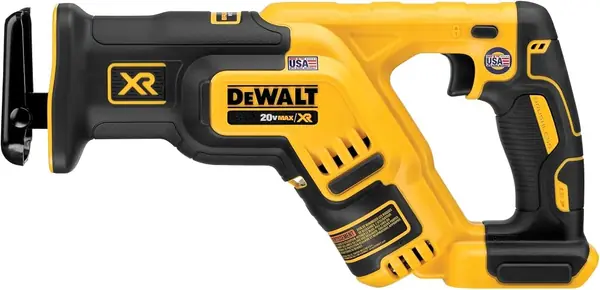
DEWALT 20V MAX XR DCS367B cordless reciprocating saw in black with keyless blade clamp

Framing and demolition

Shop Score 97/100
Weight
5.4 lb (tool only)
Speed
Up to 2,900 spm
Length
14.5 in.
Stroke Length
1-1/8 in.
View on Amazon

Fourteen and a half inches is short for a full-size reciprocating saw, and that number is most of the reason the DCS367B is our top pick. It slips between studs and into a cabinet base, and there is still enough body to keep both hands on it when a blade binds. The brushless motor drives a 1-1/8-inch stroke at up to 2,900 strokes per minute, and the variable trigger lets you start slow in drywall and lean on it in framing lumber.

The four-position keyless clamp is the detail we appreciate most: turn the blade sideways and you can run a flush cut along a floor plate without fighting the shoe. At 5.4 pounds bare it steadies itself in a cut and stays manageable overhead for short stretches, though a full morning of ceiling work favors the one-hander next on this list. The LED is bright enough to light a cabinet interior, and a three-year limited warranty backs the tool.

Battery capacity is the one thing we plan around. A 5.0Ah pack and a charged spare carry it through a demolition afternoon, while the compact packs that arrive with drill kits fade under continuous load. Stroke length is where it gives ground to the Makita XRJ04Z, 1-1/8 inches against 1-1/4, a gap you feel in wet, stringy wood more than in clean framing.

Worth Noting

  • Bare tool; battery and charger cost extra
Our Verdict

Our default for most buyers: a short brushless body that handles framing, PVC, and demolition, provided you already run 20V MAX packs.

Check Latest Price
2.

DEWALT ATOMIC DCS369B Best for Tight Spaces

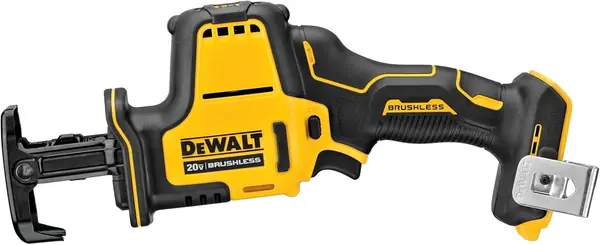
DEWALT ATOMIC DCS369B one-handed cordless reciprocating saw in black with belt hook

Tight overhead cuts

Shop Score 96/100
Weight
3.13 lb (tool only)
Speed
Up to 2,800 spm
Length
12.5 in.
Included
Two blades and belt hook
View on Amazon

Cutting a closet flange out of a cabinet base usually means one hand on the saw and the other steadying the panel, and that is the job the DCS369B was built for. Twelve and a half inches front to back, 3.13 pounds bare, and a grip shaped so the saw balances in one palm. DEWALT builds it 37 percent lighter than the DCS367B, and you feel that the first time you raise it over your head.

We're pleasantly surprised by how much the belt hook earns its place: clip the saw to a pouch and it is exactly where you left it on a ladder. The brushless motor runs to 2,800 strokes per minute, the tool-free blade release takes a second, and the pivoting shoe keeps the blade seated as you follow a line. Two blades come in the box, which is more than most bare tools here include.

What we like most is that it doesn't pretend to be the big saw. Where a full-size body physically won't fit, between joists, inside a cabinet, above a ceiling grid, this one does the cutting, and the 20V MAX packs you already own on a drill cover it. In a small shop it can be the only reciprocating saw you keep.

Worth Noting

  • One-handed grip limits heavy demolition cuts
Our Verdict

We reach for this when a full-size body won't fit: 3.13 pounds, 12.5 inches long, and controllable in one hand.

Check Latest Price
3.

Milwaukee M18 FUEL Hackzall 2719-20 Best One-Handed Power

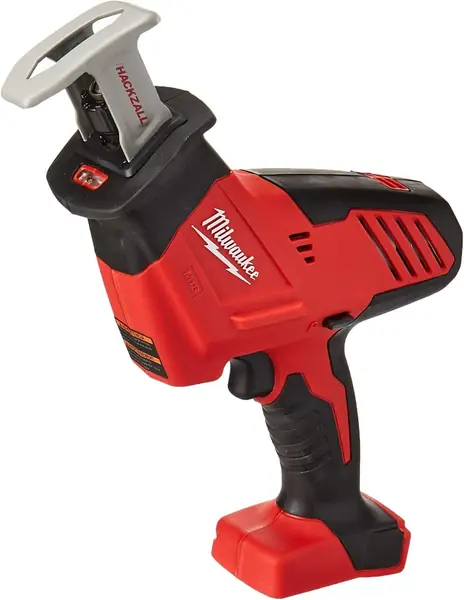
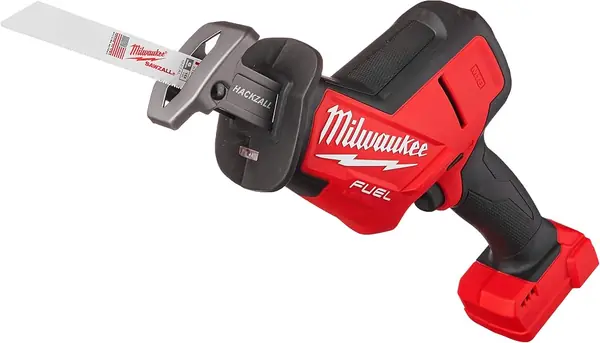
Milwaukee M18 FUEL Hackzall 2719-20 cordless one-handed saw in red and black

One-handed power

Shop Score 95/100
Weight
3.97 lb
Stroke Length
7/8 in.
Battery Platform
M18 18V
Motor
POWERSTATE brushless
View on Amazon

Seven-eighths of an inch is a short stroke next to the 1-1/8- and 1-1/4-inch saws here, and in one hand it doesn't feel short at all. The M18 FUEL Hackzall pairs that stroke with a POWERSTATE brushless motor and a counterweighted drive, and Milwaukee rates the vibration up to four times lower than competitive one-handed saws. What we noticed on overhead cuts is that our hands weren't buzzing afterward.

The layout is the real argument for it. At 3.97 pounds the saw hangs level in your hand, the trigger falls under your index finger, and the pivoting shoe keeps the blade in the kerf when you are working above your shoulder. REDLINK Plus electronics throttle the motor when it loads up, which protects the tool rather than the cut when you push it through cast iron or a nail-embedded stud.

Durability is the open question. In daily professional use some of these saws quit well inside a year, and a truck is where that risk lives; a homeowner, or a trade that rotates through several saws, never gets near it. On cutting speed, nothing else here touches it.

Worth Noting

  • Bare tool; M18 battery sold separately
Our Verdict

For one-handed cutting speed, this is our pick: a 7/8-inch stroke, low vibration, and a body that hangs level overhead.

Check Latest Price
4.

Makita 18V LXT XRJ04Z Best Long-Stroke Cutting

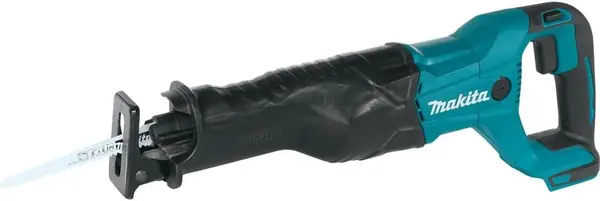
Makita XRJ04Z 18V LXT cordless recipro saw in blue with tool-less blade clamp

Long lumber cuts

Shop Score 94/100
Weight
8.3 lb with battery
Speed
0-2,800 spm
Length
19-1/8 in.
Stroke Length
1-1/4 in.
View on Amazon

Makita calls this a recipro saw, and the name fits: one and a quarter inches of stroke is the longest in this group, and it is why we choose it for long cuts in lumber and thick PVC. Every stroke clears more material from the kerf, so rips through studs and fence rails move faster than they do with the shorter-stroke saws here. A 0 to 2,800 spm variable trigger and a big two-finger switch give fine control at the low end for starting a cut without skipping.

Blade changes are the other thing Makita gets right. The tool-less clamp has a spring that kicks the blade out, so you aren't pulling on a hot piece of steel after a metal cut, and the refined crank is designed to cut down blade deflection, which is what keeps a line straight when you lean on the saw.

The trade is bulk. At 19-1/8 inches long this is a two-handed, full-size tool, and on a ladder or inside a cabinet it is the wrong saw; the compact DEWALTs are the picks for those jobs. On a bench, a fence line, or a stack of studs, the long stroke pays you back in cut speed.

Worth Noting

  • 8.3 lb with a battery is the heaviest here
Our Verdict

If most of your cutting is long and straight, the 1-1/4-inch stroke here is worth the extra weight and the two-handed stance.

Check Latest Price
5.

BLACK+DECKER 20V MAX BDCR20C Best Budget Kit

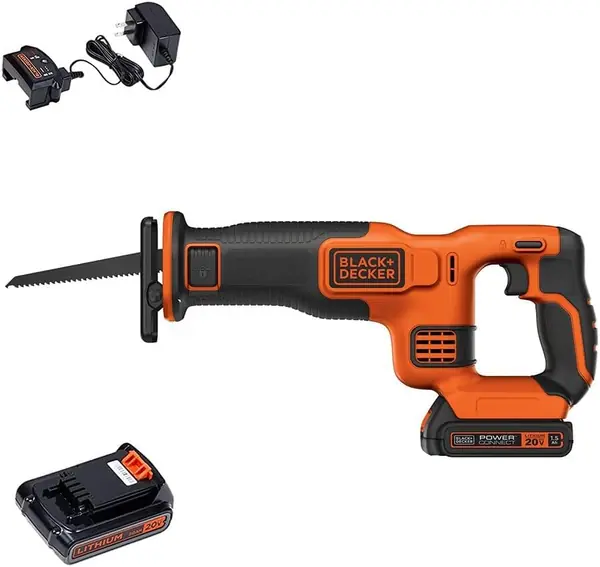
BLACK+DECKER BDCR20C 20V MAX reciprocating saw kit with battery and charger

Occasional home cutting

Shop Score 93/100
Weight
4.5 lb
Speed
Up to 3,000 spm
Blade Change
Tool-free
In The Box
Battery, charger, and blade
View on Amazon

A battery, a charger, and a blade come in the box, the only complete kit on this list, and that single fact is why this is our budget pick. Everything else here is a bare tool, so the BLACK+DECKER is the one you can buy for a household with no battery platform and have cutting the same afternoon.

The saw is more capable than the price suggests: 3,000 strokes per minute, a variable trigger, tool-free blade changes, a pivoting shoe, and an electric brake that stops the blade the moment you let go. At 4.5 pounds it is light enough to carry up a ladder with a pruning blade fitted, and the shoe rides a limb instead of chattering off it.

We wondered whether a saw this cheap would feel disposable, and it doesn't. The plastics are plain and the grip is basic, but nothing rattles in the hand, and a two-year limited warranty covers the tool. If your cutting is measured in weekends rather than hours, this is where the money goes furthest, and it is the saw we hand to someone who wants the bushes trimmed and a couple of PVC pipes cut without thinking about batteries.

Worth Noting

  • Included battery drains under continuous cutting
Our Verdict

The one we point to when you own no batteries yet: a complete, easy-handling kit for pruning, PVC, and weekend demo.

Check Latest Price
6.

RYOBI ONE+ PCL515B Best for Light Yard Work

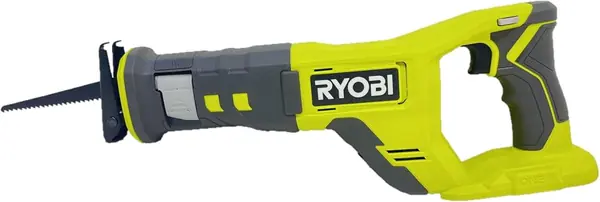
RYOBI ONE+ PCL515B 18V cordless reciprocating saw in green without battery

Light yard work

Shop Score 92/100
Weight
3.8 lb
Speed
3,400 SPM
Length
16 in.
Stroke Length
1 in.
View on Amazon

This is the least expensive bare tool in the group, and nothing on the spec list reads like a sacrifice: 3,400 strokes per minute is the highest top speed here, the stroke is a full inch, and the saw weighs 3.8 pounds. If ONE+ batteries are already on your shelf from a drill or a trimmer, the math is hard to argue with.

We paid close attention to the small stuff on a saw this cheap: the blade clamp is tool-free, the shoe pivots, and there is a proper lock-off switch, all in a 16-inch body that stows in a bag beside two or three blades. The high stroke count makes quick work of thin branches and PVC, and one ONE+ battery set covers the saw, the trimmer, and the drill.

We wish the warranty ran longer than 30 days. It is the shortest here by a wide margin, and it tells you what kind of tool this is meant to be: worn out after a season of hard use is a real outcome, while a few cuts a month on a shed, a fence line, and some pipe leaves plenty of saw for the least money here.

Worth Noting

  • Bare tool; ONE+ battery not included
Our Verdict

A strong value if ONE+ batteries are already on your shelf, and a light, fast saw for branches, PVC, and light demo.

Check Latest Price
7.

Milwaukee M18 Hackzall 2625-20 Best for Budget M18 Owners

Milwaukee M18 Hackzall 2625-20 cordless reciprocating saw in red with Quik-Lok latch

Budget M18 owners

Shop Score 91/100
Weight
4 lb
Length
13.39 in.
Blade Change
Quik-Lok keyless
Battery Platform
M18 18V
View on Amazon

The 2625-20 is the older of the two Milwaukee one-handers, and it is still the least expensive way to put an M18 saw in your hand. Four pounds, 13.39 inches long, and it runs on the same M18 packs as the drill and impact you may already own.

What it brings is comfort: an anti-vibration handle that keeps the saw from beating up your wrist over a long cut, a Quik-Lok latch that changes blades in a second, and an LED that lights the line inside a cabinet. Wood, PVC, and light metal are its everyday work, and it handles all three without complaint.

Durability is the open question. Months of daily professional use is where this saw gets shaky, and a truck is the wrong home for it; a homeowner who cuts a few times a month never gets near that point, which makes the risk a small one for garage work.

The five-year tool warranty is the longest here, and we think it is the right way to read this saw: a comfortable, inexpensive M18 body that Milwaukee stands behind, sold to people who cut a few times a month rather than every day.

Worth Noting

  • Slower in cast iron and thick wet lumber
Our Verdict

Milwaukee's five-year tool warranty and a four-pound body make this the sensible first M18 one-hander for a garage shelf.

Check Latest Price

How We Tested Cordless Reciprocating Saws

We started the shortlist with every current cordless reciprocating saw we could buy from the major battery platforms, then filtered on what this category actually turns on: stroke length, strokes per minute, one- or two-handed layout, blade clamp and shoe adjustment, and whether the saw arrives bare or as a kit with a battery and charger. That left 12 saws, which we ran for eight months.

Testing happened in a basement we were finishing, a garage, and a backyard that had gotten away from us. We timed cuts through framing lumber and thick stock, worked through PVC and metal conduit, and broke down pallets. For flush cuts we laid the shoe flat on a floor and watched how far the blade wandered; overhead, we cut into stud bays after checking each cavity for wiring and plumbing. Safety glasses and hearing protection stayed on the whole time, both hands on the full-size saws, and one hand only on the compact models built for it.

Between cuts we paid attention to the small stuff. We swapped blades in work gloves and counted the fumbles, checked whether the shoe moved when we reset it, and noted any blade slip under load. Battery life we logged as cuts per charge rather than minutes, running each pack until it quit, and we weighed every saw on a kitchen scale. A long run of repeated cuts back to back showed us which handles went numb first, and we let the blade stop before setting a saw down every time, since the blade stays exposed. Durability we judged by how clamps, shoes, and housings looked after months of use, and by what each warranty actually covers.

How to Choose a Cordless Reciprocating Saw

One hand or two?

Compact one-handers run about 12 to 14 inches and 3 to 4 pounds; full-size saws start around 14.5 inches and 5 pounds and climb past 8 pounds with a battery aboard. A one-hander reaches into cabinets, joist bays, and above a ceiling grid; a full-size saw is steadier for long cuts and heavy demolition.

Watch the word compact in a listing. On a full-size body it usually means the saw fits between studs, not that you can run it with one hand. Measure the tightest spot you plan to cut in and buy for that.

What stroke length buys you

Stroke is how far the blade travels on each pass. A 1-1/8- or 1-1/4-inch stroke clears chips out of the kerf and cuts fast in framing lumber, fence rails, and thick PVC; the Makita XRJ04Z's 1-1/4 inches is the longest here. A 7/8- or 1-inch stroke gives up some speed in wood and gains control in pipe, sheet metal, and plunge cuts.

Cut mostly wood and demolition? Go long. Cut mostly pipe and metal? A shorter stroke in a lighter body is easier to steer, and it is less likely to grab.

The battery is half the purchase

Most saws here are bare tools, and a reciprocating saw is one of the thirstier tools on any platform, so a 4.0Ah or 5.0Ah pack is the sensible match rather than the compact pack that came with a drill. If you already own 20V MAX, M18, LXT, or ONE+ batteries, buy the bare tool and put the difference into a larger pack.

If you own nothing, a kit like the BLACK+DECKER BDCR20C beats buying a body, a battery, and a charger separately, and it is the only way to start cutting the day it arrives.

Clamps and shoes you touch every cut

Blade changes should take seconds. Look for a keyless lever, twist, or Quik-Lok latch rather than a hex key, and check whether the clamp has multiple positions: the four-position clamp on the DEWALT DCS367B lets you turn the blade sideways for flush cuts along a floor plate.

A pivoting shoe keeps the blade seated and controls depth so you don't open a wall cavity you meant to leave alone. These are the parts you handle on every cut, so they matter more than a wattage figure.

Weight and vibration over a long cut

Eight pounds sounds fine until the saw is over your head. Vibration matters just as much: a rough-running saw leaves your hands buzzing after a long cut, and the brushless models here run smoother than the budget saws.

If most of your work is overhead, in a cabinet, or on a ladder, buy light and smooth. If it happens on a bench or a fence line, weight steadies the cut and the extra mass is worth carrying.

Frequently Asked Questions

Final Verdict

The DEWALT DCS367B is the saw we recommend to most people. A 14.5-inch brushless body fits between studs, the four-position clamp handles flush cuts, and there is enough weight to stay steady in demolition; the one demand it makes is a 5.0Ah pack rather than the small batteries that come with drill kits.

If most of your cutting happens overhead or inside cabinets, the one-handed DEWALT ATOMIC DCS369B is the better fit, and if you own no batteries at all, start with the BLACK+DECKER kit and add a full-size saw later.