↑↓ navigate ↵ open Esc close All results →

Best DeWalt Reciprocating Saws of 2026

Choosing a reciprocating saw comes down to where you are standing when something has to come apart—a rusted sink drain, a nail-studded wall, or a root blocking a fence post. Corded saws deliver steady, uninterrupted muscle for heavy demolition, whereas 20V cordless models let you climb into tight bays without dragging an extension cord behind you.

Cutting pipe, studs, and nail-embedded lumber with 11 saws over nine months of a bathroom gut and deck teardown put that trade-off in sharp relief. Overhead work quickly exposes how a three-pound one-hander compares to a six-pound full-size saw in your shoulder the next morning, and first-time buyers often overlook that most models ship as bare tools without batteries.

Small hardware details save time too, from four-way keyless blade clamps and tool-free adjustable shoes to brushless motors that stretch pack runtime. From heavy framing demolition to one-handed cuts inside a cabinet, matching the saw class to the clearance and power you actually need matters more than chasing raw stroke length.

Our Top Picks

The Best DeWalt Reciprocating Saws

1.

DeWalt 20V MAX XR DCS367B Best Overall
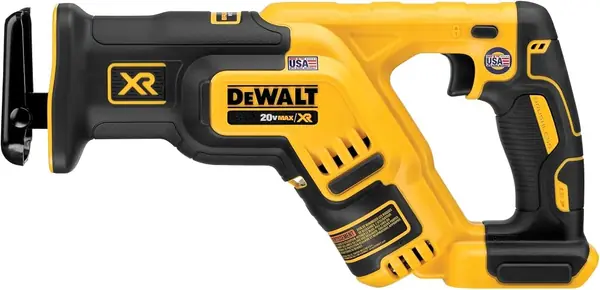
DeWalt DCS367B 20V MAX XR compact reciprocating saw with black body

All-around remodeling

Shop Score 98/100
Blade Clamp
4-position keyless
Power Source
20V MAX battery (tool only)
Weight
5.4 lb
Length
14.5 in.
View on Amazon

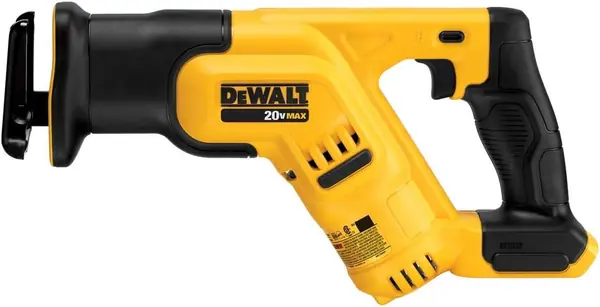
Between studs and inside a cabinet carcass, a full-size reciprocating saw is often the wrong shape. The DCS367B's 14.5-inch body is short enough to fit those openings, and its 1-1/8-inch stroke still gives the blade enough travel to clear chips and cut quickly.

We recommend it as the best all-around DeWalt recip in this guide for most 20V users. The brushless motor and 2,900-SPM top speed give it enough muscle for framing cuts and light demolition, while the compact body still fits where a full-size saw will not. It is a two-handed saw, and at 5.4 pounds it is not the one-handed Atomic, but that is the right trade for its power.

What we kept coming back to was the four-position keyless clamp: turning the blade for a flush cut takes a second, and that detail saves a trip back to the truck. The pivoting head does the same for starting a cut on an uneven surface, and the LED helps when the work is inside a cabinet. For anyone already on the 20V MAX platform, this is the saw that covers the most jobs.

Worth Noting

  • Battery and charger sold separately
Our Verdict

For most DeWalt 20V users, the DCS367B is the best all-around recip here: compact for stud bays, strong for routine demolition, and easy to control.

Check Latest Price
2.

DeWalt Atomic DCS369B Best One-Handed

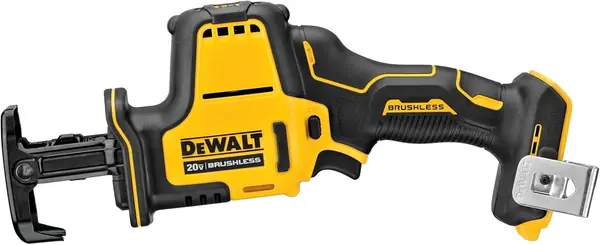
DeWalt Atomic DCS369B one-handed reciprocating saw with blade and belt hook

One-handed cuts

Shop Score 97/100
Blade Clamp
Tool-free
Power Source
20V MAX battery (tool only)
Weight
3.13 lb
Length
12.5 in.
View on Amazon

At 3.13 pounds, the Atomic DCS369B is the saw we reach for when a cut is above shoulder height or inside a cabinet. It earns the one-handed slot in this guide: the 12.5-inch body and tool-free blade release make it easy to position and reload, and the brushless motor keeps it from feeling toy-like.

The trade-off is sustained power. It will cut drywall, PVC, pruning, and quick framing cuts without complaint, but it does not match a full-size saw in thick, wet lumber or all-day demolition. For the homeowner or remodeler who needs a second saw for tight spots, that is a fair exchange. The compact body is also easier to control at the end of a long reach, which matters more than raw speed in overhead work.

We also liked the included belt hook, which keeps the saw close when you are moving around a ladder or a jobsite. The two included blades get you started, but plan on buying the right blade for your material; the saw is only as good as what you put in the clamp. For a one-handed tool, the balance is what makes it feel more secure in a tight spot.

Worth Noting

  • Tool only; battery and charger extra
Our Verdict

Buy the Atomic DCS369B when you need to cut overhead or in tight spots with one hand; it trades some power for remarkable control.

Check Latest Price
3.

DeWalt DWE305 Best Corded

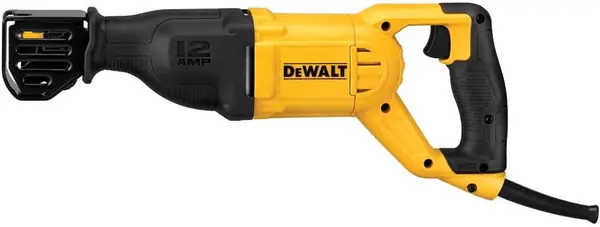
DeWalt DWE305 corded reciprocating saw in yellow with blade clamp

Heavy demolition

Shop Score 96/100
Blade Clamp
4-position keyless
Power Source
Corded electric
Motor
12 amp
Cutting Speed
2,900 SPM
View on Amazon

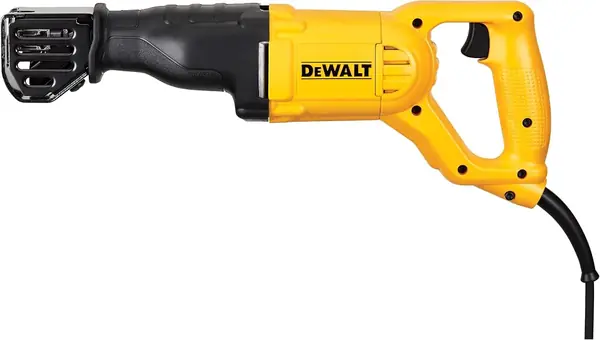
Corded saws still have one clear advantage: they do not ask you to stop and swap a battery in the middle of a demolition cut. The DWE305 uses a 12-amp motor and a 1-1/8-inch stroke to keep the blade moving through lumber, nail-embedded wood, and light metal. That steady power is why it remains the corded saw we recommend for heavy work.

The variable-speed trigger tops out at 2,900 SPM, and the four-position keyless clamp lets you turn the blade for flush cuts. We liked the lever-action clamp because it does not require a hex key when you switch from a wood blade to a metal blade. The rubber overmold gives you a secure grip when the cut gets noisy, and the long stroke clears chips instead of packing them in the kerf.

The DWE305 is our corded pick for heavy, stationary work: tearing out a deck, cutting pipe, or trimming brush near an outlet. It is not the saw for a roof or a fencerow, where a cord becomes a nuisance. For that kind of work, a 20V model is the better companion. The eight-pound body is a two-handed tool, but the weight helps steady the blade in long horizontal cuts.

Worth Noting

  • Corded design limits use away from an outlet
  • Eight-pound body requires two-handed operation
Our Verdict

The DWE305 is the corded pick for long demolition sessions and heavy materials, with steady 12-amp power and no battery anxiety.

Check Latest Price
4.

DeWalt 20V MAX DCS380B Best Full-Size Cordless

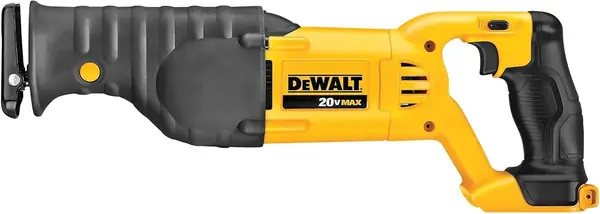
DeWalt DCS380B 20V MAX cordless reciprocating saw with pivoting shoe

Full-size cordless

Shop Score 95/100
Blade Clamp
4-position keyless
Power Source
20V MAX battery (tool only)
Cutting Speed
3,000 SPM
Shoe
Pivoting adjustable
View on Amazon

Three thousand strokes per minute is the number that sets the DCS380B apart from the compact 20V saws in this guide. It earns the full-size cordless slot for DeWalt users who want a fast top speed and a pivoting shoe; it is the cordless saw we choose when the cut is long and the material is thick.

The four-position keyless clamp gives you flush-cutting options, and the pivoting adjustable shoe lets you control depth and extend blade life. The variable-speed trigger is the other part of the story: you can start slow in metal and open it up in wood. The body is long enough to give you two-handed leverage without feeling like a specialty demolition tool.

The double oil-sealed shaft is designed to keep contamination out of the mechanism, which matters in demolition dust. That is the kind of detail we look for in a saw that will spend more time on rough framing than on finish work. For a full-size cordless saw, the balance is the thing that keeps you in control when the blade grabs.

Worth Noting

  • Tool only; battery and charger extra
Our Verdict

Choose the DCS380B if you want a traditional full-size cordless recip with a fast 3,000-SPM top speed and a pivoting shoe.

Check Latest Price
5.

DeWalt 20V MAX DCS387B Best Value Compact

DeWalt DCS387B compact 20V reciprocating saw with LED and blade clamp

Value compact work

Shop Score 94/100
Blade Clamp
4-position keyless
Power Source
20V MAX battery (tool only)
Weight
4.96 lb
Length
14 in.
View on Amazon

If you want the compact DeWalt shape without moving up to the XR model, the DCS387B is the obvious place to start. Its 14-inch body is built for cuts between studs, and the 1-1/8-inch stroke gives it the same cutting travel as the larger saws.

It is our value compact pick. You still get the four-position keyless clamp and a bright LED, and the 2,900-SPM top speed is quick enough for framing and trim. The DCS367B is the one with the brushless motor; the DCS387B is the lower-cost way into the same compact shape, and for many home projects that is the smarter buy. It is not the saw for all-day demolition, but it is enough for the repair work most of us actually do.

The LED is more useful than it sounds when you are working inside a cabinet or under a sink. The four-position clamp is the same practical detail: you can turn the blade for a flush cut without hunting for a tool. That combination is why it earns a spot even with the top pick in the same guide.

Worth Noting

  • Nearly five pounds for a compact saw
Our Verdict

The DCS387B gives you the compact 20V layout and four-position clamp for less money than our top pick, and it still handles trim and framing.

Check Latest Price
6.

DeWalt 20V MAX DCS382B

DeWalt DCS382B 20V MAX brushless reciprocating saw with black body

Brushless full-size

Shop Score 93/100
Blade Clamp
Twist-style keyless
Power Source
20V MAX battery (tool only)
Weight
5.9 lb
Motor
Brushless
View on Amazon

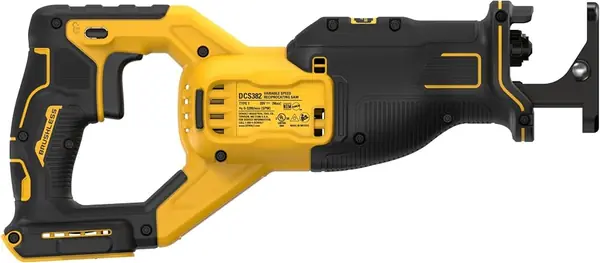
The DCS382B's two-finger trigger is the first thing you notice. It gives you a wider grip across the handle and a more controlled way to ramp the speed than a single-finger trigger, especially when you are starting a cut in metal or plastic.

The brushless motor is the other main draw. It is the sort of saw you choose for sustained cutting rather than a quick trim, and the 1-1/8-inch stroke gives it enough travel to clear chips. The twist-style keyless clamp is quick, though it is a different motion from the lever clamp on the other DeWalt saws here.

At 16 inches long and 5.9 pounds, it is a full-size saw, not a compact one. That extra length gives you reach and leverage, but it also makes it a two-handed tool for most cuts. The included blade gets you started; from there, match the blade to the material.

The DCS382B makes sense for DeWalt 20V users who want a brushless full-size saw and prefer the two-finger trigger. It is a solid choice, but it does not outrank the DCS380B for us or the DCS367B on compactness. If you are already in the 20V system and the trigger feels right in your hand, it is worth a look.

Worth Noting

  • Tool only; battery and charger extra
Our Verdict

Buy the DCS382B if you want a brushless full-size 20V saw with a two-finger trigger and twist-style clamp.

Check Latest Price
7.

DeWalt DWE304 Best for Light Corded Jobs

DeWalt DWE304 10-amp corded reciprocating saw with four-position clamp

Light corded jobs

Shop Score 92/100
Blade Clamp
4-position keyless
Power Source
Corded electric
Motor
10 amp
Cutting Speed
2,800 SPM
View on Amazon

Ten amps is the number that separates the DWE304 from the heavier corded saw in this guide. It still has a 1-1/8-inch stroke and a 2,800-SPM top speed, so it will cut wood, PVC, and light metal without drama.

The 7.3-pound body is easier to carry than the 12-amp DWE305, and the four-position keyless clamp gives you the same flush-cutting options. We liked the lever-action clamp for quick blade changes, especially when switching from a pruning blade to a wood blade. The lower weight also makes it less tiring for trimming work around the yard.

The DWE304 is our lighter corded alternative for trim work, pruning, and light demolition where you want corded power without the extra muscle of the DWE305. If you are cutting through nail-embedded lumber all afternoon, step up to the 12-amp saw. The four-position clamp is still the detail that makes it feel more versatile than a basic recip.

Worth Noting

  • Cord limits use away from outlets
Our Verdict

The DWE304 is the lighter corded alternative for trimming and light demolition, but its 10-amp motor gives up some muscle to the DWE305.

Check Latest Price

How We Tested the Best DeWalt Reciprocating Saws

We started by gathering every current DeWalt reciprocating saw we could get our hands on — corded and 20V cordless, one-handed compacts through full-size brushless models — and sorting them by power source, size class, blade clamp style, and what actually comes in the box. Because most of them ship as bare tools, we priced each saw the way a new buyer would: saw plus the batteries and charger needed to run it. That exercise reshuffled our shortlist more than once. Eleven saws made it into testing.

For nine months we used them the way a saw really gets used: tearing out a bathroom, pulling apart a deck, and cutting PVC, copper, and pressure-treated lumber to length. We timed repeated cuts in 2x10 stock and noted where a saw bogged down or wandered off the line, then counted how many cuts each cordless model finished on a single charge and how long that charge took to come back. We also ran overhead cuts until our arms gave out, which is the only honest way to judge weight, balance, and vibration.

Every blade change was done with the battery pulled or the cord unplugged, and we wore eye and hearing protection for every cut, clamping each workpiece before the blade went anywhere near it. Blade swaps were timed with work gloves on, since a clamp that fights you costs more time than the spec sheet suggests. We judged power by how the saw behaved in nail-embedded lumber rather than by its speed rating, and weighed each saw with a battery in it before deciding which ones were genuinely comfortable to run for an afternoon.

How to Choose a DeWalt Reciprocating Saw

Corded or Cordless: Match the Saw to the Outlet

A corded saw gives you constant power for long demolition cuts, and the DWE305 is the obvious example here: 12 amps, a 2,900-SPM top speed, and no battery to swap. A cordless 20V model is easier to carry up a ladder, but its runtime depends on the pack you own. The trap is treating a bare-tool price as the whole cost: a cordless saw without a battery and charger is not ready to cut, and a bigger pack adds runtime but also weight. If you already have 20V MAX batteries, a tool-only cordless saw is the lower-cost way in; if you are starting from zero, price the batteries and charger into the decision.

One-Handed vs. Full-Size: Match the Saw to the Cut

A one-handed saw like the Atomic DCS369B is built for overhead cuts, cabinet work, and tight spots; it is short and light enough to control with one hand. A full-size saw like the DCS380B or DCS382B gives you more leverage for framing and demolition, but it is a two-handed tool. The names can mislead: compact in a listing often means shorter front-to-back, not necessarily light enough for one-handed use. Check both length and weight before you choose. For most remodeling tasks, the DCS367B is the compact two-handed compromise we prefer, and if you regularly cut above your head, the Atomic is worth the trade in power.

Power, Stroke, and Speed: Read the Numbers Together

A reciprocating saw's cut comes from motor power, stroke length, and speed together. The 1-1/8-inch stroke is common across these saws, and it gives the blade enough travel to clear chips; the difference is how much muscle feeds it. Corded models use amps as shorthand: the 12-amp DWE305 has more reserve than the 10-amp DWE304 for heavy cuts. Cordless models rely on voltage and motor design, and a brushless motor is generally more efficient. Do not choose on SPM alone: a 3,000-SPM saw can be faster in wood, but blade choice and pressure matter just as much in metal.

Blade Clamp and Shoe: The Features That Save Time

A four-position keyless clamp lets you turn the blade for flush cuts and change it without a hex key, and every corded and cordless saw in this guide except the DCS382B uses that lever-style clamp. The DCS382B uses a twist-style clamp instead; both work, but the motion is different. A pivoting shoe lets you adjust how deep the blade enters the work and can extend blade life by keeping the shoe flat.

If you cut a lot of pipe or trim, the clamp matters more than the LED. The LED is useful in cabinets and crawlspaces, but a clamp that lets you turn the blade sideways is what gets you out of an awkward cut. A tool-free clamp is non-negotiable for us.

Battery, Weight, and Vibration: The Living-With-It Details

All the cordless saws here run on DeWalt's 20V MAX batteries, so the pack you already own can decide which saw makes sense. A compact pack keeps the saw lighter for overhead work; a larger pack adds runtime for long cuts but shifts the balance. Weight is not just a spec-sheet number: a 5.9-pound full-size saw feels very different from a 3.13-pound one-handed model at the end of a cut.

Vibration is the other thing you notice after a few minutes. A compact saw can shake more in tough material, while a heavier saw damps some of that but tires your arms. If you have hand or wrist fatigue, choose the lightest saw that still has enough power for your work, and let the blade do the cutting.

Frequently Asked Questions

Final Verdict

For most DeWalt 20V users, the DCS367B is the saw we recommend first. It is compact enough for stud bays, has the four-position clamp and pivoting head that make awkward cuts easier, and its brushless motor gives it more range than the one-handed Atomic.

If you work overhead all day, choose the Atomic DCS369B; if you cut heavy demolition near power, the corded DWE305 is the better tool. The DCS380B is the full-size cordless alternative when you want a faster top speed and a pivoting shoe.