↑↓ navigate ↵ open Esc close All results →

Best Barrel Grip Jigsaws of 2026

Dropping your grip from a top handle down onto the motor housing changes how a jigsaw tracks through tight trim, sink cutouts, and overhead notches. Putting the hand closer to the blade improves line-of-sight and cuts wrist strain on vertical work, though the thicker barrel and recessed power switch ask for a short adjustment period.

Across six months in a small shop and on installation jobs, we ran 12 corded and cordless barrel-grip models through cabinet cutouts, countertop openings, and finish trim, scoring cutting speed, power, ergonomics, build quality, and value. Extended runs also exposed details spec sheets hide: handle vibration, balance when cutting upside down from beneath a panel, cordless runtime, and whether the switch lands naturally under a thumb.

Cordless bare tools can look inexpensive upfront until batteries and chargers enter the total, making kit configuration just as important as raw cutting power when choosing a model for daily trim work.

Our Top Picks

The Best Barrel Grip Jigsaws

1.

Bosch JS470EB Barrel-Grip Jig Saw Best Overall
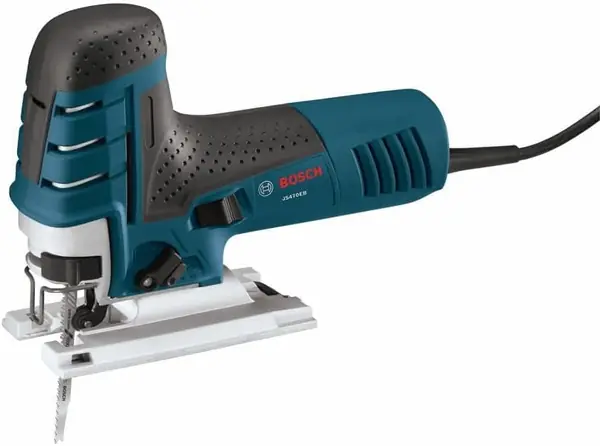
Bosch JS470EB corded barrel-grip jig saw in black with a die-cast aluminum footplate

General workshop cutting

Shop Score 95/100
Strokes Per Minute
500 to 3,100
Max Cut In Wood
5-7/8 in.
Orbital Settings
4
Amperage
7.0 amp
View on Amazon

A barrel grip puts your hand down beside the blade instead of on top of the saw, and the JS470EB is the jig saw that shows why that matters. The 7.0-amp motor and 1-inch stroke keep it moving through thick stock without bogging, and the wide die-cast aluminum footplate — with a steel insert around the blade opening — sits flat on the work instead of rocking as you come out of a curve.

What we ended up valuing most is how little the saw argues with you. The counterbalanced mechanism and Constant Response circuitry hold vibration and speed steady under load, and having both a speed dial to set the ceiling and an accelerator trigger to work the cut gives you more control than a dial alone. The four orbital settings cover the range from a clean, slow edge in veneered plywood to the aggressive stroke you want when you are hogging out a sink opening.

Blade changes are tool-less, with an ejection lever so you are not pinching a hot blade, and the bevel wrench stores on board so a 45-degree cut does not turn into a hunt for the right hex key. The 5-7/8-inch capacity in wood means it will take a countertop cutout that would stop a compact saw, which is why this is the one we hand to someone who wants a single jigsaw to do everything.

The mass is the honest trade-off: this is a heavy saw to hold out in front of you for an hour, and if your cutting happens overhead or in place, one of the compact saws here will serve you better. Clamped on a bench at waist height, where most curve work happens, we never thought about it — and the weight is part of why the base stays planted and the vibration stays low.

Worth Noting

  • Corded, so you need an outlet nearby
Our Verdict

Our default for most woodworkers: 7 amps, a 1-inch stroke and a wide die-cast foot make it the steadiest cutter here, and it costs less than the premium saws.

Check Latest Price
2.

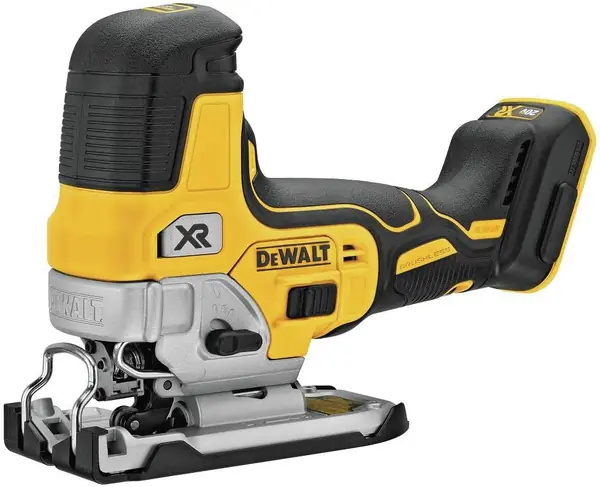
DEWALT DCS335B 20V MAX Barrel-Grip Jig Saw Best Cordless

DEWALT DCS335B 20V MAX barrel-grip jig saw in black with a brushless motor

Cordless jobsite work

Shop Score 94/100
Voltage
20V MAX
Weight
4.76 lb
Orbital Settings
4-position
Blade Speed
3,200 spm
View on Amazon

Take the Bosch's low-hand control and cut the cord, and you get the shape of the DCS335B. The 20V MAX barrel body is compact enough that your hand wraps it and the blade sits just ahead of your knuckles, which is exactly the geometry that makes a barrel grip worth choosing — your wrist steers the cut instead of your shoulder.

The brushless motor runs the blade up to 3,200 strokes per minute and gets more work out of a charge than DEWALT's previous jigsaw, while the four-position orbital action covers everything from a clean edge to fast stock removal. The all-metal lever-action clamp makes a blade swap a one-handed job, the bevel shoe has detents at 0, 15 and 30 degrees plus a positive stop at 45, and the LED sits right at the blade so you are not cutting by feel in a dim corner.

We minded the on/off switch. It is mounted on the left side of the barrel, where right-handed users have to reach across and left-handed users can end up with a palm over it — if you are left-handed, get one in your hands before you commit. Everything else about the saw we liked: it is the cordless barrel grip we pick when the work is not near an outlet, and on the 20V MAX platform the bare tool slots straight into the kit you already own.

Worth Noting

  • Power switch sits on the left of the barrel
Our Verdict

We reach for this one when there is no outlet: the same low-hand control as our top pick, cordless, with a switch placement that is its only real annoyance.

Check Latest Price
3.

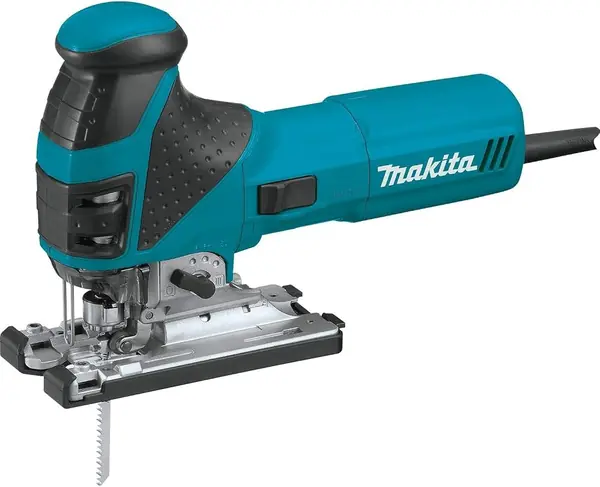
Makita 4351FCT Barrel-Grip Jig Saw Best for Cut-Line Visibility

Makita 4351FCT barrel-grip jig saw in teal with an LED light and tool-less blade change

Coping and trim

Shop Score 93/100
Strokes Per Minute
800 to 2,800
Weight
5.5 lb
Orbital Settings
3 plus straight
Amperage
6.3 amp
View on Amazon

The line you are cutting disappears first. The 4351FCT is one of two saws here that fights back with both an LED and a dust blower, and on dark hardwood, where a pencil line and a shadow look the same, that combination is worth more than another half amp of motor.

The rest of the tool is conventional in the good sense: a 6.3-amp motor with a speed dial from 800 to 2,800 strokes per minute, three orbital settings plus straight cutting, tool-less blade changes, and a base that bevels to 45 degrees. Makita balances the motor dynamically to cut vibration, and the saw tracks cleanly through long sweeping curves. Push a tight radius in thick stock and you can feel the blade deflect, so ease off the feed rate and let the orbital setting do the work.

Where it won us over is coping and finish work, where you are watching the blade more than the motor. It costs more than our top pick, so this is a saw for someone who cuts curves often enough that visibility is worth paying for, not a general-purpose first jigsaw. It ships with six blades, an anti-splintering insert, a cover plate and a case, so it is ready to cut out of the box.

Worth Noting

  • Heaviest corded saw here at 5.5 pounds
Our Verdict

We pick this one when the cut line has to stay visible: LED plus blower, a smooth 6.3-amp motor, and a price above our top pick.

Check Latest Price
4.

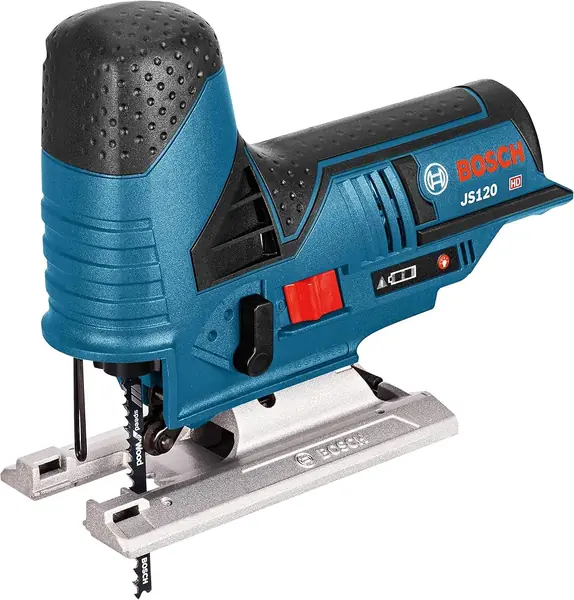
Bosch JS120N 12V Max Barrel-Grip Jig Saw Best Lightweight

Bosch JS120N 12V Max barrel-grip jig saw in blue with a slim grip body

Trim and cabinets

Shop Score 92/100
Voltage
12V max
Strokes Per Minute
1,500 to 2,800
Max Cut In Wood
2-1/2 in.
Tool Length
9.4 in.
View on Amazon

For cuts you make in place — a cabinet back, a toe kick, anything above shoulder height — the JS120N is the saw we reach for. Bosch built this one around the barrel grip rather than shrinking a top-handle saw: the body is 9.4 inches long, the grip circumference is small enough to close your hand around, and it is light enough to run one-handed when the other hand is holding the workpiece steady.

It runs 1,500 to 2,800 strokes per minute with a three-stage orbital action and bevels to 45 degrees, and the counterbalanced plunge mechanism keeps it from chattering in thin stock. Blade changes are single-handed, which matters when you are up a ladder and do not want to put the saw down. The fit and finish feel like the bigger saws in the range, and the cut is dead on in plywood and trim.

It is a bare tool, so price a battery and charger alongside it unless Bosch's 12V Max packs are already in your shop. In the box you get an anti-splinter insert and a no-mar overshoe, the two accessories that matter for laminate and finished surfaces. Even so, it is the cheapest saw here, and the cheapest way to find out whether a barrel grip suits how you work.

Worth Noting

  • Cuts only 2-1/2 inches deep in wood
  • Speed dial only, no trigger under your finger
Our Verdict

For one-handed work in tight spots, this is the saw we grab: 9.4 inches long, accurate in thin stock, and the least expensive option here.

Check Latest Price
5.

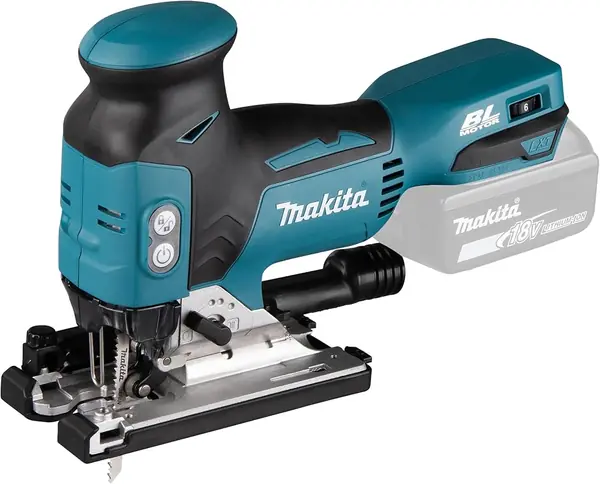
Makita DJV181Z 18V Barrel-Grip Jigsaw

Makita DJV181Z 18V barrel-grip jigsaw in teal with twin LED lights and blower

Cordless thick stock

Shop Score 91/100
Voltage
18V
Weight
4.2 lb
Max Cut In Wood
5-5/16 in. (135 mm)
Bevel Range
0 to 45 degrees left and right
View on Amazon

Five and five-sixteenths inches of wood capacity from a saw that weighs 4.2 pounds is the number that stands out on the DJV181Z, and it is the reason Makita's 18V barrel grip belongs on a shortlist for anyone cutting thick stock without a cord.

The details are what we like. Soft no-load drops motor speed when the saw is idling so it stops dancing in your hand between cuts, twin LEDs sit on either side of the blade, and a blower keeps the line clear. The base bevels 0 to 45 degrees in both directions, which saves you from flipping the workpiece when the good face has to stay up, and three orbital settings plus a variable-speed dial cover everything from a clean edge to fast hogging.

Its natural home is a shop already running Makita's 18V LXT batteries, where the saw joins a system rather than starting one. If that is your bench, the capacity answers the only question that matters when you are cutting thick stock away from an outlet.

Worth Noting

  • Bare tool at the highest price here
Our Verdict

If Makita 18V batteries already fill your shop, this is the cordless barrel grip we point you to for thick stock, thanks to the deepest wood capacity here.

Check Latest Price
6.

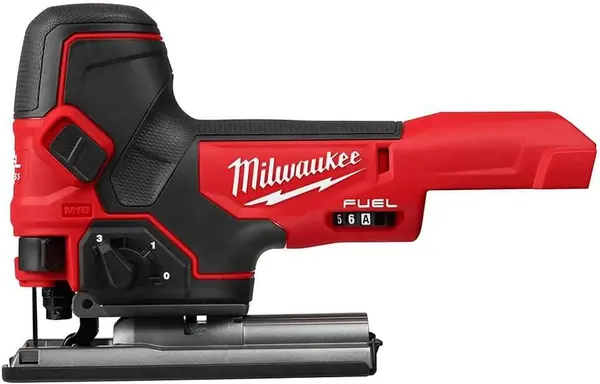
Milwaukee M18 FUEL 2737B-20 Barrel-Grip Jig Saw Best for Fast Rough Cutouts

Milwaukee M18 FUEL barrel-grip jig saw in red with a variable-speed trigger

Fast rough cutouts

Shop Score 88/100
Voltage
18V
Strokes Per Minute
800 to 3,500
Bevel Range
45 degrees left and right
Stroke Length
1 in.
View on Amazon

Milwaukee puts a trigger on a barrel-grip body, and that one choice shapes everything about living with the 2737B-20. A trigger gives you speed under your index finger mid-cut, which a dial cannot, but it also means your hand stays closed in a firing grip for the length of every cut.

The numbers are the strongest of the cordless saws here: 800 to 3,500 strokes per minute, a full 1-inch stroke, brushless M18 FUEL power, and a base that bevels 45 degrees in either direction. That top-end speed is real — on a big cutout the saw removes material instead of easing through it, and the 1-inch stroke clears chips faster than the 3/4-inch saws do.

It is also a long tool at just under a foot, which is the price of that stroke length. On a bench it balances fine; inside a cabinet it does not. Plan your cuts around that and the saw rewards you with speed you can feel through the trigger.

The reason it sits below the cordless picks above is simple: those saws are easier to live with day to day. What keeps this one on the page is a 3,500-stroke top end, trigger control, and the lowest price of the full-size cordless saws here — a lot of saw for someone already invested in M18 batteries.

Worth Noting

  • Power switch takes getting used to
  • Compact batteries run down quickly
Our Verdict

For someone already on M18 batteries who wants trigger control, this is the fastest-stroking cordless barrel grip here and the cheapest full-size one.

Check Latest Price
7.

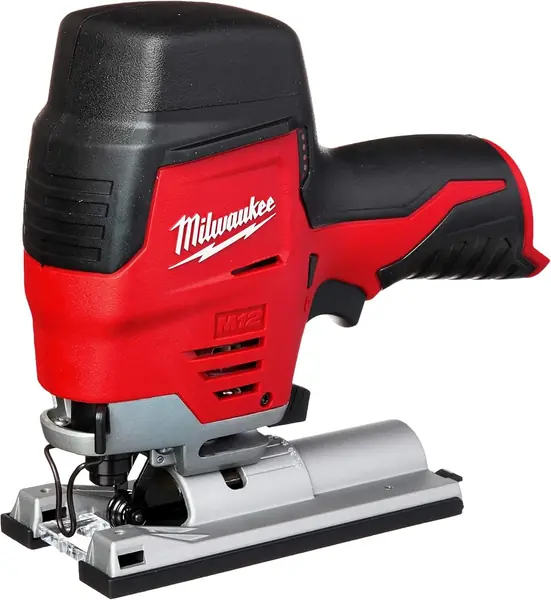
Milwaukee 2445-20 M12 Jig Saw Best for Tight Overhead Cuts

Milwaukee M12 2445-20 jig saw in red with a compact hybrid grip body

Tight overhead cuts

Shop Score 87/100
Voltage
12V
Strokes Per Minute
0 to 2,800
Stroke Length
3/4 in.
Cutting Angle
45 degrees
View on Amazon

Awkward cuts are where this saw earns its keep: an outlet opening in a cabinet back, a shim trimmed in place, anything above your head where a full-size jigsaw gets unwieldy. The hybrid grip brings your hand forward and low on a body that is short enough to steer with one hand, with the trigger under your finger instead of a switch to hunt for.

It runs 0 to 2,800 strokes per minute with a 3/4-inch stroke on Milwaukee's 12V batteries, bevels to 45 degrees with a positive lock, and the Quik-Lok clamp takes T-shank blades without tools. As a 12V saw it is a rough-cut tool: it handles plywood, trim and plastic without complaint, and hardwood thicker than a stair tread will slow it down.

We check the bevel lock before any cut that has to be square, because it can work loose over a long session — a ten-second tighten is cheap insurance. Beyond that it is an honest little saw: it does its best work in short, awkward cuts and in material thin enough that the 12V motor is not working hard.

Worth Noting

  • Cut line is hard to see under the guard
Our Verdict

We keep this one for awkward cuts — short body, trigger under the finger, 12V portability — as long as you already own M12 batteries.

Check Latest Price

How We Tested Barrel-Grip Jigsaws

We started with a shortlist of current barrel-grip models, then narrowed it by price, size, corded versus cordless, and the specs that matter for control: barrel circumference, switch placement, blade-change system, bevel range, and orbital settings. We ended up testing 12 saws over six months, in a small shop and on trim and cabinet installs. We cut pine and oak trim, 3/4-inch plywood curves, countertop sink openings, and overhead notches for pipe, keeping every cut within the maker's stated capacity for the material.

At the bench, we noted where the hand sat, how the barrel felt in a gloved hand, and whether the trigger or switch fell under the index finger or thumb. We checked base plate flatness with a straightedge, followed pencil lines through tight curves, set a bevel and tried to push it out of adjustment, and changed blades and bevels without tools while timing the fuss. We also ran long curve cuts to feel vibration at the handle, listen for noise, and run each saw through its orbital settings and speed range to compare a clean edge against speed. We used the blower and LED on shaded cuts to see whether dust hid the line.

For power, we noted how often each saw bogged down in thick stock and whether it recovered without backing off. Cordless saws were run only on their own battery platform and charger, and we tracked runtime between charges; for bare tools, we added the cost of the battery and charger a first-time buyer would need. We weighed each saw and cut overhead to judge balance, then checked after six months for loosened base plates, sloppy blade guides, and switch wear. Ease of use came down to whether we could pick up a saw and make a clean cut without hunting for the controls.

How to Choose a Barrel-Grip Jigsaw

Start With the Grip and the Switch

The reason to choose a barrel grip is the hand position — low and beside the blade, with your wrist doing the steering instead of your shoulder. That pays off on curves and coping, and it costs you reach: a barrel body is a longer tool to sight down, and a heavy one becomes a chore to hold out at arm's length.

Before you buy, decide between a trigger and a switch. A trigger keeps speed under your finger mid-cut; a dial or switch means setting speed once and leaving it. Check which side the control sits on, try it with your dominant hand, and if you are left-handed, put your palm where it would rest during a cut. That check takes a minute in a store and saves a year of annoyance.

Corded or Cordless

Corded saws put 6 to 7 amps behind a 1-inch stroke and never ask for a battery, which is why our top pick is corded and why countertop, hardwood and long curve work still goes that way. Cordless buys you the cut where the work is, and a brushless 18V or 20V body now has enough power for most trim and cabinet jobs.

Budget the platform, not just the tool. Most of the cordless saws here are bare tools, so a saw plus two batteries and a charger can cost more than the saw itself. A 12V or compact body is the right call for overhead and in-place trim work; a full-size 18V or 20V saw is the one that replaces a corded tool in the van.

What Makes a Cut Accurate

Two things keep a jigsaw on line: a base plate that stays flat and blade guidance that resists deflection. A wide die-cast footplate with a steel insert at the blade opening — the arrangement on our top pick — resists tipping as you exit a curve, and a counterbalanced mechanism cuts the vibration that makes your hand correct mid-cut and wander off the line.

Bevel locks deserve their own check. A base that creeps off square ruins a joint quietly, so set the angle, lock it, then push the saw sideways on the bench and confirm nothing moves before you start cutting.

Capacity, Stroke Length and Orbital Settings

Maximum cut in wood is the number that decides whether a saw can do your job at all: 2-1/2 inches is trim and plywood territory, while 5 inches and up handles countertops and thick stock. Stroke length is the other half of the story — a 1-inch stroke removes material faster than a 3/4-inch one and holds up better in hardwood.

Orbital settings let you trade a clean edge for speed. Use straight cutting or the lowest orbit for a finished edge, and the highest orbit when you are ripping out a rough opening. For repeatable work, a speed dial you can set and return to matters more than a trigger.

Seeing the Line

Dust is what ends a good curve: chips pile up at the kerf and you start steering blind. Two saws here pair an LED with a dust blower, and that combination is the one worth having if you cut dark hardwood or work in a dim shop.

If your saw has neither, a vacuum hose at the base or a puff between passes does the same job, and marking the line with a knife instead of a pencil keeps it readable under a layer of dust.

Frequently Asked Questions

Final Verdict

The Bosch JS470EB is the barrel-grip jigsaw we point most woodworkers to: 7 amps, a 1-inch stroke, a wide die-cast foot, and a real speed dial plus trigger, for less than the premium saws here. It is corded and it is heavy, which is exactly the trade bench work wants.

Cut away from an outlet and the DEWALT DCS335B is the cordless equivalent. Cut trim in place or overhead and the compact Bosch JS120N will do more than its size suggests.