↑↓ navigate ↵ open Esc close All results →

Best Drill Guides of 2026

Freehanding a portable drill onto a round post or the edge of a board invites the tip to follow the grain sideways, even when the mark is dead center. A drill guide trades setup speed for alignment, clamping a bored block over the layout line so the bit enters square and exits where intended.

Bushing fit turned out to matter far more than hole count across 14 guides used for three months in a garage shop and on a deck frame—slop inside the guide ruins accuracy faster than drilling without one. Reaching half-inch diameters for bolts and pipe also narrowed the field quickly, while geometry decided stability: a heavy block with a crisp V-groove stays planted on round stock and corners, whereas lighter guides demand a clamp and a steady hand.

Our Top Picks

The Best Drill Guides

1.

Big Gator Tools Original V-Drill Guide Best Overall
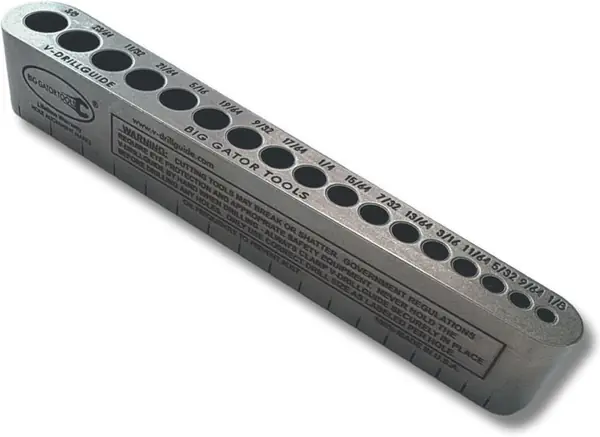
Big Gator Tools V-drill guide, silver steel block with numbered holes and alignment marks

Precise pilot holes

Shop Score 95/100
Base
V-groove for corners and round stock
Material
Heat-treated nickel-alloy steel
Drill Guides
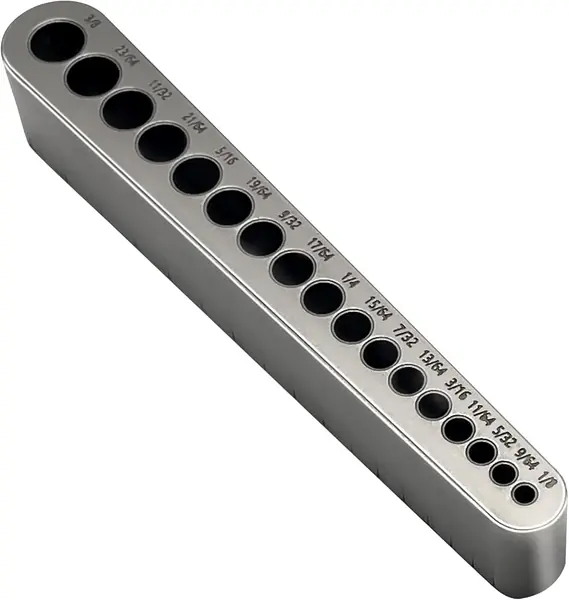
17 sizes, 1/8 to 3/8 inch, in 1/64-inch increments
Weight
8.3 oz
View on Amazon

Seventeen hole sizes between 1/8 and 3/8 inch, spaced in 1/64-inch steps, is the reason this guide takes our top spot. A bit that fills its hole with no daylight around it cannot wander, and the fractions a typical drill index skips — 9/64, 11/64, 13/64 — are all here. Anyone who has drilled a pilot hole one size large because the block offered nothing closer knows what that slack costs when a hinge screw walks off the mark.

The heat-treated steel body carries real heft at 8.3 ounces, and we credit that mass for how settled it feels on a board; a light plastic block can skate when a brad-point bit bites. Underneath, the V-groove is the other half of the case: it straddles a pipe, a dowel or the corner of a post and holds the bit on center where a flat-backed block rocks. Embedded numbers and alignment marks on top let you find the right hole without hunting for your glasses.

The ceiling is 3/8 inch, and that is the one honest limit — no 1/2-inch openings for through-bolts, pipe clamps or thick dowel stock. Most of what a drill guide gets asked to do lives at 3/8 and under, and if your work runs larger, the Kreg below trades all those fine increments for a 1/2-inch hole. What we like about the Big Gator is that nothing about it is fussy: it goes into a toolbox, it comes out straight, and the lifetime warranty covers everything but abuse.

Worth Noting

  • Pricier than the nylon-bodied blocks here
Our Verdict

Our pick when straightness matters most: seventeen hardened sizes in 1/64-inch steps hold a bit snug, and the steel body survives a toolbox.

Check Latest Price
2.

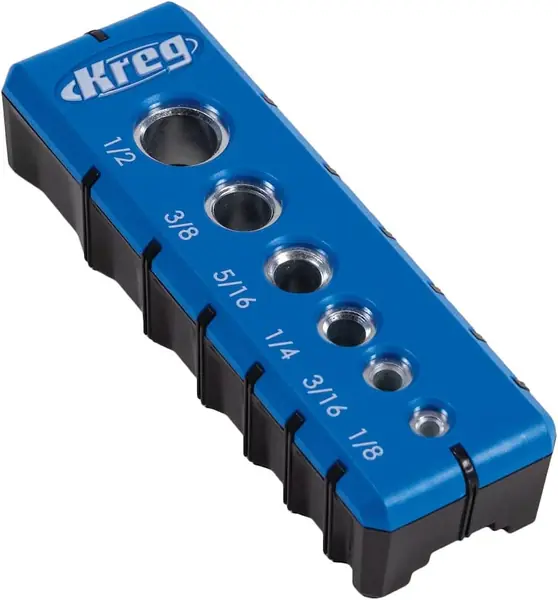
Kreg KDG-6000 Portable Drilling Guide Best for 1/2-Inch Holes

Kreg KDG-6000 portable drilling guide, blue compact body with six hardened steel guide holes

Hardware and edges

Shop Score 94/100
Base
GripMaxx non-slip surface
Drill Guides
6 hardened-steel sizes, 1/8 to 1/2 inch
Dimensions
6.97 x 2.48 x 1.14 inches
Edge Centering
Centers on 1/2-inch and 3/4-inch stock
View on Amazon

The Kreg does the two things the top pick cannot: it reaches 1/2 inch, and it centers a hole on the edge of a board. Two shoulders on the base straddle 1/2-inch and 3/4-inch stock so the bit lands in the middle of the thickness — exactly the job when a hole has to run into a frame or a dowel joint. That edge trick is what we like most about it: set the guide on the board, sight the mark, and the centering is done for you.

Six hardened-steel guides run 1/8, 3/16, 1/4, 5/16, 3/8 and 1/2 inch, and the molded numbers are easy to read with the guide in place. GripMaxx, the high-friction material underneath, holds it against smooth stock better than bare metal does, which is why this is the one we hand someone drilling a bracket into a finished cabinet. At 6.97 by 2.48 by 1.14 inches it disappears into a pocket, and it costs about what a single good bit does.

Depth is the other thing to picture. At 1.14 inches tall, the guide steadies the first inch of a hole and then the flutes take over — you drill until the body bottoms out, then finish with the bit already committed to the line. For hardware, brackets and dowel work that is all the support you need, and it keeps the body small enough to carry everywhere. A deep bore through a thick post is where it stops helping, and for that we want a drill press rather than a taller jig.

Worth Noting

  • Only six sizes, with no fine increments
Our Verdict

The guide we hand to anyone drilling 1/2-inch holes or working a board's edge: six hardened sizes, a base that grips, and very little money.

Check Latest Price
3.

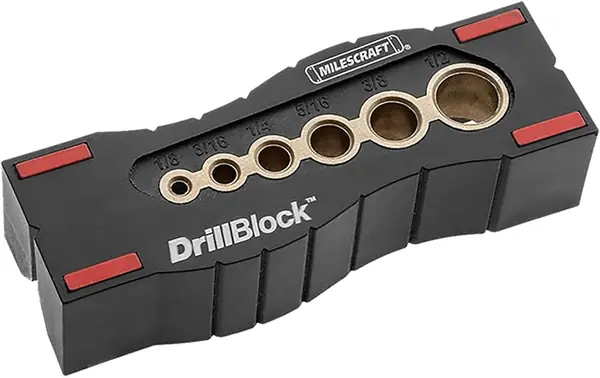
Milescraft 1312 Drill Block Best Budget

Milescraft 1312 drill block, reinforced nylon handheld guide with six steel inserts and V-grooves

Everyday shop drilling

Shop Score 93/100
Base
Two V-grooves for corners and round stock
Material
Reinforced nylon with metal inserts
Drill Guides
6 steel inserts, 1/8 to 1/2 inch
Weight
3.53 oz
View on Amazon

Turn the block over and you find the feature the flat guides do not have: two V-grooves, one each way, that let it sit on a corner or a length of pipe instead of rocking on it. Set it against the arbor of a post and drill through the corner; lay it on 1-inch dowel and the groove cradles the curve so the bit meets the centerline. For handrail work, dowel cross-holes and anything round, that is the difference between a guide and a paperweight.

The 1312's six hardened-steel inserts — 1/8, 3/16, 1/4, 5/16, 3/8 and 1/2 inch — are set into a reinforced-nylon body, with centerlines molded across the top and down one side for lining up on a mark. At 3.53 ounces it is the lightest thing here, which is why ours lives in an apron rather than the toolbox, and the rubber pads underneath keep it from marring a finished surface while they stay put.

Where it earns its keep is the small jobs — a hinge, a bracket, a quick cross-hole in dowel — because there is no setup and nothing to drop. The steel inserts do the work of holding the bit; the body only has to stay flat and keep the holes where they started. We keep one in the apron and one in the shop, which tells you what we make of the price.

Worth Noting

  • Non-slip pads can peel off with handling
  • Body is nylon, not steel
Our Verdict

At 3.5 ounces this is the one we tuck in an apron pocket, and its V-grooves handle pipe and post corners that flat blocks cannot.

Check Latest Price
4.

Milescraft 1307 Drill Block PRO Best Size Range

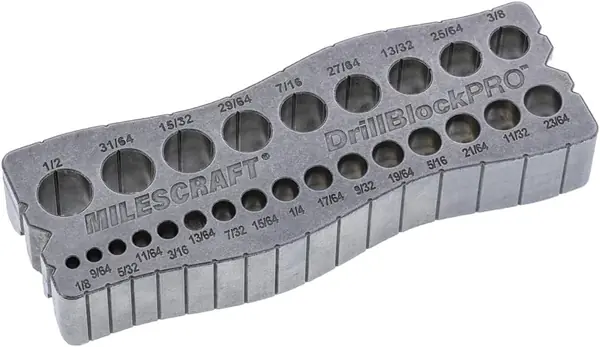
Milescraft 1307 Drill Block PRO, all-metal handheld drilling guide with twenty-five numbered guide holes

Full bit-index coverage

Shop Score 88/100
Base
Dual V-groove for round stock and corners
Material
100% hardened steel
Drill Guides
25 sizes, 1/8 to 1/2 inch, in 1/64-inch increments
Weight
1.43 lb
View on Amazon

Twenty-five holes, from 1/8 inch up to 1/2 in 1/64-inch steps, is the coverage that ends the search: every fractional bit in a standard index has a snug home, including the 1/2-inch sizes the Big Gator stops short of. Do the arithmetic and that is the whole span of a drill index in one block — nothing to swap, nothing to lose, and no excuse to drill a pilot hole with the wrong bit.

The body is hardened steel and weighs 1.43 pounds, roughly six times the nylon 1312, and we like what the weight does. It sits on a board and stays there, and the dual V-groove underneath means it handles corners and round stock as well as flat work. Built-in centering guides on top speed up lining a hole over a mark, and there is no plastic to flex under a big bit.

Set it beside the top pick and the extra money buys the 1/2-inch sizes and hardened steel around every hole; set it beside the nylon 1312 and it buys a body with nothing to flex or peel. For one block that lives on the bench and covers whatever bit you happen to pick up, that is the version we hand over.

Worth Noting

  • Heavy enough to notice in an apron pocket
Our Verdict

Every fractional size from 1/8 to 1/2 inch in 1/64-inch steps, in one steel block that feels hewn rather than molded.

Check Latest Price
5.

VASTHOME 30/45/90 Angle Drill Guide Best for Angled Drilling

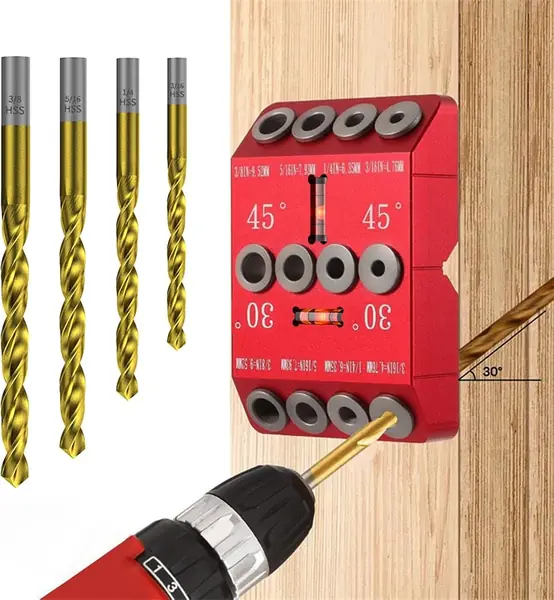
VASTHOME angle drill guide, red aluminum jig with 30, 45 and 90 degree guide holes

Angled drilling

Shop Score 87/100
Material
Aluminum alloy
Dimensions
4.2 x 2.8 x 0.5 inches
Includes
Four twist drill bits
Angle Settings
30, 45 and 90 degrees
View on Amazon

Blocks drill square holes; this one drills the others. The plate is cut with guide holes at 30, 45 and 90 degrees, so a handrail bracket, a stair stringer or a post cap gets its fastener on the angle you drew rather than somewhere near it. For anything drawn off square, nothing else in this group does the job at all.

The VASTHOME plate is 4.2 by 2.8 inches and half an inch thick, aluminum, with four twist bits in the sizes the guide takes. There is nothing on it to hold, which matters: on a rail or a post, a clamp at each end is the difference between a clean hole and one that walks as the plate pivots. Check the plate against a square when it first arrives, and drill a test hole in scrap before you commit a rail.

Where it earns its place is work where square is the wrong answer — handrails, stair brackets, deck posts — and it is small enough to sit in a bag until that job appears. The four guide holes top out at 3/8 inch, so treat it as a starter for hardware holes rather than a finishing tool. Sight the angle off the plate's edge, not the stamped marking, and a bad setting shows up in scrap instead of in a rail you have already drilled.

Worth Noting

  • Holes top out at 3/8 inch
Our Verdict

For handrail brackets, stair work and any hole drawn off square, this is the pick — clamp it down and the 45-degree setting does the rest.

Check Latest Price
6.

TJCYGO STD1000DGNP Drill Guide

TJCYGO STD1000DGNP drill guide, heat-treated steel block with seventeen numbered guide holes

Backup steel guide

Shop Score 86/100
Base
90-degree V-groove for round stock
Material
Heat-treated steel
Drill Guides
17 sizes, 1/8 to 3/8 inch, in 1/64-inch increments
Weight
9.1 oz
View on Amazon

The part number gives it away: this guide is sold as an STD1000DGNP with the same seventeen-hole layout as our top pick, which tells you what it was modeled on. We rank it last in this group, and the design is not the problem — everything the original has going for it, this one has going for it secondhand.

On its own terms the TJCYGO is a decent block: heat-treated steel, a 90-degree V-groove for pipe and post corners, and 17 sizes from 1/8 to 3/8 inch in 1/64-inch steps, plus a little more weight at 9.1 ounces. The hole numbers are embedded in the top where you want them, and clamped down it does what a block of this shape does.

What it is good for is a second block — one for the truck box, one for the bench — or a stand-in during the weeks the original is unavailable. It drills the sizes it lists correctly, the steel is the same steel, and a spare guide is never a bad thing to own.

Worth Noting

  • Costs more than the original it duplicates
Our Verdict

We rank it last: the same seventeen steel sizes and part number as our top pick, with less history and a bigger bill than the original it copies.

Check Latest Price

How We Tested Every Drill Guide on This List

To build the shortlist, we read spec sheets and size charts for two dozen guides, then cut anything that duplicated a size range we already had or priced itself out of the comparison. Fourteen made it to the bench, and we spent three months with them in a garage shop and on a half-finished deck out back.

Every guide got the same first pass: we dropped each bit it claimed to take into its hole, rocked it side to side to measure the slop, and noted how easy the size markings were to read with sawdust on them. Then we clamped each block to a scrap of 2x4, to a length of round dowel, and over the corner of a board, and drilled pilot holes in pine and white oak with our hands clear of the guide face. We watched for the block shifting at the first bite of the bit, and for how much of the shank stayed supported before the hole itself took over.

Stability got a second round on the deck, drilling on the flat and over a railing, and we marked every guide that walked. Where a guide offered angle stops, we set it to 30, 45, and 90 degrees, clamped it to a post, and checked the finished hole against a framing square. For build and wear, we ran a few hundred holes through the most-used sizes and looked for scoring and enlargement in the bores.

At the end we weighed each guide's cost against the sizes, support, and grip it delivered, and whether the jump over the cheapest block in the group was worth paying. Anything that slipped, wobbled, or wore loose came off the list. The six that remain are the ones we'd clamp and drill with again.

How to Choose a Drill Guide

Start With the Bit Fit

A guide with four or six openings makes you drill with the closest hole rather than the right one, and a bit rattling in an oversized opening is barely better than freehand. Fine increments solve it: the fine-increment drill blocks here run to 3/8 or 1/2 inch in 1/64-inch steps, so a 9/64 or 11/64 bit has somewhere to go. Count the sizes your own bit index actually uses before deciding that six is plenty — the odd fractions come up more than you expect in hinge and hardware work.

Decide on 1/2 Inch Early

Half-inch holes split the field. Bolts, pipe clamps and thick dowel stock all want one, and a guide that stops at 3/8 inch cannot start those holes square no matter how well it fits the smaller bits. The Kreg, the 1312 and the 1307 reach 1/2 inch; the Big Gator and the TJCYGO stop one step short. Look in your hardware drawer before you buy: if there is a 1/2-inch bolt in your next three projects, buy for it, because a long 1/2-inch bit is exactly the bit that wanders most.

Stability Beats Feature Count

A guide that moves is a guide that lies to you. Rubber feet and high-friction bases work on flat, horizontal stock; on a wall, a post or a rail, a clamp does the holding, so look for a body that gives the clamp a flat place to land. Weight matters more than most listings admit — the 1.43-pound 1307 sits noticeably calmer than the 3.53-ounce 1312, and the trade is portability. Our rule: clamp the guide whenever the surface is not horizontal and you can get jaws on it.

Corners, Pipe and Board Edges

Awkward stock needs a shape, not a bigger block. A V-groove machined across the bottom straddles pipe, dowel and post corners, and the Big Gator, the 1312 and the 1307 all have one, in one direction or two. Edge shoulders do a different job: the Kreg's base centers itself on 1/2-inch and 3/4-inch stock, which is what you want when a hole has to land in the middle of a board's thickness. Buy for the shapes you actually drill.

When the Hole Isn't Square

Every block here holds the bit perpendicular; none of them drills an angle. A dedicated plate with 30, 45 and 90-degree holes — the VASTHOME is the one we cover — handles handrail brackets, stair work and anything drawn off square, and it costs less than a portable drill-press guide. Expect to clamp it: an angle plate is small, and one that pivots halfway through a hole leaves a slot, not a hole. Test each setting in scrap before you commit to a rail.

Frequently Asked Questions

Final Verdict

The Big Gator earns the top spot because seventeen sizes in 1/64-inch steps is what keeps a bit from wandering, and the steel body will outlast the drill clamped behind it. If your work includes 1/2-inch hardware or holes centered in the edge of a board, add the Kreg; it is the smallest amount of money that solves both problems.

And if you want one block that covers the whole fractional index without thinking about sizes again, the Milescraft 1307 is it — heavier in the pocket, but nothing on the bench drills a straighter start.