↑↓ navigate ↵ open Esc close All results →

Best Face Shields for Woodworking of 2026

The first time a knot let go on the lathe and a chip pinged off my safety glasses, I went shopping for a face shield that afternoon. A shield isn't a replacement for those glasses — it's the layer that keeps hot chips and a face full of dust off your skin while both hands stay on the work.

We tested 14 face shields over six months in a home shop, wearing each through lathe work, router passes, and long sanding sessions. A shield can carry every rating on the box and still fog in the middle of a cut, or sit heavy enough on the brow that you shove it up after twenty minutes.

The details that decide whether you keep wearing it are duller: whether a gloved hand can find the ratchet, whether it clears your glasses and respirator, and whether you can buy a replacement window when this one clouds over. All seven of these earn their ANSI rating; what separates them is coverage from brow to chin and how they feel in hour three.

Our Top Picks

The Best Face Shields for Woodworking

1.

Uvex Bionic S8510 Face Shield Best Overall
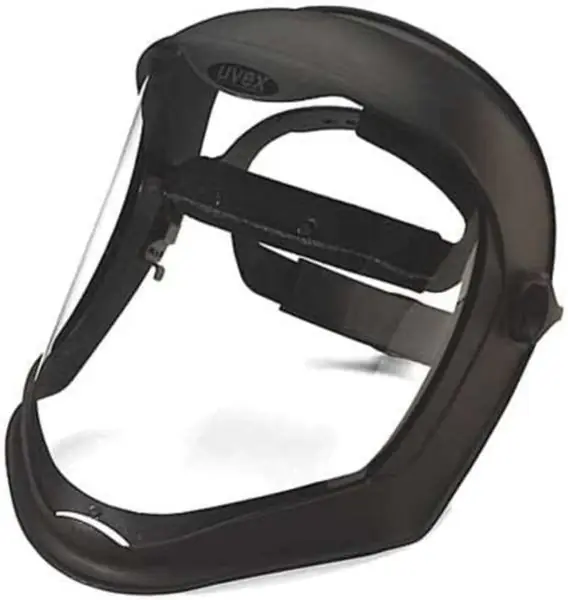
Honeywell Uvex Bionic clear polycarbonate face shield with black matte ratcheting headgear

All-day sanding

Shop Score 94/100
Weight
1.3 lb
Safety Standard
ANSI Z87.1-2010 and CSA Z94.3
Visor
Clear polycarbonate with anti-fog/hard coat
Replacement Visor Options
Clear uncoated, anti-fog/anti-scratch, shade 3.0, shade 5.0
View on Amazon

The anti-fog hard coat is the reason this visor is our top pick, and we tested the claim the unglamorous way: breathing hard behind it with a random-orbit sander running. The window stayed clear enough to follow a pencil line, which is more than we can say for the uncoated shields in this group. Clarity you have to wipe every few minutes is not clarity you can work behind.

The rest of the design is aimed at wearing it for hours. Cell foam at the back of the headgear and a removable, washable headband keep pressure off your forehead, the ratchet spans a wide range of head sizes, and the visor tilts closer to or farther from your face. That last adjustment is what makes it work over prescription glasses or a half-face respirator; we wore ours with glasses all afternoon and never fought with the frames.

What we appreciate most is that it is a system rather than a disposable: replacement windows come in clear uncoated, anti-fog, and shade 3.0 and 5.0 tints, the headband comes off for washing, and there is no metal in the headgear to rust or conduct. If you want the widest window in this group instead, that is the Jackson Maxview. We still put the Uvex on first, because we can see through it after an hour of sanding.

Worth Noting

  • Wide crown will not fit inside most closed-back earmuffs
Our Verdict

We reach for this one first: the anti-fog coat keeps a pencil line visible through a long sanding session, and it wears easily over glasses and a respirator.

Check Latest Price
2.

Jackson Safety Maxview Face Shield Best Coverage

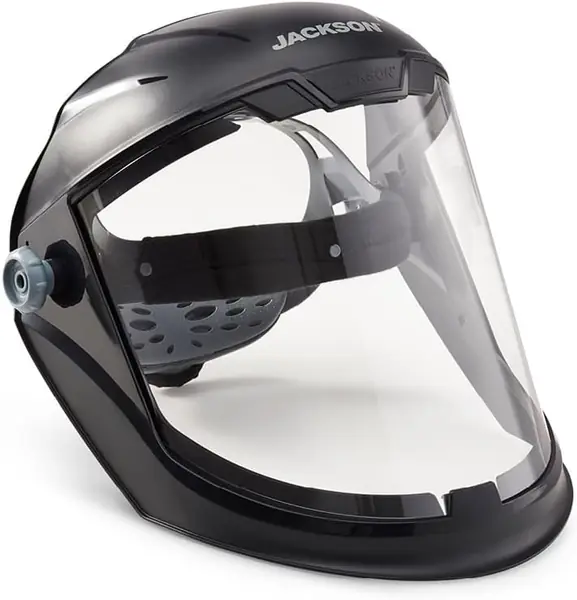
Jackson Safety Maxview clear polycarbonate face shield with black ratcheting headgear and chin guard

Routing and turning

Shop Score 93/100
Weight
1.74 lb
Safety Standard
ANSI Z87.1+ and CSA Z94.3
Window
Oversized clear polycarbonate, replaceable
Headgear
370 Speed Dial ratchet with quick-fit rear swivel
View on Amazon

Chips and dust do not only arrive from straight ahead, and the Maxview is built as though it knows that. The window wraps past your temples, integrated side panels fold back toward the ears, the chin guard closes the gap underneath, and the crown extends up over the forehead. Run a router for ten minutes and the difference shows up on your collar.

The 370 Speed Dial is the other half of the appeal. It is an oversized ratchet knob you can turn with a glove on, and the rear band swivels so the headgear toes in around the back of your head instead of pinching. We tightened it one-handed with a piece of stock in the other hand, and it went over a ball cap and a half-face respirator without a fight.

What all that coverage costs is weight. At 1.74 pounds this is the heaviest shield we handled, and your neck knows it by the end of a long session. We make that trade for overhead work, lathe work, and any cut where the offcut leaves in an unexpected direction. The window is replaceable, so scratches are not permanent, which is part of why we do not baby it.

Worth Noting

  • No anti-fog coating on the window
Our Verdict

Buy this one if chips reach you from below and above; the side, chin, and crown coverage is the most complete here, and the gloved ratchet makes it easy to live with.

Check Latest Price
3.

3M H8A Headgear with WP96 Faceshield Best for Hard Hats

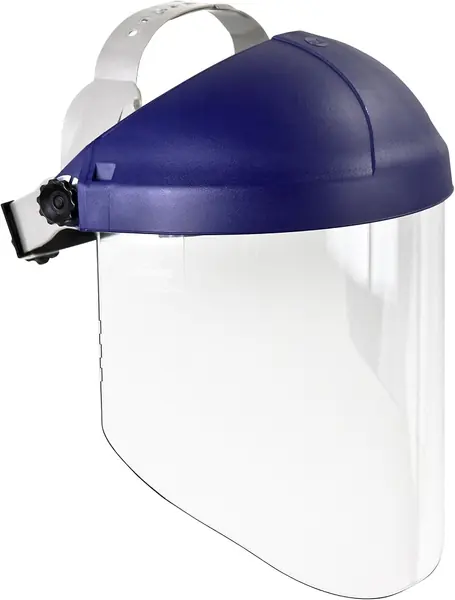
3M H8A ratchet headgear with clear WP96 polycarbonate face shield and black crown strap

Hard hat wearers

Shop Score 92/100
Weight
8 oz
Safety Standard
ANSI Z87.1-2010
Window
WP96 clear polycarbonate, 0.08 inches thick
Headgear
H8A aluminum ratchet, 13-position suspension
View on Amazon

Aluminum headgear is unusual on a face shield, and it is the first thing we noticed taking this one out of the box. The crown is metal and thermoplastic rather than molded plastic, with a thirteen-position ratchet at the back and a five-position crown strap, and it feels like equipment rather than packaging.

We came away thinking of it as the hard-hat shield. The assembly is designed to fit over most hard hats, the straps leave room for cap-mounted earmuffs, and there is enough clearance to wear glasses or goggles underneath. In a shop where a shield gets handed around and hung on the same nail every day, that is the version we put on the person borrowing it for the afternoon.

Two details we liked: the visor holds where you leave it when you flip it up between cuts, and the WP96 window comes off the headgear easily when it needs replacing. At 8 ounces listed, it is also the lightest shield in this group, which is not nothing when the thing sits on your head for a full shift.

Worth Noting

  • Costliest shield in this group
  • Uncoated window with no anti-fog treatment
Our Verdict

Our pick for anyone wearing a hard hat: this headgear sits over the shell and leaves room for muffs and a respirator, and it holds its position when you flip it up.

Check Latest Price
4.

Blue Eagle B1BL+FC48 Face Shield Best for Long Sessions

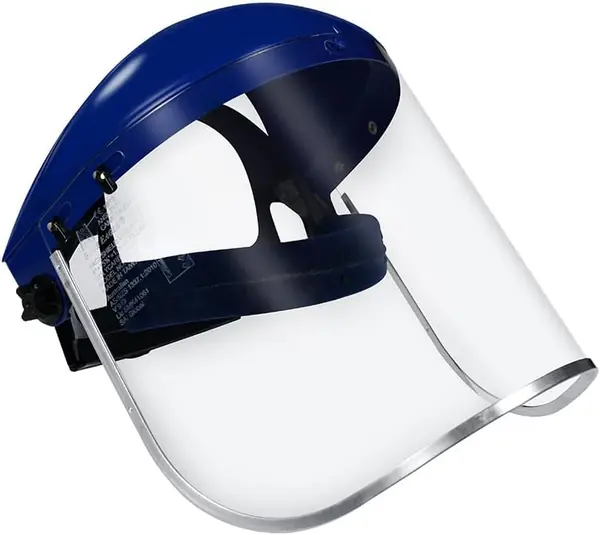
Blue Eagle B1BL+FC48 clear full face shield with aluminum-reinforced edge and blue headgear

Long shop sessions

Shop Score 91/100
Weight
10.6 oz
Extra Visor
One replacement visor included
Visor Material
Extrusion-grade polycarbonate with aluminum-reinforced edge
Safety Standards
ANSI Z87.1, CE EN166, CSA Z94.3, UKCA
View on Amazon

At 10.6 ounces the Blue Eagle is one of the lightest full-wrap shields here, and that is the number we noticed most. The weight of a face shield lands on your neck, not your face, and it is what decides whether you keep the thing down for the last hour of a session or flip it up and stop protecting yourself. This is the one we leave down.

The aluminum-reinforced edge is a detail we did not expect to care about. You can bow the visor slightly to suit your face, and the bound edge keeps the window from curling at the corners the way plain plastic can. The visor also stands well away from your face, which is why we had almost no trouble with fog on a warm morning: air moves through, and your breath does not land on the plastic.

A second visor ships in the box, so a deep scratch costs you a swap rather than a new shield, and the crown is narrow enough to sit inside closed-back earmuffs while you run a saw. It carries ANSI Z87.1, CE EN166, CSA Z94.3, and UKCA marks, which is more paperwork than most of this group bothers with.

Worth Noting

  • Sold in a single crown size
Our Verdict

The shield we keep on for hours: light on the neck, easy to see through, narrow enough for earmuffs, and shipped with a second visor for the day you scratch this one.

Check Latest Price
5.

Sellstrom 301 Face Shield Best Budget

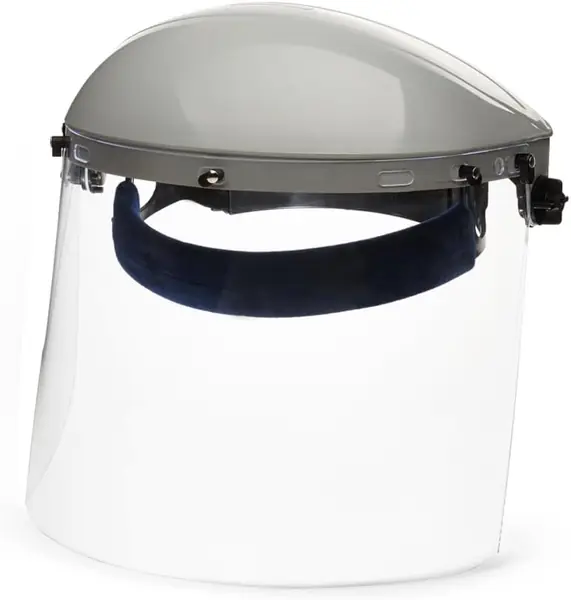
Sellstrom 301 clear polycarbonate face shield with gray ABS crown and ratchet headgear

Occasional shop jobs

Shop Score 90/100
Weight
9.76 oz
Safety Standard
ANSI Z87.1+ and CSA Z94.3
Window
Clear uncoated polycarbonate
Crown
Universal pin pattern, fits other brands' windows
View on Amazon

The 301 is the least expensive shield in this group by a wide margin, and it still carries the ANSI Z87.1+ high-impact and CSA Z94.3 marks. For a shop that needs a rated face mask on hand without spending on one, that is the whole pitch: a clear uncoated polycarbonate window, a gray ABS crown, and nothing you did not ask for.

The crown takes a universal pin pattern, so it accepts replacement windows from other makers as well as Sellstrom's own, which is the right way around for a budget shield: the headgear outlives the window. The window mounts on those pins, the twist-knob ratchet is quick to set, and the sweatband comes out for washing.

Where it earns its place in our shop is as the shield we keep by the bench for guests, for quick cuts, and for the jobs where a nicer visor is overkill. At 9.76 ounces it barely registers on your head, and the fit takes up quickly on most people who pick it up.

Worth Noting

  • Window clarity varies from unit to unit
Our Verdict

The least expensive way to put rated impact protection on your face, and the one we hand to guests and keep for quick cuts.

Check Latest Price
6.

Sellstrom DP4 Face Shield Best for Welding and Cutting

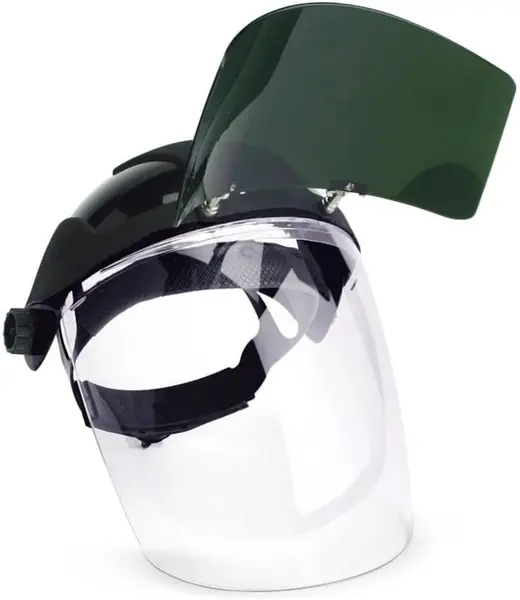
Sellstrom DP4 clear anti-fog face shield with flip-down shade 5 IR visor

Welding and cutting

Shop Score 89/100
Weight
1.7 lb
Safety Standard
ANSI Z87.1-2015 and CSA Z94.3-2015
Windows
Clear anti-fog polycarbonate with flip-down shade 5 IR panel
Coverage
Chin guard and extended crown
View on Amazon

The DP4 is two shields in one: a clear anti-fog polycarbonate window for grinding and sanding, and a spring-mounted shade 5 panel that flips down over it for oxy-fuel work, brazing, and plasma cutting. Both meet ANSI Z87.1-2015 and CSA Z94.3-2015, the clear window has a chin guard, and the crown extends over the top of your head.

We like it best in a shop that does both jobs. The tint panel means you do not swap headgear between a sanding pass and a plasma cut, and the clear window keeps protecting you while the dark panel is down. The flip mechanism is spring-mounted and consistent, so it does not wander halfway through a cut.

Weight is the tax. At 1.7 pounds this is the second-heaviest shield here, and if you never strike an arc the shade panel is weight and money you do not need to spend. For the bench where cutting and grinding happen between the same two clamps, we think the trade is worth making.

Worth Noting

  • Heavy at 1.7 pounds
Our Verdict

Worth it if you weld, cut, and grind at the same bench; the flip-down shade saves a helmet swap, and the clear window stays put underneath.

Check Latest Price
7.

NoCry Ultrashield Pro Mask Best for Sanding and Dust

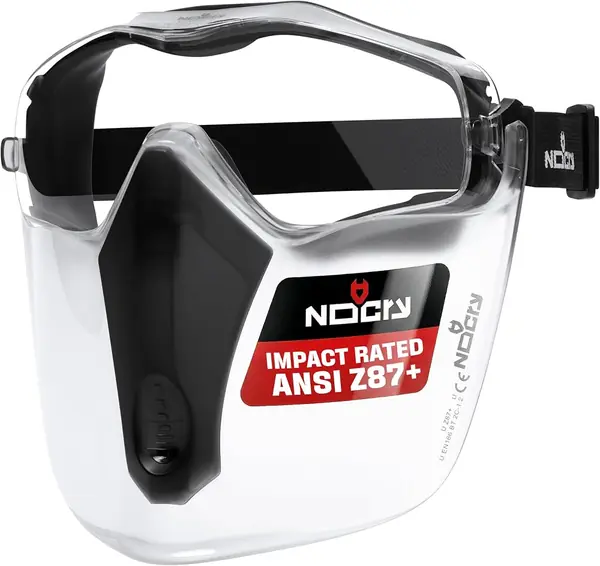
NoCry Ultrashield Pro clear safety goggles with clip-on polycarbonate face shield and TPR seal

Sanding and dust

Shop Score 88/100
Fit
Adjustable, fits over glasses
Goggle Lens
Anti-fog, scratch resistant, UV380
Safety Rating
ANSI Z87+
View on Amazon

This is a goggle system first and a face shield second, and that is the thing to understand before you order. You get a sealed pair of anti-fog goggles with a soft TPR gasket and a polycarbonate shield that clips on over them. The listing is sold in four variants and two of them are goggles alone, so choose the Premium Goggles + Shield option or you will get half of what is described here.

As eye protection it is the most complete thing we used. The gasket seals against your cheekbones and brow, the lens wraps around the sides, and the adjustable strap fits over prescription glasses without pressing the frames into your temples. For a shop where the air is full of fine dust, that seal does more than any open visor can.

Finishing work is where it earns its keep. Sanding, routing dust, and blowing out a machine with compressed air all send particles around the edges of a flat shield, and the gasket closes that path. The shield on top takes the bigger hits and keeps your face clean while the goggles handle your eyes.

Where it stops being a face shield is coverage. It is a smaller guard than the wrap-around visors here and it sits close to your face, so a chip coming off a saw blade at speed is a job for the Maxview or the Bionic. If it is your eyes you are worried about, nothing else here seals like this one.

Worth Noting

  • Shield covers less of the face than a full visor
  • Anti-fog coating fogs up for some wearers
Our Verdict

Our pick when dust and eye protection matter more than face coverage: sealed goggles, a clear wrap lens, and a shield that clips over them.

Check Latest Price

How We Tested Face Shields in the Shop

We started with the rating, not the marketing panel. We checked the impact marking stamped on each window itself, dropped anything without an ANSI Z87.1, Z87.1+, or CSA Z94.3 rating, then filtered the rest by coverage — chin guard, side wrap, extended crown — and by whether replacement windows could actually be ordered. From that shortlist we bought 14 shields, from bare-bones budget models to flip-up welding setups.

Testing ran six months across a home woodshop and garage. Each shield went through lathe turning, router work on the table, belt sanding, and a few afternoons of cutting steel. We wore ANSI Z87-rated safety glasses underneath every one, as the listings specify, and a fitted respirator whenever the dust got serious, since a shield doesn't filter anything. We noted where the window pressed, how much of a gap the crown left at the eyebrows, and whether chips reached our collars.

The rest we graded by action. Every shield was weighed on a kitchen scale, then worn through a full afternoon to see how soon we pushed it up onto our foreheads. We adjusted headgear with nitrile gloves on to see whether the ratchet or dial could be found by feel, and fitted each shield over prescription glasses, earmuffs, and a half-mask respirator to look for pinch points. Fogging was logged in real time — clear at the first cut or clouded by the second pass — and windows were wiped with a shop towel, checked for scratches, and priced for replacement so we knew the long-term cost, not just the sticker.

Durability got the least glamorous test: each shield lived in a drawer between sessions, got knocked off the bench at least once, and had its visor flipped up and down a few dozen times to see whether the pivot loosened. Any window that cracked, clouded, or scratched badly enough to blur the work was retired rather than pushed back into service.

How to Choose a Face Shield for Woodworking

Impact rating comes before everything else

ANSI Z87.1 is the baseline for eye and face protection in the U.S.; the plus sign after it marks a shield tested for high-velocity impact, and CSA Z94.3 is the Canadian equivalent. A visor with no stated standard is a splash guard, whatever the listing calls it. Every shield we recommend states a rating, and the cheapest one in this group still carries the Z87.1+ and CSA marks.

The rating does not make a shield stand alone. Face shields are secondary protection, and every listing in this group specifies safety glasses or goggles underneath: the shield stops the big chip, the glasses stop what comes around the edge.

Coverage decides what reaches your collar

A woodworking shield needs a chin guard, side wrap, and a crown that reaches the forehead, because a router bit, a lathe gouge, and a circular saw all throw debris on lines that are not straight ahead. The Jackson Maxview is the coverage benchmark in this group: side panels, chin guard, extended crown, and a window that wraps past your temples.

Coverage is bought with weight and airflow. The bigger the shield, the more material sits in front of your face, and the more you feel it by the end of a session. If your work is mostly sanding and bench work, a lighter shield with a clear window is easier to live with than a full-coverage one.

Clarity, fog, and the film trap

Fog is what ends a sanding session early. An anti-fog hard coat is worth paying for if you run warm or work in a cold shop, and a visor that stands away from your face fogs less than one that sits against your nose. Uncoated windows are perfectly clear until your breath finds them.

The trap: nearly every shield ships with a protective film on both faces, and a window that looks cloudy, blue, or tinted out of the box is usually film nobody peeled. Take both layers off before you judge it. Then check that the visor is replaceable, because a scratched window should not retire the headgear. The Blue Eagle ships a spare, the Uvex takes tinted replacements, and Sellstrom's universal crown accepts other makers' windows.

Headgear, glasses, respirators, and earmuffs

A ratchet with detents beats a friction band: it holds the visor where you leave it, and an oversized dial is easy to reset with gloves on. The dials on the Jackson crowns are the easiest here to turn one-handed, while the 3M aluminum headgear adjusts through more positions than anything else in this group and is built to sit over a hard hat.

Then check what else is on your head. Closed-back earmuffs need a narrow crown, and the Blue Eagle slips inside them where a wide crown will not. If you wear a respirator, put it on first and the shield second, so the headband sits flat and the mask seal stays where it should.

Frequently Asked Questions

Final Verdict

The Uvex Bionic is the shield we put on without thinking about it, and that is the highest compliment safety gear gets. The anti-fog coat keeps a pencil line visible through a long sanding session, the headgear clears glasses and a respirator, and a scratched window is a replacement part rather than a new purchase.

Move up to the Jackson Maxview if chips reach you from below and above, or to the 3M H8A if your workday starts under a hard hat. Whichever you choose, keep Z87-rated safety glasses on underneath.