↑↓ navigate ↵ open Esc close All results →

Best Mobile Bases for Bandsaws of 2026

A bandsaw needs open clearance on all four sides for infeed, outfeed, and long resaw stock, yet most shops tuck the machine tight into a corner until cut time. Putting the saw on a mobile base lets you roll it into open floor space for a rip and push it back against the wall afterward, provided the casters lock down firmly enough to keep the frame from creeping while the blade runs.

Twelve mobile bases were assembled, bolted under a bandsaw, and rolled across a floor littered with shavings and extension cords over six months of shop work. Measuring added deck height with a straightedge mattered because even an extra half inch shifts table ergonomics, and checking each frame at its tightest adjustment showed that minimum dimension — not the maximum printed on the box — decides whether a base actually fits.

From compact frames sized for benchtop bandsaws to heavy-duty rigs built under floor-standing cast-iron machines, these eight bases divide by the weight and footprint of the saw they have to carry.

Our Top Picks

The Best Mobile Bases for Bandsaws

1.

JET JMB-UMB Universal Mobile Base Best Overall
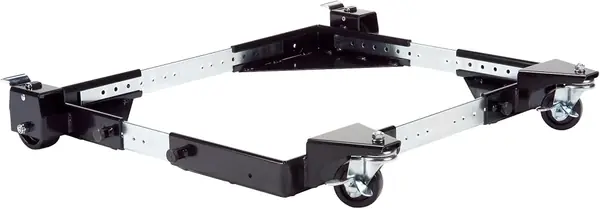
JET JMB-UMB universal mobile base with black steel side plates and four casters

Standard bandsaw stands

Shop Score 91/100
Load Capacity
600 lb
Height Added
1/2 inch
Footprint Range
18" x 18" to 28" x 28"
Caster Setup
Two locking swivel, two fixed
View on Amazon

Two spring-loaded knobs per side plate and the frame moves: the JET is the only base here that resizes without a wrench, and that one design decision is why we made it the default for a bandsaw. It runs from 18 by 18 inches square to 28 by 28, which takes in most 14-inch stands and plenty of larger ones, and four steel corner brackets carry the machine instead of a pair of sliding rails taking the load on their own.

What we noticed once a saw was on it is how little the base changes the machine. JET raises the tool half an inch, so a bandsaw table that was comfortable to work at stays comfortable, and the frame sits low enough that a tall saw doesn't feel perched. Two casters swivel and lock with a step; the pair at the other end is fixed and tracks straight when you pull the saw across the shop.

Assembly is the least eventful part of ownership. The side plates index into their holes, the casters bolt on with the included hardware, and there's no wrench in the process at all. Slow down when you square the frame, though: the caster brackets are the least rigid part of an otherwise stout base, and a frame set slightly out of square shows up as a wobble in a tall machine.

The 600-pound rating is headroom rather than a target; mount a 300-pound saw and the frame is barely working. That margin, plus the fact that resizing for a different machine takes a minute, is why this one stays our recommendation.

Worth Noting

  • Frame stops at 28 inches square
Our Verdict

For most floor-standing bandsaws, this is the base we point people to: it resizes without tools, locks solid, and barely changes your working height.

Check Latest Price
2.

Shop Fox D2058A Adjustable Mobile Base Best for Heavy Bandsaws

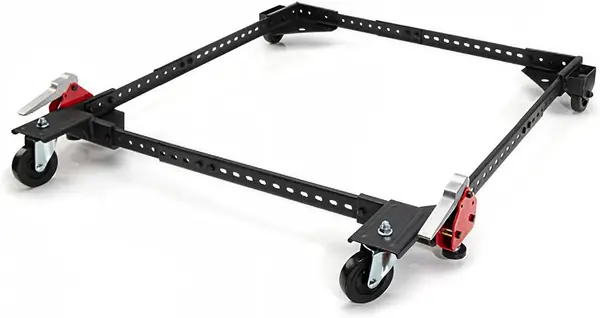
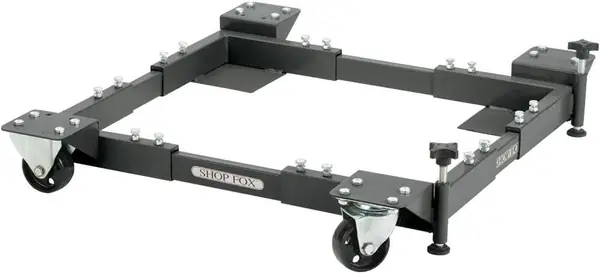
Shop Fox D2058A adjustable mobile base in steel with outrigger casters and retractable feet

Heavy floor-standing bandsaws

Shop Score 90/100
Load Capacity
1300 lb
Footprint Range
18-1/2" x 24-1/2" to 28-1/2" x 33-1/2"
Caster Layout
Two swiveling, two fixed on outriggers
Assembly Configurations
Eight
View on Amazon

A 1300-pound rating on a 34-pound frame reads like a typo until you see where the wheels sit. Shop Fox hangs its casters on outriggers outside the machine's footprint, so the saw rides as low as the casters allow, and the two-piece retractable feet at the corners are what actually carry it once you're cutting.

Those feet are the part we appreciate most. Each pad turns independently of its knob, so you can crank the frame level against an uneven garage floor with the pad already tight to the concrete, and the saw doesn't shift when you straighten up. Eight assembly configurations and a bolt pattern that lets you face the fixed wheels either way mean the frame can be built around a machine that isn't quite square to anything.

The footprint is where this base gets particular. This is the large version of the D2058A, and it builds rectangular at every setting, so a bandsaw with a near-square base can fall short of the rails at minimum extension. Measure both dimensions of the saw's base — not the tabletop — before you order.

Putting it together is a wrench job rather than a puzzle, and the finished frame reads as overbuilt in the way you want under a heavy saw. We also like how low the machine ends up sitting: on a big cabinet-style bandsaw, every extra inch of height is an inch of leverage you don't need.

Worth Noting

  • Magnet clips barely hold the retractable pads up
Our Verdict

If your bandsaw is heavy enough to make a 400-pound frame nervous, we reach for this one — as long as your stand measures more than it is square.

Check Latest Price
3.

VEVOR Mobile Base with 4 Swivel Wheels Best Heavy-Duty Value

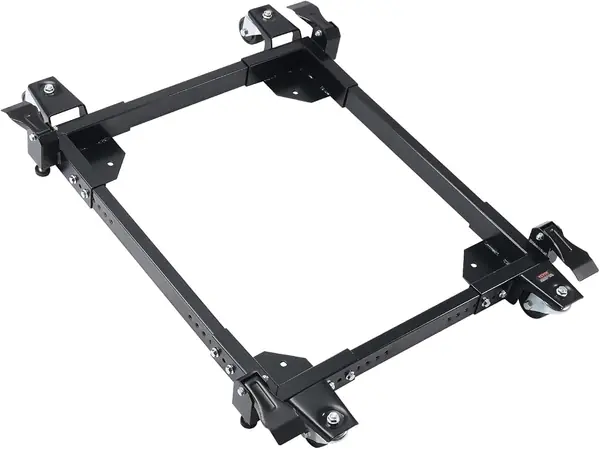
VEVOR mobile base in black carbon steel with four swivel casters and adjustment rails

Big heavy bandsaws

Shop Score 89/100
Load Capacity
1500 lb
Footprint Range
20" x 24.5" to 28" x 33.5"
Frame Weight
44.7 lb
Caster Layout
Four swivel
View on Amazon

Forty-four pounds of carbon steel arrives flat and bolts into a frame, and the mass is the point: put a heavy bandsaw on top and a weighty base keeps the whole assembly's center of gravity where you want it. VEVOR rates this one at 1500 pounds, which is more saw than most of us will ever own.

All four casters swivel, and that changes how the base behaves. Instead of steering one end and dragging the other, you can walk the saw sideways into a corner and swing the tail around after it. We like that freedom on open concrete; in a narrow aisle where the saw has to track straight, the two-swivel frames here are easier to aim.

The frame swallows larger stands, and the casters lock when the saw is parked, so it sits rather than rolls while you set up a cut. Assembly is straightforward — bolts, no fabrication — though the finished frame is heavy enough that standing it up and walking it into place goes better with a second pair of hands. For a machine that weighs more than you want to think about, that's the right trade: a little heft now, no drama later.

Worth Noting

  • Minimum footprint is 20 by 24.5 inches
Our Verdict

We like it for a big saw in a tight shop: 1500 pounds of capacity on four steering casters, with a heavy frame that keeps the machine planted.

Check Latest Price
4.

Steelman Universal Rolling Base Best Budget

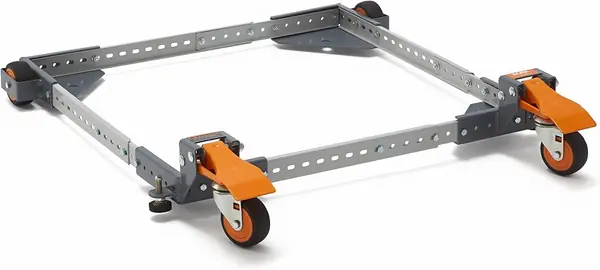
Steelman universal rolling base in gray and red steel with four casters and foot levers

14-inch bandsaws

Shop Score 88/100
Load Capacity
400 lb
Casters
Two swiveling, two fixed, 3 inch
Locking
Foot levers drop rubber-footed stabilizers
Side Adjustment
12 to 33 inches in 1-inch increments
View on Amazon

Two foot levers drop rubber-footed stabilizers to the floor, and that's the whole trick: the Steelman locks by taking the wheels out of the equation instead of braking them. We prefer that arrangement to a caster brake, because a bandsaw standing on four loaded feet can't creep the way one standing on locked wheels can.

The frame adjusts from 12 to 33 inches a side in one-inch steps, runs on two fixed and two swiveling 3-inch casters, and weighs just over 15 pounds in powder-coated steel — light enough to position by yourself, heavy enough to feel like a tool rather than a dolly.

Four hundred pounds is the ceiling. That clears any 14-inch bandsaw and stand with room to spare, and it rules out the cast-iron machines the Shop Fox and the VEVOR are built for, so know which side of that line your saw is on before you order.

The levers are what we keep coming back to. They work with a foot, the stops hold the saw where you left it, and there's no crouching behind the machine to set a brake before every cut.

Worth Noting

  • Instructions are thin on detail
Our Verdict

Our budget pick: the drop-down feet lock more convincingly than caster brakes, and it fits any standard 14-inch bandsaw stand.

Check Latest Price
5.

WEN MB500 Heavy Duty Mobile Base Best for Long Rectangular Footprints

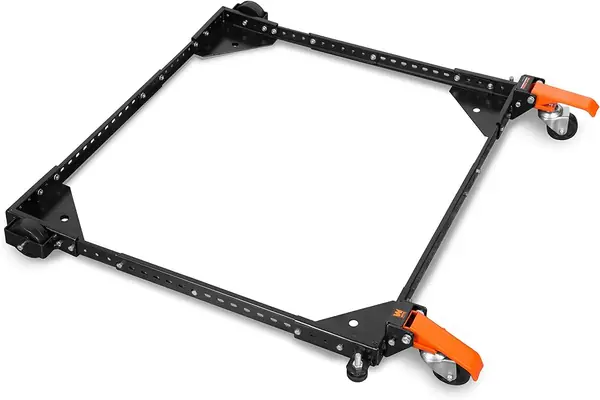
WEN MB500 mobile base in black steel with two fixed and two swivel casters

Long rectangular footprints

Shop Score 87/100
Load Capacity
500 lb
Casters
Two fixed, two swivel with foot brakes
Square Range
11.8" x 11.8" to 35.4" x 35.4"
Rectangular Range
Up to 51.2" x 19.7"
View on Amazon

Nothing else in this group swings as wide. The WEN goes from 11.8 inches square to 35.4 square, and it also builds a 51.2-by-19.7 rectangle — the setting for a long machine or a saw with a wide stance and rails sticking out past the frame.

At this end of the price range we expected stamped steel and a roll that wanders. What's here instead is a steel frame with ball bearings in the wheels and two foot brakes that hold it where you set it, and for a small shop with a 14-inch saw the combination of range and money is hard to argue with.

Two of the four casters are fixed, so the base tracks straight and steers from the front: predictable on a long run down the shop, less agile in a tight corner than the four-swivel VEVOR.

The other thing the money buys is a two-year warranty, longer than the one-year coverage most of these frames carry — worth having on a base with this many sliding parts.

Worth Noting

  • Leveling feet can leave the frame rocking
Our Verdict

We recommend it when your saw's footprint is wide or long and your floor is flat, because nothing else here adjusts this far for the money.

Check Latest Price
6.

BORA PM-2500 Adjustable Mobile Base Best for Odd-Shaped Machine Footprints

BORA PM-2500 adjustable mobile base in orange powder-coated steel with locking levers

Odd-shaped machine footprints

Shop Score 86/100
Load Capacity
650 lb
Height Added
About 1 inch
Wheels
3-inch ball bearing
Square Range
12" x 12" to 36" x 36"
View on Amazon

A 20-by-52-inch rectangle is the setting that sells this one. Long machines and saws with a wide stance fit a frame that shape without a plywood deck underneath or a pile of spacers at the corners.

The rest of the numbers are accommodating too: 12 inches square up to 36 square in one-inch steps, 650 pounds of capacity, and about an inch of added height. The 3-inch ball-bearing wheels handle the grit and offcuts that collect around a saw, and the locking levers are worked with a foot rather than a wrench.

What we like about one-inch increments is the honesty of them. Set the frame to a size, check the fit, and move it up or down a notch instead of hunting for the nearest half-inch — for a shop with one odd machine, that's the difference between a base that fits and a base that nearly fits.

Worth Noting

  • Instruction sheet is a few paragraphs and one tiny photo
  • Can sag near the top of its rating
Our Verdict

Buy this one when your machine's footprint is the awkward one — the one-inch steps and the 20-by-52 setting cover shapes nothing else here will.

Check Latest Price
7.

BORA PM-1000 Universal Mobile Base Best for Benchtop Bandsaws

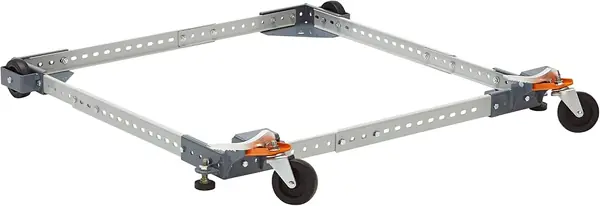
BORA PM-1000 universal mobile base in gray steel with hard rubber wheels and foot levers

Benchtop bandsaws

Shop Score 85/100
Load Capacity
400 lb
Height Added
Under 1 inch
Footprint Range
12" x 12" to 32" x 32"
Frame Weight
12.9 lb
View on Amazon

Treat 400 pounds as a ceiling rather than an invitation. This is the base for a benchtop bandsaw on a small stand; hang a 300-pound cast-iron saw on it and you're asking more of the frame than it wants to give.

What it does well is stay out of the way. The frame adds less than an inch of height, weighs under 13 pounds, and adjusts from 12 inches square to 32 square, or a 17-by-48 rectangle. Foot-operated levers lock it and 3-inch hard rubber wheels roll it, so getting one under a light machine is a one-person job.

What we didn't expect from the lightest frame here is how planted it feels with the levers down — the frame settles onto its feet and the saw stops moving. That's a small thing right up until you've tried to cut a curve on a base that rocks.

Worth Noting

  • Overmatched by saws above roughly 250 pounds
Our Verdict

We keep it in the guide as the light-saw option: it's the base for a benchtop bandsaw on a small stand, not for cast iron.

Check Latest Price
8.

KASTFORCE KF2005 Universal Mobile Base Kit Best for Custom Plywood Decks

KASTFORCE KF2005 mobile base kit in gray steel with four corners and plastic wheels

Custom plywood decks

Shop Score 84/100
Load Capacity
500 lb
Height Added
Under 1 inch
Wheels
3-inch hard plastic
Corner Size
6 inches
View on Amazon

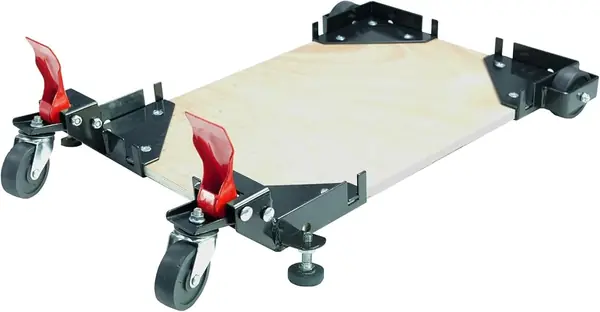
Six-inch corners are larger than most kits here, and that extra span is what lets a 500-pound machine sit on a plywood deck you cut yourself.

What arrives is four corners, four 3-inch hard plastic wheels, foot levers, and the hardware to join them; the deck is yours. Set the corners around your saw's footprint, cut 3/4-inch plywood to match, and screw it down through the predrilled, recessed holes — the recess matters, because it keeps the bolt heads below the surface the saw sits on.

The advantage of a kit is size. If your bandsaw's base is an odd number, or you want a deck a couple of inches wider than the machine so there's somewhere to set a push stick, you decide the dimensions instead of hunting for a frame that matches.

The trade is work: cutting, sealing, and drilling a deck is an afternoon a complete frame skips. We like the result anyway — a kit base ends up built to the saw, and six-inch corners mean the deck doesn't have to be perfect to sit flat.

Worth Noting

  • You supply, cut, and finish the plywood deck
Our Verdict

We like it for an exact-size build: the big corners hold a 500-pound machine on a deck you cut to fit.

Check Latest Price

How We Tested the Best Mobile Bases for Bandsaws

We started with spec sheets, because a mobile base either fits your saw's footprint or it doesn't. We compared published minimum and maximum settings, load ratings, caster layouts, and whether a frame arrived complete or as a corner kit that needs a plywood deck built for it. From that pool we ordered 12 bases and spent six months with them under bandsaws in a working garage shop, bolting each one to a saw and leaving it there through real projects, weighing what each cost against what its frame and casters actually delivered.

Assembly came first, timed solo with only the tools in the box, and we counted how many times we had to flip a frame over and how legible the instructions were at each step. Then we measured the height each base added with a straightedge against the floor, checked that the saw's own base sat fully on the rails rather than hanging over an edge, and shrank each frame to its smallest setting to see what it would actually hold.

Out in the shop, we rolled each saw over chipped concrete, extension cords, and piles of shavings, turned it 180 degrees in a tight corner, and noted where a caster hung up or a frame flexed. Before every cut we locked the base, dropped the feet where it had them, and tried to shove the saw sideways; then we resawed and watched for creep. We kept each saw comfortably under its base's stated rating and checked the saw's manual before mounting, since a base that rolls while the blade is running is a tip-over waiting to happen.

How to Choose a Mobile Base for Your Bandsaw

Measure the Footprint Before the Weight Rating

Every base here advertises a maximum size, and that's the number shoppers read first. The minimum is the one that decides whether you can use the thing. A frame that opens to 35 inches square may floor out at 20, and a stand smaller than that won't sit on the rails however you adjust them. Measure the saw's base — not the tabletop — in both directions and write the numbers down.

Then check the shape. Some frames build square, like the JET's 18-to-28-inch range, which suits a typical 14-inch stand. Others build rectangular and carry a longer minimum on one side, so a stand that's close to square is the case to check twice before you order.

Match the Rating to the Saw and Keep Some Margin

Ratings here run from 400 to 1500 pounds. A floor-standing 14-inch bandsaw with its stand usually lands between 250 and 400, which puts most of these frames in range and makes the lightest ones a judgment call: a 400-pound base asked to carry 400 pounds has nothing left for a fence, a jig, or the day you set a board on the table.

We want a couple of hundred pounds of headroom, and we also look at how the load reaches the floor. Corner brackets and drop-down feet carry weight better than sliding rails alone, which is why two frames with the same rating don't behave the same under the same saw.

How It Locks Decides How It Cuts

Three systems turn up here: a brake on the swivel casters, foot levers that drop rubber stabilizers to the floor, and two-piece feet you crank down. We rank them in that order, worst to best. A brake stops a wheel; a foot takes the wheel out of the equation, and a tall bandsaw standing on four loaded feet won't creep the way a braked one can.

Whichever you choose, park it on the flattest patch of floor you have and confirm all four feet are carrying weight. A frame rocking on three points is a saw that cuts a taper, and no amount of tightening fixes it.

Height, Casters, and Getting Around the Shop

Height added runs from half an inch to about an inch among these frames, and on a bandsaw that's more than it sounds: the table lands where your hands want it only if the base doesn't push everything up. A low frame also lowers the center of gravity on a tall machine, which is worth more than an extra inch of clearance underneath.

On casters, two swiveling and two fixed tracks straight and steers from one end; four swiveling turns inside its own footprint but wanders while you line up. Three-inch wheels are the practical minimum for chipped concrete and the offcuts that collect around a saw.

Complete Frame or Kit With a Deck You Build

The least expensive route to an odd footprint is a kit: four corners, wheels, and hardware, plus a plywood deck you cut, seal, and bolt on. It's the right call when your saw's base is an unusual size or you want a deck a little wider than the machine — budget an afternoon for it.

A complete frame goes together with wrenches in well under an hour and there's nothing to finish. Either way, lay the parts out and read the sheet before you start; fasteners and instructions are where the cheapest frames trim costs.

Frequently Asked Questions

Final Verdict

The JET JMB-UMB is the base we recommend for most bandsaws: two spring pins resize it, it carries 600 pounds, and it adds half an inch, so the saw you already like working at stays at the height you like working at.

If your bandsaw is genuinely heavy — a cast-iron 17-inch machine or a big cabinet saw — the Shop Fox D2058A's 1300-pound frame and outrigger casters are worth the extra money, provided the stand measures longer than it is square. And if you're fitting out a small shop around a 14-inch saw, the Steelman's drop-down feet lock better than anything else at its end of the price range.