↑↓ navigate ↵ open Esc close All results →

Best Drill Press Clamps of 2026

When a drill bit catches an unrestrained workpiece, the stock spins around the column in a fraction of a second, ruining the part and putting fingers near the chuck. Even a bargain clamp that creeps a quarter inch mid-cut pulls the hole off its layout mark; a proper vise or hold-down locks stock flat, square, and low enough to clear the quill.

Over eight months of bolting 12 drill press vises and hold-down clamps to a benchtop machine in both a garage and a basement shop, workholding reliability came down to slotted bases, V-groove jaws, quick-release screws, and swivel mounts. Because jaw width and maximum opening rarely match, and body height directly eats into quill travel, every model covered here fastens securely to the table rather than relying on hand pressure.

Our Top Picks

The Best Drill Press Clamps

1.

Wilton LP4 Drill Press Vise Best Overall
Wilton LP4 blue cast-iron low-profile drill press vise with V-groove jaws

General shop drilling

Shop Score 93/100
Jaw Width
4 inches
Max Opening
4 inches
Jaw Depth
1-1/2 inches
Mounting Slots
Four 1/2-inch shoulder slots
View on Amazon

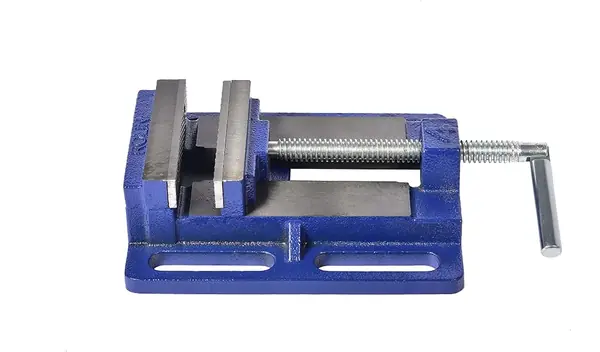
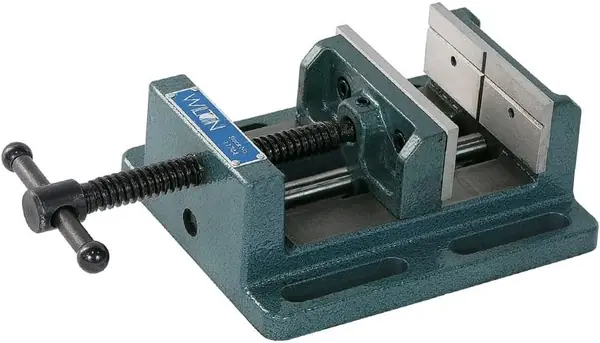
The first thing we noticed about the Wilton LP4 is how little room it takes up under the quill. The low-profile body and 1-1/2-inch jaw depth keep the work close to the table. On a benchtop drill press with short quill travel, that means you keep more of the bit's usable stroke instead of cranking the table down to clear a tall vise.

The 4-inch jaws open to 4 inches, and the hardened steel jaws have V-grooves that hold round bar vertically or horizontally as well as flat stock. We like that the V-grooves are cut into the jaws rather than sold as an add-on, because round stock is where a plain vise usually slips. Four 1/2-inch shoulder slots give you several ways to bolt it down, and the 11.6-pound cast-iron body stays planted once it is fastened.

Wilton machines the beds and bases parallel to within ±.001 inch, and that is the part we care about most. A drill press vise only helps accuracy if the jaws present the work square to the spindle, so the machined surfaces matter more than the paint. The LP4 is a fixed drilling vise, not a cross-slide or a milling vise; it is at its best when you set a stop or a fence and drill a straight hole.

The extra mass is a feature as long as your table can take it. We bolted ours through the shoulder slots and left it in place; the vise is heavy enough that it does not skate when the bit grabs. The trade-off is table space: this is not the smallest vise here, and the 4-inch opening will not swallow a wide board.

We recommend the LP4 as the default drill press vise for a home woodworking shop. It gives you a low profile, parallel jaws, V-grooves for round stock, and enough mass to stay steady, and those are the things that make drilling safer and more accurate. If you need a wider opening or a lighter vise, the IRWIN is the alternative we name; if you need to hold a large flat panel, go to the Strong Hand clamp.

Worth Noting

  • Jaw alignment can vary between units
Our Verdict

We recommend the Wilton LP4 for most drill press work: its low profile, parallel jaws, and V-grooves hold stock accurately without eating quill travel.

Check Latest Price
2.

IRWIN 226340 Drill Press Vise Best Light-Duty Vise

IRWIN 226340 blue forged-iron drill press vise with slotted base and textured jaws

Light benchtop drilling

Shop Score 92/100
Weight
16 oz
Base
Slotted
Jaw Capacity
4.5 inches
Clamping Pressure
1,000 lb
View on Amazon

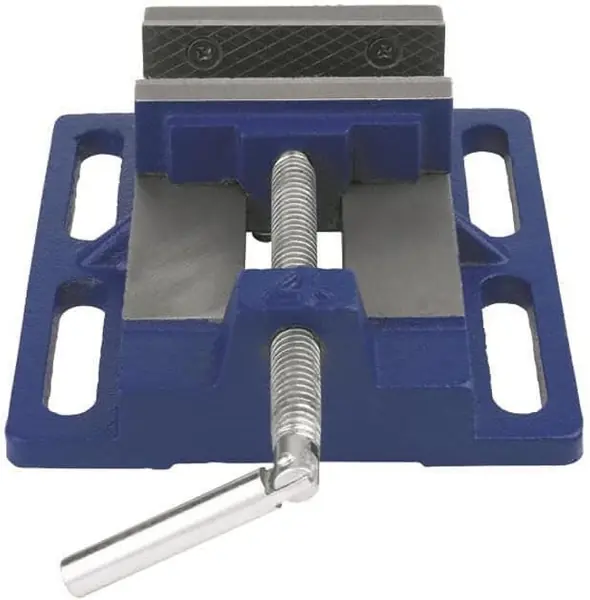
The IRWIN 226340 is the vise we suggest for light benchtop drilling, where you want a wider 4.5-inch capacity without a heavy lump on the table. It weighs about a pound, so you can lift it off the shelf, set it on the table, and bolt it down through the slotted base. That light body is also the catch: this is not a vise that stays put by its own weight, so the mounting bolts are doing the real work.

The forged-iron body and textured jaws are rated for 1,000 pounds of clamping pressure, and the textured faces give you more bite on slick stock than smooth jaws. We like the slotted base because it lets you position the vise where the bit needs to come down rather than centering it on the table. The 4.5-inch capacity is generous for a vise this light, and it gives you room for small jigs and fixtures as well as the workpiece.

What this vise does not do is add much mass. If you are drilling a lot of steel or working with a long lever, the Wilton LP4 is the steadier choice; the IRWIN is better for wood, plastic, and light metal where you can clamp the work low and keep the bit close to the jaws. We also treat the slotted base as a setup step, not an option: line up the slots, use washers, and snug the bolts before you drill.

Worth Noting

  • May not fit small benchtop tables
Our Verdict

We like this one for light benchtop drilling where you want a wider 4.5-inch capacity and a vise you can move easily.

Check Latest Price
3.

Strong Hand Tools PTTD634 Drill Press Clamp Best Hold-Down Clamp

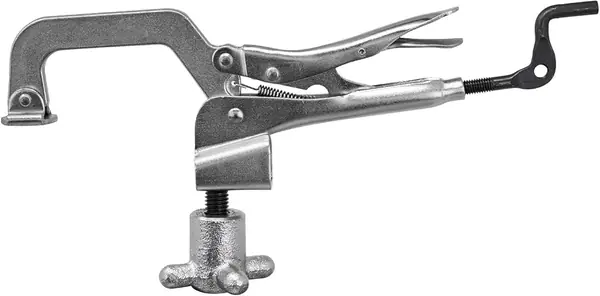
Strong Hand Tools PTTD634 metallic drill press clamp with crank handle and stud

Large flat stock

Shop Score 91/100
Weight
1.61 lb
Throat Depth
3.4 inches
Mounting
Surfaces up to 1 inch thick
Max Clamping Capacity
3.3 inches
View on Amazon

A vise is the wrong tool for a wide flat panel. The Strong Hand Tools PTTD634 is a hold-down clamp that locks the work against the table instead of squeezing it between jaws, and that is the shape of workholding many drill press jobs actually need. It mounts through a 1/2-13 stud to any surface up to 1 inch thick and uses a crank handle to set the jaw opening and torque.

We reach for this clamp when we need to keep both hands clear and the workpiece is too big for a vise. The 3.3-inch clamping capacity and 3.4-inch throat give it more reach than a small vise, and the quick lock-and-release mechanism makes repeated parts faster. We like the crank handle because it lets you preset the opening for a run of parts, then lock and unlock without readjusting the screw every time.

The limit is your table. The clamp mounts through a hole or slot, and it works best on a table with enough thickness and stiffness to take the load. On a thin stamped table, add a backing plate so the stud does not pull through. For a large flat workpiece, though, it does what a vise cannot, and it keeps your fingers farther from the bit.

Worth Noting

  • One-point hold lets long stock pivot
Our Verdict

We reach for this clamp when a vise won't fit: it locks large flat stock fast and keeps your hands away from the bit.

Check Latest Price
4.

MYTEC 4.2-Inch Quick-Release Vise Best Quick-Release Vise

MYTEC black 4.2-inch quick-release drill press vise with 110-degree swivel base

Quick-release workholding

Shop Score 90/100
Weight
12.5 lb
Jaw Width
4.2 inches
Max Opening
4.25 inches
Swivel Base
110 degrees
View on Amazon

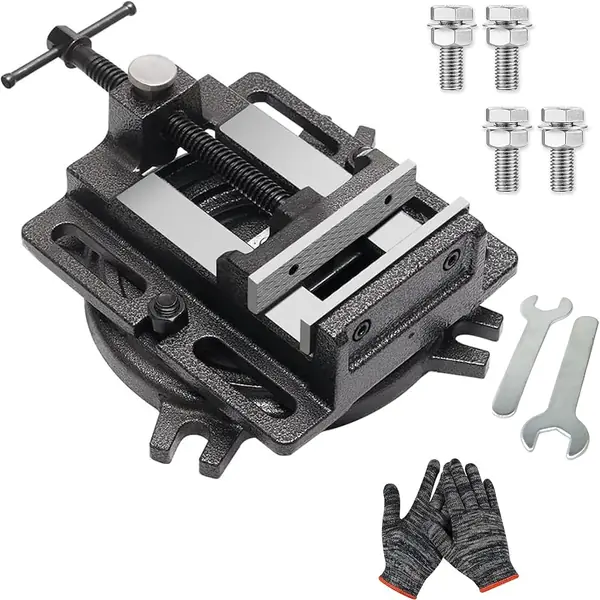
The one-click release on the MYTEC 4.2-inch vise is the reason to look at it. Press the button, push the jaw to the work, and you are clamped; press again to release. That is a different rhythm from a screw vise, and it is welcome when you are drilling a run of similar parts or moving between sizes.

The 110-degree swivel base is the second useful trick. It lets you angle the vise on the table instead of moving the work in the jaws, which can help when a hole has to go in at an angle or when the table slots do not line up with the bit. The 4.2-inch jaws open to 4.25 inches, and the 12.5-pound cast-steel body gives it enough mass to feel planted once you bolt it down.

We choose this vise when speed matters more than the last word in precision. The quick-release mechanism is not as fine an adjustment as a screw, so we set the jaw close and use the button for the last bit. The swivel base also adds footprint: at 7.4 by 7.4 inches, it needs a table with room around the bit. On a small benchtop press, check that the base clears the column and the table edges before you commit.

For a shop that drills a lot of repetitive holes and wants to swing the vise out of the way between operations, the quick release and swivel earn their space. We tighten until the work is secure and stop there; this is a vise for normal drilling, not for leaning on the handle.

Worth Noting

  • Main adjustment bolt can strip under heavy torque
Our Verdict

We choose this vise when speed matters, thanks to its one-click release and swiveling base that make repeated setups quicker.

Check Latest Price
5.

ROLIN 4-Inch Drill Press Vise Best Budget Vise

ROLIN blue 4-inch cast-iron drill press vise with hardened steel jaws

Budget benchtop drilling

Shop Score 89/100
Weight
6.5 lb
Jaw Width
4 inches
Max Opening
4.33 inches
Material
Gray cast iron
View on Amazon

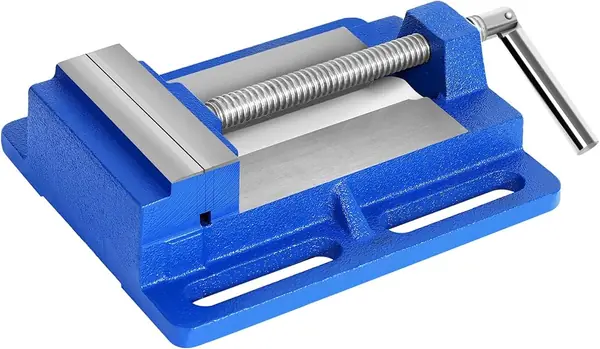
The ROLIN 4-inch vise is the value pick in this group: a cast-iron body, hardened steel jaws, and a 4.33-inch opening for about the same money as the small 3-inch vises. We recommend it for a benchtop drill press where you want a real vise but do not need the low profile or the V-grooves of the Wilton. The 6.5-pound body is heavy enough to sit still when you set it down, though you should still bolt it through the base.

The 4-inch jaws and 4.33-inch opening give you a little more room than the size suggests, and the screw moves freely enough to set the work without fighting it. We like the plain, open body because it is easy to brush chips out of the ways. For wood, plastic, and light metal, it is a lot of vise for the money.

Worth Noting

  • Jaws are not as refined as premium vises
Our Verdict

Our value pick is the ROLIN 4-inch: a stable cast-iron body and a wide opening without a premium price.

Check Latest Price
6.

WEN DPA423 3-Inch Drill Press Vise Best for Small Benchtop Drills

WEN DPA423 silver 3-inch cast-iron drill press vise with four mounting slots

Small benchtop drills

Shop Score 88/100
Jaw Width
3 inches
Max Opening
3-1/10 inches
Throat Depth
1 inch
Mounting
Four onboard slots
View on Amazon

The WEN DPA423 is small enough to leave on a crowded benchtop table. The 3-inch jaws open to 3-1/10 inches, and the 1-inch throat depth keeps the body low, so it does not crowd the quill on a small drill press. Four onboard mounting slots give you more placement options than the size might suggest.

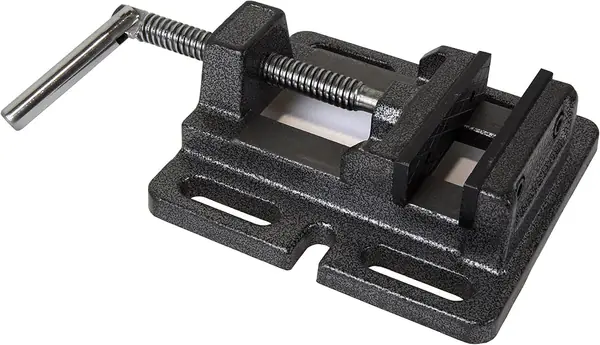
The cast-iron body weighs 4.87 pounds, which is enough to feel solid but not so much that you dread moving it. We like it for light woodworking and plastic, and for holding small jigs that would be awkward in a bigger vise. The four slots make the mounting obvious: line up two bolts, snug them down, and the vise stays put.

We recommend the WEN for a small benchtop drill press or a second work station where a full-size vise would take over the table. It is also a sensible first vise because the low throat and small body are forgiving on a short-quill machine. If you need more opening or more mass, step up to the ROLIN or the Wilton; if you need to hold a flat panel, use a clamp instead.

Worth Noting

  • 3-inch jaws limit wide stock
Our Verdict

We keep this compact 3-inch vise in mind for small benchtop drills where a full-size vise crowds the table.

Check Latest Price
7.

Forward Q193A 3-Inch Drill Press Vise Best for Low-Cost Small Work

Forward Q193A blue 3-inch cast-iron drill press vise with slotted base

Low-cost small work

Shop Score 87/100
Jaw Width
3 inches
Max Opening
3.15 inches
Jaw Height
0.79 inches
Clamping Force
1,760 lb
View on Amazon

The Forward Q193A caught our eye with its 1,760-pound clamping force and 30,000-psi cast-iron body. Those are big numbers for a 3-inch vise, and they matter if you are drilling small metal parts that want to spin. The jaw height is only 0.79 inch, so the vise stays low and leaves room for the bit.

We recommend it for low-cost light drilling where you want a high clamping-force rating without a larger opening. The 3.15-inch jaw opening is the limit; for bigger stock, step up to the ROLIN. For the money, it is a capable little vise for wood, plastic, and light metal, especially if you bolt it down and keep the work low in the jaws.

Worth Noting

  • Sharp edges may need filing
Our Verdict

We suggest this low-cost 3-inch vise for light drilling where high clamping force matters more than a large opening.

Check Latest Price
8.

ArtyMaster Mini Drill Press Vise Best for Crafts and Jewelry

ArtyMaster black and red mini aluminum drill press vise with rubber soft jaws

Crafts and jewelry

Shop Score 86/100
Weight
1.04 lb
Material
Aluminum
Jaw Type
V-grooved with rubber soft jaws
Clamping Range
0 to 2.48 inches
View on Amazon

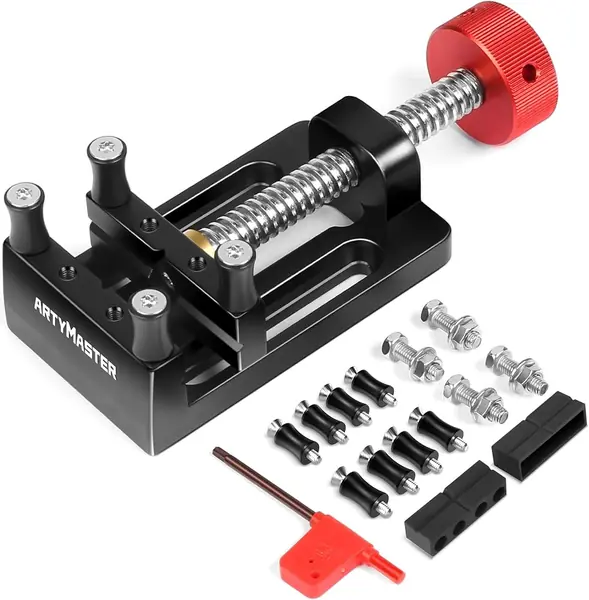
The ArtyMaster mini vise is not trying to hold a deck board. Its 0-2.48-inch clamping range and 1.04-pound aluminum body are sized for small parts: jewelry blanks, model pieces, small turnings, and anything else that would disappear in a full-size vise. The rubber soft jaws are the detail we appreciate most, because they grip without leaving jaw marks on soft material.

The V-grooves on both sides give you a place to cradle round stock, and the one-piece clamping block is designed to keep the moving jaw level as it closes. We like that the body is anodized aluminum with a nickel-plated screw; it resists rust and wipes clean, which matters if you use it around wet polishing or lapidary work.

The mini vise is light enough to carry to a craft table, and the compact footprint leaves room for a Dremel or small drill press. It also comes with a flag wrench, a POM column screw, and rubber pads, so you can set it up without hunting for extra hardware. The trade-off is that aluminum is not the material for heavy drilling; this is a precision holding tool, not a shop vise for steel.

We recommend it for crafters and modelers who need a third hand for tiny work. It holds delicate parts firmly, and the soft jaws protect finishes that a serrated vise would scar. If you are drilling wood or metal at drill-press scale, choose one of the cast-iron vises instead; the ArtyMaster is at its best when the part is small and the bit is small too.

Worth Noting

  • 2.48-inch opening limits larger parts
Our Verdict

We use this mini vise for delicate parts, where its soft jaws and V-grooves hold small shapes without crushing them.

Check Latest Price
9.

Elsjoy 2-Pack Drill Press Clamps Best for Two-Sided Clamping

Elsjoy silver two-pack 9-inch drill press clamps with T-slot bases

Two-sided clamping

Shop Score 85/100
Material
1045 carbon steel
Throat Depth
3 inches
Pack Count
2 clamps
Jaw Opening
2 inches
View on Amazon

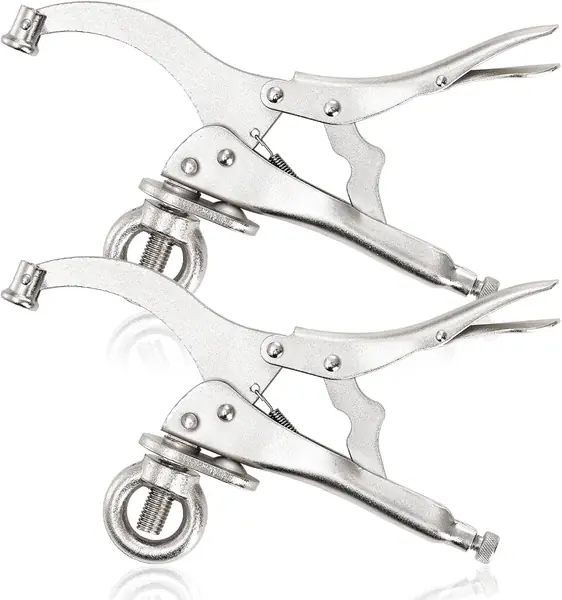
Two clamps in one pack is the whole idea behind the Elsjoy set. A single hold-down clamp can let a long workpiece pivot; two clamps let you pin both ends to the table and keep the part from spinning when the bit bites. Each clamp has a 2-inch jaw opening, a 3-inch throat, and a T-slot base that slides into a table slot or a fixture.

The 1045 carbon steel body has a titanium coating and a pre-oiled finish, and the spring-loaded mechanism self-locks when you set it. We like the lever handle because it releases quickly, and the knurled knob lets you preset the jaw opening for repeat parts. The T-slot base is the part that makes them useful on a drill press table: you can position them where the work needs support rather than where the table happens to have a hole.

The 2-inch jaw opening means these are for flat stock and edges, not for holding a tall block. For a benchtop table with slots, though, two clamps give you a lot of holding options for the money. They are also handy as a second set of hands on a welding table or a drill press fixture.

We recommend the Elsjoy pair when you want to hold a wide panel or a long board without buying a large vise. If your work is mostly small parts, a vise is faster; if it is flat and wide, two clamps are the better shape. Check that your table has a slot or a hole for the base bolt before you order.

Worth Noting

  • Can feel large on small 9-inch drill presses
Our Verdict

This pair earns our recommendation when you need to clamp both ends of a long workpiece and want a fast, self-locking setup.

Check Latest Price

How We Tested Drill Press Clamps

We started with spec sheets and the numbers that actually matter on a drill press table: jaw width, maximum opening, jaw depth, and how far the body sits above the table. From a long list of vises and hold-down clamps we narrowed to 12, favoring slotted bases and table-grip mounting that would fit common slot spacing, then bought each one at retail.

Each unit spent eight months bolted or clamped to a benchtop drill press and a larger floor-standing press, doing the ordinary mix of shop work: flat aluminum bar, bracket plates, hardwood blocks, and round stock held in V-groove jaws. We checked fit the day each one arrived by running the mounting bolts through the slots, then rocked the base by hand to see whether it sat flush or needed shimming.

For jaw alignment we clamped a machined block, ran a feeler gauge around the jaws, then drilled and watched whether the bit wandered. We measured clearance under the quill with the vise mounted and the chuck lowered, and supported long stock off the table to see whether it could pivot. Smooth operation got its own pass: we ran every screw, crank, and quick-release through repeated open-and-close cycles, looked for backlash and creep under load, then ran a thumb along the edges to catch burrs and rough casting lines.

Durability and sturdiness we judged by weight and by what eight months did to each one — sloppy threads, scarred jaws, paint flaking off a base. Value came last: what each clamp cost against how much grip and how much setup time it bought.

How to Choose a Drill Press Clamp

Pick the workholding shape first

A drill press vise is the better choice for small blocks, round bar, and parts you will drill again and again, because the jaws locate the work and the vise stays in one place. A hold-down clamp is the better choice for wide panels, odd shapes, and anything too large for jaws, because it presses the work against the table and keeps your hands clear. We keep both shapes in the shop; the vise does most of the drilling, and the clamp takes the jobs the vise cannot hold.

Measure the table, slots, and quill clearance

We prefer a low-profile vise on a benchtop drill press with short quill travel. The Wilton LP4 is about 3 inches tall, which leaves more room for the bit; a taller vise can force you to lower the table and lose usable stroke. Check the base footprint and the slot spacing against your table, not just the jaw size. A compact vise can still have a wide base, and a swivel model like the MYTEC needs a 7.4-inch square of table clear of the column.

Read jaw width and opening as two numbers

Jaw width is the width of the jaws; maximum opening is how far apart they spread. They are not the same, and a vise with 4-inch jaws may open to 4.33 inches or only 4 inches. Match the opening to the stock, and match the jaw style to the shape: V-grooves for round bar, serrated jaws for grip, smooth or soft jaws for finished surfaces. If you drill a lot of round stock, the Wilton's V-grooves earn their keep; for flat work, a wider opening like the ROLIN's 4.33 inches is more useful.

Plan the mounting and the safety setup

Every vise and clamp here needs to be fastened to the table; none is a substitute for hand pressure. Use the base slots or T-slot with the largest bolts that fit, add washers, and check that the vise sits flat before you tighten. On a thin table, a backing plate spreads the load. Keep the work low in the jaws, support long stock so it cannot pivot, and keep your hands out of the bit's path. Two clamps are better than one for a long panel.

Frequently Asked Questions

Final Verdict

We recommend the Wilton LP4 as the default drill press vise for most home shops. Its low profile preserves quill travel, its parallel jaws and V-grooves hold round and flat stock, and its 11.6-pound body stays put once bolted down. If your work is a wide flat panel, the Strong Hand PTTD634 clamp is the better shape; if you want a budget 4-inch vise, the ROLIN is our value pick.