↑↓ navigate ↵ open Esc close All results →

Best Drill Press Stands of 2026

A drill press stand only solves bit wander and angled holes if its column and base hold still when the bit bites into stock. What separates dependable units from frustrating ones rarely shows up in product photos: solid base mass and a positive depth stop matter far more than extra tilt detents, and the bolts from an evening of assembly always deserve a second pass with a wrench.

Drilling aligned rows of holes across 11 stands over eight months split the category cleanly between heavy benches for bolting down a benchtop machine and compact stands that hold a hand drill—via a neck collar, an integrated chuck, or a rotary-tool cradle. Both types are represented ahead, grouped by how securely they anchor the tool and put each hole on its mark.

Our Top Picks

The Best Drill Press Stands

1.

wolfcraft 5027000 Drill Stand Best Overall
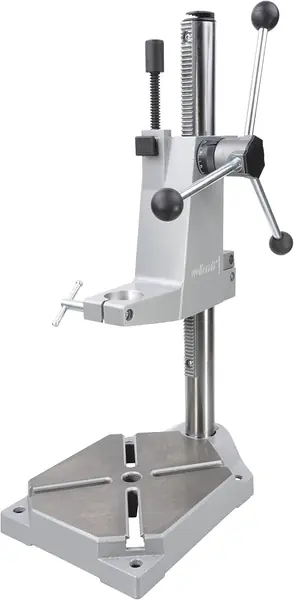
wolfcraft 5027000 silver die-cast drill stand with round column and three-arm feed lever

Precision vertical drilling

Shop Score 90/100
Weight
17.6 lb
Column
40 mm with 420 mm rack
Drill Collar
43 mm Euronorm
Drilling Capacity
40 mm wood, 10 mm metal
View on Amazon

The 5027000 has no chuck of its own. It clamps your drill by the neck — a 43 mm Euronorm collar — and lets the drill's own chuck do the cutting, so the torque you feel at the bit is the torque of the tool you already own. That is the whole architecture of the thing: a stand, a column, and a feed mechanism standing in for your arm.

What separates it from everything else here is that feed. A three-arm lever drives the head down a 40 mm column riding a 420 mm toothed rack, so the bit advances at a rate you set rather than a rate your shoulder can manage. We like the depth stop for the same reason: a quick adjuster gets you close, a scale ring gets you exact, and a run of holes ends at the same depth as the first. Height adjustment runs on the same rack, continuously, with no pins to hunt for.

The rest is die-cast aluminum and stated capacity — 40 mm in wood, 10 mm in metal — in a unit about 23 inches tall and 17.6 lb. It takes roughly two feet of bench depth and under ten inches of width, so it can live at the end of a bench without displacing the whole surface.

What we keep coming back to is how little of the result depends on us. The lever sets the pace, the column holds the head square, and the depth stop repeats. The variables left are the bit and the layout, which is exactly where you want them.

Worth Noting

  • Only holds drills with a 43 mm collar
Our Verdict

For a drill with a 43 mm collar, the wolfcraft is the stand we recommend: lever feed, a rack-and-pinion column and a depth stop that repeats.

Check Latest Price
2.

Dremel 220-01 Rotary Tool Workstation Best for Rotary Tools

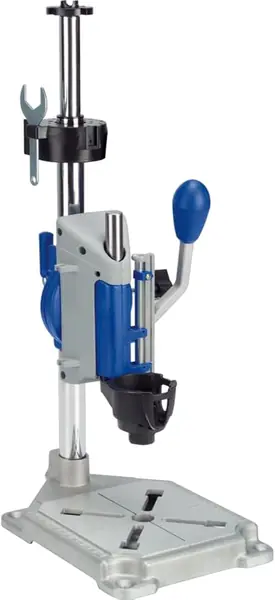
Dremel 220-01 rotary tool workstation stand in blue gray and black with metal base

Rotary tool drilling

Shop Score 89/100
Weight
4.9 lb
Angle Range
15-degree steps to 90 degrees horizontal
Drilling Depth
2 inches
Flex-shaft Height
16 to 29 inches
View on Amazon

Two inches is the working depth, and it decides who this is for. The 220-01 gives a Dremel rotary tool a plunge head, a depth stop, angle settings and a base with inch and metric markings, but the bit only travels two inches — plenty for pen blanks, jewelry, circuit boards, model parts and hinge screws, not enough for a through-hole in a 2x4. For small-scale work it is the pick we keep closest to the bench, and at 4.9 lb it is the only stand here that goes back on the shelf when you are done.

Three tools share one casting. Upright, it is a mini drill press that swings through 15-degree increments all the way to 90 degrees horizontal for angled holes. Laid flat, the cradle holds the tool horizontally for polishing, grinding and sanding with both hands free. Add a flex shaft and the same frame becomes a stand with telescopic height from 16 to 29 inches — a setting that puts the handpiece where the work is instead of where the tool body has to sit.

Details we appreciate: the crow's nest at the back holds bits, wrenches and collets; cord clips keep the lead clear of the cut; the depth stop makes a run of holes repeat. The plunge is the compromise — a light casting on sliding ways can show side play in harder material, so we treat this as a craft and repair station rather than a joinery tool.

Worth Noting

  • Tool cradle fits Dremel's listed rotary models
Our Verdict

We keep the 220-01 for craft-scale work: it turns a Dremel into a small drill press with a depth stop and angle settings, and it fits on a shelf.

Check Latest Price
3.

POWERTEC UT1002 Tool Stand Best for Benchtop Drill Presses

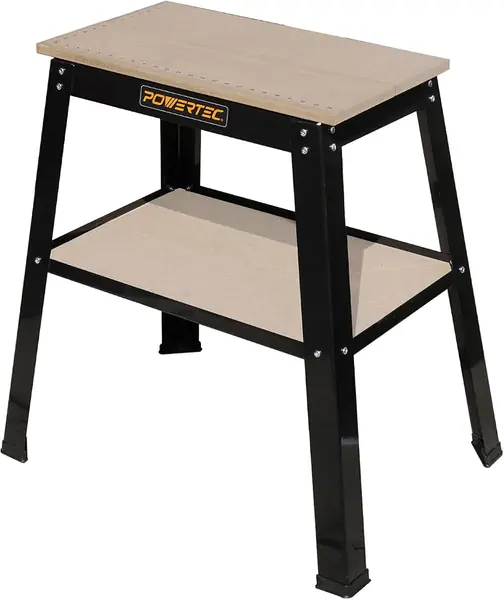
POWERTEC UT1002 steel tool stand with split MDF top and lower storage shelf

Benchtop drill presses

Shop Score 88/100
Top Size
14 x 25 in, expands to 20 x 25 in
Load Capacity
500 lb
Shelf
18 x 27 in
Work Height
32 inches
View on Amazon

Two MDF panels make the top, and they slide apart. Closed, the surface is 14 x 25 inches; opened, it is 20 x 25 — which is how a stand this size swallows a benchtop drill press with a wide base and a vise bolted to one end. Below, an 18 x 27 inch shelf takes the clamps, the bit index and the chuck key that would otherwise go missing.

The frame is powder-coated steel rated to 500 lb, with rubber feet that soak up machine vibration and keep the legs from walking across a smooth floor. Working height is 32 inches. With a benchtop drill press on top, that makes it a standing tool rather than a stooping one, and we think that is the specification to compare first.

What we value most is how little it asks of you. There is nothing to adjust, nothing to plug in and nothing to learn: the machine bolts down, the feet settle, and the stand disappears under the work. It is a fixed piece of furniture once it is loaded, so site it with the shop layout in mind and leave it there.

Worth Noting

  • No casters or wheels for moving it
Our Verdict

Own a benchtop drill press already? The UT1002 puts it at a standing 32 inches on a top that widens to fit a wide base, and it holds 500 pounds.

Check Latest Price
4.

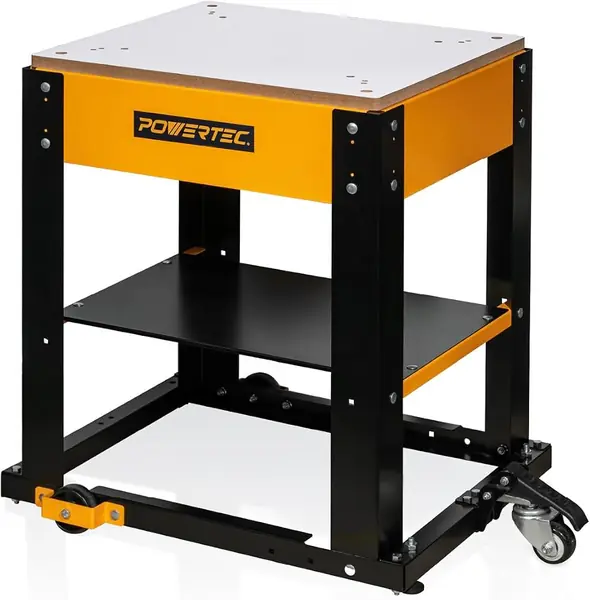
POWERTEC UT1008 Mobile Tool Stand Best Mobile Stand

POWERTEC UT1008 mobile tool stand with melamine MDF top wheels and orange frame

Rolling tool stations

Shop Score 87/100
Weight
53.3 lb
Top Size
23-1/16 x 20-1/8 in
Height
29.5 in with top
Mobility
Wheels, levelers and lever caster
View on Amazon

Fifty-three pounds of steel arrives flat in a box, and once it is together the stand is meant to roll: wheels at one end, levelers at the other, and a lever that drops the casters so the whole thing rides instead of sits. In a one-bench shop, that is the difference between owning a drill press and actually using it.

The top is melamine-faced MDF, 23-1/16 x 20-1/8 inches, with pre-drilled holes for mounting the machine and a surface that wipes clean after glue and finish spills. Height with the top on is 29.5 inches, and a 23-7/16 x 15 inch shelf sits 11-3/4 inches up for clamps and bits.

We pay close attention to the levelers. With a drill press up top, the stand is steadiest with the feet down and the casters lifted, so the lever gets used every time the stand comes to rest. Roll it on smooth concrete or plywood — the small wheels are not built for a gravel apron.

What we like is that mobility does not cost you the machine. Roll it to the door for a hinge job, drop the feet, drill, roll it back: the stand stays at working height the whole time and nothing has to be unbolted. If your shop is a corner of a garage rather than a room, this is the one to plan around.

Worth Noting

  • 53.3 lb frame takes patience to assemble
Our Verdict

If your shop has one open floor and three tools, the UT1008 rolls a benchtop drill press to the work and locks down when you drill.

Check Latest Price
5.

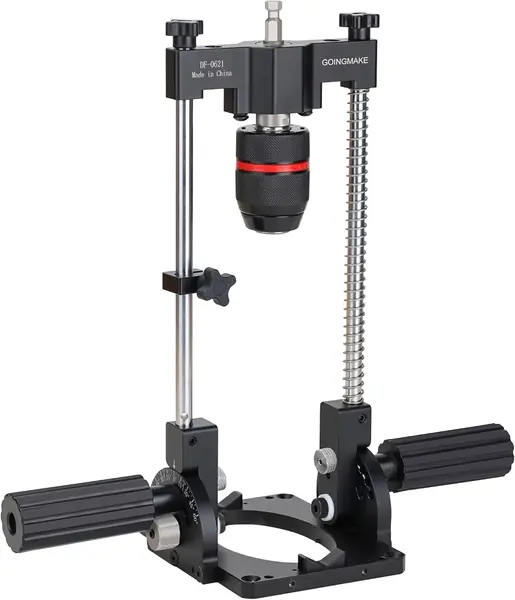
GOINGMAKE Portable Drill Guide Best Portable Drill Guide

GOINGMAKE portable drill guide in black metal with half-inch keyless chuck and angle stops

Angled holes by hand

Shop Score 86/100
Weight
4.86 lb
Chuck
1/2 in self-locking
Drill Fit
3/8 in and 1/2 in drills
Angle Stops
90 to -60 degrees
View on Amazon

Nine stops are cut into the frame — 90, 60, 45, 30, 15, 0 and the three negatives — and two locking handles pin the head at the one you chose. Set 45 once and the next hole is 45 too, without a protractor and without re-checking.

That repeatability is what we like most about it. A guide without positive stops drifts between holes, and the drift is what ruins a chair leg. Around the stops there is a 1/2 inch self-locking chuck that holds bits without a key, a V-groove in the base for round stock, and mounting holes for screwing it to a bench or a jig. At 4.86 lb it is a portable drill press you can carry to the job.

It is still a guide you hold, not a stand with a feed lever — you supply the downward force, which is fine for a half-inch bit in pine and tiring in oak. Set it over a scrap first and check the angle against a square before the real workpiece goes under it.

Worth Noting

  • Short bits may not reach the workpiece
Our Verdict

We reach for the GOINGMAKE when the hole has to be at 45 degrees: nine locking stops, an all-metal body and a keyless half-inch chuck.

Check Latest Price
6.

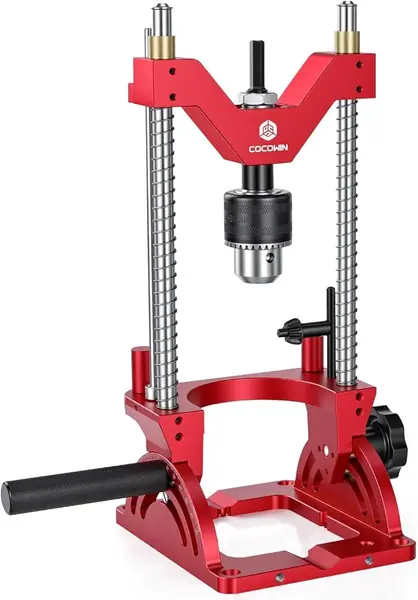
Cocowin Portable Drill Guide Best for Stepless Angle Work

Cocowin portable drill guide in red aluminum with printed angle dial and chuck

Stepless angle work

Shop Score 85/100
Weight
6.2 lb
Chuck
1/2 in
Angle Range
0 to 60 degrees
Frame
Aluminum alloy
View on Amazon

We take the Cocowin when the angle is not a round number. Where the GOINGMAKE clicks into nine presets, this one slides: a laser-printed dial runs 0 to 60 degrees continuously, so 37 degrees is a setting rather than a compromise between stops.

The rest of the build aims at the same kind of work: an aluminum frame with a central encircling support bar, a V-groove for pipe and dowel, dual removable center pins for finding the mark on round stock, and a 1/2 inch chuck. It packs into 17.83 x 10.2 x 5 inches, so it travels in a tool bag and sets up on a jobsite.

What struck us setting it up is how much of the adjustment you can simply read: the dial is printed rather than stamped, and the center pins pull out when you do not want them in the way. Against the GOINGMAKE you are trading the certainty of a stop for the flexibility of a scale, and that trade is worth making only if odd angles genuinely come up in your work. For a run of 45s, the stops win.

Worth Noting

  • Heavier 6.2 lb body than the other guides
Our Verdict

The Cocowin earns its place when your angle is not on anyone's preset: a stepless 0 to 60 degree dial, at the cost of extra weight and money.

Check Latest Price
7.

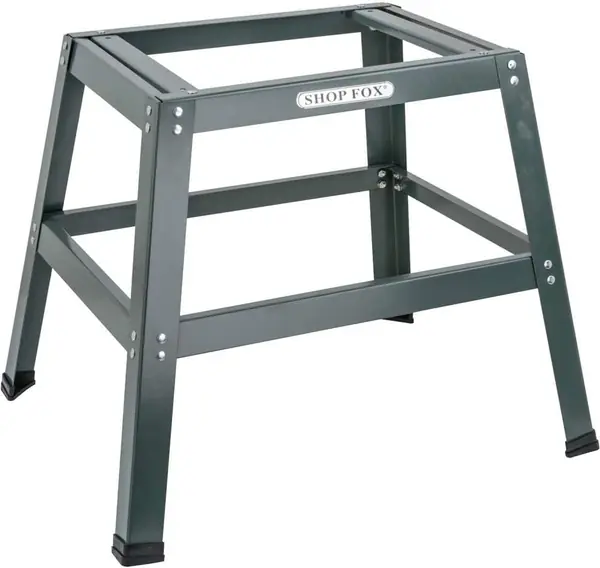
Shop Fox D2275 Tool Stand Best for Heavy Benchtop Machines

Shop Fox D2275 black steel tool stand with open frame and non-slip rubber feet

Heavy benchtop machines

Shop Score 84/100
Top Size
18 x 22 in
Height
24 inches
Load Capacity
1,000 lb
Feet
Non-slip rubber
View on Amazon

A thousand pounds is the rating, and the frame looks it: steel legs, cross braces under the top, rubber feet at the bottom. Nothing about it is fussy — no wheels, no lever, no adjustment beyond where you put it.

The top measures 18 x 22 inches, big enough for a benchtop planer, a table saw or a bench grinder, and the open frame leaves room to drop a plywood shelf onto the cross braces for blades and push sticks. It is a stand you plant and load, then forget about.

Where it earns its place is under weight. We think of the D2275 as the heavy-tool stand: put a heavy machine on it and the frame does not care, the feet do not skate, and nothing about the setup invites a second thought. Whether your drill press belongs on it depends on how you work — most drill presses want the extra height a 32-inch stand gives, while a planer or a benchtop saw is easier to feed from a low top like this one.

Worth Noting

  • 24-inch height sits too low for most drill presses
  • No wheels, height adjustment, or included lower shelf
Our Verdict

The D2275 is the stand for a heavy benchtop tool that never moves: 1,000 pounds of capacity, a steel frame and a low, settled top.

Check Latest Price

How We Tested Drill Press Stands

We started with the tool, not the stand. Stands in this category hold a drill three different ways — a collar that clamps the drill's neck, a chuck the stand supplies itself, or a cradle for a rotary tool — while others are benches a machine bolts onto, so we sorted candidates by type first, then by column diameter, table size, working height, and footprint. Eleven stands came in for testing, and we used them for eight months.

Assembly came first, timed solo with the hardware that shipped in the box; we noted screws that stripped, holes that didn't line up, and how much one person could do without a second pair of hands. Then we bolted or clamped a tool to each stand, through the mounting holes every time, and drilled row after row of holes in plywood, checking each depth against the last with a caliper. We pushed the head sideways with the quill down to see how much a column flexed, ran round stock and a 45-degree cut to see whether the angle stops came back to zero, and kept every cut inside the maker's stated drilling capacity and load rating.

Stability showed up in use: whether a base walked across the bench mid-hole, whether a wheeled stand cleared an extension cord or the lip of a garage threshold, and whether the levelers took the rock out of a sloped floor. We also watched the small things — finding nowhere on the frame to route a cord or zip-tie a power strip is a daily annoyance — and how the finish held up to chips, glue drips, and being leaned on for eight months. Value was the last question: what a stand did versus what it cost.

How to Choose a Drill Press Stand

Pick the type of stand before the model

The names blur, but four different products get sold as drill press stands. A machine stand holds a benchtop drill press and drills nothing itself — it is a table with a load rating, which is exactly what the POWERTEC and Shop Fox picks are. A collared drill stand grips a power drill by its neck and adds a feed lever. A drill guide, sometimes sold as a portable drill press, clamps around a hand drill and brings its own chuck, so the whole setup travels to the work. A rotary workstation does the same at craft scale.

The trap is buying across types. A machine stand cannot hold a hand drill, and a guide cannot carry a benchtop machine, no matter how good either one is.

Rigidity decides whether the hole is straight

Side play is the failure mode here, not lack of power. It comes from the column and the ways the head slides on: a 40 mm column on a screwed-on rack resists twist in a way a thin tube on a light casting cannot, and a tall guide with a small base flexes under a big bit however hard you grip it.

Look for metal ways or bushings, a base with mounting holes, and a column diameter matched to the bits you actually use. Above about half an inch, rigidity matters more than any feature on the box.

Feed and depth stop: what makes holes repeat

Either a three-arm lever on a rack and pinion or a spring-loaded plunge beats pushing down on the drill body, because what you are buying is a controlled rate of feed. The other half is the depth stop. A scale ring and quick adjuster let you set a depth once and repeat it a dozen times; a plain thumbscrew stop gets you close.

If you drill shelf pins, hinge cups or dowel holes in runs, spend your money on the depth stop before anything else on the stand.

Height, footprint, and whether it moves

Working height across our picks runs 24, 29.5 and 32 inches, and the difference is where your hands end up: a benchtop drill press adds its own column and table above the stand, so measure the whole stack against the way you work. Footprint is just as real — from a six-inch square base on the Dremel to a 27-inch frame under the Shop Fox.

And if the tool has to share a wall with the car, buy wheels. A loaded stand is not something you slide.

Angles and round stock

Straight down is only half the job. Positive stops at set intervals lock predictably and repeat, which is what you want for a run of 45-degree holes; a stepless dial covers the odd angle, like 37 degrees for a splayed leg, at the cost of reading a scale every time. Both kinds work better on round stock with a V-groove in the base and center pins to find the mark.

If everything you drill is at 90 degrees, put the money into the column and the feed instead.

Frequently Asked Questions

Final Verdict

Two picks earn a permanent place in our shop. The wolfcraft 5027000 is what we recommend first to anyone whose drill has a 43 mm collar: the lever feed, the rack-and-pinion column and the repeating depth stop are the three things a straight hole actually needs, and it is the only stand here with all three.

Without a collar, the GOINGMAKE guide gets you square and angled holes from a hand drill. And if a benchtop drill press is already in the shop, the POWERTEC UT1002 is the base it deserves.