↑↓ navigate ↵ open Esc close All results →

Best Benchtop Drill Presses of 2026

Putting a bit in the exact same spot on the second, twentieth, and hundredth hole demands a rigid column and smooth mechanical stops, not just a bigger motor. Even compact 8- to 12-inch benchtop presses weigh 50 to 85 pounds on a narrow footprint and often ship with drive belts that need truing before their first cut.

Bolted to real benches across garages, basements, and a tight laundry-room shop for nine months, eight machines bored through white oak, aluminum, and mild steel. The top performers were rarely the loudest or flashiest; instead, they let you shift speeds, lock the cast-iron table, and swap bits without fighting binding collars or flex.

Once anchored securely, every recommended press drilled square and held its depth stop, leaving the decision down to required swing, spindle travel, and whether lever-actuated or belt-driven speed changes fit your workflow.

Our Top Picks

The Best Benchtop Drill Presses

1.

WEN 4214T 12-Inch Benchtop Drill Press Best Overall
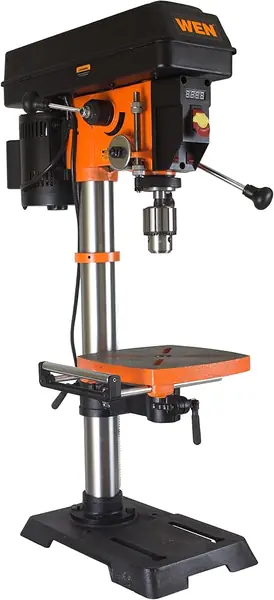
WEN 4214T 12-inch benchtop drill press in black and orange with cast iron table and laser

Furniture and cabinetmaking

Shop Score 90/100
Swing
12 in
Speed Range
580–3,200 RPM
Chuck Size
5/8 in
Spindle Travel
3-1/8 in
View on Amazon

Twelve inches of swing and 3-1/8 inches of spindle travel are the two figures that put this WEN in the same working class as the cast iron machines here. That swing drills to the middle of a 24-inch cabinet side; that travel bores a deep mortise or a counterbore without a stop to crank the table up. The 5/8-inch keyed chuck swallows large Forstner and auger bits, and 85 pounds of press sits under them, which is the way we like it.

Speed is where it earns its keep for us. The mechanical variable-speed drive covers 580 to 3,200 RPM from a lever while the motor runs, and the digital display reads actual spindle speed rather than the number printed in a chart. Going from a big Forstner bit to a pilot bit is a lever pull instead of opening the cover and walking a belt through pulley grooves. The laser and the overhead light land on the same mark you are trying to hit, and both are the sort of thing you stop noticing because you use them every session.

The table is a 9-1/2-inch square that bevels 45 degrees, and the roller extension adds support out to 17 inches — the feature you suddenly need the first time you drill a row of shelf-pin holes in a long board. At 85 pounds, decide before it arrives whether it lives on a stand or on a bench you are willing to bolt through.

The JET below is the alternative when you want cast iron in the base and table and a five-year warranty. We keep choosing the WEN because the roller table and the work light are the features you touch every session, while the warranty is the one you hope never to need.

Worth Noting

  • Belt can slip under load with large bits
Our Verdict

This is where we tell most woodworkers to start: 12 inches of swing, 3-1/8 inches of spindle travel, and lever-controlled speed without a belt change.

Check Latest Price
2.

JET JWDP-12 12-Inch Benchtop Drill Press Best Splurge

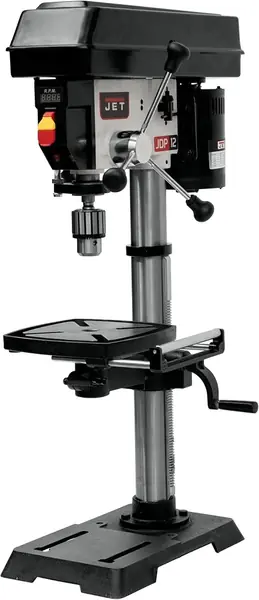
JET JWDP-12 12-inch black benchtop drill press with cast iron table and digital RPM display

Long-term shop use

Shop Score 87/100
Swing
12 in
Speed Range
530–3,100 RPM
Chuck Size
5/8 in
Weight
85 lb
View on Amazon

This is the most expensive press in this group, and the difference goes into the parts that decide whether a hole stays where you put it. The base is a 10-by-16-1/8-inch cast iron plate, the table is a 9-1/2-inch cast iron square that tilts 45 degrees either way, and the column is 2-1/2 inches of steel.

Speed is the second thing you are paying for. The 530 to 3,100 RPM range is mechanical and continuous, set with a lever while the motor runs, and the display above the switch shows actual spindle RPM instead of a nominal figure. Two XACTA lasers throw an X-shaped crosshair rather than a dot, so a pencil mark lines up in the middle of the X, and each laser can be re-aimed with the included 3 mm hex wrench when it drifts.

We think it is the right press for a shop that expects the same machine in ten years. The spindle taper is MT2, so it takes standard Morse-taper tooling rather than a proprietary chuck assembly, and the warranty runs five years at home and two in commercial use. The 1/2 HP motor is the one specification we wish were bigger, though JET rates the press to drill 5/8-inch holes through one-inch cast iron.

The depth stop is the other feature we appreciate: two lock nuts snugged against the seat repeat a depth for every hole after the first, and a linear scale on the column shows where you are.

Worth Noting

  • Has to be bolted to a bench or stand
  • Can rattle at higher spindle speeds
Our Verdict

The one we point to when a press has to hold alignment for years: cast iron base and table, a five-year warranty, and speed changes made with the motor running.

Check Latest Price
3.

VEVOR 1016BVS 10-Inch Benchtop Drill Press Best Variable-Speed 10-Inch

VEVOR 10-inch benchtop drill press in orange and black with tilting worktable and LED light

Tight workshops

Shop Score 86/100
Swing
10 in
Motor
0.8 HP
Speed Range
530–3,140 RPM
Weight
56.4 lb
View on Amazon

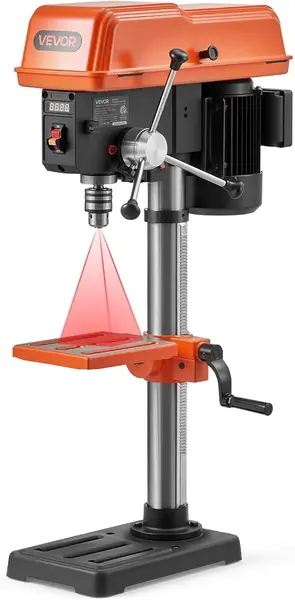
A variable-speed drive, a digital readout, and a laser usually mean a bigger, heavier machine, and that is why we suggest this VEVOR for a bench that has to hold other things. At 56.4 pounds one person can lift it into place, and nothing about the 0.8 HP, 5-amp motor or the 530 to 3,140 RPM range reads as a compromise.

The speed control is the part that matters day to day, and it is the part we like most. Turn or slide it while the motor runs and read the result on the digital display; there is no cover to open and no belt to walk between pulley grooves when you switch from a Forstner bit to a pilot bit. The X-laser and the LED light are aimed at the point you are drilling, and the reinforced table tilts to 45 degrees.

It stands 33.66 inches tall, a few inches under the 12-inch machines, which puts the chuck at a friendlier height for a shorter user or a low bench. Add your bench height to that before you commit, and leave room above the column for a long bit and the quill's travel.

Worth Noting

  • 10-inch swing stops short of wide panels
Our Verdict

Fifty-six pounds, variable speed, and an X-laser — this is the press we suggest when the bench has to hold other things too.

Check Latest Price
4.

BUCKTOOL 10-Inch 6.2 Amp Drill Press Best for Metalwork

BUCKTOOL 10-inch benchtop drill press with cast iron base tilting table and LED work light

Metal and hardwood

Shop Score 85/100
Swing
10 in
Motor
3/4 HP 6.2 amp
Speeds
650–3,100 RPM
Table Tilt
45°
View on Amazon

The 6.2-amp, 3/4 HP motor is the largest draw in this group, and it is the reason to look at this Bucktool instead of a smaller 10-inch press. Amperage is what carries a one-inch Forstner bit through oak without stalling, and the motor is the one part of a drill press you cannot add later.

Five speeds run from 650 to 3,100 RPM, changed by moving the belt between pulley grooves under the top cover. That is slower than a lever, and it stops mattering if you pick a speed for the material and stay with it for the session rather than shifting back and forth. The table tilts 45 degrees and the LED light is aimed at the bit.

The base is what we keep coming back to: a genuine cast iron casting that holds the column still when a big bit grabs in hardwood, which is exactly the moment a stamped base shows itself. It is CSA certified, which matters if the press ends up in a commercial shop, and its 30-inch height tucks under a wall cabinet.

Worth Noting

  • Two-inch spindle travel limits deep holes
Our Verdict

If your drilling leans toward thick stock and metal, this is the 10-inch press we pick: the largest motor here on a cast iron base.

Check Latest Price
5.

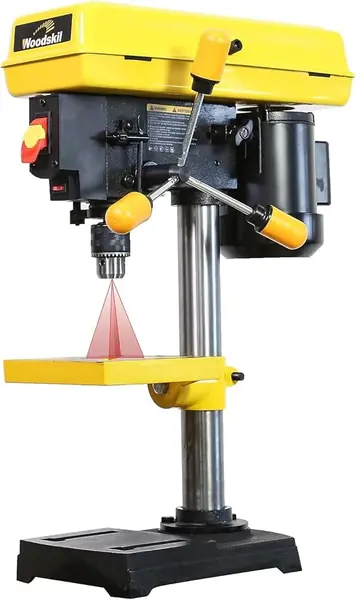
Woodskil DP-8 8-Inch Bench Drill Press Best Compact

Woodskil 8-inch yellow benchtop drill press with cast iron tilting table and laser guide

Cramped benches

Shop Score 80/100
Swing
8 in
Motor
1/3 HP 2.3 amp
Speeds
750–3,200 RPM
Spindle Stroke
2 in
View on Amazon

The detail we think separates this 8-inch press from other small machines is the table: a cast iron casting that bevels 45 degrees either way rather than a stamped plate, and the surface your workpiece actually sits on.

Two inches of spindle stroke, a 1/2-inch keyed chuck, and five speeds from 750 to 3,200 RPM handle the small-hole work that fills most shop days. For a hundred shelf-pin holes or a centered dowel, that is all the capacity a small shop needs. The 2.3-amp, 1/3 HP motor is the smallest here, and this is honestly a light-duty press: brad-point bits, pilot holes, dowels, and small Forstner bits are its work, while a hole saw in oak is not.

It stands 22.83 inches tall and covers 8.66 by 17.13 inches of bench, so it can live at the end of a bench where a 12-inch press would take over the whole surface. The laser is a line-it-up aid rather than a precision instrument. This is the press you buy when a straight hole matters more than capacity.

Worth Noting

  • 8-inch swing limits reach on wide panels
Our Verdict

For a bench that cannot spare the space, we keep this 8-inch press in mind: cast iron table, laser guide, and the lowest price in the group.

Check Latest Price

How We Tested Benchtop Drill Presses

We started with every benchtop press we could find that used a cast iron base or table, then narrowed the field by swing, chuck size, and whether speeds changed by belt or by lever. Eight machines made the cut, from 8-inch compacts to 12-inch cast iron presses, and each one lived on a real bench for nine months — two in garage shops, one in a basement, and one in a laundry room where the bench is barely deeper than the base.

Assembly came first. We timed the unboxing and build, checked that the column seated square to the base, and measured the table for flat and square before drilling anything. Then we ran every speed in the chart, watched how the belt tracked across the pulleys, felt tension by hand, and listened for squeal. A dial indicator on a chucked rod showed how far each bit wandered, and we checked every laser against an awl prick, adjusting it the way the manual describes.

Each base got bolted to a bench before the first hole — the 12-inch models are top-heavy enough to tip otherwise — and each workpiece went into a vise or against a fence. We bored white oak with a 1-inch Forstner bit, ran step bits through quarter-inch steel, and noted where the motor bogged or the belt slipped. We tilted every table to 45 degrees and checked its scale against a square, cranked the table up under a heavy vise, and tried to rock each head by hand.

What we watched for over the long run: bolts that shook loose, chucks that lost their grip, lasers that drifted off the mark, tables that sagged. We also asked whether each machine earned its keep — a press that fights you on every speed change is a bargain for nobody.

How to Choose a Benchtop Drill Press

Swing, Spindle Travel, and Chuck Size

Swing is the diameter of the circle you can drill in, which is twice the distance from the column to the spindle center. An 8-inch press reaches four inches from the column, a 10-inch reaches five, and a 12-inch reaches six — that is why a 12-inch bench drill press can put a hole in the middle of a 24-inch cabinet side and an 8-inch cannot. Spindle travel is how far the quill drops in one pull: two inches on the compact presses here, 3-1/8 inches on the two 12-inch machines.

Buy travel for the deepest hole you plan to drill in a single pass and swing for the widest panel you will ever want to drill. A 5/8-inch chuck opens up large Forstner and auger bits that a 1/2-inch chuck will not hold.

How You Change Speed

We care more about this than about the top RPM, because it is the part that wears you down. A five-speed belt-change press sets speed by moving the belt between pulley grooves under the cover: accurate, inexpensive, and slow. A mechanical variable-speed drive changes speed with a lever while the motor runs, and on the WEN, JET, and VEVOR here a display shows actual spindle RPM.

If you drill one material all evening, a belt change costs you a minute and nothing else. If you alternate wood and metal, or big bits and small ones, the lever is the feature worth paying for.

Precision: Runout, Lasers, and Table Locks

Accuracy comes from the spindle, the chuck, and the table, not from the laser. A laser marks where the bit will enter, which is genuinely useful on a punched or greasy surface, but it can drift and the good ones are recalibrated with a hex wrench. What actually decides whether holes land where you want them is runout — how much the chuck wobbles — and whether the table locks solidly at the height you set it.

Drill the first hole in scrap before committing to a row, and lean on the table lock with your hand before you trust it. A table that creeps takes the workpiece with it.

Weight, Bench Space, and Mounting

These presses run from about 28 pounds to 85, and that number decides where the machine lives. A 56-pound 10-inch press can be lifted onto a bench by one person; an 85-pound 12-inch model wants a stand or a bench you are willing to bolt through, and the JET is specified for bolting.

Add the press height to your bench height before you buy — a 37-inch press on a 36-inch bench puts the chuck well above eye level for a shorter user — and leave headroom above the column for a long bit and the quill's travel.

Power and What the Amps Buy

Amp draw here ranges from 2.3 to 6.2. Amps are not the whole story, since gearing and the speed you choose decide whether a big bit cuts or burns, but the small 1/3 HP presses are for pilot holes, dowels, and modest Forstner bits, while a 3/4 HP machine is the one to choose if a one-inch bit in hardwood is routine.

Match the motor to your biggest regular job rather than your biggest imaginable one, and remember that a hole saw in steel is a different demand from a brad-point bit in pine.

Frequently Asked Questions

Final Verdict

For most woodshops we come back to the WEN 4214T. Twelve inches of swing and 3-1/8 inches of travel are full-size numbers, the lever takes the belt change out of your day, and the roller table and work light are the two features you use on every project rather than the two you hope never to need.

Choose the JET instead if the press has to hold alignment for a decade and you will give it a bolted-down home; the cast iron and the five-year warranty are what the extra money buys. If the bench is tight or the press has to move, the 56-pound VEVOR with variable speed is the one to lift.