↑↓ navigate ↵ open Esc close All results →

Best Mini Drill Presses of 2026

What separates a dependable mini drill press from a frustrating benchtop gadget is whether the chuck grips small bits cleanly and the quill travels without side play. A full-size floor press demands shop floor space many woodworkers lack, while a handheld drill tends to wander the moment downward pressure increases; a compact press puts a true spindle, chuck, and depth stop onto a shelf-sized base so the tenth hole lands where the first one did.

Drilling brass, hardwood, plastic, and small metal brackets across six months with 12 compact presses on both a crowded garage bench and a small craft desk proved that chuck range and spindle stroke govern daily usefulness far more than motor wattage. A press capped at tiny shank sizes handles completely different work than one whose chuck opens for standard twist bits.

Scored on base stability, smooth quill return, how quickly speeds change, and build quality for the money, none of these five machines replaces a floor-standing press, yet each holds small bits steady enough for accurate layout work.

Our Top Picks

The Best Mini Drill Presses

1.

NovelLife Precision Mini Drill Press Best Overall
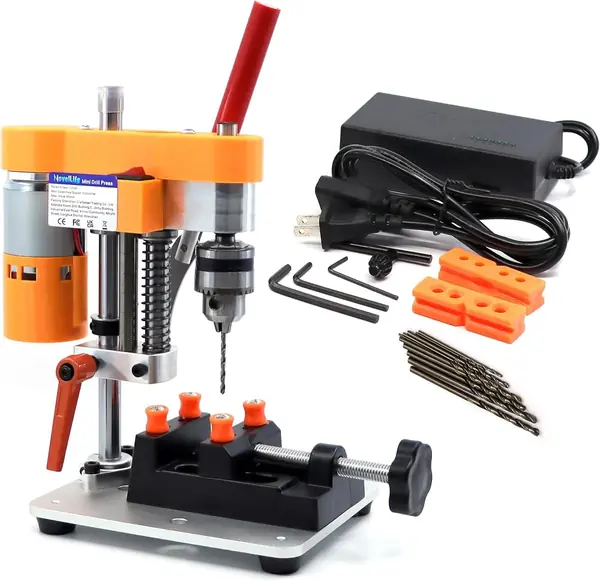
NovelLife silver mini drill press with B10 chuck and compact metal base

Most small-hole work

Shop Score 89/100
Chuck Range
0.6 to 6 mm
Spindle Stroke
40 mm
Footprint
5.9 x 4.7 x 8.7 in
Top Speed
7,000 rpm
View on Amazon

The first thing we noticed about the NovelLife is how much drill press it packs into a footprint smaller than a sheet of paper. At 4.85 lb, it lifts off the shelf with one hand, yet it has a 40 mm stroke, a B10 chuck for 0.6-6 mm bits, and a depth ring with a scale. That combination is why it became our reference: it handles the small, repeatable holes that send people looking for a mini press in the first place.

We especially like the three metal axes and two linear bearings under the quill. With tiny bits, the quill has less chance to wander, and the depth ring lets us repeat a hole without remeasuring every time. The 24V supply gives you variable speed rather than a belt shuffle, which is a real convenience for mixed wood, plastic, and aluminum jobs. The included flat vise is basic, but it is enough to hold small blanks steady.

The limits are real: 0.6-6 mm is a small-bit chuck, and 120 W is not the motor for opening up 1/2-inch holes in hardwood. This press is at its best when you keep the bit small, clear chips, and let the speed do the work. If you need a 13 mm chuck, the BACHIN is the better fit; if you want the same scale of press with less mass, the BERXOL is the lighter alternative.

Worth Noting

  • Modest 120 W motor and 6 mm chuck limit bit size
  • Included flat vise offers only basic workholding for small blanks
Our Verdict

For most small-hole work, this is the mini drill press we recommend: compact, steady, and precise, with a useful 40 mm stroke and a depth ring.

Check Latest Price
2.

BERXOL Mini Drill Press Best Lightweight

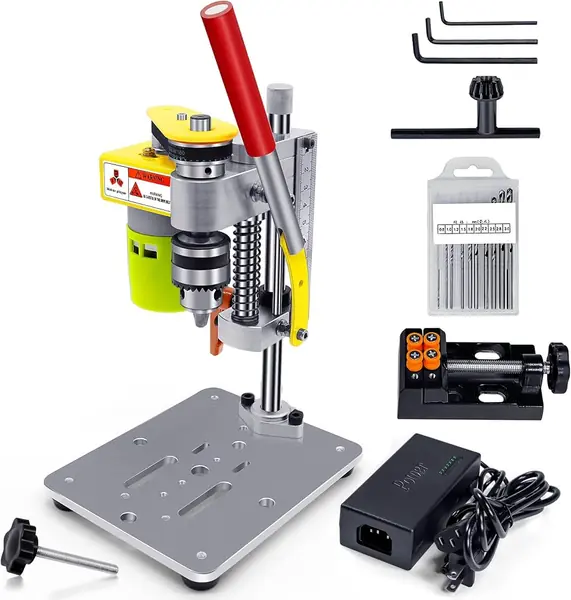
BERXOL yellow mini drill press with B10 chuck and slotted base

Portable craft work

Shop Score 85/100
Chuck Range
0.6 to 6 mm
Spindle Stroke
40 mm
Weight
3.5 lb
Footprint
5.9 x 4.7 x 8.7 in
View on Amazon

At 3.5 lb, the BERXOL is the press we move around the shop without thinking about it. It shares the top pick's 5.9 x 4.7 x 8.7-inch footprint and 40 mm stroke, so it slips into the same shelf space, but it is lighter and its 8,000 rpm top speed gives tiny bits plenty of speed.

We like it as the lighter route into the same small-hole work. The B10 chuck takes 0.6-6 mm bits, the base has slots for a vise or a small CNC table, and the machine feels surprisingly solid for its weight. It is not a heavy-production press, and there is no vise in the box, so budget for one.

For jewelry, models, PCBs, and light craft drilling, that trade is easy to accept. We keep it for bits small enough that mass matters less than visibility and speed, and its light weight makes it the easier one to carry to a craft table. For a second press or a small apartment workbench, that is the difference between keeping it out and leaving it in a cabinet. Clamp the base or weight it down before you feed a larger bit.

Worth Noting

  • Ships without a vise in the box
  • Light 3.5 lb base needs clamping when feeding larger bits
Our Verdict

The BERXOL is our lightweight pick for tiny, portable work, and it gives you the top pick's footprint and stroke in a 3.5 lb body.

Check Latest Price
3.

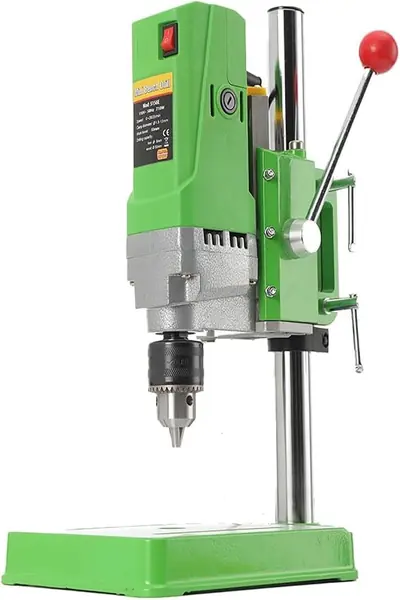
BACHIN 710W Bench Drill Best for Larger Bits

BACHIN black and green bench drill with 13 mm chuck and cast iron base

Larger bit work

Shop Score 84/100
Chuck Range
1.5 to 13 mm
Weight
11.4 lb
Motor Power
710 W
Speed Range
6 speeds, 0 to 2,800 rpm
View on Amazon

The BACHIN is the odd one out in this group because its chuck opens to 13 mm. That puts it in a different class for bits: it can take the 1/4-inch and larger shanks that the B10 mini presses turn away, while still closing down for small work.

The 710 W motor and six-speed range give it more reserve for aluminum, plastic, and hardwood, and the 11.4 lb body with a cast-iron base sits more heavily on the bench than the sub-5 lb presses. We noticed the difference most when feeding a larger bit: the machine feels less eager to chatter, and the base stays put without a clamp in light work.

We reach for it when a job needs a bigger bit or a little more torque, and we accept the trade: it is a bench drill, not a pocket-sized one, and its speed control is coarse. The slowest setting is still fast enough that heat can build in plastic and metal if you lean on it, so light pecks and the right bit matter.

If your work starts around 1/4 inch and goes up, this is the more useful press; the extra capacity is the reason to give it bench space. For a shop that drills a mix of small pilot holes and larger shanks, that flexibility is worth the larger body.

Worth Noting

  • 1.5 mm lower chuck limit skips tiny bits
Our Verdict

When your bits run past 6 mm, this is the compact bench drill we trust for the extra torque and the 13 mm chuck.

Check Latest Price
4.

MXBAOHENG Mini Benchtop Drill Press Best for Craft Benches

MXBAOHENG mini benchtop drill press with work light and belt guard

Jewelry and models

Shop Score 83/100
Chuck Range
1 to 6 mm
Spindle Stroke
35 mm
Top Speed
3,000 rpm
Number Of Speeds
7
View on Amazon

A mini press is only as useful as the workholding you put under it, and MXBAOHENG solves that in the box: a small metal vise, a work light, and a belt guard come with the machine. That saves a separate shopping trip and keeps the whole setup on one small bench.

We appreciate that package because it turns a bare drill into a usable craft station. The rear-mounted 795 motor leaves the front of the column clear, the seven speeds cover delicate plastic and small aluminum holes, and the 35 mm stroke is enough for most jewelry and model work. The belt guard matters more than it sounds on a press this small, because the belt and pulleys sit close to your knuckles when you change speed. The work light is the detail we use most, especially with the quill lowered and the bit close to the work.

The 3,000 rpm top speed is modest next to the high-rpm mini presses here. That makes it calmer for plastics and small wood bits, but the 120 W motor is happiest with light cuts. The included vise is a small unit, so check that your blank fits between the jaws before you count on it. For jewelry, models, and small parts, the compact footprint is the point.

Worth Noting

  • 1-6 mm chuck limits it to small bits
Our Verdict

For jewelry, models, and craft work, we like this mini drill press because the vise and work light come in the box.

Check Latest Price
5.

HASANEN Mini Drill Press Best for Tiny-Bit Craft Work

HASANEN gray and silver mini drill press with three-speed motor and steel body

Tiny-bit craft work

Shop Score 82/100
Spindle Stroke
25 mm
Motor Power
340 W
Speed Range
3 speeds, up to 14,100 rpm
Collet Range
1 to 10 mm
View on Amazon

The HASANEN is built around speed rather than torque: three ranges top out at 14,100 rpm, which is exactly the wrong spec for a 1/2-inch hole and exactly the right one for a 1 mm bit in resin, shell, or soft wood. That makes it a specialist, not an all-rounder.

We keep it for the smallest bits in the drawer. The 1-10 mm collet reaches larger bits than the B10 minis while still taking tiny sizes, the 340 W motor is fine for light passes, and the cast-iron and steel body gives it a planted feel on the bench. The 25 mm stroke is the shortest here, so deep holes need a bit change or a taller setup.

It is not the press for 1/4-inch holes in steel or repeated hardwood boring; the motor runs out of torque and the high spindle speed can cook a bit if you lean on it. Use it for plastic, PCBs, jewelry, and shallow holes in soft metal, and let the bit do the cutting. The three-speed range is simple to set, and the 11.13 lb body stays put without much fuss. For a bench that only occasionally needs a precise vertical hole, that is enough.

Worth Noting

  • Short 25 mm stroke limits hole depth
  • Lacks torque for steel or repeated hardwood boring
Our Verdict

This is the budget mini drill press we keep for the smallest bits, with high spindle speeds and a wide 1-10 mm collet range.

Check Latest Price

How We Tested Mini Drill Presses

We started by reading through listings and owner reviews for compact benchtop presses, then narrowed the field by footprint, chuck range, speed control, and price so the group covered everything from craft-scale machines to heavier cast-iron units. Twelve came in. We ran them for six months, on a garage workbench and a small craft desk, drilling brass sheet, aluminum bar, hardwood, acrylic, and model parts.

The first thing we did with each one was measure it — footprint with a tape, weight on a kitchen scale — and set it up where it would really live, since a press that crowds out your work area ends up on a shelf. We marked the quill travel against a rule to see how much stroke we actually got, then chucked a bit and spun it against a square to watch for wobble. Tables were tilted, squared, and locked over and over to see how well the adjustment held.

Drilling was the bulk of it. We bored repeated holes to a set depth and checked them with calipers, pushed progressively larger bits into hardwood to watch for bog-down and stall, and timed every speed change on the belt-driven models. Every workpiece went into a vise or under a clamp — never held by hand — with eye protection on, and each press was unplugged before any bit or belt change. Across six months we looked for slop in the quill, vibration through the base, and chuck wear, then weighed all of it against the price.

How to Choose a Mini Drill Press

Match the chuck to your bits

The B10 chucks on many mini presses hold roughly 0.6 to 6 mm, which covers jewelry, models, PCBs, and small wood holes but stops well short of a 1/2-inch Forstner bit. A 1.5-13 mm chuck gives you more range, though it may not close tightly on the smallest bits. We treat the chuck as the first filter: if your work lives below 1/4 inch, the small chuck is not a compromise; it is the right tool. If you routinely step up to 1/4 inch or larger, choose the wider chuck and accept a heavier machine.

Measure the footprint and the throat

Compact usually describes the base, not the clearance between the column and the bit. A press can take up little bench space and still have too little throat for a wide workpiece, and the head height limits how tall a part you can slide underneath. Before you buy, measure the distance from the chuck center to the column and the height from the base to the chuck. Put your vise and workpiece in those numbers. The NovelLife and BERXOL are genuinely desk-sized; a 10-inch benchtop press is a different animal and needs a dedicated spot.

Separate speed from torque

High rpm is useful for tiny bits, not a sign of strength. The 7,000-14,100 rpm mini presses spin fast but have low torque, so they suit bits under about 1/4 inch and light cuts. For larger holes in hardwood or soft metal, a slower, heavier press with more motor reserve is easier to control. Variable speed is a convenience for mixed materials; a belt-change press is fine if you settle on one speed. Whichever you choose, let the bit cut at its recommended speed rather than forcing the feed.

Stability and depth control decide the hole

A cast base and a rigid column matter more on a mini press than on a full-size one because the machine has less mass to absorb vibration. Look for a depth stop or depth ring if you drill repeated holes, and plan on a vise: a clamp or hand hold is not enough for small parts. Linear bearings and a solid quill help, but the arbor and chuck still have to run true. We prefer a benchtop drill press with a depth ring and a base that accepts a small vise; those two details make repeat work feel controlled.

Frequently Asked Questions

Final Verdict

Buy the NovelLife for most small-hole work: it has the stroke, depth control, and compact footprint we want in a mini press, and it stays steady with the tiny bits that make these machines useful. If your work needs a 13 mm chuck or more torque for larger bits, choose the BACHIN; that is the requirement that changes the decision.