↑↓ navigate ↵ open Esc close All results →

Best Keyless Drill Press Chucks of 2026

Hunting behind the bench for a lost chuck key slows down every stepped-hole job on a drill press. A keyless chuck replaces that fiddle with a knurled collar you tighten by hand in seconds, though convenience runs straight into spindle compatibility: JT33, MT2, and R8 mounts do not interchange, and many chucks ship without the arbor required to seat them.

In nine months of testing 11 keyless chucks across benchtop drill presses, a lathe tailstock, and a small mill, we ran bits from 1/32 inch up to 5/8 inch and measured runout with a dial indicator after repeated swaps. One-piece shanks looked sturdier at first glance, yet well-machined two-piece assemblies held tight once their tapers seated.

Reliable models grip tiny twist bits without slipping, stay concentric across dozens of tool changes, and fit the taper already in your quill or tailstock.

Our Top Picks

The Best Keyless Drill Press Chucks

1.

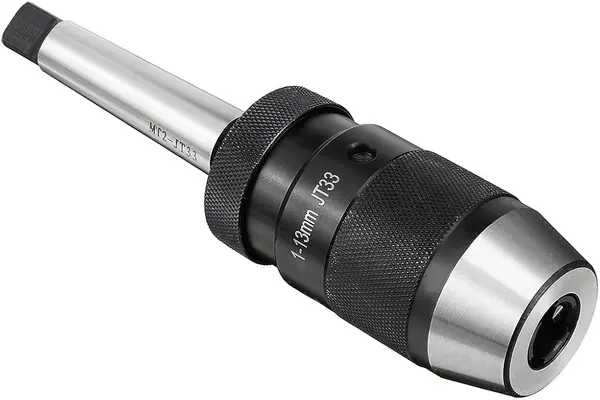
KIPA MT2 to JT33 Keyless Drill Press Chuck Best Overall
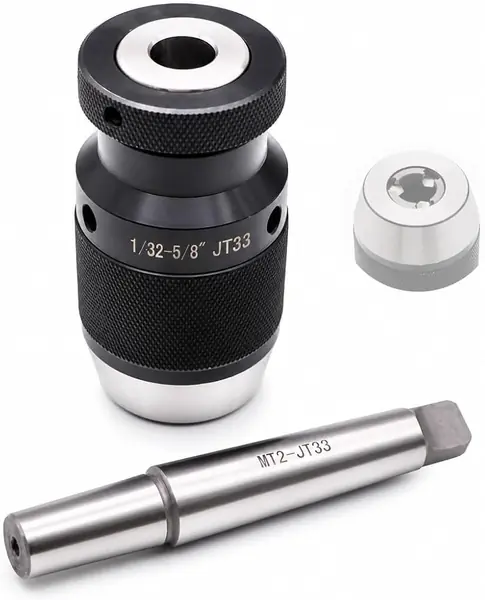
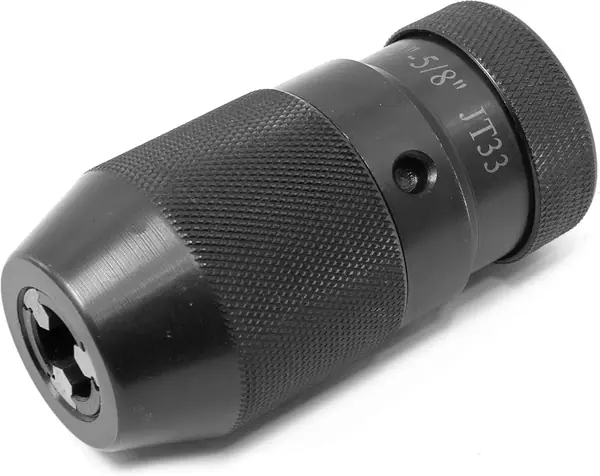
KIPA keyless drill press chuck with MT2 to JT33 arbor and steel three-jaw body

Either spindle type

Shop Score 87/100
Mount
JT33 chuck, MT2-to-JT33 arbor included
Clamping Capacity
1/32"-5/8"
Weight
2.76 lb
Material
40Cr alloy steel
View on Amazon

Two spindle types come out of one box: the chuck itself is JT33, and a tang-ended MT2-to-JT33 arbor rides alongside it. Mount the chuck straight onto a JT33 quill, or press it onto the arbor and seat that in an MT2 spindle. Nothing else in this group covers both.

That is why it is our top pick. Buying a keyless drill chuck usually begins with a compatibility question that is easy to get wrong, and this one answers it before you order — a single part number for the two tapers found on most benchtop drill presses and small lathes. The 1/32- to 5/8-inch range also takes pen mandrels and heavy shanks that the 1/2-inch chucks here turn away.

The working end is a knurled collar instead of a key. Spin it by hand and the mechanism keeps tightening as the bit loads; on a 5/8-inch shank we add leverage through the spanner holes rather than trusting hand torque alone, which is the difference between a bit that holds and one that spins. Seating matters as much as the collar, so wipe the taper clean and dry before you press it on.

At 2.76 pounds it is one of the heavier chucks in this group, and on a small press you feel that mass when you work the feed handles. We did not mind it, because the heft comes with a body that stays put while you lean into a big bit.

Worth Noting

  • Forward-rotation drilling only; no reversing
  • Needs another adapter for R8 or MT3 spindles
Our Verdict

We make it the default because one order fits either taper you are likely to have, takes 5/8-inch shanks, and settles the arbor question before you press buy.

Check Latest Price
2.

uxcell MT2 Keyless Drill Chuck Best for Small Benchtop Presses

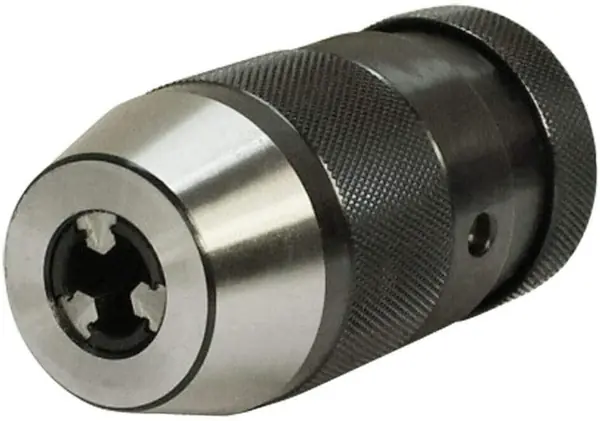
uxcell MT2 keyless drill chuck with steel three-jaw body and knurled collar

Small benchtop presses

Shop Score 86/100
Mount
MT2 Morse taper
Clamping Capacity
1/32"-1/2" (1mm-13mm)
Weight
2.07 lb
Jaws
3-jaw, quench hardened
View on Amazon

Less chuck, fewer problems. One MT2 mount, a hand-tightened collar, nothing else to match up, and a stated 2.07 pounds that makes it the lightest chuck in this group. On a benchtop press with a short quill, that is less weight hanging off the spindle every time you lower it.

We reach for it on small presses and mini lathes, where the 1/32- to 1/2-inch range covers the bits that actually get used and the lighter body keeps the quill feeling neutral. Quenched, ground jaws in the standard three-jaw layout are done cleanly here, and nothing about the chuck asks for a learning curve.

The taper also seats in an MT2 lathe tailstock, so it earns its keep beyond the press — drilling, pen turning, the small jobs where setting up a second machine makes no sense. For cabinets, jigs and pilot-then-clearance work in softwood, we have not found anything here that is easier to live with.

Worth Noting

  • Capacity tops out at 1/2-inch shanks
Our Verdict

Our pick for a small benchtop press or a mini lathe: the lightest chuck here, the simplest to seat, and the one we trust to hold a bit straight without fuss.

Check Latest Price
3.

WEN DPA164L JT33 Keyless Drill Press Chuck Best for JT33 Benchtop Presses

WEN DPA164L JT33 keyless drill press chuck in carbon steel with three jaws

JT33 spindles

Shop Score 85/100
Mount
JT33 spindle
Clamping Capacity
1/32 to 5/8 inches
Material
Carbon steel
Runout
Less than 0.008 in (0.2 mm)
View on Amazon

WEN puts a number on the thing most listings leave vague: less than 0.008 inch of runout. That is the circle a bit's tip traces as the chuck turns, and it is the figure that decides whether a shelf-pin hole lands where the drawing says or a few thousandths wide of it.

The chuck is JT33, listed for WEN's 4208, 4210, 4210T and 4212 presses and for any other JT33 spindle, with 1/32 to 5/8-inch capacity and a 2.12-pound carbon-steel body. It presses on with a tap of a rubber mallet, and the three jaws open and close without a key anywhere in sight.

Where it earns its place is a press that spends its life in wood: the published figure gives you something to check a wandering hole against, and 5/8-inch capacity takes plug cutters and larger shanks. WEN calls it light duty, and that is the honest boundary — for steel work, the CanCNC is the chuck to buy.

Worth Noting

  • JT33 spindle mount only
Our Verdict

We like it for a JT33 quill on a woodworking benchtop press, where its published runout figure and 5/8-inch capacity do the most good.

Check Latest Price
4.

CanCNC MT2 Keyless Drill Chuck Best Heavy-Duty

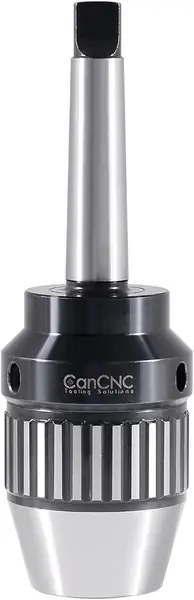
CanCNC MT2 keyless drill chuck with one-piece shank and titanium jaws

Metalworking

Shop Score 84/100
Mount
MT2, one-piece shank
Clamping Capacity
1/16-5/8 in
Max TIR
0.003 in
Jaw Hardness
HRC 60
View on Amazon

Roughly double the midrange price buys the one thing no other chuck here has: a shank machined from the same piece of steel as the body. There is no arbor joint to spin, cock or add runout of its own, and on a chuck that lives in a fixed spindle we think that is exactly where the money belongs.

The rest of the specification backs the idea up — 0.003 inch maximum TIR, jaws hardened to HRC 60, capacity from 1/16 to 5/8 inch, and a 3.13-pound body. It is built for CNC mills, metal lathes and drill presses on a fixed spindle, and the seller is explicit that it is not for a hand drill.

What the one-piece body buys you is a chuck that stays put under aggressive feed rates in steel, where hand torque alone starts to look optimistic. It is a metalworking tool first, and on a wood-only benchtop press the premium is more chuck than the work asks for.

Worth Noting

  • Seating a bit takes the wrench and a tap
Our Verdict

Worth the premium if you drill metal on a fixed spindle: the one-piece MT2 shank and hardened jaws hold their tolerance under a heavy feed.

Check Latest Price
5.

LLDSIMEX JT33 Keyless Drill Chuck Best for Budget JT33 Setups

LLDSIMEX JT33 keyless drill chuck with steel three-jaw body and knurled collar

Budget JT33 setups

Shop Score 83/100
Mount
JT33 taper
Clamping Capacity
1/32"-1/2"
Weight
2.2 lb
Accuracy
0.002" / 0.05 mm
View on Amazon

The box is small: a bare JT33 chuck with no arbor and no key. That is everything you need on a JT33 spindle and one more purchase on an MT2 quill. We like it best as the accuracy play — 0.002 inch is the tightest figure quoted by any chuck in this group, and it comes on one of the cheapest.

Treat that number as a claim to verify rather than a promise. Seat it on a clean arbor and indicate a ground pin before you trust it with a hole that has to be exact; the tightening action is smooth, with no slop in the jaws or the collar, and it releases with hand torque alone.

The 2.2-pound body and light collar suit a small benchtop press or a minimill, where you change bits constantly and want the chuck to open and close without a fight. Between a pilot hole and the finished size, that smoothness is the whole reason to go keyless.

Worth Noting

  • Ships as a bare chuck without an arbor
  • 0.002-inch accuracy claim needs verification before precision work
Our Verdict

A sensible buy if you already own a JT33 arbor: it makes the tightest accuracy claim in this group for less than the midrange chucks.

Check Latest Price
6.

Vkinman R8 Keyless Drill Chuck Best for R8 Spindles

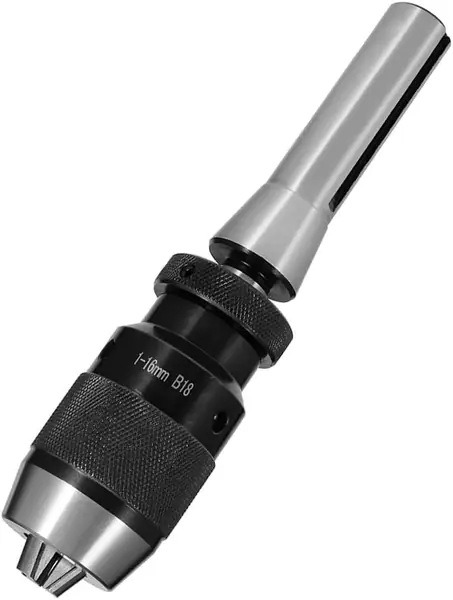
Vkinman R8 keyless drill chuck with stainless steel three-jaw body and knurled sleeve

R8 spindles

Shop Score 77/100
Mount
R8 shank
Clamping Capacity
1/32"- 5/8"
Weight
3.15 lb
Accuracy
0.005"
View on Amazon

R8 is the odd taper in this category — the one on Bridgeport-style mills and mill-drills — and this is the only chuck here that carries it. If that is your spindle, the search narrows fast; if it isn't, nothing on this page will make it fit.

What you get is a self-tightening collar, 1/32- to 5/8-inch capacity and a 3.15-pound body, heavier than the MT2 and JT33 chucks and less of a burden on a mill than on a small press. The R8 shank seats straight into the spindle, and there is no key in the picture.

We check a new taper-mounted chuck on a ground pin before it goes anywhere near a workpiece, and this is the one where that habit matters most: a taper that is not seated cleanly, or a shank that is off, shows up as a bit that wobbles. Clean both surfaces, seat it dry, and check before the return window closes. At the lowest price here, that is a fair trade.

Worth Noting

  • R8 taper only; nothing for JT33 or MT2
Our Verdict

Our R8 pick: nothing else here mounts to an R8 spindle, and it takes 5/8-inch shanks for the least money in this group.

Check Latest Price

How We Tested Keyless Drill Press Chucks

We built the shortlist by sorting the category by spindle mount first, since a chuck that doesn't match your machine is a paperweight. From there we compared capacity at both ends of the range, noted which ones shipped with the arbor needed to mate chuck to spindle, and looked at whether the shank was machined in one piece or took a separate taper. We also weighed price against build, because a keyless chuck is a small part with a job that punishes cheap jaws. That left 11 chucks, which we mounted and used for nine months.

Every chuck went onto a fixed machine spindle — a benchtop drill press, a lathe tailstock, or a small mill — never a hand drill. We cleaned and dried each taper before seating it, then checked accuracy by indicating a ground pin with a dial indicator and repeating the reading after ten bit changes. In the shop we drilled pilot holes in white oak and bored through mild steel plate, chucking bits from 1/32 inch up to each chuck's stated maximum and stopping there rather than forcing a shank the jaws weren't rated for.

Tightening got its own pass: we changed bits by hand only, noted how much grip the knurled collar gave with oily fingers, then tried the spanner holes and any supplied wrench to see how much easier the final quarter turn became. We weighed each chuck on a kitchen scale and watched for quill droop on a small benchtop press. The one-piece shanks and cleanly seated tapers held a bit noticeably firmer under load than two-piece setups we couldn't get to seat true, and those are the ones we dropped.

How to Choose a Keyless Drill Press Chuck

Match the taper to your spindle first

Three mounts cover nearly everything: JT33 on many benchtop drill presses, MT2 on larger presses and lathe tailstocks, and R8 on mill-drills. A JT33 chuck will not seat in an MT2 quill by itself — it needs an MT2-to-JT33 arbor, and buying a chuck that ships with the arbor, as the KIPA does, removes the step where people order the wrong part. Read the marking on your old chuck or check the press's manual before you buy.

Arbors carry a trap of their own. Some MT2 arbors have no tang at the end, and on a quill bored to accept one, a tangless arbor can bottom out before the chuck ever seats. If your press has a slot for a drift key, buy a tang-end arbor.

Decide between 1/2-inch and 5/8-inch capacity

Most drill bits stop at a 1/2-inch shank, so a 1/2-inch chuck covers everyday work and saves a little weight on the quill. The 5/8-inch chucks here earn their keep with reduced-shank bits, pen mandrels, plug cutters and heavier shanks.

We look harder at the small end of the range. Whether the jaws close to 1/32 inch, or only 1/16 on the CanCNC, is what decides whether a wire bit for a pilot hole grips or spins.

Read the runout figure, then check the seat

Runout, or TIR, is how far a bit's axis wanders as the chuck turns; the chucks in this guide quote 0.002 to 0.008 inch. The number only holds if the taper is clean and the arbor is seated, which is why a well-specced chuck on a dirty arbor drills worse than a plain chuck on a clean one.

So we treat the spec sheet as the claim and the dial indicator as the answer. Wipe both tapers with solvent, seat with a firm tap from a rubber or dead-blow mallet, indicate a ground pin, and do it before the return window closes.

What keyless tightening asks of you

A knurled collar and a self-tightening cam replace the key: spin it by hand and the mechanism adds grip as the bit loads. That is faster, and it is one less tool to lose under the bench.

It also gives you less torque than a key does. Large shanks, hole saws and big Forstner bits want the leverage of the spanner holes and a slower spindle, and a chuck rated for forward rotation only will not serve you for tapping or back-spotting.

Frequently Asked Questions

Final Verdict

The KIPA is the chuck we point most people toward: it mounts on either an MT2 or a JT33 spindle, takes 5/8-inch shanks, and costs about the same as the single-mount chucks here. That combination answers the compatibility question before you order, which is where most chuck purchases go wrong.

If your press is small and you never spin anything over 1/2 inch, the uxcell is the lighter, simpler buy. If you drill steel on a fixed spindle, the CanCNC's one-piece shank is the upgrade that earns its keep.