↑↓ navigate ↵ open Esc close All results →

Best Wood Lathe Chucks of 2026

A lathe chuck is the only grip holding a heavy blank spinning at speed, yet the detail that decides whether it works properly rarely shows up in catalog photos: exact spindle thread compatibility through a direct tap or properly seated insert adapter. A chuck that threads up dead square keeps turning sessions calm instead of forcing constant stops to check blank runout.

Eight months of turning across a bench-top lathe and two mid-size machines with nine self-centering four-jaw chucks showed jaw-screw retention and body concentricity outlasting flashy accessory counts. Pin jaws, bowl jaws, and woodworm screws expand capability, though firm gripping power and smooth key tightening decide whether a chuck stays reliable as workloads grow.

Compact bodies sized for bench-top spindles sit alongside heavier chucks built for large green bowl blanks—none bargain-basement cheap, yet all five hold true enough to bolt straight back onto the spindle.

Our Top Picks

The Best Wood Lathe Chucks

1.

VINWOX SCR4-4 4-Inch 4-Jaw Chuck Best Overall
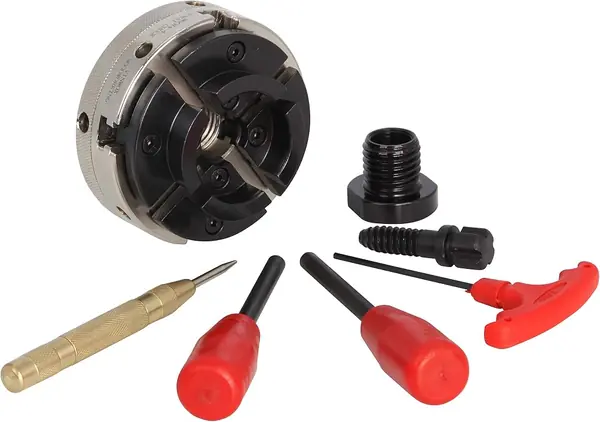
VINWOX SCR4-4 four-jaw self-centering wood lathe chuck with nickel-plated body and jaw wrench

General woodturning

Shop Score 90/100
Weight
6.59 lb
Jaw Set
2 in dovetail, mounted
Inside Jaw Range
1-1/2 to 3 in
Spindle Thread And Adapter
1"x8TPI, 3/4"x16TPI
View on Amazon

Two spindle threads in one box is what earns this the top spot. The body is threaded 1 inch x 8TPI and VINWOX includes a 3/4-inch x 16TPI adapter, which covers the mid-size lathes most people start on and the older bench models that turn up secondhand. If you haven't settled on a forever lathe yet, that flexibility is worth more than any single feature, and it's the reason we hand this one to first-time buyers.

The mounted 2-inch dovetail jaws close on spigots from about 1-1/2 inches to 3 inches, and the included screw chuck takes a flat blank that has no tenon to grip. We especially like that nothing else is needed on day one: jaw set, tightening levers, T-handle hex wrench, screw chuck, and adapter all come in the box.

Holding power is where we paid closest attention. The dovetail bites hard when it seats on a square shoulder with the tenon sized to the jaw; cut the tenon undersized or leave the shoulder rough and the blank creeps, and no amount of leverage on the levers fixes a fit that was wrong to begin with. Prepare the tenon properly and the grip stops being something you think about mid-cut.

Jaw options are where the kit is thin. The 2-inch dovetail set is the only profile included, so pin jaws for pen blanks or a wider bowl set become later purchases. That's the trade for the price, and if your work is mostly bowls and boxes between 1-1/2 and 3 inches, you may never need another set.

Worth Noting

  • Two levers leave no hand free for the blank
Our Verdict

We recommend the SCR4-4 to anyone buying a first chuck: it threads onto two common spindle sizes and arrives with jaws, a screw chuck, and a wrench, so a bowl blank can go on the day it lands.

Check Latest Price
2.

NOVA Pro-Tek G3 Chuck Bundle Best Complete Kit

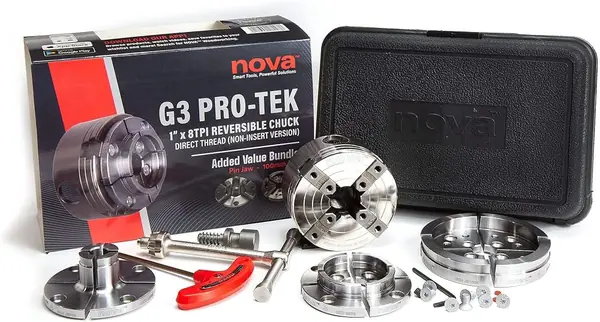
NOVA Pro-Tek G3 wood lathe chuck bundle with three jaw sets and storage case

Serious hobby turning

Shop Score 89/100
Spindle Thread
1 in x 8TPI direct thread
Included Jaws
2 in PRO-TEK, 1 in pin, 4 in bowl
Included Extras
Woodworm screw and storage case
View on Amazon

Three jaw sets, one case: the Pro-Tek G3 bundle arrives with 2-inch dovetail jaws on the body, a 1-inch pin jaw set, and a 4-inch bowl set, plus a woodworm screw. That spread is the whole point. Pin jaws take pen blanks and small spindle work, the dovetail set handles boxes and bowls, and the 4-inch jaws open up larger platters and rims without buying a second chuck body.

Where the extra money actually goes is repeatability, and we were pleasantly surprised by how much of the usual fiddling disappears. Laser-etched numbering on the jaws and slides tells you which jaw belongs in which slot, the 6-point star screws take torque without chewing up, and the T-bar handle gets them snug without hunting for an Allen key. Changing jaws stops being the chore you put off. The nickel plating is the quieter win: turn green wood, wipe the body down, and you're not fighting rust spots on the slides.

Threading directly to 1 inch x 8TPI rather than through an insert means there's no adapter to seat and nothing extra stacked between the spindle shoulder and the jaws, which is the arrangement we trust most on a small lathe. It also means this body fits that spindle and no other, so check your thread before ordering; a 1-1/4-inch spindle needs the Supernova 2 instead.

Worth Noting

  • Gaps between the three supplied jaw ranges
Our Verdict

We point experienced turners to the Pro-Tek G3 bundle: three jaw sets and a woodworm screw in one case make it the chuck you stop thinking about, as long as your lathe runs a 1-inch spindle.

Check Latest Price
3.

Nova Supernova 2 Pro-Tek Bundle Best for Big Bowl Blanks

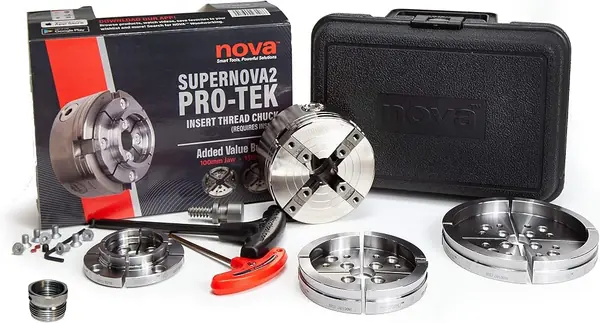
Nova Supernova 2 Pro-Tek chuck with 4-inch and 5-inch bowl jaws and woodworm screw

Large bowl blanks

Shop Score 88/100
Weight
9.35 lb
Spindle Thread
1-1/4 in x 8TPI insert included
Included Jaws
2 in Pro-Tek, 4 in and 5 in bowl sets
Included Extras
Woodworm screw and storage case
View on Amazon

Five-inch bowl jaws and a body that comes in around nine pounds tell you what this chuck is for. On a lathe with the swing and the low-end torque to spin a big, heavy, wet blank, that mass is an asset: the jaws get real surface area on a wide rim, and the chuck never feels like it's working at the edge of what it can hold.

The 1-1/4-inch x 8TPI insert is included, which makes this the only chuck here that mounts to a large-lathe spindle without a second purchase. We appreciate the sealed composite backing plate and copper-infused jaw slides for the same reason: shavings and dust stay out of the mechanism, and the nickel-plated body survives the wet blanks that go with big bowl work.

Set against the Pro-Tek G3 bundle, you trade the 1-inch pin jaws for the 5-inch bowl set. That's the right trade if your work is wide platters and heavy bowls, and the wrong one if you also turn pens and small spindles — the G3 is the better buy for that mix. For a large lathe that sees nothing but big blanks, this is the chuck with jaw to spare.

Worth Noting

  • No pin jaws for pen-sized blanks
  • Weight and 5-inch jaws want a larger lathe
Our Verdict

We keep the Supernova 2 for large lathes: the 1-1/4-inch insert is in the box and the 5-inch bowl jaws suit heavy blanks, though pen turners will want pin jaws it doesn't include.

Check Latest Price
4.

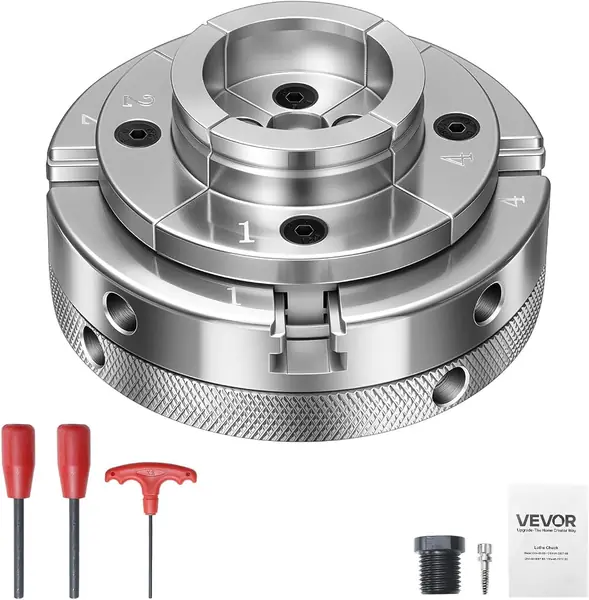
VEVOR CK4-4S-SS 4-Inch Chuck Best for Budget Bowl Turning

VEVOR CK4-4S-SS four-jaw self-centering wood lathe chuck with nickel-plated steel body

Budget bowl turning

Shop Score 85/100
Weight
5.4 lb
Body Thread
M33 x 3.5 mm with 1 in x 8TPI adapter
Inside Clamping
1.5-2.8 in/39-72 mm
Outside Support
2-3.5 in/50.5-89 mm
View on Amazon

An M33 x 3.5 mm body with a 1-inch x 8TPI adapter is an unusual pairing among these picks, and a useful one: the same chuck goes onto a mid-size lathe with the adapter fitted and onto a European-thread machine without it. The tapered wood screw is the other piece we didn't expect to see here, and it turns a flat platter blank into a simple mounting job.

Two locking bars drive the jaws, with 1.5 to 2.8 inches of inside clamping and 2 to 3.5 inches of outside support — a range that handles bowls and boxes comfortably. The nickel-plated steel body feels substantial in the hand, and the action is serviceable rather than slick. We were also impressed by how well it held once the tenon had a square shoulder, which is usually where a cheaper chuck gives itself away.

Where it lands against the others is straightforward: it's the cheapest route here onto an M33 spindle and one of the least expensive chucks in the group. If your lathe runs M33 and your work is small to mid-size bowls, that's a fair trade, and at 5.4 pounds it sits easily on a mid-size lathe without asking much of the headstock.

Worth Noting

  • Inside jaw travel stops at 2.8 inches
Our Verdict

Turners on a tight budget get real versatility here: it takes an M33 spindle directly or a 1-inch spindle with the adapter, and the tapered screw makes short work of platters.

Check Latest Price
5.

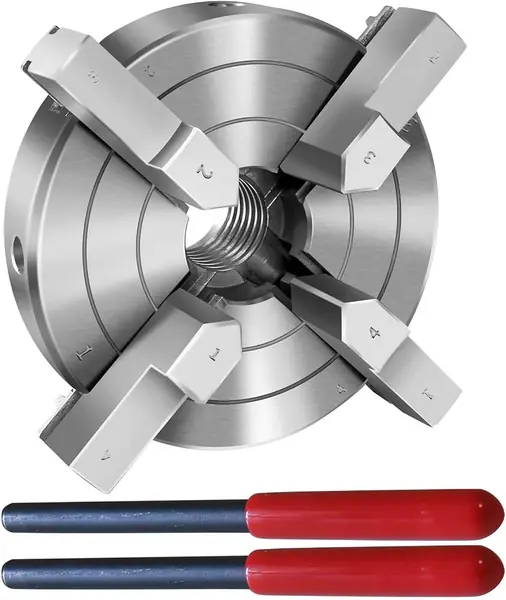
NNBWKIXI 4-Inch 4-Jaw Chuck Set Best for Small Bench-Top Lathes

NNBWKIXI four-inch four-jaw self-centering wood lathe chuck with two tightening levers

Small bench-top lathes

Shop Score 83/100
Weight
4.1 lb
Spindle Thread
1 in x 8TPI
Jaw Mounting
Reversible, positive or negative
View on Amazon

The jaws on this chuck can be flipped and installed facing either way, so the same four hold a spigot or spread inside a recess without a second set. That reversibility is the most interesting thing about it, and near the bottom of this group's price range it's a lot of holding flexibility for the money. If your work is small — boxes, mugs, a few bowls — this is a sensible place to start.

The body is cast alloy steel and weighs about four pounds, which matters more than it sounds. A bench-top lathe with a light headstock spins a heavy chuck with less enthusiasm, so a chuck this size keeps a small machine in its comfort zone. The body is threaded 1 inch x 8TPI and arrives with two tightening levers.

What you accept at this price is coarser machining. The jaw action has more drag than the VINWOX, and blanks want a check between cuts rather than assuming the grip will hold through a heavy pass. For light finishing cuts on small blanks it does its job; hog out a big bowl and you'll feel where the money went.

Worth Noting

  • Tightening takes both levers and both hands
Our Verdict

Bench-top lathes are where this one fits best: the jaws reverse for two different holds, and the light body won't overwhelm a small spindle.

Check Latest Price

How We Tested Wood Lathe Chucks

We started with the spindle, not the chuck. Before ordering anything, we pulled specs on every self-centering four-jaw chuck we could find in the mid-price range and crossed off the ones that came in a thread we couldn't match and had no insert or adapter available to get us there. That left nine chucks, which we mounted on a bench-top lathe and two mid-size machines in a garage shop and turned with for eight months — spindle work in the evenings after work, green bowl blanks on weekends.

Out of the box, we checked runout with a dial indicator against the body and the jaw faces before the first blank went on, then seated each body against the spindle shoulder and looked for daylight at the seam. Thread fit got the same treatment: we noted whether a direct thread or an insert screwed on smoothly or needed coaxing, and whether it stayed put through a session of turning.

Grip was the part we cared most about. We cut a tenon on each blank, tightened the jaws, marked the tenon shoulder and the jaw with a pencil line, and checked after every roughing pass to see whether the blank had crept, counting how often a chuck needed re-tightening mid-project. Inside clamping and outside recess capacity were measured with calipers on real tenons and bowl bottoms, and jaw changes were timed so we could see whether the wrench needed one hand or two.

Weight and balance showed up in use: we weighed every chuck and spun large, out-of-balance blanks at low spindle speed with a face shield on, watching for vibration that traveled into the tool rest. After eight months of chips, dust, and repeated tightening, we looked for thread wear, jaw screw backlash, and anything that had gone sloppy. The lathe was stopped for every jaw change, every tightening, and every reach near the chuck — no exceptions.

How to Choose a Wood Lathe Chuck

Start With Your Spindle Thread

1 inch x 8TPI is the thread on most mid-size and mini lathes, 3/4 inch x 16TPI turns up on older and smaller machines, and 1-1/4 inch x 8TPI and M33 x 3.5 mm belong to larger lathes. Read the thread off your spindle or the spec plate before you shop: a direct-thread body fits one spindle and nothing else.

An insert or adapter is the alternative, and it's what lets the VINWOX cover two threads and the Supernova 2 mount a 1-1/4-inch spindle. We prefer a direct thread when you know your lathe — one less joint between the spindle shoulder and the jaws — and an adapter or insert when you're unsure or turning on two machines.

Match the Jaws to the Tenon You Cut

Chuck diameter is not gripping range. The 4-inch bodies here close on tenons from roughly 1-1/2 inches up to 3 inches with a dovetail set, and the VEVOR stops at 2.8 inches inside. Cut the tenon to sit inside that band with a square shoulder that seats against the jaw face; a tenon that bottoms out in the jaw leaves the dovetail holding air.

Recess work is the other half of the job. Jaws expand inside a turned recess to hold a bowl by its rim, and the outside support range tells you how wide a recess the chuck can span. How hard the jaws hold comes down to how well the dovetail seats, not how hard you lean on the key — overtightening a poor-fitting tenon is how shoulders crush and blanks come loose.

Decide How Many Jaw Sets You Need

One dovetail set will turn bowls and boxes for years, which is why the VINWOX ships with exactly that. Extra sets buy range: 1-inch pin jaws for pen blanks and small spindles, 4- and 5-inch bowl jaws for wide, heavy blanks, and a woodworm screw for a blank that has no tenon yet.

That's the real argument for the Nova bundles, where the Pro-Tek G3 arrives with three jaw sets and the Supernova 2 adds 5-inch jaws. We buy jaws for the next few projects rather than the whole catalog, and we care about how fast they change: etched numbering and a T-bar handle beat two loose levers when your hands are tacky with shavings.

Weight, Runout, and Lathe Size

Mass cuts both ways. A 4-inch chuck around four to six pounds is friendly to a bench-top lathe, while a nine-pound body wants a machine with the swing and low-end torque to carry it. Match the chuck to the lathe you own, not the one you plan to buy.

Then check that it seats. Thread the chuck on, spin it by hand, and watch the jaw faces; a wobble that shows up only once the chuck is mounted usually means a chip or burr on the shoulder rather than a bad chuck. Clean the threads, reseat, and if it still runs out, sort it out before a blank goes on.

Frequently Asked Questions

Final Verdict

The VINWOX SCR4-4 is the chuck we tell most people to buy. It threads onto the two spindle sizes that cover mid-size and older lathes, ships with the jaws, screw chuck, and wrench you need to mount a blank, and holds well as long as the tenon is cut square — all for far less than the premium bundles.

If you want one body that covers pens through bowls and you'd rather not buy twice, the Nova Pro-Tek G3 bundle is the upgrade we point to. If your lathe runs a 1-1/4-inch spindle, skip both and take the Supernova 2, whose insert is already in the box.