↑↓ navigate ↵ open Esc close All results →

Best Thickness Planers of 2026

A thickness planer makes a simple promise: feed in a roughsawn board, get back one that measures the same from edge to edge, ready for a glue-up that closes without a fight. The catch is at the ends. Nearly every machine in this class leaves some snipe, a shallow dip in the first and last few inches of the board, and how a planer handles that — along with how loud it is while doing it — is most of what separates a satisfying machine from an infuriating one.

We ran eight planers for ten months, mostly in a basement shop on a shared wall with a shop vac parked alongside. One machine fed beautifully and still left a step at the tail of every board, which is how we learned to check the outfeed table before anything else. Worth knowing before you buy: a planer makes a board uniform, not flat — that's the jointer's job.

The six machines below cover the range, from three-knife workhorses built for wide panel glue-ups to lighter benchtops you can move without help. All of them cut cleanly, hold a depth setting, and leave you with less sanding than you feared.

Our Top Picks

The Best Thickness Planers

1.

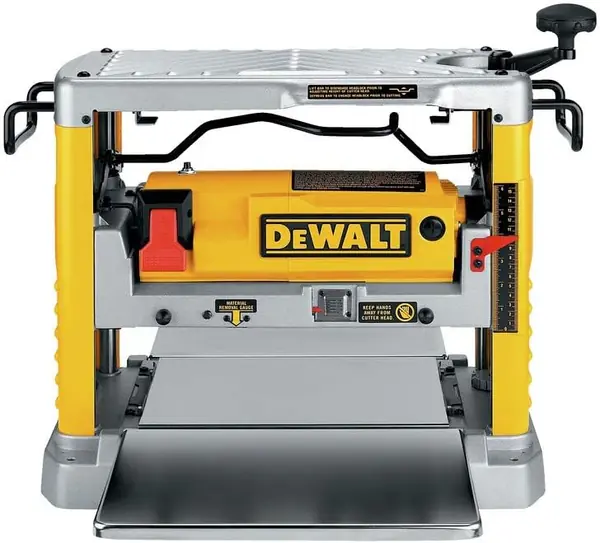
DEWALT DW735X Thickness Planer Best Overall
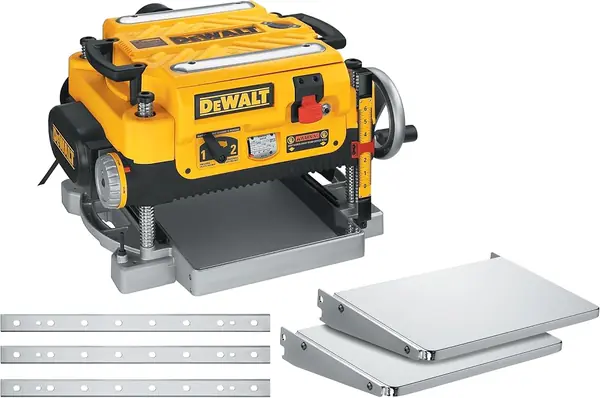
DEWALT DW735X 13-inch benchtop thickness planer in black and yellow with folding tables

Wide glue-ups

Shop Score 95/100
Item Weight
102 lb
Cutting Width
13 inches
Cutterhead
Three knife, 10,000 rpm
Cuts Per Inch
96 or 179
View on Amazon

Two feed speeds, and the slower one is the reason we make this our top pick. Set for 179 cuts per inch, the DW735X takes a light final pass that leaves knife marks faint enough to sand out with a few strokes; drop to 96 and the same 15-amp motor turns a rough-sawn board flat without complaint. Most planers in this class give you one speed and one surface. The second speed, plus 13 inches of width that swallows a three-board glue-up, is what the extra money buys.

Chips leave this machine under real pressure. A fan behind the cutterhead blows them out the chute, which is great with a hose attached and a snowstorm without one — plan on a shop vac or a dust collector from day one. We also appreciated the base: cast aluminum, with tables that fold out of the way when the bench has to be a bench again. At 102 pounds, though, this is a planer with a permanent address, so build or buy the cart before the machine arrives.

The finish is the payoff. Boards come off flat, and with the tables set coplanar and support at both ends of long stock, the scooped ends that plague machines in this class shrink to a trim allowance you cut off anyway. Snipe is not gone, it is controlled, and controlling it is a matter of setup rather than luck. A spare set of knives ships in the box, which is the practical answer to how hard this planer is on an edge.

Worth Noting

  • Very loud even by planer standards
  • Knives chip on hard stock and replacements add up
Our Verdict

Two feed speeds, 13 inches of width, and a three-knife cut that comes off close to finished — we recommend the DW735X to anyone whose projects start with rough lumber.

Check Latest Price
2.

DEWALT DW734 Benchtop Planer Best Midrange Pick

DEWALT DW734 12-1/2-inch benchtop thickness planer in black and yellow with infeed tables

Small cabinet shops

Shop Score 94/100
Item Weight
80 lb
Cutting Width
12.5 inches
Cuts Per Inch
96
Table Support
33-1/2 inches
View on Amazon

The gap between the DW734 and our top pick is narrower than the price suggests. Both machines run a 15-amp motor and a three-knife cutterhead at 10,000 rpm, so the cut itself is a family resemblance: 96 cuts per inch, straight off the machine. What you give up is the second feed speed and half an inch of width, 12-1/2 inches against 13. For a shop building cabinet parts and furniture legs rather than wide panels, that is the trade to make.

Where this planer beats its bigger sibling is the carriage. Four columns lock the cutterhead in place, and that rigidity is the whole snipe story; we paid close attention to how much of a board came off flat versus scooped at the ends, and the lock earns its keep. Extra-long infeed and outfeed tables add up to 33-1/2 inches of support, so long stock rides in and out instead of dropping. We think that pairing is what makes it feel bigger than 12-1/2 inches.

Eighty pounds is a two-person lift onto a bench and a one-person shove around the floor, and the dust hood takes a hose without drama. The three-year limited warranty covers materials and workmanship, which is unusually generous for this class and worth noting on a machine that runs hard stock all weekend.

Worth Noting

  • Feed speed fixed at 96 cuts per inch
  • Gearbox failures can show up early
Our Verdict

We think the DW734 is the smart buy for a home shop that planes boards rather than panels — same three-knife cut, less money, and 22 fewer pounds.

Check Latest Price
3.

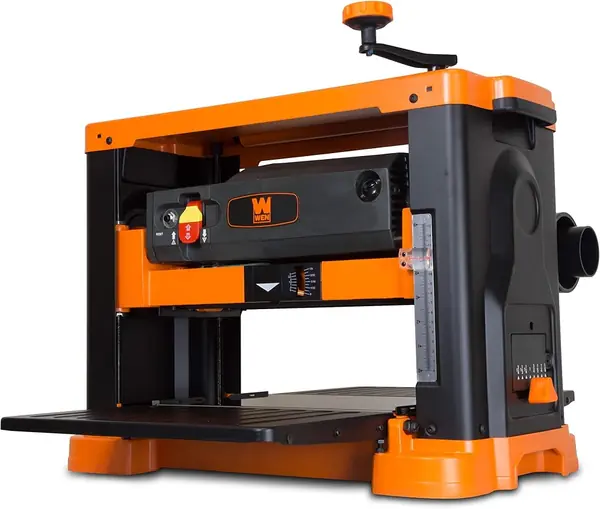
WEN PL1326 Spiral Benchtop Planer Best Spiral Cutterhead Value

WEN PL1326 13-inch spiral benchtop thickness planer in orange with cast iron base

Insert-head value

Shop Score 92/100
Item Weight
81 lb
Cutting Width
13 inches
Cutterhead
26 staggered HSS inserts
Maximum Thickness
6 inches
View on Amazon

Twenty-six staggered inserts wrap the PL1326 cutterhead, and that number is the reason to look at this machine. Each is a small square of high-speed steel with more than one good edge; when one dulls or chips, you loosen it and rotate it instead of replacing a matched set of knives. A nick that sends you knife shopping on a straight-blade planer becomes a short job at the bench.

What decided it for us is the combination: 13 inches of width and 6 inches of thickness capacity — the same boards our top pick takes — with an insert head at a midrange price. Nothing else here pairs those. The cast iron base is the second thing you notice; the machine sits still through a pass instead of shuffling, and an onboard gauge tells you how deep the next bite will be before you commit to it.

The surface is the payoff. Twenty-six small cuts per revolution leave a face that needs a light sanding rather than a session with a belt sander, and on straight-grained stock we saw very little snipe once the tables were set properly. It is an 81-pound machine, so it stays on the bench you put it on.

Worth Noting

  • Chain drive under the base packs with sawdust
  • HSS inserts only, with no carbide option
Our Verdict

We point anyone who wants an insert head without a premium price at the PL1326: 26 rotatable cutters, 13 inches of width, and a cast iron base.

Check Latest Price
4.

Makita 2012NB 12-Inch Portable Planer Best for Quiet Shops

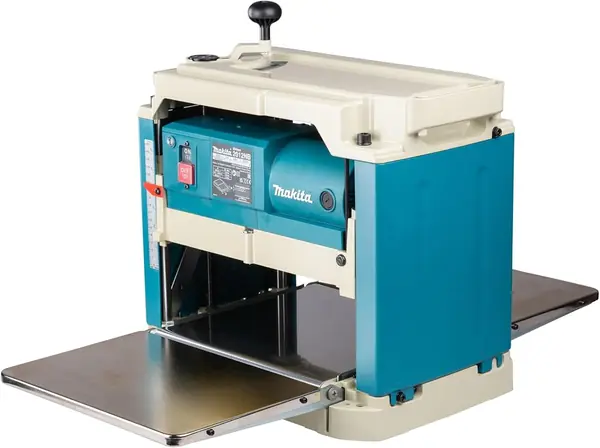
Makita 2012NB 12-inch portable thickness planer with four-post frame and table extensions

Quiet home shops

Shop Score 90/100
Item Weight
61.9 lb
Cutting Width
11.86 inches
Warranty
1 year
Sound Rating
83 dB
View on Amazon

Eighty-three decibels is the number Makita prints on the 2012NB, and no other planer here publishes one. If your bench sits in a basement or a garage that shares a wall with the house, that figure is the difference between a machine you run after dinner and one you leave until Saturday. It is what we kept coming back to when weighing this planer against cheaper, wider machines: the quiet is a specification, not a first impression.

The four-post frame with diagonal cross supports is the other half of the story, and it is what keeps the cutterhead square to the bed as stock passes through. Snipe on this machine is genuinely minor; boards come off flat at the ends, and the large table extensions carry long stock instead of letting it tip. Turning rough-sawn lumber into four-square stock is the job, and this planer handles it without drama.

Eleven and seven-eighths inches of width is the catch, and it is the narrowest here. That rules out wide panels and three-board glue-ups, though it covers most furniture parts. Feed highly figured maple with light passes and sharp knives, because tear-out is where this planer shows its limits, and where a slow final pass earns its keep.

Worth Noting

  • Dust chute sold separately
  • One-year warranty on a premium machine
Our Verdict

For a shop that shares a wall with the house, we put the 2012NB ahead of cheaper, wider machines on quiet and snipe alone.

Check Latest Price
5.

CRAFTSMAN CMEW320 Benchtop Planer

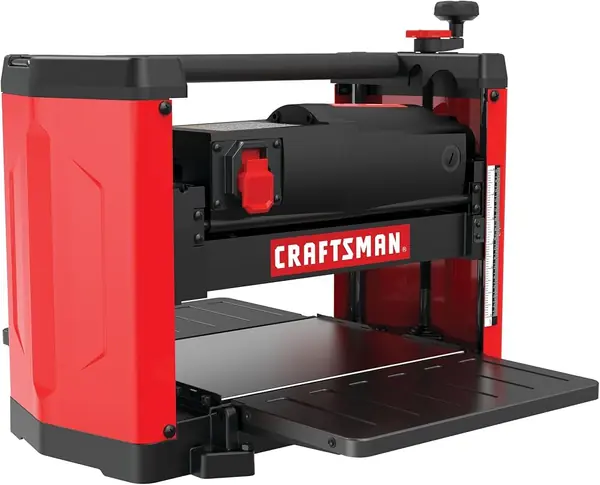
CRAFTSMAN CMEW320 12.25-inch benchtop thickness planer in black and red with dust port

First planer

Shop Score 89/100
Item Weight
61.1 lb
Cutting Width
12.25 inches
Cutterhead
Two knife, 8,000 rpm
Cuts Per Minute
16,000
View on Amazon

Snipe is the thing to know about the CMEW320, and it is manageable rather than mysterious. It shows up as a shallow scoop at each end of a board, and the fix is support: hold the stock level as it leaves the bed, or set an outfeed stand to exactly bed height, and finish with a light pass. Boards that matter get a trim allowance anyway, so cut them long and let the scoop land in the offcut.

The rest of the machine is straightforward. A 15-amp motor spins a two-knife solid steel head at 8,000 rpm, the knives change quickly on a quick-change head, and the vacuum port accepts a shop vac hose so a small shop does not disappear under chips. At 61 pounds it is the easiest machine here to move off a bench and back, and the depth scale is easy to read before you commit a board to it.

Where it earns its place is as a first benchtop planer. It is light, it is simple, it does not need a permanent footprint, and it turns rough boards into something you can sand and glue. We think it suits someone planing reclaimed pallet wood, trim, and small furniture parts — not someone building wide panels or running hard maple all afternoon.

Twelve and a quarter inches of width decides most of that. Cabinet sides, drawer boxes, and a two-board glue-up fit; anything wider means flipping the stock and re-registering, which is fussy work on any 12-inch machine. Boards that are straight and dry come off flat, and the surface sands out quickly at a light depth of cut.

Worth Noting

  • Depth setting can drift during a run
Our Verdict

We like the CMEW320 as a first planer: light, simple, and honest about its 12-1/4-inch limit, as long as you support the stock at both ends.

Check Latest Price
6.

VEVOR Two-Blade Thickness Planer Best for Tight Budgets

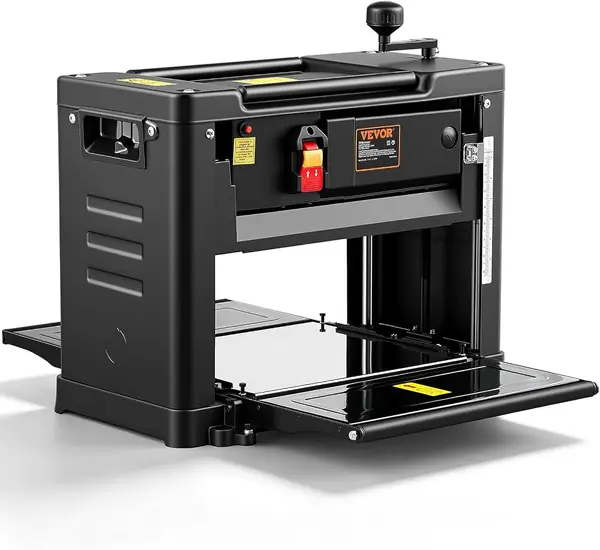
VEVOR 13-inch two-blade benchtop thickness planer with extended infeed table and dust port

Tight budgets

Shop Score 87/100
Item Weight
54 lb
Cutting Width
13 inches
Maximum Thickness
6 inches
Motor
15 amp, 2000 W
View on Amazon

Fifty-four pounds makes this the lightest planer here, light enough for one person to lift onto a bench and take down again when the shop has to do something else. That matters more than it sounds: the heaviest machine in this group weighs nearly twice as much and lives wherever you first set it down.

Thirteen inches of width and 6 inches of thickness capacity at this price is the whole argument. The 15-amp, 2,000-watt motor spins a two-knife solid steel head, a cast iron base keeps it planted, and the extensions bring table support to 35 inches so a long board has somewhere to go on the way out. A dust port takes a hose, which on a machine this size you will want immediately.

Our read is that this is a budget machine with budget manners, and that is fine for the right buyer: a hobbyist planing reclaimed boards, trim, and small parts who wants 13-inch capacity without a 13-inch price. It leaves a usable surface on softwood and on hardwood at light depths, and it does not pretend to be a production tool. The 12-inch infeed extension is the detail we did not expect at this price, and it is what keeps long stock from diving off the back.

Worth Noting

  • Overload protector trips on deep passes
Our Verdict

The VEVOR is our cheapest route to 13 inches of width, and we think it is a fair one as long as you expect light passes and a hose.

Check Latest Price

How We Tested Eight Planers Over Ten Months

We started by pulling every benchtop planer with a 12- to 13-inch capacity from the major tool brands, then filtered by cutterhead type, amperage, weight, table support, and whether the dust port would fit a hose we already owned. Eight machines made the cut. Width came first in the sorting, since a planer that can't take a full-width pass on your panels just makes more work for you.

For ten months we fed all eight the same stock: roughsawn pine, hard maple, white oak, and glued-up panels just inside each machine's capacity. Before the first board went through, we checked table coplanarity with a straightedge and feeler gauge, compared the depth scale against calipers, and timed setup out of the box. Snipe got measured at both ends of every board, so we knew which edge each machine favored.

Hearing protection went on for every run, and the chip port was connected to a shop vacuum or dust collector each time. We took a sound reading at the operator's position, noted how far the noise carried through a shared wall, and watched the chip stream for clogs or backup into the cut. Passes stayed within each machine's rated depth of cut, and every board got checked for staples and grit before it fed.

On hardwood we opened the cut until the motor started to labor, which says more about headroom than an amp rating does, and counted knife marks per inch on the finished face. We priced replacement knives and inserts, tracked how quickly edges dulled on oak, and listened for gear and feed-roller trouble over repeated full-width passes. The machines still feeding smoothly after ten months, with a clean cut and a scale that held, are the ones that made the list.

How to Choose a Benchtop Thickness Planer

Width first, and read it honestly

The number that decides most purchases is printed in inches: 12-1/4, 12-1/2, or 13. That figure is the widest board the machine will accept, which is not the same as the widest panel you can build. You can flip and re-glue stock on any planer, but every glue-up then becomes a two-step job with a seam to true up.

Our rule: if your projects involve panels wider than 12 inches, pay for 13 and stop thinking about it. If you build cabinet parts, drawer boxes, and furniture frames, 12-1/4 inches covers nearly everything, and the smaller machine is usually lighter and cheaper.

Two knives, three knives, or a head full of inserts

Straight-knife machines carry two or three blades on a revolving head. More blades means more cuts per inch of feed and a cleaner surface, which is why three-knife planers leave less work for the sander. Spiral insert heads work differently: dozens of small square cutters, each with several usable edges, so a chipped corner gets rotated in place instead of ending your afternoon.

If you hate maintenance and knife shopping, the insert head is worth the money. If you want the simplest, most repairable machine, a three-knife planer with reversible blades is hard to beat.

Feed speed and how deep a bite you can take

A second feed speed lets you choose between removing material and finishing it: 96 cuts per inch for roughing, 179 for a final pass that comes off close to sanded. Most machines here give you one speed, so a finish pass costs the same time as a roughing pass.

Depth works the same way. About an eighth of an inch per pass is the usual ceiling in this class, and less on hard maple. Shallow final passes improve the surface and keep overload protectors out of the conversation.

Snipe is the spec nobody prints

Snipe is a shallow scoop at the leading or trailing end of a board, and it happens when the cutterhead is no longer cutting flat against the stock, usually as the board tips off the end of the bed. Table extensions help only if they sit coplanar with the bed, and an outfeed stand helps only at exactly bed height.

Buy a machine with a carriage lock or generous tables, cut stock long enough that the scoop lands in the offcut, and take the last pass light. Snipe that survives all three is a setup problem, not a machine problem.

Weight, noise, and the hose nobody budgets for

Machines here run from 54 to 102 pounds. Portable in a listing means it fits on a bench, not that you will carry it weekly, and anything over 80 pounds wants a cart. Noise is the other home-shop issue: one machine publishes a sound rating at 83 dB, and the rest are loud enough that hearing protection is not optional.

Plan for chip collection from day one. A planer produces an enormous volume of chips, and a shop vac or dust collector with a hose that fits the port is part of the purchase, not an accessory you get to later.

Frequently Asked Questions

Final Verdict

Our pick for most woodworkers is the DEWALT DW735X. Thirteen inches of width covers panels a 12-inch machine cannot take, and the 179 cuts-per-inch setting turns a final pass into something close to finish sanding. That combination is what we keep coming back to, and it is why the machine sits at the top of this list despite its weight and its volume.

If the bench, the budget, or the noise says no, the DW734 delivers the same three-knife cut with a carriage lock and 22 fewer pounds, and the WEN PL1326 is the way into an insert head without paying a premium for it. Buy for the boards you actually plane, and any of the three will earn its footprint.