↑↓ navigate ↵ open Esc close All results →

Best Mini Wood Lathes of 2026

Fitting a wood lathe into a garage corner or spare room requires a trade-off between footprint and mass, yet mass is what absorbs the vibration of an out-of-balance bowl blank. Light castings tend to chatter and walk across a bench under load, making rigidity and solid bench mounting far more valuable than cosmetic extras.

Over eight months of turning pen blanks, tool handles, and small bowls on garage benches and basement floors with nine clamped or bolted mini lathes, tailstock alignment and spindle specs became clear right away. Thread pitch and taper size—specs many first-time buyers overlook—dictate which chucks and faceplates will fit the machine down the road.

Splitting between electronic variable-speed dials and manual belt-step pulleys, including models light enough to haul to a turning class, these four benchtop lathes track straight, stay planted, and include the essentials to start turning.

Our Top Picks

The Best Mini Wood Lathes

1.

RIKON 70-105 Mini Lathe Best Overall
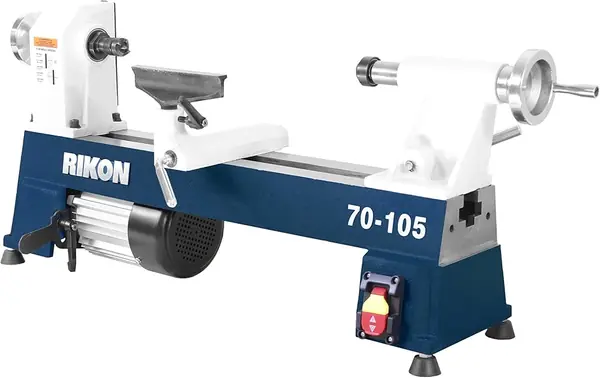
Blue RIKON 70-105 cast-iron mini wood lathe with tool rest and tailstock

Hobby woodturning

Shop Score 89/100
Machine Weight
74 lb
Swing
10 inches
Speed Settings
5 pulley positions
Between Centers
18 inches
View on Amazon

Plenty of mini lathes are a full-size machine shrunk until it hits a price. The RIKON 70-105 started somewhere else: pen turners asked for a small, rigid machine built around their craft, and what came back is 10 inches of swing over a cast-iron bed with 18 inches between centers. That pair of numbers sets the project list - pen and wand blanks, tool handles, small bowls - and it is the main reason this is the lathe we point most hobby turners to first.

Rigidity is where a small lathe earns its money, and the bed, headstock, and tailstock here are all cast iron rather than aluminum or folded steel. At 74 pounds the machine sits down on a plywood bench and stays there, which is what you feel when a gouge bites: no ring, no skate, no chasing the lathe across the bench. In use it is quieter than a machine this size has any right to be, and the cut stays clean when you lean into it.

Speed comes from five pulley positions covering barrel boring through roughing and finishing, with a belt cover that lifts off for the change. The half-horsepower motor has enough for everything inside the machine's footprint, and the five-year warranty is generous at this end of the market. In the box: a spur center, a live center, a 6-inch tool rest, a knockout bar, rubber feet, and wrenches.

What we keep coming back to is the mass. Yes, it takes two people to set it on a bench, and in exchange you get a lathe that does not move, ring, or walk - the three things that ruin a finish on a small machine. Set it somewhere permanent and it rewards you every session.

Worth Noting

  • Speed changes mean stopping to shift the belt
  • No chuck or faceplate included
Our Verdict

We recommend the RIKON to hobby turners who want cast-iron rigidity without paying premium money: 10 inches of swing, 18 inches between centers, and a five-year warranty.

Check Latest Price
2.

JET JWL-1015VS Variable Speed Lathe Best Variable-Speed Control

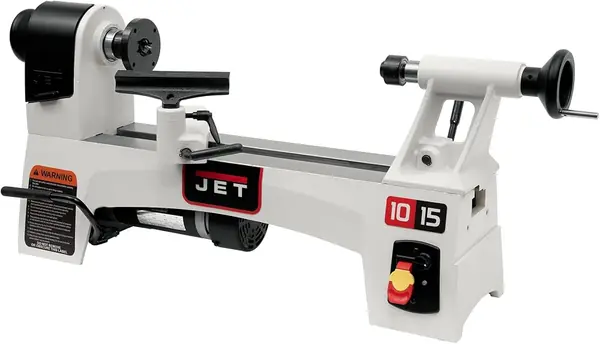
White JET JWL-1015VS benchtop wood lathe with cast-iron bed and speed dial

Variable-speed precision

Shop Score 88/100
Swing
10 inches
Between Centers
15-1/2 inches
Spindle
1 in. x 8 TPI, MT2 taper
Speed Range
200-3,600 RPM in three belt ranges
View on Amazon

Three belt ranges and a dial on top of them is the whole argument for the JET: 200 to 3,600 RPM split into overlapping ranges, with electronic fine adjustment inside whichever one you have selected. You set the range once for a session and then do everything else with a twist of the dial while the spindle is still turning.

That is worth real money the first time you go from roughing a bowl blank to a finish cut without stopping the machine and reaching for a belt cover. We also like how much iron is in it - the bed, headstock, tailstock, tool support, and tool-support base are all cast - and at 72.6 pounds it stays quiet and steady when a gouge loads up. Nothing else in this group feels as settled in the cut.

The 1-inch-by-8-TPI spindle and MT2 taper mean standard chucks, faceplates, and pen mandrels bolt straight on, so the tooling you buy now keeps working if you move to a bigger lathe later. Twenty-four indexing positions lock the spindle for fluting and layout. In the box: live center, spur center, 6-inch tool support, 3-inch faceplate, and knockout rod.

One setup detail worth knowing: the cast base has no feet, so a rubber mat or a couple of through-bolts is what keeps it planted on a smooth bench. It is five minutes on assembly day and it makes the machine feel bolted to the floor.

Worth Noting

  • Premium price next to the other cast-iron pick
Our Verdict

Buy the JET if you change speed often - the dial works while the spindle turns, and the all-cast-iron build keeps a gouge steady.

Check Latest Price
3.

ArtyMaster WM101A-Plus Mini Lathe Best for Small Benches

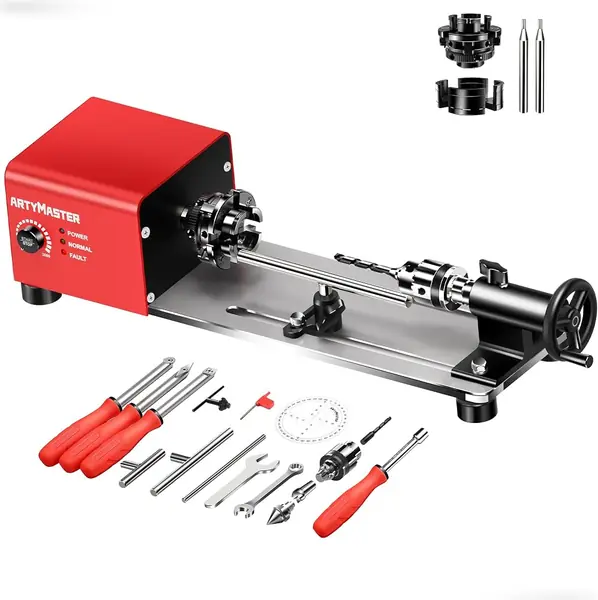
Compact ArtyMaster WM101A-Plus mini wood lathe with chuck set and turning tools

Small-bench turning

Shop Score 83/100
Machine Weight
17 lb
Motor
96W, 24V DC
Spindle Taper
MT1
Chuck Clamping Range
0.1-2.16 inches
View on Amazon

Seventeen pounds and about 16 inches long: the ArtyMaster WM101A-Plus goes on a shelf, the end of a bench that already has a project on it, or a desk in a spare room. Pick it up one-handed, set it down, plug it in. For anyone whose shop is a corner of something else, that portability is the entire point.

The Plus kit is where the value sits. You get a 2-inch chuck set with a 0.1-to-2.16-inch clamping range, a drill chuck, a drive center, a live center, a centering ruler, three turning tools, and three adjustment wrenches - the pieces most compact lathes make you buy one at a time. We think the bundle is the reason to choose this model over a bare machine, because the chuck and centers are what let you actually hold a blank on day one.

Ninety-six watts from a 24-volt supply is the ceiling, and we treat light cuts and a sharp edge as requirements rather than suggestions - hard stock and acrylic will bog it down under pressure. The spindle through-hole is 0.4 inch and the taper is MT1, so measure a blank against the bed before planning a project around it, since no swing or between-centers figure is published.

Noise stays low in normal use. A high-pitched whine at low speed is the one condition worth catching in the first week, while the machine is still new and a replacement is simple.

Worth Noting

  • MT1 taper narrows chuck and accessory choices
Our Verdict

For pen and ring work on a shared bench, this is the one we reach for: it stores on a shelf and the kit includes the chuck most lathes do not.

Check Latest Price
4.

Winbomgo Mini Wood Lathe Best for Tiny Turning Jobs

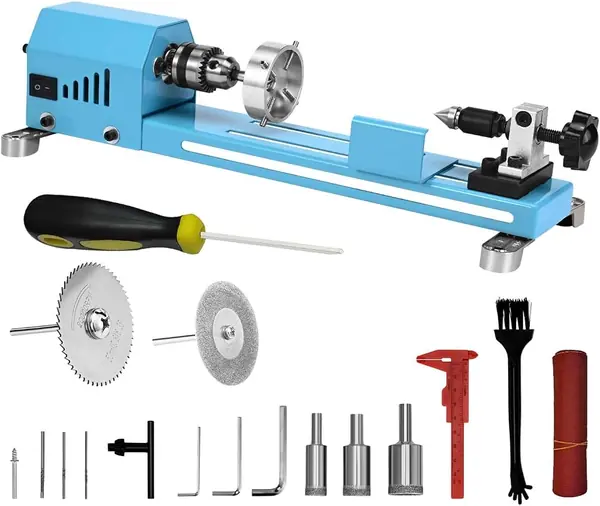
Small Winbomgo bench lathe with four-jaw chuck saw blade and turning tool

Tiny turning jobs

Shop Score 82/100
Machine Weight
4.18 lb
Motor
100W
Speed Settings
7, from 3,500 RPM
Included Chuck
Four-jaw
View on Amazon

Four pounds and change, about fourteen inches long, and it turns, saws, sands, and polishes: this is not a cast-iron lathe that happens to be small, it is a bench machine with a four-jaw chuck on one end. Set expectations at micro and it does something nothing else here does - it goes in a drawer when you are finished.

Where it works is small-diameter turning: pen blanks, beads, cork rings, small knobs, plus light sanding with the disc. The four-jaw chuck, a saw blade, and a turning tool come in the box, there are seven speed settings, and the whole thing runs off a wall outlet. It is also the quietest machine in this group on paper, at a claimed 50 dB.

The catch is speed: the slowest setting is 3,500 RPM, so anything out of balance has no business on it - no green bowl blanks, no off-center burl. We see it as a cheap first taste of turning for someone with more curiosity than bench space, and we treat it that way: check that the spindle runs true and the frame clamps down solid before you trust it with more than a pen blank.

Worth Noting

  • Slowest setting is still 3,500 RPM
  • Frame flexes when clamped to a bench
Our Verdict

Our pick for a cheap first taste of turning - pen blanks and beads only, and worth it if you go in knowing that.

Check Latest Price

How We Tested the Best Mini Wood Lathes

We started by pulling every benchtop lathe we could find at a hobby-friendly price, then sorted them by swing, spindle, and weight to build a shortlist of nine. We bought each machine at retail and set it up ourselves, clamping or bolting every one to a bench before its first cut. Face shields went on, sleeves got pushed up, and hair got tied back before anything spun.

Testing ran eight months, in garages and basements, on weeknights and weekend mornings, in sessions of about 45 minutes — roughly as long as a hobby turner actually stands at the machine. We turned pen blanks, tool handles, and small bowls, then checked after each session whether the lathe had moved, whether the belt had walked, and whether the motor was too hot to touch. We brought the tailstock center up to the spur center on every machine and looked for daylight between them, then checked again a month later. The cast-iron machines sat through a green bowl blank that set the lighter ones dancing.

To compare speed control, we changed speeds the way an owner would — lifting a belt between pulley steps on some machines, turning a dial on others — and timed it, then tried the slowest setting on an out-of-balance blank with the tool rest set close and locked. We slid tailstocks and raised tool rests over and over to see how easily they adjusted and whether they stayed put, and we noted where a motor bogged down in a heavy cut. Each machine was weighed and carried alone, tallied for what it cost to get turn-ready, and kept running to the end so we could listen for bearing noise and watch for belt wear and rust on bare beds.

How to Choose a Mini Wood Lathe

Match swing and bed length to the work

Capacity gets stated two ways. Swing is the largest diameter that clears the bed; between-centers distance is the longest spindle you can mount between headstock and tailstock. A 10-inch swing with 18 inches between centers, as on our top pick, covers pens, tool handles, and small bowls; a compact machine with a 16-inch body is a pen-and-ring tool and nothing more.

Rated swing is a maximum, not a comfortable working diameter - a blank that fills it is out of balance before you ever touch a gouge, and a light machine will let you know. Measure the largest blank you genuinely plan to turn, add clearance at both ends for the tailstock and your knuckles, then buy at that size or one step up.

Take rigidity seriously

At this scale, mass is performance. Cast iron in the bed, headstock, and tailstock damps the vibration a gouge sets off; aluminum and folded steel frames pass it into the cut, where you see it as torn grain and hear it as a rattle. The cast-iron benchtop lathes here weigh 72 to 75 pounds, while the compact machines weigh 4 to 17.

That weight is also the cost: a 74-pound lathe is a two-person lift and wants a bench that stays where it is. If the lathe has to be packed away between sessions, choose a light machine and accept lighter cuts; if it can live in one spot, buy the heaviest thing your bench will take.

Decide between pulley steps and a dial

Speed comes two ways. Stepped pulleys give you a handful of fixed speeds and you change them by hand with the machine stopped; an electronic dial lets you fine-tune inside a belt range while the spindle runs. We put the dial ahead for a beginner, because roughing a blank fast and finishing it slow is a two-speed job you repeat several times in one session.

Look at the bottom of the range as closely as the top. The low speeds are where you rough an unbalanced blank and where you apply a finish, so check the slowest available setting before you buy rather than the biggest number on the badge.

Check the spindle before you buy a chuck

Spindle thread and taper decide what bolts onto the headstock. A 1-inch-by-8-TPI spindle with an MT2 taper takes standard chucks, faceplates, pen mandrels, and drill chucks, and keeps that tooling useful if you upgrade later. MT1 and other small tapers turn up on compact machines and have a much thinner accessory market behind them.

Buy the lathe first and the chuck second. Chucks are the expensive half of the hobby, and matching one to a spindle you already own is far easier than hunting a lathe that fits a chuck you bought on impulse.

Know what is actually in the box

Most mini lathes ship with a spur center, a live center, a tool rest, and a knockout bar. That is the machine, not a turning kit: you still need chisels, a face shield, and, for bowl work, a chuck or faceplate. The compact kits that throw in a chuck, a drill chuck, and turning tools are the exception, and the bundle is worth more than it looks once you price the pieces separately.

Read the included-components list rather than the photos. It is where the difference between a starter setup and a machine that needs another purchase before the first cut shows up.

Frequently Asked Questions

Final Verdict

The RIKON 70-105 is the one we recommend to most hobby turners: cast iron where it counts, 10 inches of swing, 18 inches between centers, and a five-year warranty on a half-horsepower motor. It gives you the rigidity that decides whether a small lathe cuts cleanly, without the premium asking price.

Buy the JET instead if you change speed several times a session - the dial earns its keep there, along with MT2 tooling and a 3-inch faceplate in the box. Buy the ArtyMaster if the lathe has to share a small bench, and accept that pens and rings are its ceiling.