↑↓ navigate ↵ open Esc close All results →

Best Live Centers for Wood Lathes of 2026

A dead center seems fine for about ten minutes. Then the point starts chirping against the spinning tenon, the wood scorches, and you're backing off the tailstock to let things cool instead of finishing the cut. A live center puts bearings between the taper and the point, so the tip turns with the work and you can keep the piece seated and keep cutting.

We turned with 12 live centers over eight months, and the differences that actually showed up at the lathe were less glamorous than bearing counts: taper fit, seal quality, tip geometry, and how much quill travel the body eats. One thing we wish we'd known sooner — a taper with a burr or a little grit will spin in the socket, and once it has, it keeps slipping.

Our picks run from a small crown center for green wood to a heavy body with a threaded nose for cones and shop-made tips, plus a cased one that travels well. Different lathes, different projects, same requirement: a point that turns true and a taper that holds.

Our Top Picks

The Best Live Centers for Wood Lathes

1.

Oudtinx MT2 Heavy Duty Live Tailstock Center Best Overall
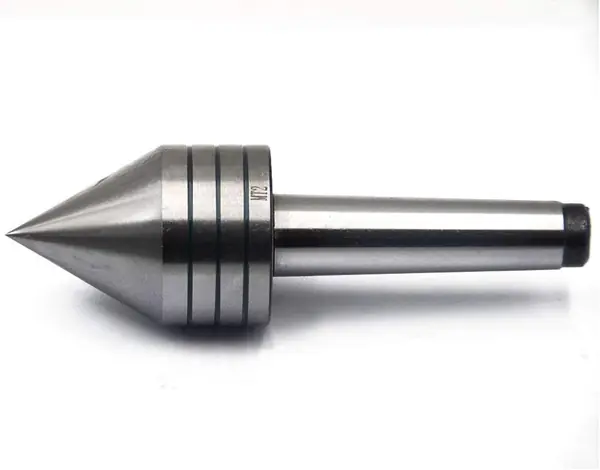
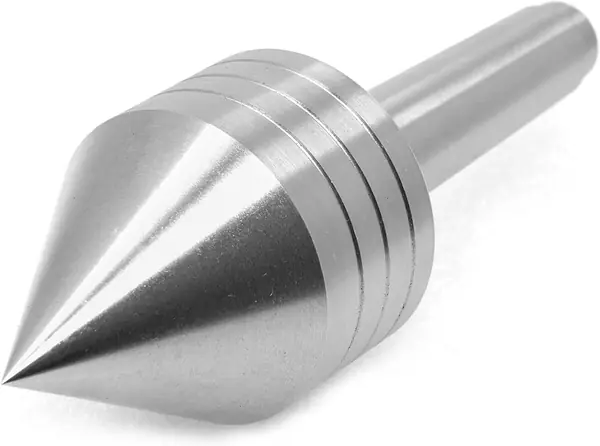
Oudtinx MT2 live tailstock center with a large alloy steel cone and 60-degree point

General MT2 turning

Shop Score 93/100
Taper
MT2
Cone Size
2-1/2 by 1-11/16 inches
Point
60 degree
Weight
1.17 lb
View on Amazon

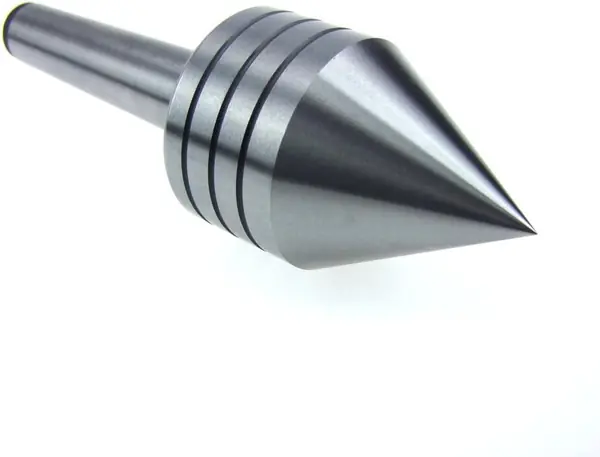
The cone is 2-1/2 inches long and 1-11/16 inches across, which is a lot of bearing surface to put against the end of a blank, and it is the reason this is the first center we reach for. A cone that size steadies a heavy spindle instead of balancing it on a pin, and the 60-degree point set into the middle takes the drilled dimple you would normally use for smaller work.

Seating it is uneventful. The MT2 taper drops into a #2 Morse tailstock and releases as you back the quill off, and at 1.17 pounds the body feels planted without dragging a small lathe around. The ball bearings turn the point smoothly enough that you stop hunting for a vibration that was never coming from the wood.

Small work is where it gives ground. A 1-11/16 inch cone is a lot of steel at the tailstock end, and on a pen blank or a finial it crowds the tool rest and hides the last half inch of the work from your gouge. Under about an inch in diameter, we use the point in a drilled dimple and leave the cone out of it entirely.

Everything else is quiet competence, at the lowest price in this group, which leaves more of the tool budget for gouges and chucks. For a mixed diet of legs, spindles and small bowls on an MT2 lathe, this is the one to order first.

Worth Noting

  • Wide cone crowds the tool rest on small pen blanks
Our Verdict

We tell most MT2 owners to start here: a wide cone, bearings that run true, and the lowest price in this group.

Check Latest Price
2.

INPANOLS MT2 Live Center Best for High-Speed Turning

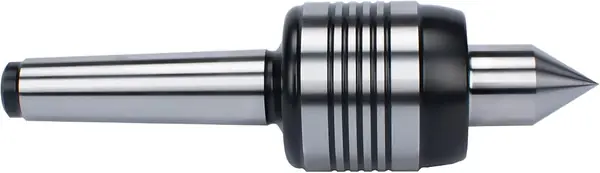
INPANOLS MT2 live center with a hardened steel body and long rotating head

High-speed spindle work

Shop Score 92/100
Taper
MT2
Bearings
Three-bearing design
Warranty
2 years
Stated Accuracy
0.0003 inch
View on Amazon

Three bearings sit behind this point — a deep groove ball bearing, a thrust bearing and a needle roller — with a sealing ring at the front gland to keep dust and chips out of the race. The body is ground hardened steel at HRC 63, and the whole center is built for higher spindle speeds than the plain points here.

We like the seal more than the accuracy figure. The listing quotes .0003 inch, which is the maker's number and not something we can check to four decimal places; what we can tell you is that the point turns true in the tailstock and the head stays cool through a long spindle. The seal is the part that buys you time, because dust that reaches a bearing grinds it flat.

Plan around the length. At 5.94 inches overall the body is the longest in this group, and that length comes straight out of your tailstock travel — on a small lathe with the quill near the end of its range, a long center plus a thick blank can leave you short. Retract the quill and measure the gap before you order. What you get for it is a sealed three-bearing head and a two-year warranty, which few centers here carry.

Worth Noting

  • Point only, no threaded accessories
Our Verdict

We recommend it where the lathe runs fast: the sealed head and the two-year warranty are what the extra money buys.

Check Latest Price
3.

Oneway Multi-Tip Live Center Set Best Multi-Tip System

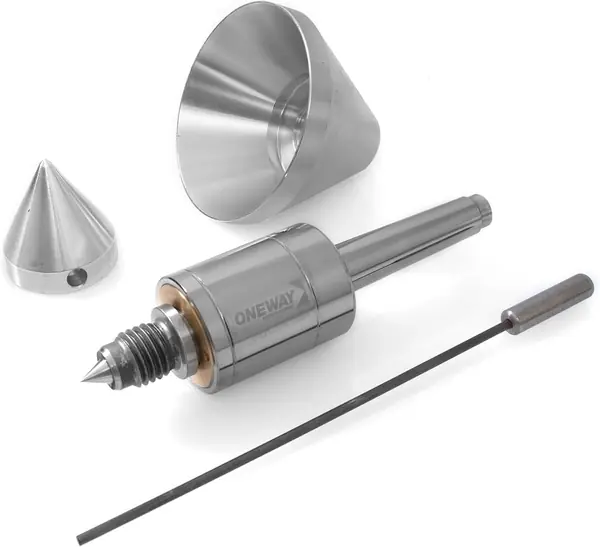
Oneway four-piece multi-tip live center set with cup center and two cones

Bowls and spindles

Shop Score 91/100
Taper
#2 Morse taper
Thread
3/4 inch by 10 TPI
Cup Diameter
5/8 inch
Self-centering Capacity
Up to 3-1/4 inches
View on Amazon

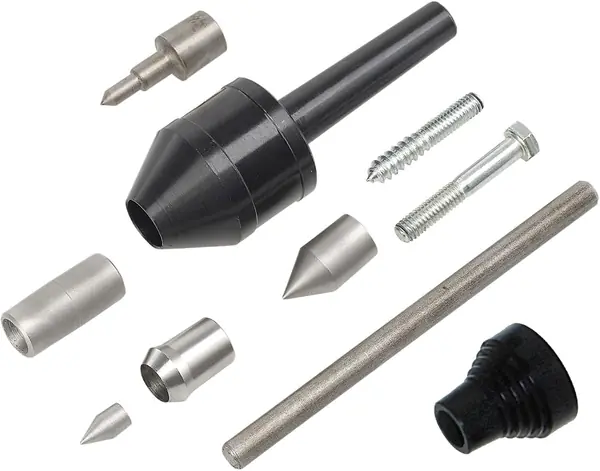
Four pieces do the work of a drawerful of centers: a 5/8 inch cup with a removable point, a bull nose cone, a full point cone, and a knock-out rod. The outside of the cup is threaded 3/4 inch by 10 TPI, so the cones screw on either way round — the bull nose reversed grips a round or square spindle up to 3 inches, and turned the other way it self-centers work up to 3-1/4 inches across.

That range is what you are paying for on bowls. A tenon sitting inside a cone has a ring of contact around it instead of a single point, so you can lean into a heavier cut at the tailstock end without the work creeping. The nickel-plated body has shrugged off chips and wet blanks, and the knock-out rod saves you improvising when a taper decides to stay put.

What we don't love is the missing pen point. For everything from a lamp post to a hollow form this is the set that stays on the lathe, but pen turners still need a separate point, which is an odd gap in a four-piece kit at this money.

If your turning is all spindles, none of it earns the premium — a 60-degree point in a drilled dimple does the same work for a fraction of the cost. If you turn bowls and hollow forms and want one center that covers both, this is the best thought-out system in this group.

Worth Noting

  • Omits a dedicated pen point despite the four-piece kit
  • High price is hard to justify for spindle-only turning
Our Verdict

Worth the premium for bowl and hollow-form work: threaded cones hold shapes that a 60-degree point simply cannot.

Check Latest Price
4.

NOVA 5015 Live Center System Best for Boring Through Spindles

NOVA 5015 live center system with hollow body and interchangeable centers

Drilling through spindles

Shop Score 90/100
Taper
#2 Morse taper
Bearings
3
Warranty
2-year replacement
Centers Included
Five interchangeable centers
View on Amazon

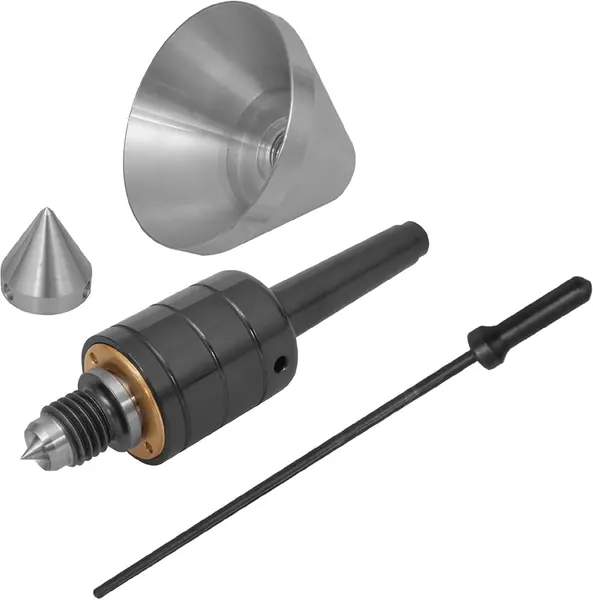
A hole runs right through the body, which is what separates this center from every other one here. Fit the hollow cup and you can bore into the end of a spindle while the tailstock still supports it — a lamp cord hole, a dowel socket, the pilot you want before a long boring job — without taking the work off the lathe to do it.

The rest is a system: five interchangeable centers, including a 60-degree point, a threaded center, a miniature extension, a stepped cone and the hollow cup, all swapping into the same three-bearing body. The threaded center takes shop-made wooden tips, which sounds fussy until you need a soft tip that will not mark a finished surface.

Boring through the center means clearing chips often, since the hole is blind and the bit has nowhere to throw them; that is the nature of the job rather than a fault. Five loose centers are five things to lose, so we keep them together in one box. The two-year full replacement warranty is the most generous coverage in this group, and we think it makes the higher price easier to justify than it first looks.

Worth Noting

  • Small centers are easy to misplace
Our Verdict

For anyone who drills through spindles on the lathe, we think the hollow body alone justifies this one.

Check Latest Price
5.

Savannah Dual Bearing Live Center Best Threaded Platform

Savannah MT2 dual bearing live center with threaded nose for bull nose cones

Threaded accessory setups

Shop Score 89/100
Taper
MT2
Bearings
Dual sealed
Thread
3/4 inch by 10 TPI
Cone Diameter
3-3/8 inches
View on Amazon

Cheaper than the full multi-tip kits and dearer than the plain points, this is the middle route to a threaded center: one body, a 3/4 inch by 10 TPI nose that takes a large reversible bull nose cone, and a sealed dual-bearing head.

The bearings are heat sealed and lubricated for life, so there is nothing to oil before a session and nothing to adjust. The shaft is precision ground hard steel and runs true in the taper, and the nose takes the same 3/4 inch accessories that fit other threaded systems.

One thing to know before you buy: the cone threads on by hand, and like any thread-on accessory it can work loose while the lathe runs, so we give it a twist before each session. That is a habit rather than a defect, and it is the same with any threaded tip in this group.

The geometry is what sells it. The bull nose reverses to grip small or large work, and at 3-3/8 inches across it puts a serious ring of contact on a bowl tenon. If you already own cones and tips on a 3/4 inch thread, this is the least expensive way to put them on an MT2 lathe.

Worth Noting

  • Sealed bearings cannot be repacked later
Our Verdict

A good pick if you want a threaded accessory platform without buying the biggest kit: sealed bearings and one big cone.

Check Latest Price
6.

HFS MT2 Live Center Best for Toolbox or Travel

HFS MT2 live tailstock center with alloy steel cone and protective storage case

Toolbox and travel

Shop Score 88/100
Taper
#2 Morse taper
Bearings
Ball bearing
Cone Size
2-1/2 by 1-11/16 inches
Included
Protective case
View on Amazon

It arrives in a small end-mill-style case with the taper coated in protective oil. That case is not a throwaway detail: a Morse taper that picks up grit in a toolbox drawer will not seat, and a box is cheap insurance for the one surface the whole center depends on.

The working end matches our top pick — a 2-1/2 inch by 1-11/16 inch cone on a steel shaft, with ball bearings behind it. We found it steady on larger blanks and quiet at speed, with no vibration coming back through the tool rest. The one habit it asks for is oil: the maker wants the bearing lubricated before each use, and a dry bearing is the quickest way to turn a smooth center into a hot one.

What it is not is a system. There is no thread, no cup and no cone set — just a good cone and a point, which suits a turner who wants a second center for the tailstock or one that goes to a club night. If yours is going to live in a bag, the case makes it the better choice over our top pick for that job.

Worth Noting

  • 30-day seller warranty is short
Our Verdict

We like it as the center that travels: the same big cone as our top pick, and it comes in a case.

Check Latest Price
7.

WEN LA1334 MT2 Crown Live Center Best Crown Center for Green Wood

WEN LA1334 MT2 crown live center with a 3/4-inch multi-tooth ring

Green wood turning

Shop Score 87/100
Taper
MT2
Bearings
Ball bearing
Type
Crown revolving center
Crown Diameter
3/4 inch
View on Amazon

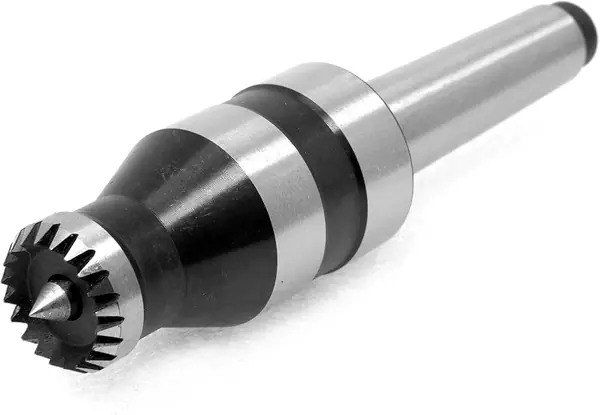
A crown center grips instead of poking. The 3/4 inch ring of teeth bites into end grain and holds it without a drilled dimple, so the work stops spinning on a point and stops burning — the two things that send people looking for a different tailstock center. It is the one we fit for green wood and for any blank whose end will not hold a dimple.

The trade is centering. A ring locates on a circle rather than a point, so this is not the center for a finial or a tenon that has to run dead on axis; a 60-degree point in a drilled dimple is more precise. On its internal ball bearings it spins freely with the work, and the steel body has enough mass to feel solid when you crank the quill down.

It lives beside a plain point center rather than replacing one, and that is how we use it: point for furniture parts, crown for anything wet, splitty or already rounded. If most of your turning is green wood, the specialist is worth the drawer space.

Worth Noting

  • Set screw and center pin can work loose
Our Verdict

The fix for work that spins or burns on a point: a ring of teeth that grips instead of poking.

Check Latest Price
8.

WEN LA1158 MT2 Tailstock Live Center

WEN LA1158 MT2 tailstock live center with a 1-5/8-inch steel nose

Basic spindle support

Shop Score 86/100
Taper
MT2
Bearings
Ball bearing
Nose Diameter
1-5/8 inches
View on Amazon

One body, one nose, one set of bearings: 1-5/8 inches across on an MT2 taper, with nothing to screw on and nothing to adjust. There is no cone, no cup and no thread here, which is either the whole point or a dealbreaker depending on what you turn.

For ordinary spindle work — a leg held in a drilled dimple — a simple center like this is all the job needs, and the wide nose gives you a reference when you are eyeballing the end of a blank. WEN also lists the specific lathe models it fits, the 3424, 3424T, 34018, 3427, 34027 and 34034, which is more than most listings tell you, though any MT2 tailstock will take it.

It asks nothing of you between sessions in the way of oil or adjustment, and the point turns smoothly on its ball bearings. That is the appeal: it is the center you leave in the tailstock while you move between projects.

Where it gives up ground is in adaptability. The nose is a fixed 1-5/8 inches, so it cannot be fitted with cones or shop-made tips, and the money saved over the multi-tip systems is money you spend again the first time you want to hold a bowl tenon. We never have to think about this one, and for a lot of lathes that is exactly the right answer.

Worth Noting

  • Threaded bearing cover can work loose
Our Verdict

A plain, smooth MT2 center for ordinary spindle work, and a straight upgrade from a solid dead center.

Check Latest Price

How We Tested Live Centers on the Lathe

We started with more than 40 live centers, reading specs and owner reviews and filtering hard on taper. If your tailstock is MT2, an MT1 shank is dead weight, and a listing that didn't state its bearing arrangement or thread size got cut. That left 12, which we ran for eight months on a midi lathe and a full-size lathe.

Before the first cut with each one, we cleaned the shank, looked for burrs and grit, and lubed the bearing exactly as the maker directed, since a dry bearing runs hot and wears fast. We seated every center in a clean socket, spun it by hand against a dial indicator, then put a spindle between centers and watched the tailstock end for wobble. We also noted how much quill travel each body ate up.

In use, we turned bowls and spindles, roughed green blanks against crown centers, and pushed spindle speeds until the tailstock was the limiting factor. We screwed cones and shop-made tips onto the threaded noses to see how the threads felt going on, and drilled through spindles with the interchangeable-tip setups. After each session we felt the body for heat and listened for a rumble; one center rode in a toolbox to a Saturday class and back.

Every couple of months we rechecked the group for play in the point, rust on the taper, and any change in how smoothly they spun. We also counted what came in the box, whether the bearings could be serviced, and what the warranty covered, because value here isn't the sticker alone.

How to Choose a Live Center for a Wood Lathe

Start With the Taper

The one specification you cannot work around is the taper. A #2 Morse taper is the common size on mid-size lathes and on many mini lathes, and it is what every center here uses; several also come in MT1 or larger, so order by the size field rather than the photograph. If you do not know yours, check the manual or the stamping on the quill: an MT2 taper runs roughly 0.7 inch across the big end and an MT1 about 0.475 inch, which calipers settle in seconds.

Then treat the taper like the precision joint it is. Wipe it before every session, look for a burr, and never let it spin in the socket — a Morse taper that has slipped once will keep slipping, and no amount of quill pressure fixes a scored one.

Bearings, Seals, and Heat

Bearings are where the money goes. Two bearings handle ordinary spindle work; three, with a thrust bearing in the stack, hold up better when you run fast or lean on a big blank. A sealed front gland keeps wood dust out of the race, and wood dust is abrasive — it is the difference between a center that stays smooth and one that starts to growl halfway through a bowl.

A center that runs hot is telling you something. Feel the body after a few minutes at speed: warm is normal, hot means the bearing is dry, overloaded or on its way out. Some makers want a drop of oil before every session; sealed units want nothing at all but cannot be repacked once they go gritty. Decide which kind of maintenance you prefer before you buy.

Point, Cup, or Crown: Match the Tip to the Work

A 60-degree point sits in a dimple drilled in the end of the work, which is the most accurate way to hold a spindle and the right default for legs, handles and anything you have bored. A cup center surrounds the end instead of poking it, so it protects a finished surface and holds soft or splitty wood. A crown or ring center grips with a circle of teeth and is what you reach for when the end keeps spinning or burning.

Size the tip to the work as well. A big cone holds a big tenon, but on a pen blank it crowds the tool rest and hides the last half inch of the blank from your gouge. Below about an inch in diameter, a point in a dimple beats any cone.

Threaded Noses and What They Add

A 3/4 inch, 10 TPI nose turns a live center into a platform: cones and cups screw on, and you can turn your own wooden tips when you need something soft against a finished surface. Both threaded picks here use that thread, so their accessories cross over. It is worth paying for if you turn bowls and hollow forms, and money you will never use if your work is all spindles.

The catch is that threaded accessories are tightened by hand. They can work loose as the lathe runs, so check the cone with a twist before each session and keep the thread clean so it seats all the way down.

Length, Heft, and Tailstock Travel

Two centers with similar cones can behave quite differently because of what sits behind the cone. A long body — the INPANOLS runs 5.94 inches overall — takes that length out of your quill travel, which matters on a short-quill mini lathe. Heavier bodies feel steadier going in, though a very light tailstock will notice the weight when you crank it home.

Before you order, retract the quill, measure the gap between the tailstock and the work, and compare it with the center's overall length. That is the check that saves a return.

Frequently Asked Questions

Final Verdict

For most MT2 lathes, the Oudtinx is the center to order first. A wide cone, smooth bearings and the least money in this group make it the default we hand to anyone who turns a mix of spindles and small bowls.

If you run the lathe fast and want a sealed bearing with a two-year warranty behind it, the INPANOLS is the step up we recommend. And if your turning is bowls and hollow forms, skip both and buy the Oneway set — the screw-on cones hold shapes that a point cannot.