↑↓ navigate ↵ open Esc close All results →

Best Wood Lathes of 2026

A lathe supplies the mass and the spin while your hands guide the chisel, which makes weight and rigidity non-negotiable when an out-of-balance bowl blank starts to wobble. A light frame hops across the bench, and an underpowered motor stalls the gouge mid-cut, turning an evening of turning into a fight with vibration.

Over a year of shop use on eight lathes—from a desktop mini to a full-size cast-iron frame that took two people to lift—the same practical limits kept showing up. Swing over the bed and distance between centers define what projects fit, electronic variable speed saves constant belt swaps compared with another half horsepower, and heavy cast iron keeps a hardwood cut calm.

From compact pen-blank machines to larger floor-standing models, this lineup spans tight benchtop footprints, varied spindle setups, and budgets without forcing constant belt changes on every size shift.

Our Top Picks

The Best Wood Lathes

1.

JET JWL-1015VS Benchtop Lathe Best Overall
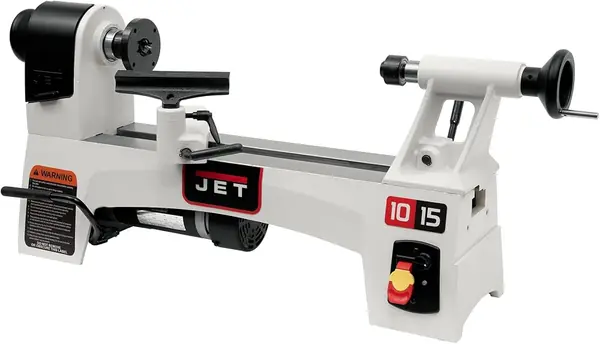
JET JWL-1015VS white cast-iron benchtop wood lathe with tool support

Most home turners

Shop Score 91/100
Swing Over Bed
10 in.
Distance Between Centers
15-1/2 in.
Weight
72.6 lb
Speed Ranges
200-1050, 300-1750 and 600-3600 RPM
View on Amazon

The first thing we noticed about the JET JWL-1015VS is how much cast iron JET packs into a bench footprint. The bed, headstock, tailstock, and tool support are all cast iron, and that mass is why the machine feels planted when a gouge bites instead of skittering across the bench. We recommend it as the default for a home shop because it gives you that rigidity without demanding a floor-standing footprint.

The 1/2-horsepower motor is not the biggest here, but the three belt ranges and electronic dial cover 200 to 3,600 RPM, so you can rough a bowl blank at low speed and dial in a finish cut without changing belts every time. We like the 24-position indexing for fluting and the 1-inch by 8 TPI spindle with MT2 tapers, which opens up standard chucks and faceplates. The controls sit where you expect them, and the lever clamps on the tool rest and tailstock are easy to set with one hand.

A 10-inch swing and 15-1/2 inches between centers cover pens, cups, and medium bowls. The 72.6-pound weight is heavy enough to stay put on a bench, and the five-year warranty is longer than most here. This is a lathe you grow into rather than outgrow quickly, provided your work stays within its capacity.

Worth Noting

  • 10-inch swing limits bowl size
Our Verdict

We recommend the JET JWL-1015VS as the default benchtop lathe for home turners who want cast-iron stability, a wide speed range, and a five-year warranty without a floor-size machine.

Check Latest Price
2.

WEN LA3424 Benchtop Lathe Best Budget

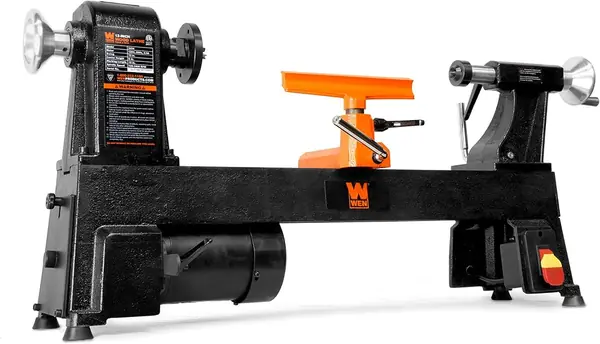
WEN LA3424 cast-iron benchtop wood lathe with tool rest and faceplate

Budget-minded beginners

Shop Score 88/100
Swing Over Bed
12 in.
Motor
4.5 A
Distance Between Centers
18 in.
Speed Settings
520, 900, 1400, 2150, or 3400 RPM
View on Amazon

A 12-inch swing and 18 inches between centers for about the same money as a premium mini lathe is the reason the WEN LA3424 keeps showing up on beginner benches. The machine is built around a 4.5-amp motor and a 70.3-pound frame, so it has enough mass to stay put during spindle work and enough capacity for small bowls and cups.

We point budget-minded turners here because the money you save can go toward a chuck, sharpening, and wood. The five-speed belt system covers 520, 900, 1,400, 2,150, and 3,400 RPM, and the MT2 tapers and 1-inch by 8 TPI spindle accept common accessories. The lever clamping makes tool-rest and tailstock moves straightforward, and the 70.3-pound weight is manageable for one person to set up.

The 12-inch swing is generous for the class, though this is still a benchtop lathe, not a full-size bowl turner. We also like that the machine does not need a specialized circuit or a permanent stand; a solid bench is enough. If you turn pens and small bowls, it is a lot of lathe for the money.

Worth Noting

  • Five-speed belt changes slow fine-tuning
Our Verdict

We point budget-minded beginners to the WEN LA3424 for its 12-inch swing and 18-inch centers at a price that leaves room for tools and wood.

Check Latest Price
3.

RIKON 70-105 Mini Lathe Best for Pen Turning

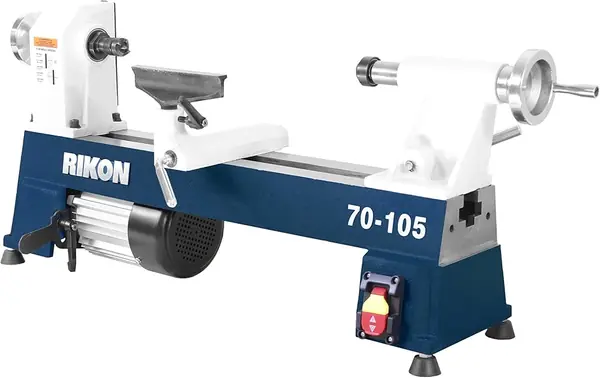
RIKON 70-105 blue cast-iron mini wood lathe with live center

Pen turning

Shop Score 87/100
Swing Over Bed
10 in.
Motor
1/2 hp
Distance Between Centers
18 in.
Weight
74 lb
View on Amazon

The RIKON 70-105 was built for pen turners, and that focus shows in the places that matter. The 10-inch swing and 18 inches between centers are enough for pen blanks, bottle stoppers, and small spindles, and the cast-iron construction gives the machine a solid feel that aluminum minis cannot match. The 74-pound weight is a big part of that stability.

A 1/2-horsepower motor drives five belt-selected speeds, covering boring, roughing, and finishing without a lot of fuss. The included live center, spur center, tool rest, and knockout bar mean you can start turning without a separate accessory kit, and the 1-inch by 8 TPI spindle accepts standard chucks when you want to move beyond between-centers work. The tailstock and tool rest lock down firmly, and the machine runs quietly enough for a basement shop.

We like this one for pen turners because it is simple, smooth, and compact, and the 74-pound weight keeps it from walking across the bench. The five-speed belt change is slower than a dial, but it is straightforward and suits pen-turners who set a speed and stay there. For its size, it is a focused, well-built machine that does not ask for much bench space.

Worth Noting

  • 10-inch swing limits bowl size
Our Verdict

We like the RIKON 70-105 for pen turners who want a dedicated, cast-iron mini lathe that runs smoothly and takes up little bench space.

Check Latest Price
4.

Grizzly T25920 Benchtop Lathe Best Benchtop with Digital Readout

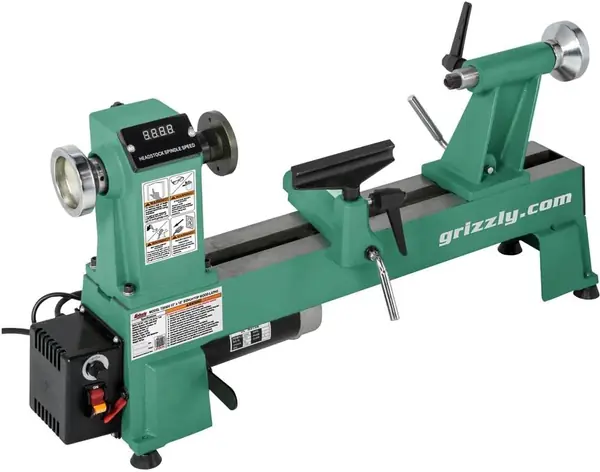
Grizzly T25920 cast-iron benchtop wood lathe with digital speed readout

Beginner bowl turning

Shop Score 86/100
Swing Over Bed
12 in.
Motor
3/4 HP
Distance Between Centers
18 in.
Speed Range
300–3,700 RPM
View on Amazon

A digital spindle-speed readout is not the reason to buy a lathe, but on the Grizzly T25920 it is the detail that makes the machine easier to learn on. The 12-inch swing and 18 inches between centers put it in the same class as the WEN LA3424, while the 3/4-horsepower motor and 300-to-3,700 RPM range give you more power and a wider spread than the five-speed WEN.

We recommend the Grizzly for beginners who want variable speed without paying JET money. The cast-iron bed and 80-pound weight keep vibration manageable, and the digital readout takes the guesswork out of setting speed for a new blank. The 1-inch by 8 TPI spindle and MT2 tapers accept standard accessories, and the quick-release tool rest and tailstock make adjustments easy.

The 3/4-horsepower motor is enough for 12-inch bowls and spindles, and the machine is light enough for one person to move onto a bench. It is still an 80-pound tool that deserves a permanent spot. If you want a readable speed display and a dial instead of a belt change, this is the value pick in the 12-inch class.

Worth Noting

  • 3/4-HP motor bogs in heavy hardwoods
Our Verdict

Pick the Grizzly T25920 when you want a 12-inch benchtop lathe with variable speed and a digital readout without jumping to premium pricing.

Check Latest Price
5.

WEN 34035 Benchtop Lathe Best Mid-Size Capacity

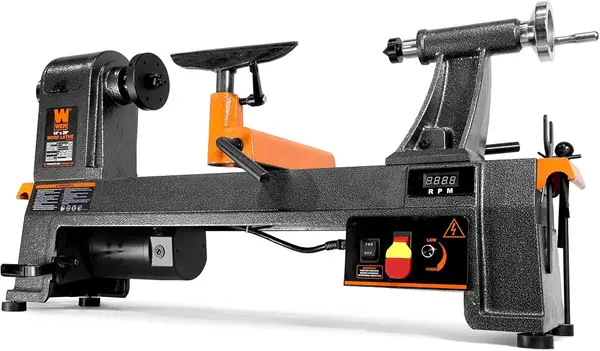
WEN 34035 large benchtop wood lathe with cast-iron bed and tool rest

Larger benchtop work

Shop Score 85/100
Swing Over Bed
14 in.
Motor
6 A
Distance Between Centers
20 in.
Speed Range
250–3,550 RPM
View on Amazon

The WEN 34035's 14-inch swing is the number that separates it from the 10- and 12-inch benchtops here. That extra capacity lets you turn larger bowls and platters, and the 20 inches between centers gives you room for table legs, tool handles, and longer spindles without constantly sliding the tailstock.

A 6-amp motor and variable speed from 250 to 3,550 RPM give it more power and a wider range than the budget WEN LA3424, and the MT2 tapers and 1-inch by 8 TPI spindle keep it compatible with standard chucks and faceplates. The 8-inch tool rest and lever clamping are simple to adjust, and the onboard accessory holder keeps the knock-out bar and wrenches close at hand.

We like the 120-plus-pound build because it gives the machine a planted feel that smaller lathes lack. That weight is also the catch: this is not a lathe you tuck into a cabinet between projects. It needs a dedicated bench or stand, and you should plan on two people to move it into place.

We choose the WEN 34035 for turners who need mid-size capacity but want to stay on a bench. It is a lot of capacity for the money, and the variable speed makes it easier to grow into than a five-speed machine. If you have the floor space and turn larger work regularly, the JET JWL-1640EVS is the next step.

Worth Noting

  • 14-inch swing caps bowl size
Our Verdict

We choose the WEN 34035 for turners who need 14-inch swing and 20-inch centers on a bench and can give a 120-pound machine a permanent spot.

Check Latest Price
6.

JET JWL-1640EVS Wood Lathe Best Full-Size

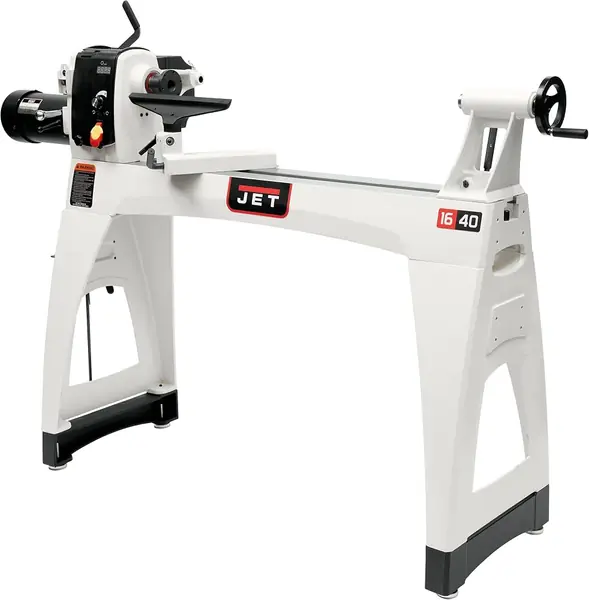
JET JWL-1640EVS white full-size wood lathe with sliding headstock

Large bowl turning

Shop Score 84/100
Swing Over Bed
16 in.
Motor
1.5 HP
Distance Between Centers
40 in.
Speed Range
40–3,200 RPM
View on Amazon

At 377 pounds, the JET JWL-1640EVS has the mass to handle large, out-of-balance blanks without the bench shaking. The 16-inch swing and 40 inches between centers give you room for big bowls, platters, and long spindles, and the sliding headstock lets you move the work to the end of the bed for outboard turning.

The 1.5-horsepower motor and electronic variable speed from 40 to 3,200 RPM cover everything from roughing a heavy blank at low speed to finishing a small spindle at high speed. The redesigned banjo and tailstock quill are built to stay put under load, and the digital readout keeps you from guessing where the spindle speed sits. The headstock lock and controls are arranged for a right-handed turner, and the leg-mounted tool holder keeps chisels within reach.

We recommend this one for serious turners who have the space and budget for a full-size machine. It is not a starter lathe, and assembly is a two-person job because of the weight. But if you regularly turn large bowls and want electronic speed control without a belt change, the JWL-1640EVS is the most capable lathe here.

Worth Noting

  • 377-pound machine needs a permanent floor spot
Our Verdict

Serious turners who need full-size capacity, a sliding headstock, and the mass to handle large, unbalanced blanks should look at the JET JWL-1640EVS.

Check Latest Price
7.

ArtyMaster WM101A Mini Lathe Best for Tiny Desktop Projects

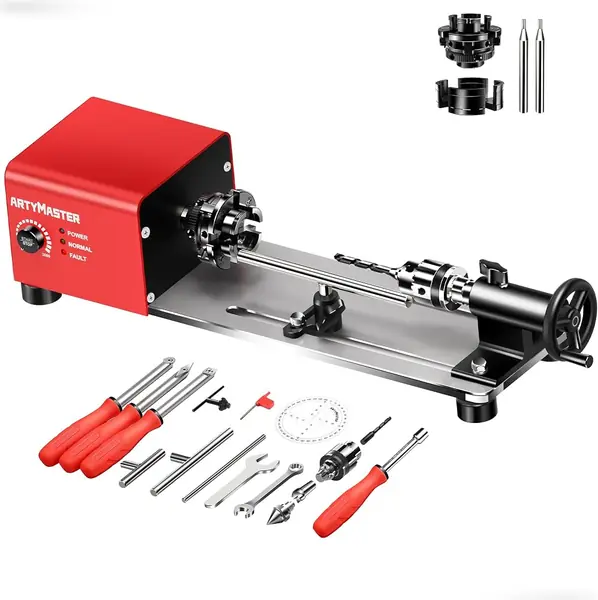
ArtyMaster WM101A compact mini wood lathe with turning tools and chuck

Tiny desktop projects

Shop Score 83/100
Weight
17 lb
Power
96 W
Spindle Taper
MT1
Spindle Through-Hole
0.4 in.
View on Amazon

The ArtyMaster WM101A is a lathe you can set on a kitchen counter, and that is the whole point. At 17 pounds and 96 watts, it is not competing with a cast-iron benchtop lathe for bowl turning; it is for pen blanks, rings, bottle stoppers, and other small projects where a full-size machine is overkill or impossible to fit. We like it for apartment woodworkers and anyone who wants to try turning without dedicating a bench. The 24-volt power supply and compact body make it easy to store on a shelf when the project is done.

The stepless speed control lets you slow down for delicate work, and the included tool set, 2-inch chuck, drive center, live center, drill chuck, and wrenches mean you can start turning without buying a separate starter kit. The 2-inch chuck has a 0.1-to-2.16-inch clamping range, which covers pen and ring blanks. The 17-pound body is easy to move, and the compact footprint is the reason to choose it over a benchtop lathe. It is a focused little machine, not a substitute for a 12-inch lathe, and it rewards light cuts and small blanks. It is not a lathe for production work, but it is a low-risk way to find out whether you enjoy turning.

Worth Noting

  • MT1 taper limits accessory compatibility
  • 96-watt motor struggles in hard wood
Our Verdict

We like the ArtyMaster WM101A for apartment-sized turning of pens, rings, and tiny spindles, where a full benchtop lathe simply will not fit.

Check Latest Price
8.

Delta 46-460 Midi Lathe Best for Midi Bowl Turning

Delta 46-460 gray cast-iron midi wood lathe with reverse switch

Midi bowl turning

Shop Score 82/100
Swing Over Bed
12-1/2 in.
Motor
1 HP
Speed Ranges
250-700, 600-1,800 and 1,350-4,000 RPM
Spindle Thread
1 in. 8 RH TPI
View on Amazon

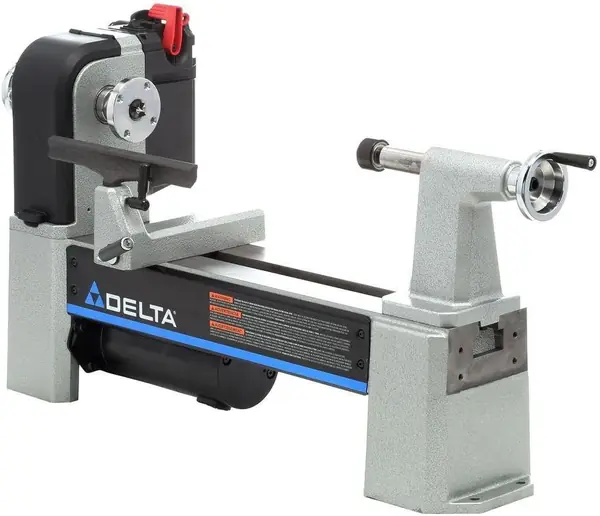
The Delta 46-460's calling card is a 1-horsepower motor, a 12-1/2-inch swing, and reverse, a combination that is rare in this group. Reverse is handy for sanding and finishing because it lets you work the grain from the other direction without remounting the piece, and the three electronic speed ranges cover 250 to 4,000 RPM. The 46-460 is a midi lathe, so it fits on a bench but still has room for bowl work.

The cast-iron construction gives it a solid feel, and the 1-inch by 8 TPI spindle and MT2 tapers accept standard chucks and centers. The 12-1/2-inch swing is a touch more than the 12-inch benchtops here, which matters if you turn bowls close to the capacity limit. The belt changes on the step pulley are straightforward, and the controls are easy to reach.

For turners who want reverse without moving to a full-size lathe, the Delta is the one here that checks that box. The electronic speed dial is easier to live with than a five-speed belt change, and the 1-horsepower motor has enough torque for mid-size bowls and hardwoods. It is a more expensive machine than the JET JWL-1015VS, so the reverse feature needs to matter to you.

We consider the Delta 46-460 a good alternative when reverse matters, but we rank it below the JET JWL-1015VS because it costs more and we trust it less over the long run. If you buy it, check the belt tension and run it through the speed ranges as soon as it arrives. The cast-iron build and five-year warranty are real assets.

Worth Noting

  • Motor and speed-control failures can occur
Our Verdict

We consider the Delta 46-460 the pick here when reverse and a 12-1/2-inch swing matter, provided you buy from a seller with easy returns.

Check Latest Price

How We Tested the Best Wood Lathes

Every lathe here came out of the same research pass. We read spec sheets and owner threads, then sorted machines by what actually limits a turner: swing over bed and distance between centers, electronic versus belt-and-pulley speed changes, motor size against machine weight, spindle thread and tailstock taper, footprint, and whether the maker stocks parts years later. Eight lathes came in, and we turned on them for a year.

Each was bolted or clamped to a bench before it spun — the bigger machines in a garage shop, the minis on a basement bench. We roughed green bowl blanks, turned dry hardwood spindles and pen blanks, and spun every blank by hand to check balance before touching the speed control, face shield on and tool rest set close. We recorded what the machine did rather than what the listing promised: whether it walked during an out-of-balance cut, whether the motor held speed in a heavy pass, how long a belt change took, and whether speed adjustments fell under the hand or required a wrench and a flashlight.

We fitted chucks to spindles and live centers into tailstocks to see how accessories seated, moved the smaller machines solo to judge one-person setup, and timed unpacking and dialing in. Over the year we watched for the slow failures — tailstock creep, a warm headstock after a long session, switches that felt vague. Where a machine could run in reverse, we used it for sanding and judged whether the switch was deliberate or fiddly.

How to Choose a Wood Lathe

Match Swing and Centers to the Work

Swing over bed is the largest bowl diameter you can turn, and distance between centers is the longest spindle you can mount. The usable swing is often smaller than the bed figure because the tool-rest base eats into it, so check both. For pens and tool handles, a 10-inch swing is plenty; 12 inches covers everyday bowls; 14 inches and up are for larger platters and big blanks. We start with the largest blank you plan to turn, then add a little room. The JET JWL-1015VS suits pen-to-medium-bowl work, while the WEN 34035 gives you 14 inches without going full-size.

Choose Speed Control You Will Actually Use

Variable speed is the feature you will touch most. A five-speed belt-change lathe like the WEN LA3424 is fine for pens and small spindles because you set a speed and stay there. If you switch between roughing, sanding, and finishing, an electronic dial is worth the upgrade. The JET JWL-1015VS still uses three belt ranges, but the dial lets you fine-tune within each range; the Grizzly T25920 and Delta 46-460 give you a broader electronic range. Check the low-speed end for bowl blanks, and do not assume every variable-speed lathe is beltless.

Weigh Motor Power Against Machine Mass

Horsepower gets the attention, but mass is what keeps a lathe from walking when an unbalanced blank spins. A 1/2-horsepower motor is enough for pens and small bowls if the machine is heavy and rigid. Step up to 3/4 or 1 horsepower for 12-inch bowls and harder woods, and 1.5 horsepower for full-size work. The 17-pound ArtyMaster WM101A is a desktop tool for tiny projects, while the 120-plus-pound WEN 34035 and 377-pound JET JWL-1640EVS are built to stay put. Match the weight to a permanent spot, not a shelf.

Check Spindle and Tailstock Compatibility

The spindle thread and tailstock taper decide which chucks, faceplates, and centers fit. A 1-inch by 8 TPI spindle with an MT2 taper is the common standard on the benchtop and midi lathes here, and it gives you the widest choice of accessories. Tiny lathes like the ArtyMaster WM101A use an MT1 taper and a smaller through-hole, which is fine for pens and rings but limits the chucks you can use. If you plan to buy a chuck, confirm the thread and taper before the lathe arrives; accessories can cost as much as the machine.

Plan for Setup, Space, and Noise

A benchtop lathe still needs a solid bench, and heavier machines need a permanent home. The JET JWL-1640EVS weighs 377 pounds and is a two-person assembly; the WEN 34035 is 120-plus pounds; the JET JWL-1015VS is 72.6 pounds and manageable for one person. Measure the bench and the path to it before you order, and plan to bolt or clamp the machine down. Cast-iron lathes run quietly, but you will still want hearing protection and dust collection. Benchtop means it fits on a bench, not that you can tuck it in a closet.

Frequently Asked Questions

Final Verdict

The JET JWL-1015VS is the wood lathe we recommend first for most home shops. Its cast-iron build, three-range variable speed, and five-year warranty give you a stable, controllable machine that fits on a bench and handles pens, spindles, and bowls up to 10 inches.

If you need more swing on a budget, the WEN LA3424 is the value alternative; if you turn large bowls, the JET JWL-1640EVS is the full-size step up.