↑↓ navigate ↵ open Esc close All results →

Best Benchtop Wood Lathes of 2026

Spinning an out-of-balance green bowl blank reveals a benchtop lathe's true character within seconds. Built to bring bowl, spindle, and pen turning onto a standard 115-volt garage bench without claiming floor space, lighter machines will happily skate across the top unless bolted down, while heavy cast iron damps the shake before it reaches the chisel.

Nine months of turning on eight lathes—ranging from a 17-pound mini you can lift onto a shelf to a 120-pound cast-iron bench model—showed that electronic speed control matters more than raw horsepower for most shop work, and how smoothly a headstock runs two hours into a session says plenty about its bearings. The low end of the speed dial counts far more than top rpm when roughing uneven blanks.

Because a four-jaw chuck and sharpening gear quickly add to the initial outlay, evaluating what ships in the box—faceplates, centers, and rests—helps keep total startup costs grounded.

Our Top Picks

The Best Benchtop Wood Lathes

1.

JET JWL-1015VS 10" x 15" Variable Speed Lathe Best Overall
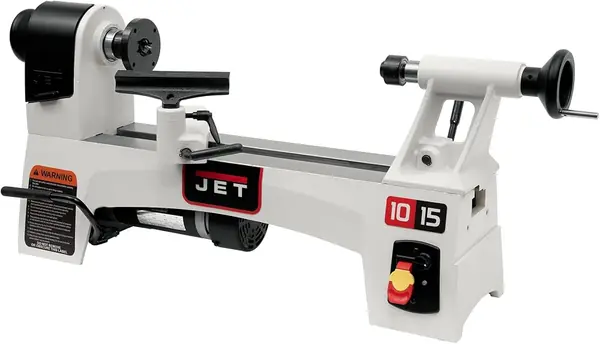
White JET JWL-1015VS benchtop wood lathe with cast iron bed and tool support

Most hobby turners

Shop Score 91/100
Swing Over Bed
10 in.
Between Centers
15-1/2 in.
Speed Ranges
200-1050, 300-1750 and 600-3600 RPM
Spindle And Taper
1 in. x 8 TPI, MT2
View on Amazon

Ten inches of swing sounds like the compromise until you count what the money buys: cast iron for the bed, headstock, tailstock and tool support, a half-horsepower DC motor, and a dial that fine-tunes speed inside three belt-selected ranges from 200 to 3,600 RPM. That combination is why this JET is our default recommendation for a hobby turner with a bench and no floor space. The machine is small; nothing about how it cuts feels small.

Vibration is what separates a usable benchtop lathe from a maddening one, because a light machine that rings when a gouge bites forces timid cuts. At 72.6 pounds with cast iron in all the right places, this one runs quiet and stays settled, and the tool support doesn't shiver when you take a heavier pass. One practical detail worth knowing before you set it up: there are no rubber feet under the cast base, so clamp or bolt it down before you rough out anything out of balance.

Fifteen and a half inches between centers puts pens, goblets, lidded jars, tool handles and most furniture parts within reach. The 24-position indexing, the 1-inch by 8 TPI spindle and the MT2 tapers keep chucks, faceplates and centers easy to find, and the removable safety key on the paddle switch is a small thing we appreciate in a shop where other people wander through. The 6-inch tool support and its 2-inch quill travel suit the work this machine is built for; if wide bowls are the plan, the 1221VS below is the step up.

Worth Noting

  • Ten-inch swing limits bowl diameter
Our Verdict

We recommend this JET to nearly every hobby turner: all cast iron, three ranges with a dial, and the best reliability showing in this group.

Check Latest Price
2.

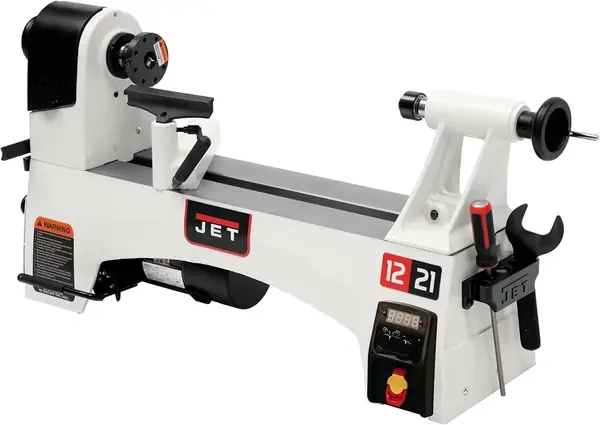
JET JWL-1221VS 12" x 21" Variable Speed Lathe Best for Large Projects

White JET JWL-1221VS benchtop wood lathe with cast iron bed and digital readout

Large bowl work

Shop Score 87/100
Swing Over Bed
12-1/2 in.
Between Centers
20-1/4 in.
Weight
121 lb
Speed Ranges
60-900, 110-1800 and 220-3600 RPM
View on Amazon

Buy this one with your eyes open about how it arrives. The 1221VS is a lot of machine, and some reach the bench with fasteners that worked loose in transit or a casting that cracked before it ever turned, so check the headstock bolts and the belt door before you mount a blank. JET's five-year warranty is what keeps that from being a dealbreaker.

What you get in exchange is the widest working envelope here: 12-1/2 inches over the bed, 20-1/4 inches between centers, and 1 HP on ordinary 115-volt power. We especially like the speed architecture, three ranges from 60 to 3,600 RPM with a dial and a digital readout that let you go from a roughing cut to a finish pass without shutting down, plus reverse you can switch while the spindle is turning for sanding.

Sixty RPM at the bottom is the part that matters most and gets discussed least. It is slow enough to start a big, out-of-balance blank without drama, and the next-lowest floor in this group is 200 RPM. Cast iron in the bed, the tool support and its base accounts for the 121 pounds, which is exactly what keeps a 12-inch blank from turning the machine into a tuning fork.

Worth Noting

  • At 121 pounds it needs a dedicated bench
Our Verdict

The lathe we point to when 12-inch bowls are the goal: 1 HP, 60 to 3,600 RPM, and reverse, provided you inspect it on arrival.

Check Latest Price
3.

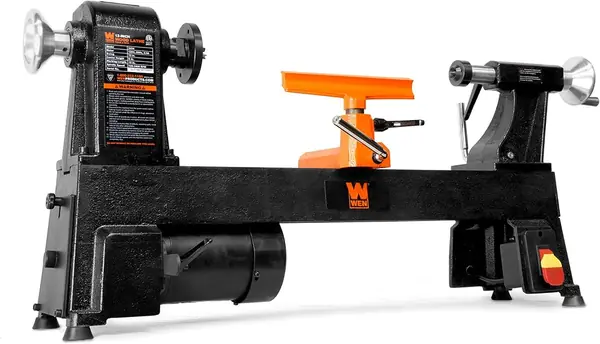
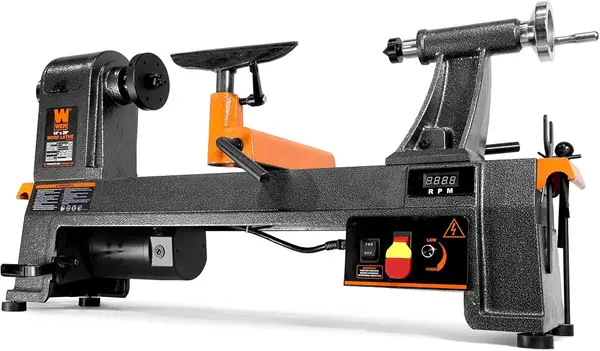
WEN 34035 14" x 20" Variable Speed Benchtop Lathe Best for Bowl Turning

WEN 34035 variable-speed benchtop wood lathe with 14-inch swing and accessory holder

Largest Swing

Shop Score 86/100
Swing Over Bed
14 in.
Between Centers
20 in.
Weight
120+ lb
Speed Range
250-3,550 RPM
View on Amazon

Fourteen inches of swing is more than any other lathe on this page, and for bowl work that single number decides what you can and cannot turn, because a roughed-out blank that is too big for a 10-inch machine goes straight back on here. That is why we put the 34035 at the top of the list for bowl turners even though it is not the most refined machine in the group.

Speed comes from one electronic range, 250 to 3,550 RPM, and we were pleasantly surprised by how little fiddling that involves: no belt to move between ranges, no pulley to hunt for, just a knob and a heavy body that stays put while a big blank comes into balance. WEN lists the build at over 120 pounds, and you feel every one of them in a good way, because the machine sits still and runs quiet through a long session.

The footprint is the catch. At 38 inches long and over 120 pounds it is the biggest thing here, so it wants a bench of its own rather than a shelf, and it should be bolted down before you spin anything wide. What we keep coming back to is the capacity: 20 inches between centers, an 8-inch tool rest, a 4-inch faceplate, spur and live centers, and an onboard holder for the wrenches.

Worth Noting

  • Six-amp motor is modest for 14-inch blanks
Our Verdict

Fourteen inches of swing is the most here, and it's the one we choose when bowl blanks rather than long spindles fill your shop.

Check Latest Price
4.

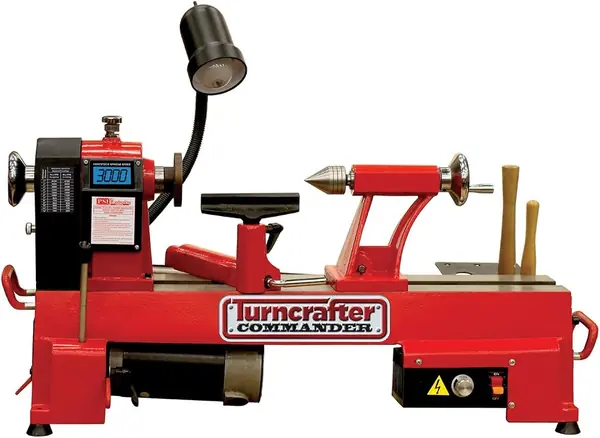
PSI Woodworking KWL-1218VS Turncrafter Midi Lathe Best Midrange Power

PSI Turncrafter 12-inch variable-speed midi wood lathe with cast iron base

First serious lathe

Shop Score 85/100
Swing Over Bed
12 in.
Between Centers
18 in.
Speed Ranges
500-1,800 and 1,950-3,800 RPM
Spindle And Taper
1 in. x 8 TPI, MT2
View on Amazon

One horsepower and a 3,800 RPM ceiling are numbers you normally pay JET or Delta money for, and they are the reason the Turncrafter is on this list at all. Twelve inches of swing and 18 inches between centers put it in the same working class as the machines above, and the cast iron base accounts for 106 pounds of the package.

Two belt positions split the range, 500 to 1,800 and 1,950 to 3,800 RPM, so you still get off the stool to move the belt, but a digital readout tells you exactly where you landed and 24 indexing positions lock the spindle for fluting and layout. The 1-inch by 8 TPI spindle and MT2 tapers are the standard sizes, which means the chucks and centers you buy now will fit the next lathe too.

We think it is the right step up for someone who has outgrown a 10-inch machine but cannot justify the premium models: the induction motor is smooth, the machine is ETL listed, and the 3,800 RPM top end is where small-diameter work like pen blanks and finials wants to live. Check the tailstock alignment when it arrives, since centers that are not true out of the box are the one thing worth catching before you start a project.

Worth Noting

  • 1-5/8-inch quill travel limits deep boring
Our Verdict

One horsepower and a 3,800 RPM ceiling for midrange money — our pick for 12-inch capacity without premium pricing.

Check Latest Price
5.

WEN LA3424 12" x 18" 5-Speed Benchtop Lathe Best Budget

WEN LA3424 five-speed benchtop wood lathe with cast iron bed and tool rest

Budget first lathe

Shop Score 84/100
Swing Over Bed
12 in.
Between Centers
18 in.
Weight
70.3 lb
Speeds
520, 900, 1,400, 2,150 and 3,400 RPM
View on Amazon

Five speeds, 520, 900, 1,400, 2,150 and 3,400 RPM, is the honest description of a budget lathe: you get real speed choices, but you get them by moving the belt rather than turning a dial. For a lot of hobby turners that is the right trade, because it is the cheapest way here to put a 12-inch cast-iron machine on a bench.

We like how much of the money goes into iron rather than electronics. Twelve inches of swing and 18 inches between centers is the same working envelope as machines much further up this list, the tool rest and tailstock clamp with levers instead of a wrench, and the standard 1-inch by 8 TPI spindle with MT2 tapers means every chuck and center you buy will fit the next lathe. At 70.3 pounds, one person can set it on a bench without a plan.

What the budget does not buy is finesse at the edges: a 4.5-amp motor that is happy in pens, handles and dry bowl blanks but not in wet stock, and a 7-7/8-inch tool rest better suited to spindle work than to the inside of a deep bowl. Those limits are real, and none of them will stop a new turner from learning the craft, which is the whole job of a first lathe.

Worth Noting

  • No speed below 520 RPM
Our Verdict

Five pulley speeds and 12 inches of cast-iron swing make this the budget lathe we steer new turners toward.

Check Latest Price
6.

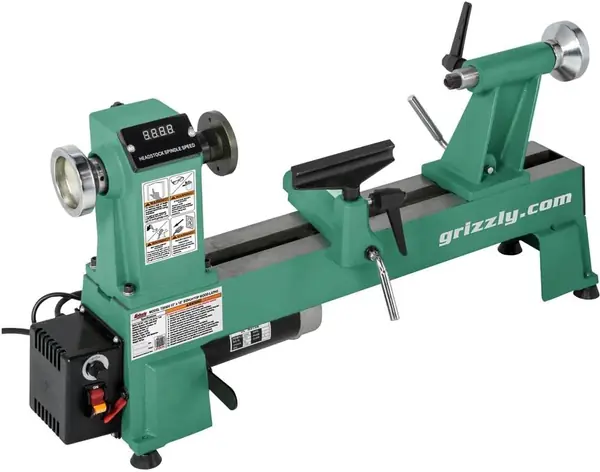
Grizzly T25920 12" x 18" Variable-Speed Lathe

Grizzly T25920 12-inch variable-speed benchtop wood lathe with digital readout

Shared bench space

Shop Score 83/100
Swing Over Bed
12 in.
Between Centers
18 in.
Weight
80 lb
Speed Range
300-3,700 RPM
View on Amazon

Eighty pounds is the number we keep coming back to. Every other variable-speed 12-inch or larger machine here is noticeably heavier, which means a permanent address, while the Grizzly is light enough for one person to lift onto a shelf between projects and steady enough to sit still once it is up there.

The rest of the package is a genuine 12-inch lathe: 9-1/2 inches over the tool rest base, 18 inches between centers, a 1-inch by 8 TPI spindle with MT2 tapers, a cast-iron build and a 5-7/8-inch tool rest on a 5/8-inch post. Quick-release levers on both the tool rest and the tailstock are the sort of detail you notice every single time you move them.

Three hundred to 3,700 RPM with a digital tachometer makes this an easy lathe to learn on, because you can set a number, see it, and come back to it next session. The 3-1/4-inch faceplate in the box is a starter rather than a bowl chuck, so plan on buying a four-jaw chuck if bowls are the goal.

What settles it for us is the control layout: exact spindle speed on a readout, and levers instead of wrenches at the rest and the tailstock. Those are conveniences you feel every session, and on a lathe this light they are what keeps setup from eating your shop time.

Worth Noting

  • Three-quarter-horsepower motor bogs in wet hardwood
Our Verdict

The lightest 12-inch variable-speed lathe here — we like it for a bench that has to do other jobs on Monday.

Check Latest Price
7.

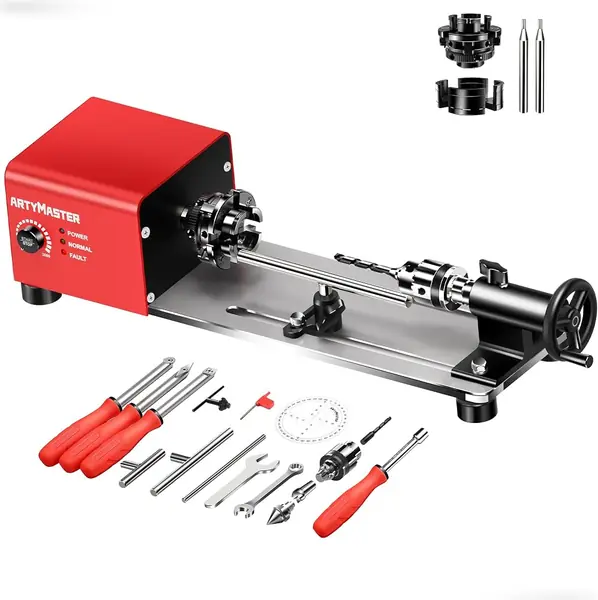
ArtyMaster WM101A-Plus Mini Wood Lathe Best for Pens and Rings

ArtyMaster WM101A-Plus mini wood lathe with chuck turning tools and live center

Pens and rings

Shop Score 82/100
Weight
17 lb
Spindle Taper
MT1
Chuck Capacity
0.1-2.16 in.
Spindle Through-Hole
0.4 in.
View on Amazon

Seventeen pounds, a 16-1/2-inch footprint, and a box holding a two-inch chuck, a drill chuck, three turning tools, a drive center, a live center and a centering ruler: the WM101A-Plus arrives closer to ready-to-turn than anything else on this page.

It spins small stock, meaning pen blanks, ring blanks, bottle stoppers and thumb-sized goblets. Speed is infinitely variable through a 24-volt DC motor on a UL-certified power supply, the 0.4-inch spindle through-hole takes pen mandrels, and it runs quietly enough for an apartment workbench. The two-inch chuck, with a clamping range of 0.1 to 2.16 inches, is both the point and the limit, because this is a lathe for work measured in inches.

We think it is the cheapest here to answer the only question that matters before a big purchase: do you actually like turning? Put it on a counter, make a few pens and a ring, and find out. If the answer is yes, the JET above is the next step, and the tools that came in this box will still be useful.

Worth Noting

  • 24-volt motor stalls under heavy cutting pressure
  • MT1 taper limits big-lathe accessories
Our Verdict

Seventeen pounds and a box of accessories make this our cheapest route to finding out whether you enjoy turning.

Check Latest Price

How We Tested These Benchtop Lathes: Eight Machines, Nine Months

We started with every benchtop lathe we could find that ran on a grounded 115-volt circuit and fit a standard bench, then narrowed by swing, distance between centers, spindle thread, and tailstock taper, keeping track of which accessories would carry over and which wouldn't. Eight lathes came into a garage shop for nine months of turning.

Each one got assembled and checked with a dead center between headstock and tailstock to confirm the points met, then clamped or bolted to the bench before a blank went on. We plugged them into a grounded 115-volt circuit on a shop breaker and wore a face shield for every roughing cut. Weeknights were pen blanks and short spindles; weekends were green bowl blanks and longer table legs, which is where a machine's stability shows up.

During each session we measured real swing and distance between centers instead of trusting the label, timed speed changes on a dial against stepped pulleys, and noted how slow the slowest setting actually ran while hogging out a heavy blank. We swapped chucks and centers between machines with matching threads and tapers to see how they seated, watched how much vibration reached the tool rest, took sound readings from the operator's spot, and lifted each lathe ourselves to judge whether one person could get it onto a bench.

At the end of the nine months we checked that centers were still true, that fasteners hadn't loosened, and that what came in the box — faceplate, centers, tool rest — left a realistic budget for the chuck and sharpening gear that follows.

How to Choose a Benchtop Wood Lathe

Swing and centers decide the projects

Swing over the bed sets the largest bowl you can turn; distance between centers sets the longest spindle. There is a trap in the middle of that: swing over the tool rest base is always smaller than swing over the bed, because the rest has to live somewhere. The JET 1221VS is 12-1/2 inches over the bed but 9.45 inches over the rest base, and the Grizzly is 12 and 9-1/2.

Measure the roughed-out blank you actually plan to finish. If it is over about nine inches across, check the number against the tool rest base rather than the bed, and give a 14-inch machine like the WEN 34035 serious thought if wide bowls are the whole point of buying.

A dial, a belt, or both

Variable speed covers three different arrangements, and the difference shows the first time you go from roughing to finishing. The WEN LA3424 gives you five fixed pulley speeds. The JETs give you three belt ranges with a dial that adjusts steplessly inside each. The WEN 34035 gives you one electronic range and no belt to move at all.

We care most about the bottom of the range. Roughing an unbalanced blank is the slowest work you will do, and a machine whose floor is 520 RPM is a very different proposition from one that reaches 60. Pay for the dial before you pay for extra horsepower.

Weight, cast iron, and the bench underneath

Mass is what stops a benchtop lathe from chattering, so the cast-iron machines here run from 70 to 121 pounds and you feel the difference in the cut. You feel it in your back too: an 80-pound Grizzly goes onto a shelf alone, while a 121-pound JET is a two-person lift and a permanent address.

Whichever you choose, bolt or clamp it. Cast bases without feet will walk once a blank is out of balance, and a lathe that shifts mid-cut is how catches happen. Decide whether the bench is dedicated or shared before you choose the machine, not after.

Tapers, threads, and the accessories that follow

A 1-inch by 8 TPI spindle thread and MT2 tapers are the common standard on every 12-inch machine here, which is why a chuck bought for one will fit the next. The smallest machines use MT1, and that narrows what fits.

Look past the included faceplate as well. The 3- to 4-inch plates in these boxes are for small bowls and jam-chuck work, not for coring a big blank, so budget for a four-jaw chuck and a sharpening setup before you buy a second lathe's worth of gouges. JET backs these machines for five years, PSI for three.

Frequently Asked Questions

Final Verdict

The JET JWL-1015VS is the lathe we recommend first: cast iron everywhere it matters, three speed ranges with a dial that makes them usable, and the strongest reliability showing in this group. Its 10-inch swing is the one thing to weigh before you order.

If bowls are the point rather than pens and spindles, the JET 1221VS adds 2-1/2 inches of swing, 1 HP and a 60 RPM floor for the money, and the WEN 34035 goes further still for bowl blanks. Otherwise buy the 1015VS and put the difference into a chuck and a sharpening setup.