↑↓ navigate ↵ open Esc close All results →

Best Benchtop Bandsaws of 2026

Where a jigsaw wanders slightly from one pass to the next, a benchtop bandsaw pulls a continuous blade straight down through the stock so repeated curves, gentle rips, and light resaw cuts leave the table smooth enough for quick sanding. All of that control fits inside a footprint not much larger than a microwave, making real bandsaw accuracy practical in cramped garages and basements.

Running nine benchtop models over eight months across small home workshops showed that spec sheets rarely capture what matters once lumber hits the table. Resaw height and throat width cap the stock you can feed, dual-speed pulleys and steady torque show up when slicing thicker hardwoods, and heavier frames cut cleaner while demanding more effort to lift onto a bench.

Fitting a sharp, properly tracked blade improves cut quality more than chasing an extra half-amp on the label, and the five saws ranked ahead each solve that small-shop space equation in a different way.

Our Top Picks

The Best Benchtop Bandsaws

1.

WEN 9-Inch Benchtop Band Saw Best Overall
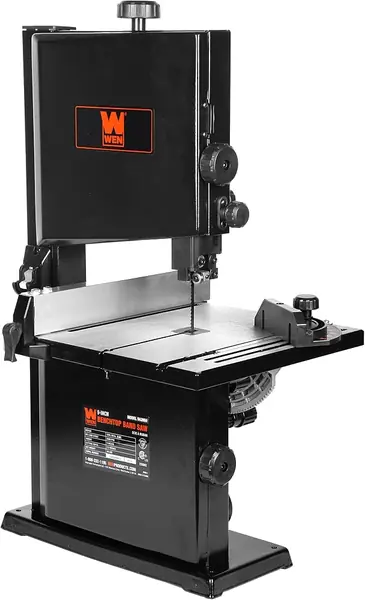
WEN 9-inch benchtop band saw with black and silver body and work table

Beginner woodshops

Shop Score 88/100
Weight
40 lb
Cutting Capacity
3-1/2 inches deep and 9 inches wide
Table Size
12-1/4 x 11-7/8 inches
Motor And Speed
2.8 amp, 2,500 FPM
View on Amazon

A 9-inch band saw has to earn its bench space, and this WEN does it by staying light enough to shift when you need the real estate back. The cast table measures 12-1/4 by 11-7/8 inches and tilts to 45 degrees, while the 2.8-amp motor turns a 59-1/2-inch blade at up to 2,500 feet per minute. We also like that WEN includes the rip fence, miter gauge, and a 2-1/2-inch dust port rather than selling them as extras.

For a home shop doing curves, toy parts, and light rips, we think this is the right first band saw. In our time with it, the saw was happiest in 1-inch hardwood and thinner stock, where it cut smoothly without much fuss. Setup is short, and the included 1/4-inch blade is a sensible starting point for curves. The fence is basic but useful for straight rips, and the dust port connects to a standard shop vac hose.

The saw knows its limits. Its 3-1/2-inch cutting depth is the main ceiling, so it is not the tool for resawing thick boards into veneer. If you need more height or spend your weekends resawing, the 10-inch WEN is the better fit. For everything else, this one is easy to recommend.

We kept coming back to the size: at 40 pounds, it is a benchtop saw you can actually store on a benchtop. The 1/4-inch blade handles curves, and stepping up to a 3/8-inch blade widens its range for straight work.

Worth Noting

  • Blade guides need careful adjustment
Our Verdict

For most home woodworkers, we recommend this WEN as the first benchtop band saw: it is compact, affordable, and ready for curves and light resawing.

Check Latest Price
2.

WEN 10-Inch Two-Speed Band Saw Best for Resawing

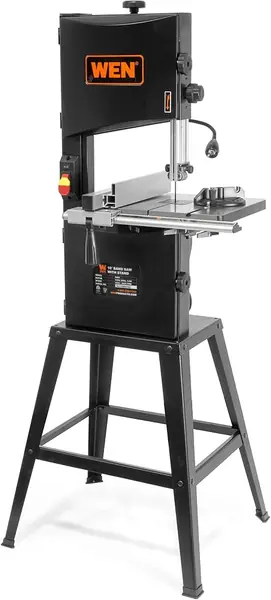
WEN 10-inch two-speed band saw on stand with work light and black frame

Resawing thicker stock

Shop Score 87/100
Weight
80.8 lb
Cutting Capacity
6 inches deep and 9-3/4 inches wide
Table Size
14-1/8 x 12-1/2 inches
Motor And Speeds
3.5 amp; 1,520 or 2,620 FPM
View on Amazon

Six inches of cutting depth is the number that separates this WEN from the 9-inch saws here. The 3.5-amp motor drives a 72-inch blade at either 1,520 or 2,620 feet per minute, and the 14-1/8 by 12-1/2 inch table tilts to 45 degrees. WEN also includes a stand, a flexible work light, a fence, a miter gauge, and a 3-in-1 dust port.

We recommend it for the woodworker who keeps running into the 3-1/2-inch ceiling of a smaller saw. The extra height lets you resaw thicker stock, and the two speeds give you a slower option for hardwoods and a faster one for softwoods. The stand raises the saw to a comfortable working height, and the work light is genuinely useful when you are following a pencil line.

The included 3/8-inch blade is a general-purpose one rather than a fine-finish blade. A sharper, better-matched blade will get more from the saw, especially on curves. We also check the table and fence for square before the first cut.

The larger table supports long boards better than the 9-inch models, and the two-speed belt change is straightforward. For resawing and gentle curves in thicker stock, this is the saw we choose.

Worth Noting

  • Heavy 80.8-pound frame needs a permanent spot
Our Verdict

We recommend this WEN when a project needs more resaw depth: six inches of cut and two speeds make it the step-up 10-inch choice.

Check Latest Price
3.

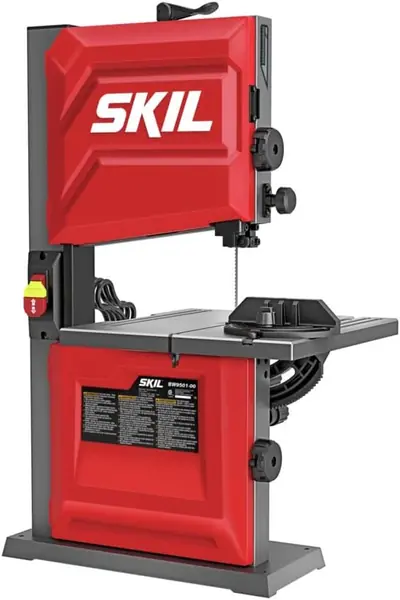
SKIL 9-Inch Two-Speed Band Saw Best for Tight Shops

SKIL 9-inch benchtop band saw in red and black with blade and table

Small workshops

Shop Score 86/100
Weight
38.7 lb
Motor
2.8 amp induction
Saw Size
9 inches
Blade Speeds
Two-speed drive
View on Amazon

At 38.7 pounds, this is the saw we move out of the way when the bench needs to become an assembly table. The 2.8-amp induction motor and two-speed drive do the real work, while tool-free belt tensioning and rack-and-pinion table adjustment make changes quicker than on a basic saw. We also like the ball-bearing and lower blade guides, which help the blade track through curves.

For a small shop, the 9-inch class is enough for guitar templates, toy parts, and trimming small boards. We found the SKIL quick to set up and easy to control on gentle curves, and the two-speed drive gives you a slower setting for harder stock. The table adjustments are straightforward, and the lower guides are a useful step up from plastic-block guides.

This is a light hobby saw, not a resaw machine. It will handle 3/4-inch stock and occasional thicker cuts, but steady work in thick hard maple belongs on a larger saw. Keep the blade sharp and feed slowly, and the SKIL cuts smoothly within its range.

The dust port accepts a standard 2-1/2-inch hose, which makes it easy to connect a shop vac. The miter gauge is basic but serviceable for crosscuts, and the saw stores without much fuss.

Worth Noting

  • Light hobby capacity is not built for steady resawing
  • Includes only a basic miter gauge for crosscuts
Our Verdict

If bench space is tight, we think this SKIL is the easiest 9-inch saw to live with, thanks to its low weight and tool-free speed changes.

Check Latest Price
4.

Woodskil 10-Inch Band Saw with Stand Best with Stand

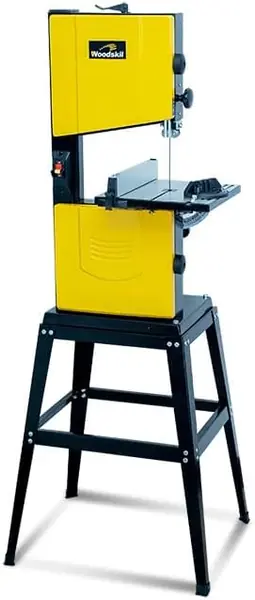
Woodskil 10-inch benchtop band saw with stand and cast aluminum table

Stand-mounted shops

Shop Score 85/100
Cutting Capacity
5-1/8 inches high and 10 inches wide
Table Tilt
0 to 45 degrees
Motor And Speeds
3.4 amp; 2,360 or 3,000 FPM
Blade Guides
Six ball-bearing guides
View on Amazon

A stand, a 10-inch throat, and 5-1/8 inches of cutting height arrive in one box here. The 3.4-amp motor runs at either 2,360 or 3,000 feet per minute, and the cast aluminum table tilts from 0 to 45 degrees. Woodskil also fits six ball-bearing blade guides, a quick-tension handle, and tool-free doors for blade changes.

We like the quick-tension handle most: one lift releases the blade, and a small turn dials in fine tension without fighting a wrench. The tool-free doors make a blade change less of a project, and the six guides support the blade from more angles than the basic three-guide setups on some 9-inch saws. The stand puts the table at a comfortable height for standing work.

Where it fits is a shop that wants one saw for curves, light resawing, and the occasional bevel. The 5-1/8-inch height is generous for a benchtop model, though it is still not a production resaw. The 3.4-amp motor has enough torque for hardwood within that height, and the dual speeds let you slow down when the cut starts to feel pushy. We think it earns its space when the stand is part of the plan.

Worth Noting

  • Not suited for heavy production resaw work
Our Verdict

We recommend this Woodskil when you want a stand and more cutting height in one box; its dual-speed drive handles both curves and thicker stock.

Check Latest Price
5.

Woodskil 9-Inch Benchtop Band Saw Best for Steel-Base Benchtops

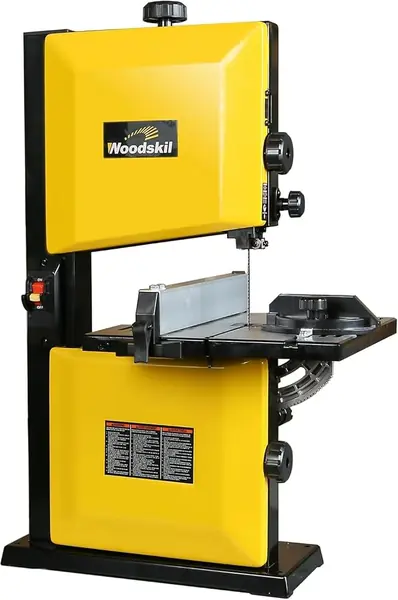
Woodskil 9-inch yellow benchtop band saw with steel base and fence

Steel-base benchtops

Shop Score 84/100
Weight
40 lb
Cutting Capacity
3-1/2 inches deep and 9 inches wide
Table Tilt
0 to 45 degrees
Motor And Speed
3 amp; 2,500 FPM
View on Amazon

The steel base is what sets this Woodskil apart from the other 9-inch saws here. It carries a 3-amp motor, a 2,500-FPM blade speed, and a cast aluminum table that tilts from 0 to 45 degrees. Woodskil includes a rip fence and a 120-degree miter gauge, and the saw uses 59-1/2-inch blades from 1/8 to 3/8 inch wide.

We found the 3-amp motor comfortable in 3/4-inch stock and capable of cutting a 2x4 on end with a slow feed. The steel base gives it a planted feel that the lightest saws here lack, and setup is simple enough to get cutting the same afternoon. The table and fence are basic, but they are accurate once you take the time to square them.

The extra amp and steel base are real, but they do not change the class of work the saw can do. We see it as a reasonable step-up for someone who values the planted base. The 120-degree miter gauge is more generous than most in this class, and the removable key is a small safety detail we appreciate.

Worth Noting

  • Higher price than WEN for similar capacity
Our Verdict

A sensible alternative for a steel-base bench saw, with a planted feel and a 3-amp motor for light workshop cuts.

Check Latest Price

How We Tested Benchtop Bandsaws

We started by surveying the benchtop class — saws small enough to sit on a bench or roll under one — and narrowed the field by cutting height and throat width, motor amperage, weight, and whether a stand came in the box. Anything that assumed a dedicated 220-volt circuit or a full-size shop footprint was out. That left nine saws, which we ran for eight months.

Testing happened where these saws actually live: a garage bay, a basement bench, and one shared two-car garage where the saw gets wheeled against the wall between projects. We set each one up out of the box and timed how long it took, then cut curves in 3/4-inch plywood, ripped narrow strips with a push stick, and ran thicker hardwood through the two-speed models on the slower setting. On the saws with tilting tables, we set the table to 45 degrees and checked the bevel against a square. We adjusted the guides by hand, and we unplugged every saw before touching a blade.

What separated them was rarely the spec sheet. We watched for blade drift after a long rip, noted which tables stayed put when we leaned into the stock, and set a nickel on the table at full speed to see which saws rattled it off.

We checked how much dust landed in the port versus on the floor, whether the fence and miter gauge included with a saw were worth using, and what came in the box for the money. After eight months of weekend work, we looked at vibration, bearing noise, and whether the tracking still held — then compared notes on setup effort and blade changes, the two chores that decide whether a saw gets used at all.

How to Choose a Benchtop Band Saw

Start With Cutting Height and Throat

A 9-inch label refers to the throat, or the width you can pass beside the blade, not to the height under the guides. Two 9-inch saws can have very different resaw ceilings: the WEN 9-inch cuts 3-1/2 inches deep, while the Woodskil 10-inch reaches 5-1/8 inches and the WEN 10-inch reaches 6 inches. Measure the thickest board you plan to cut and add an inch for clearance. If you mostly cut curves in 1-inch stock, a 3-1/2-inch saw is enough; if you want to resaw, start with the 10-inch models.

Match Motor and Speeds to Your Work

Amp ratings are a rough guide, not the whole story. A 2.8-amp saw at 2,500 FPM is fine for light work, while a 3.5-amp motor and two speeds give you more torque and a slower setting for hardwood. We prefer a two-speed saw if you cut hardwood or thicker stock; a single-speed 2.8-amp model makes sense for softwood, curves, and small parts. The SKIL and both 10-inch saws here give you that second speed.

Measure the Bench and the Weight

Benchtop does not automatically mean light. The SKIL is 38.7 pounds, the WEN 9-inch is 40 pounds, and the WEN 10-inch is 80.8 pounds with a stand. If the saw shares a bench with assembly work, pick one you can move alone and leave enough room for infeed and outfeed. If it gets a permanent stand, extra weight buys stability rather than inconvenience.

Plan for Setup, Guides, and Dust

Blade tracking and guide adjustment separate a smooth cut from a wandering one. Look for ball-bearing guides, tool-free tension, and a table that locks square. The Woodskil 10-inch has six ball-bearing guides and tool-free doors; the SKIL has rack-and-pinion table adjustment. We check the table for square and set the guides before the first cut. A 2-1/2-inch dust port is worth having, and a work light helps on detailed curves.

Frequently Asked Questions

Final Verdict

For most home woodworkers, the WEN 9-Inch Benchtop Band Saw is the one we recommend first. It is compact enough to live on a bench, comes with the fence and miter gauge you need to start, and handles curves and light rips without drama.

Step up to the WEN 10-Inch if you regularly resaw stock thicker than 3-1/2 inches; if your bench is tight, the lighter SKIL is the easier saw to move and store.