↑↓ navigate ↵ open Esc close All results →

Best Band Saws of 2026

A band saw does two jobs no other saw handles cleanly: it cuts a curve without a drilled starting hole, and it slices steel pipe without sparks. In return it asks for patience — a blade that tracks, guides that stay put, and a slow, steady feed.

The category splits in two, and that's the first thing to sort out. Benchtop saws bring a cast table, a fence, and a bevel tilt; handheld portables trade all that for a deep throat and go to the pipe and the overhead cut. We ran 12 saws for 10 months across a home woodshop and a metal bench, and the same lesson held: blade tracking, guide adjustment, and setup separate a good saw from a frustrating one.

Several of these are bare tools, which only pays off if the batteries already on your shelf fit. The eight picks below cover both halves of that split, and each was judged on the same things: how it cuts, how much adjusting it takes, and how much saw you get for the money.

Our Top Picks

The Best Band Saws

1.

WEN BA3959 9-Inch Benchtop Band Saw Best Overall
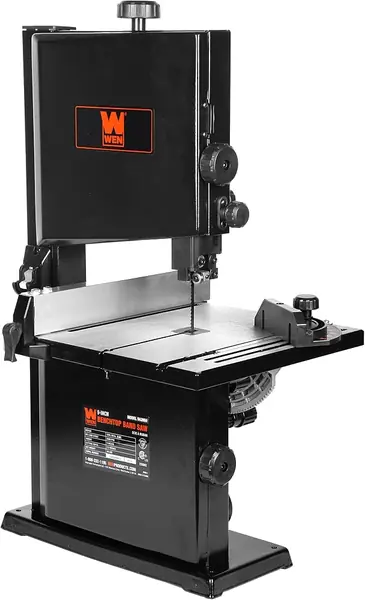
WEN BA3959 9-inch benchtop band saw with silver table and black base

Home woodshop

Shop Score 95/100
Cutting Capacity
3-1/2 inches deep x 9 inches wide
Blade Speed
2500 FPM
Motor
2.8 amp
Table Size
12-1/4 x 11-7/8 inches
View on Amazon

A 9-inch benchtop band saw is not a do-everything machine, but it is the right size for a lot of home woodworking. The WEN BA3959 cuts 3-1/2 inches deep and 9 inches wide, runs a 59-1/2-inch blade, and tilts its table to 45 degrees. We like that it leaves room for curves and small furniture parts without taking over a one-car garage.

The 2.8-amp motor is modest, so we keep it to 1-inch stock, toys, trim, and light resawing. What makes it useful is the kit: a rip fence, a miter gauge, a 2-1/2-inch dust port, and ball-bearing blade guides are all included. The 40-pound frame stays put on a bench, and the 12-1/4 by 11-7/8-inch table gives you room to maneuver.

The included fence and miter gauge save you from buying accessories right away, and the table has enough room to turn a small workpiece without the saw feeling cramped. We also appreciate the two-year warranty on a saw at this level; it does not turn it into a production machine, but it covers the basics.

Worth Noting

  • Blade guides need patient adjustment
Our Verdict

We recommend this to home woodworkers who want a compact benchtop saw for curves and light resawing without spending much.

Check Latest Price
2.

DEWALT DWM120K Deep Cut Portable Band Saw Best Corded Portable

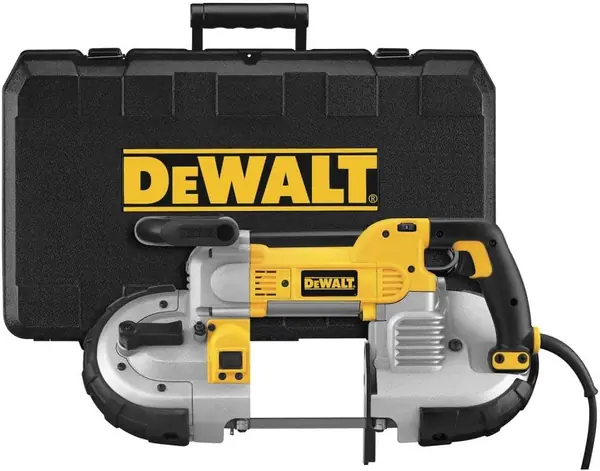
DEWALT DWM120K yellow corded portable band saw with carrying case

Metal fabrication

Shop Score 94/100
Cutting Capacity
5 inches
Weight
15 lb
Blade Speed
Variable speed
Motor
10 amp
View on Amazon

Corded power and a 5-inch throat make the DWM120K the heavyweight of this group: a 10-amp motor, deep-cut capacity, and a 15-pound body. It is built for metal, with a variable-speed dial, an LED sight light, and a steel shroud that takes jobsite knocks. We see it as the portable band saw for someone who wants corded power and does not want to think about batteries.

What sold us is how much saw you get for a stationary setup. Bolt it into a table and the 5-inch capacity handles square tube, pipe, and plate; the hang hook and case make it easy to move between jobs. At 15 pounds it is not a one-hand tool for ladder work, so we leave it for the bench or the truck.

The kit includes a blade, hex wrench, and case, which matters when the saw lives outside the shop. We recommend it to fabricators and serious DIYers cutting steel all day; if you need to climb a ladder with the saw, a compact cordless makes more sense.

Worth Noting

  • Cord limits use away from an outlet
Our Verdict

If your work is mostly metal and you want corded power that never asks for a battery, we think this deep-cut DeWalt is the one to set up.

Check Latest Price
3.

DEWALT DCS374B 20V MAX Portable Band Saw Best Cordless for DeWalt Users

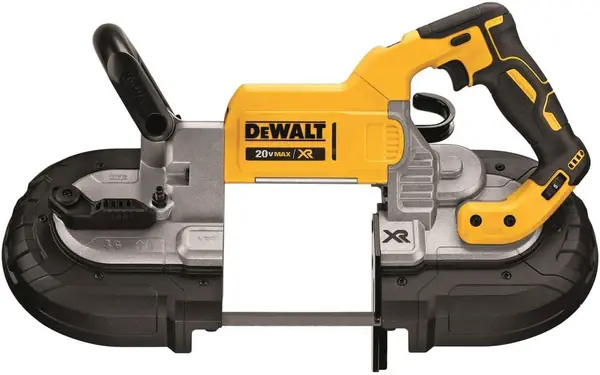
DEWALT DCS374B yellow and black cordless portable band saw

Cordless jobsites

Shop Score 93/100
Weight
12.4 lb
Voltage
20V MAX
Round Capacity
4 in.
Rectangular Capacity
5 in. x 4-3/4 in.
View on Amazon

Five inches of cut capacity in a 12.4-pound cordless body is the reason the DCS374B earns a place here. It runs on DeWalt's 20V MAX batteries, uses a brushless motor, and has a tool-free blade-change lever plus an LED light with a 20-second delay. We like it for jobs where dragging a cord across a deck or scaffold is the real annoyance.

The variable-speed trigger gives you control when starting a cut in steel, and the integrated hang hook is not a gimmick: it keeps the saw within reach on a ladder or lift. We noticed the body feels bulkier than its weight suggests in tight spots, so it is better for straight cuts than for delicate work.

For a DeWalt user with a few packs, it is a natural step up from a reciprocating saw; for everyone else, the corded DWM120K gives more power for less commitment. The hang hook and the delayed LED light are the details we notice most once the saw is living in the truck.

Worth Noting

  • Bare tool needs batteries and charger
Our Verdict

We reach for this one when the job is off the bench and the cut is deep, though you'll need to bring your own 20V batteries.

Check Latest Price
4.

Makita XBP02Z 18V LXT Portable Band Saw Best Cordless for Control

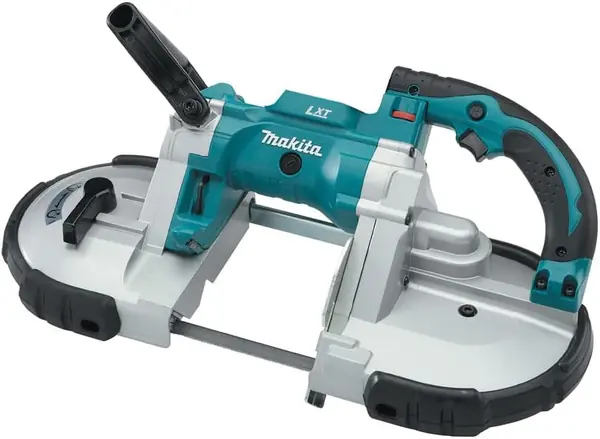
Makita XBP02Z blue and black cordless portable band saw

Overhead pipe cuts

Shop Score 92/100
Cutting Capacity
4-3/4 inches
Weight
15 lb
Blade Speed
275-530 ft/min
Voltage
18V LXT
View on Amazon

A six-setting speed dial and 4-3/4-inch capacity make the XBP02Z the control-minded cordless saw here. The dial runs from 275 to 530 feet per minute, and the saw uses 44-7/8-inch blades on Makita's 18V LXT batteries. An over-torque alert warns you before the motor gives up, and a lock-off trigger adds a second step before startup.

We like the dial because it lets you match the blade to stainless, mild steel, or plastic instead of relying on trigger pressure alone. The 15-pound body is not the lightest here, but the weight sits well between the handles, and the low-profile frame lets you guide the saw without fighting it. We found the saw smoother in overhead cuts than the compact 12V saws, which is exactly where its balance earns the extra pounds.

We recommend it to someone who cuts pipe and angle iron overhead and wants a controlled, quiet-feeling saw; the DeWalt DCS374B is the better value for a 20V shop, while this Makita is the smoother-handling choice. The speed dial is the feature we miss when we switch back to a single-speed saw.

Worth Noting

  • Tool only; batteries add cost
Our Verdict

We like this for ladder work and overhead pipe because it balances its 4-3/4-inch capacity in a body you can control.

Check Latest Price
5.

Milwaukee 2729-20 M18 FUEL Deep Cut Band Saw Best Deep Cut for M18 Users

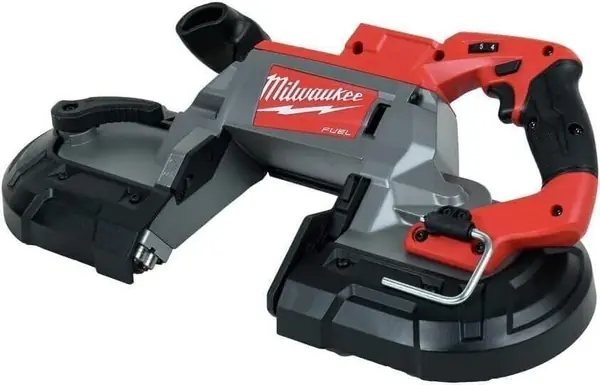
Milwaukee 2729-20 red cordless deep-cut band saw

Steel pipe runs

Shop Score 91/100
Cutting Capacity
5 inches
Weight
15 lb
Blade Speed
380 FPM
Voltage
18V
View on Amazon

Five inches of cut depth and a 15-pound body put the 2729-20 at the deep end of Milwaukee's M18 line. It runs at 380 FPM and accepts the M18 battery packs you already own. The appeal is simple: you get the cut depth of a corded saw without a cord, which matters when the work is a rack of conduit or a pipe run against a wall.

The D-handle and deep frame let you keep two hands on the tool for square cuts, and the brushless motor holds speed through steel. It is not the saw for tiny trim cuts; the extra frame gets in the way when you are working in a tight corner. That is the trade for the capacity.

We recommend this to electricians and metalworkers with a few M18 packs already in the truck. For an M18 user, it is the deep-cut option that makes a reciprocating saw feel crude, and it rewards a steady two-handed cut more than a quick one-handed trim.

Worth Noting

  • Bare tool; batteries and charger extra
Our Verdict

For five-inch cuts in steel with a battery, we trust this Milwaukee's deep-cut frame and steady feel.

Check Latest Price
6.

WEN 94396 Portable Band Saw Best Budget Portable

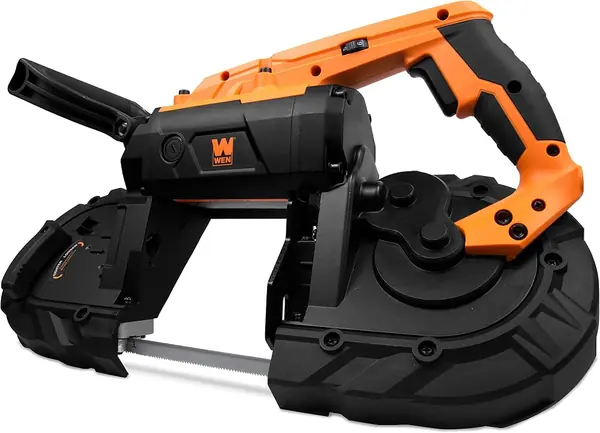
WEN 94396 orange and black corded portable band saw

Budget metalwork

Shop Score 90/100
Cutting Capacity
5 inches wide x 5 inches deep
Weight
14.5 lb
Blade Speed
60-420 ft/min
Motor
10 amp
View on Amazon

A 10-amp motor and 5-inch by 5-inch capacity make the WEN 94396 the value play in this group, but it is not a toy. It has a variable-speed dial from 60 to 420 FPM and weighs 14.5 pounds. It comes with a 10/14 TPI metal-cutting blade, an adjustable front handle, and ball-bearing blade guides.

The trade-off is weight and control: at 14.5 pounds it is manageable on a bench but tiring overhead, and the front handle helps only so much. The payoff is a saw that cuts pipe, angle iron, and aluminum without asking for a battery, which makes it a strong choice for a farm shop or a garage where an outlet is always close.

We recommend it to someone who cuts metal every few weekends and wants a corded saw that stays under a bench. For a first portable band saw, this WEN gives you the size and power to learn on; if you cut overhead all day, spend for the DeWalt or Makita.

Worth Noting

  • Blade tracking needs frequent attention
Our Verdict

We keep this corded WEN on our short list for shop and farm metal cutting when the budget is tight.

Check Latest Price
7.

Ryobi P590 18V Compact Band Saw Best Compact Cordless

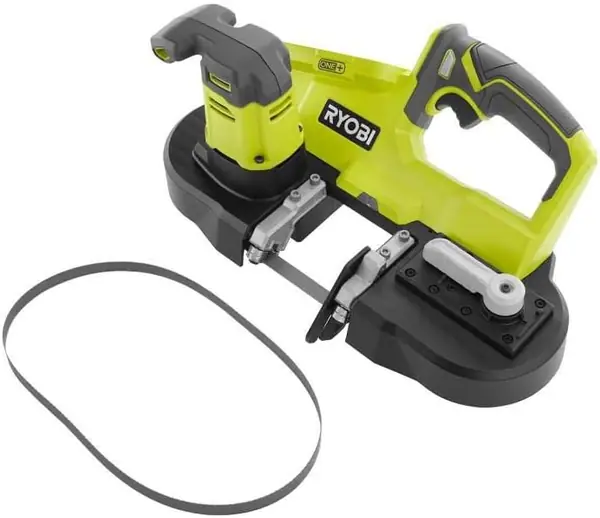
Ryobi P590 green and black compact cordless band saw

Conduit and trim

Shop Score 89/100
Cutting Capacity
2-1/2 inches
Weight
9.3 lb
Voltage
18V
Battery System
18V ONE+
View on Amazon

At 2-1/2 inches, the Ryobi P590 has the smallest capacity here, but it also has the smallest body at 9.3 pounds. It runs on the 18V ONE+ battery system and is built for conduit, threaded rod, and trim cuts where a full-size saw is awkward. It fits in a bag and comes up to speed without a cord.

The compact frame is the whole point. It is easy to guide in a tight spot, and the blade changes are straightforward. A full-size saw makes cleaner work of a pipe rack, but it also makes you clear space and find a cord.

The trade-off is capacity: 2-1/2 inches is a hard ceiling, so it will not replace a deep-cut saw for schedule 40 pipe or square tube. Keep it for light stock and you will not be disappointed; push it into heavier work and you will feel the motor strain.

We recommend this to an electrician or a homeowner already on the ONE+ platform who wants a handy second saw. It is not the only band saw for a fabrication shop, but it is the one we reach for when the cut is small and the space is tight.

Worth Noting

  • Bare tool needs 18V batteries
Our Verdict

We recommend this compact Ryobi for light conduit and trim work where a bigger saw will not fit.

Check Latest Price
8.

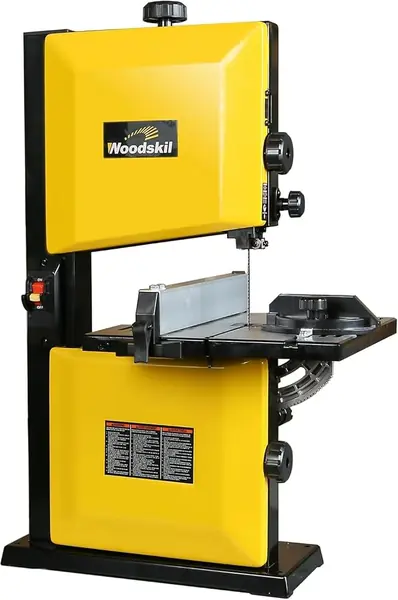
Woodskil BS0901 9-Inch Benchtop Band Saw

Woodskil BS0901 yellow benchtop band saw with cast table

Starter woodshop

Shop Score 86/100
Cutting Capacity
3-1/2 inches deep x 9 inches wide
Blade Speed
2500 FPM
Motor
3 amp
Table Tilt
0-45 degrees
View on Amazon

A 3-amp motor and a cast-aluminum table separate the Woodskil BS0901 from the other 9-inch benchtop saw here. It cuts 3-1/2 inches deep and 9 inches wide, tilts its table to 45 degrees, and includes a rip fence, a 120-degree miter gauge, a steel base, and a 2-1/2-inch dust port.

The extra amp over the WEN is not a transformation, but it gives the saw a little more headroom in hardwood. The 40-pound frame stays put on a bench, and the table has enough room for small workpieces. It is a detail saw for curves, toy parts, and light furniture stock.

The cast table is the detail that separates it from the cheaper 9-inch saws, and the fence and miter gauge save you from buying accessories right away. The steel base adds stability, and the dust port is a practical touch for a small shop.

We recommend this to a home woodworker who cuts mostly 1-inch and 2-inch stock and wants a second benchtop saw for a small shop. It is a sensible step up from the WEN for the cast table and extra amp, and we like the way the table feels under a small workpiece.

Worth Noting

  • Table and guides need careful setup
  • Nine-inch size limits resawing
Our Verdict

We suggest this for a second benchtop or a starter shop that wants a bit more motor than the WEN, with similar capacity.

Check Latest Price

How We Tested Band Saws, Bench to Handheld

To build the shortlist, we started with the saws shoppers actually cross-shop — benchtop models with cast tables and handheld portables from the major battery platforms — then filtered by cutting capacity, power source, and price. Owner reviews filled in what spec sheets leave out, like how much assembly a saw needs out of the box and whether the guides hold their adjustment. Twelve saws made the cut, and we ran them for 10 months.

In the woodshop, that meant resawing 1-inch oak, cutting curves in 3/4-inch plywood, and tilting each table to 45 degrees to check it against a square while watching for fence drift and a miter gauge that wanders. We set blade tracking and tension from scratch on every saw, noted how close the guides would sit to the work and how long the adjustment took, and looked at how much dust landed in the lower housing versus the floor. Setup and footprint got timed and measured — real square footage in a shop where the table saw already owns the middle.

On the metal side we cut 3/4-inch steel pipe, half-inch conduit, angle iron, and threaded rod at bench height and overhead, holding each saw up between joists to judge weight and balance one-handed, with the cord run back clear of the cut. Saws were weighed bare and with a battery, and every blade change was timed with the battery pulled or the cord unplugged first. Variable-speed models ran at the low end for stainless and near the top for mild steel to see whether the dial did anything useful.

Months of repeat cuts showed which blades dulled early, whether tracking drifted, and whether the guides stayed where we set them — the difference between a saw that's cheap to own and one that isn't. Throughout, the guard stayed on, workpieces got clamped, and eye protection stayed on.

How to Choose a Band Saw

Match the capacity to the stock

Capacity is stated two ways: depth of cut and the width or round diameter the saw accepts. The WEN BA3959 cuts 3-1/2 inches deep and 9 inches wide, plenty for curves and small parts but not for resawing wide boards. A portable saw is rated by its throat: 5 inches on the DeWalt DWM120K, 2-1/2 inches on the Ryobi P590. Measure your stock before you shop; the maximum is a hard ceiling, not a suggestion. If resawing is the main job, look for a larger stationary saw rather than pushing a 9-inch model.

Choose corded power or a battery platform

Corded saws give you sustained power and no battery cost, which is why the 10-amp DeWalt DWM120K and WEN 94396 are strong shop tools. Cordless saws trade some of that for freedom from an outlet; the catch is the platform. A bare tool is only the saw, so the real investment includes batteries and a charger you may not own. If you already have DeWalt 20V, Makita 18V LXT, Milwaukee M18, or Ryobi ONE+ packs, stay on that system. If you are starting fresh, compare a kit against a corded saw and be honest about how often you cut away from power.

Pick the table and blade for wood or metal

Wood saws run fast—2500 FPM on both 9-inch benchtop models here—and rely on a fence, miter gauge, and tilting table for straight and angled cuts. Metal saws run slower and use a variable-speed dial so the blade matches the material; the DWM120K and WEN 94396 both give you that control. Do not assume a wood blade will cut steel or that a metal blade will leave a clean wood edge. If most of your work is metal, buy a metal saw and add a benchtop base if you want stationary cuts; if most is wood, start with a benchtop saw and a fence.

Plan for weight, setup, and blade tracking

A benchtop saw is a small stationary tool: the 9-inch WEN and Woodskil weigh about 40 pounds, so they stay on a bench and need clearance for the table and the stock. A portable saw runs 7 to 15 pounds in this group, and the lighter ones are easier overhead but cut smaller stock. Set aside time for setup. Check that the blade tracks in the center of the wheel, that the guides do not pinch it, and that the fence is parallel before the first precision cut. We prefer to spend an hour on setup than fight a wandering blade on every cut.

Frequently Asked Questions

Final Verdict

For a home woodshop, we recommend the WEN BA3959 because it combines a 9-inch throat, a tilting table, and the fence and miter gauge a beginner needs in a saw that fits a small bench. Its blade guides take patience, but it is the most sensible first band saw here.

If your cutting is mostly steel, the DEWALT DWM120K is the better buy: the 10-amp motor and 5-inch deep-cut capacity make short work of pipe and tube, and the case keeps it ready for the truck. Choose the WEN for wood, the DeWalt for metal.