↑↓ navigate ↵ open Esc close All results →

Best Drill Presses of 2026

First-time buyers almost always shop for a drill press by motor horsepower, when swing—the distance from the column to the chuck, doubled—is what actually dictates which panels and fixtures fit on the table. A hand drill gets through a single bracket, yet only a rigid column, a reliable depth stop, and a square table let you bore matching hinge pockets in oak or clean holes in steel on repeat passes.

Running nine benchtop presses for eight months, from lightweight desk-sized units to cast-iron machines that take two people to lift, highlighted how sharply build quality diverges. Speed changes that fight the operator or tables that arrive out of square quickly overshadow raw power, so the models ahead are judged on holding their settings, shifting cleanly, and tracking where they live in the shop.

Our Top Picks

The Best Drill Presses

1.

WEN 4214T 12-Inch Drill Press Best Overall
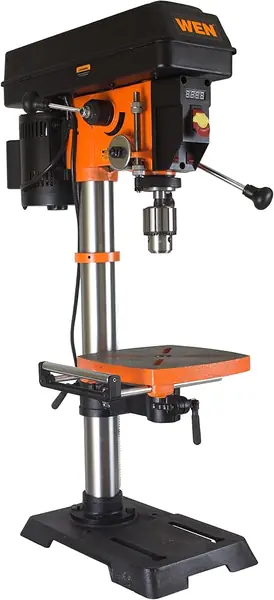
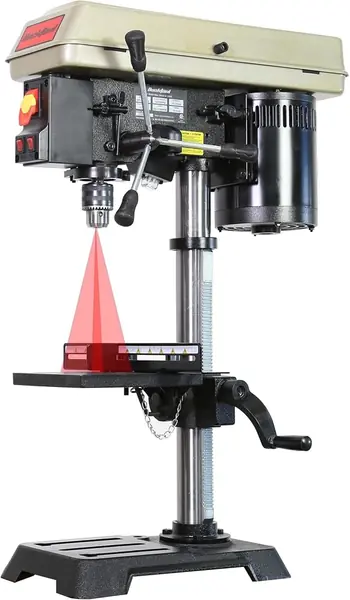
WEN 4214T benchtop drill press in black and orange with laser and work light

Furniture and jigs

Shop Score 90/100
Swing
12 inches
Weight
85 lb
Chuck Size
5/8 inch
Speed Range
580–3,200 RPM
View on Amazon

The speed control is the first thing we show anyone who asks about this press. On most machines at this level you unplug, lift the cover, loosen the motor and walk a belt across a stepped pulley; here you move a lever while the motor runs and watch the digital readout settle anywhere from 580 to 3,200 RPM. In a shop that drills a 1/4-inch pilot, then a 1-inch Forstner, then a 3/8-inch brad point before lunch, that is the difference between adjusting and skipping the adjustment.

Twelve inches of swing and a 5/8-inch keyed chuck put it in furniture territory: rails, jigs, shelf-pin rows, hinge cups. The table is 9-1/2 inches square in cast iron and it bevels, and the roller extension pulls out to 17 inches when you are boring into the end of a long board and want something under it. A laser crosshair marks the entry point, and the work light is bright enough to find a punch mark in walnut.

Our chuck ran true, and the lasers were close enough to the mark out of the crate that we left the adjustment screws alone. Assembly is the usual column-then-table sequence; at 85 pounds the finished press is steady but not something you slide around, so pick the bench or stand before you build it and plan on bolting it down.

The JET is the step up if you want a five-year warranty behind the machine, and the Bucktool carries more motor for steel. For most woodworking shops, though, this is the press that covers cabinets and jigs without taking over the room.

Worth Noting

  • Belt can slip under load with large bits
Our Verdict

We think the WEN 4214T is the press most woodworkers should buy: 12 inches of swing, a 5/8-inch chuck and speed you change with a lever.

Check Latest Price
2.

JET JWDP-12 12-Inch Drill Press Best Premium

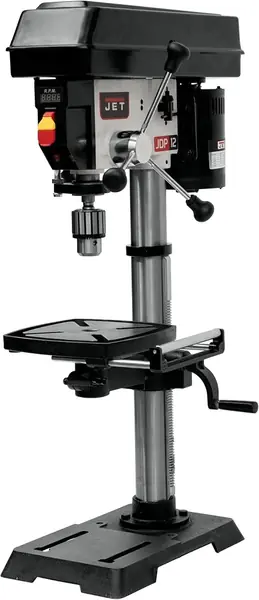
JET JWDP-12 benchtop drill press with cast iron table and digital RPM display

Constant speed changes

Shop Score 88/100
Swing
12 inches
Speed Range
530–3,100 RPM
Warranty
5 years
Spindle-to-table Height
17 inches
View on Amazon

What the extra money buys is a machine that never asks you to stop. The speed lever moves while the motor runs, forward for faster and back for slower, and the display above the switch reads actual spindle RPM, so 530 and 3,100 are each a two-second change rather than a cover-off job.

We think that lever is worth the premium for anyone who drills wood and metal at the same bench, because the speed for a 1/4-inch bit in aluminum is nothing like the speed for a 1-inch Forstner in oak. The accuracy package is thought through the same way: two XACTA lasers form a crosshair you can recalibrate with the supplied hex wrench, the depth stop uses lock nuts against a linear scale, and the table tilts 45 degrees each way on a marked scale.

Cast iron base and table, a 5/8-inch chuck on an MT2 taper, 3-1/8 inches of spindle travel and 17 inches of clearance under the spindle make this a serious benchtop machine rather than a big hobby press. It has to be bolted to a bench or stand, and the head is heavy enough that the lift is a two-person job. Five years of warranty is the longest in this group, and on a press this expensive that coverage is most of why we are comfortable pointing you to it.

Worth Noting

  • Can rattle at higher spindle speeds
Our Verdict

We recommend the JET for anyone who changes bits and speeds all day and wants a five-year warranty behind the machine.

Check Latest Price
3.

BUCKTOOL DP25016A2 10-Inch Drill Press Best Power for the Money

BUCKTOOL 10-inch benchtop drill press with cast iron base and tilting worktable

Metal and wood

Shop Score 87/100
Swing
10 inches
Chuck Size
1/2 inch
Motor
3/4 HP
Spindle Travel
2 inches
View on Amazon

Amps are where this one makes its case: 6.2 of them through a 3/4-horsepower induction motor, against 5 amps and 1/2 horsepower on the 12-inch presses here. If half your holes go into mild steel, that is the number that decides the purchase.

Five speeds run 650 to 3,100 RPM, set by moving the belt across the pulleys under the top cover, which is how a press at this money carries a motor this size. Around the work you get a cast iron base and a table that bevels to 45 degrees, an LED light, and separate switches for the light and the spindle. The 2-inch spindle travel and 1/2-inch chuck are the honest limits of a 10-inch machine, so deep mortises and 5/8-inch shanks belong on something bigger.

We like it best in a shop that fabricates as much as it builds furniture. The removable switch key matters if the garage is shared with kids, the 30-inch height puts the table at a comfortable level on a standard bench, and the CSA listing is one more thing not to think about. It carries the biggest motor in this group and sits in the middle on price, which is a combination worth taking seriously.

Worth Noting

  • Belt changes require opening the top cover
Our Verdict

Our pick when the work runs to steel as often as wood: 3/4 horsepower and a cast iron base for midrange money.

Check Latest Price
4.

VEVOR DP1006L 10-Inch Drill Press Best Budget

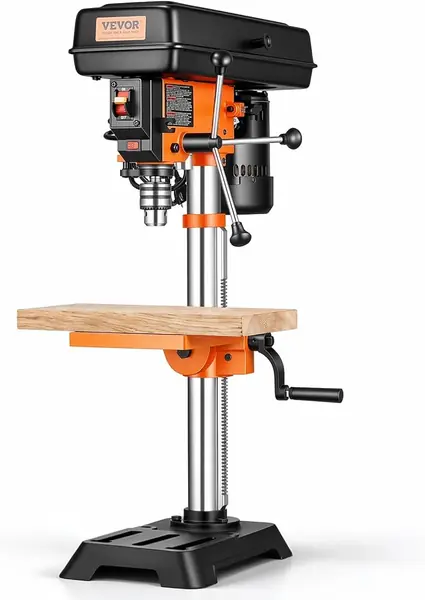
VEVOR 10-inch benchtop drill press with cast iron frame and orange accents

First home shop

Shop Score 86/100
Swing
10 inches
Weight
41.9 lb
Chuck Size
1/2 inch
Motor
3.2 amps
View on Amazon

For a first press in a garage shop, the case here is simple: a real 10-inch cast iron machine that weighs 41.9 pounds and stands 28.7 inches tall, so it goes on a bench you already own and one person can move it. It drills wood and light metal, the table tilts from 0 to 45 degrees, and the work light earns its place the first time you drill a dark blank.

The crank that raises and lowers the table is the detail we appreciated most at this size. You set the height, lock it and get on with the hole instead of lifting the table by hand. Five speeds are changed at the pulleys, the 1/2-inch chuck takes the bits most home projects call for, and the frame is cast iron rather than stamped steel, which is not a given this far down the price range.

Budget an afternoon for assembly and cleanup. The base, column and table go together in the usual order, and the machined surfaces benefit from a wipe-down and a light file on any burrs before the table slides the way it should. It is the least expensive full-size press in this guide, and the one we point to when the budget decides.

Worth Noting

  • 3.2-amp motor is the smallest in this group
Our Verdict

We suggest the VEVOR for a first shop on a tight budget, where the work is mostly wood and light metal.

Check Latest Price
5.

NovelLife Mini Drill Press Best for Craft and Models

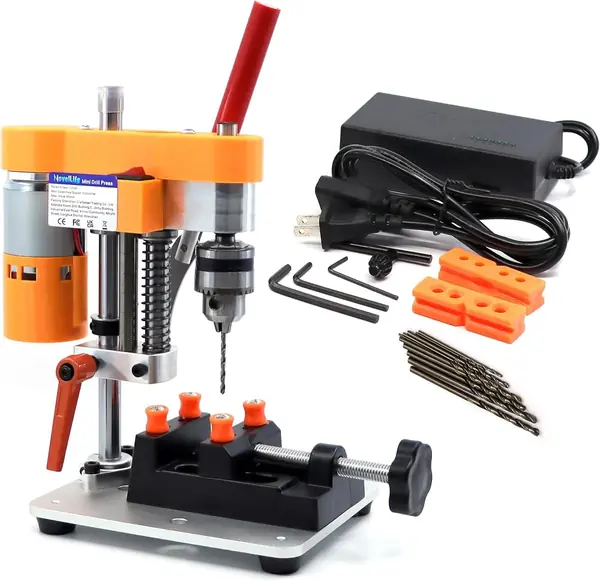
NovelLife mini benchtop drill press with B10 chuck and included flat vise

Craft and models

Shop Score 85/100
Weight
4.85 lb
Max Speed
7,000 RPM
Chuck Capacity
0.6–6 mm
Spindle Stroke
40 mm
View on Amazon

This is not a scaled-down woodworking press, and we won't pretend otherwise: the chuck is sized for small bits and the quill stroke is short, so plan on craft-scale work rather than cabinet parts. We recommend it anyway, because for model makers, jewelry work and small craft holes it does a job no full-size press does comfortably, and it does it on a shelf.

At 5.9 by 4.7 by 8.7 inches and under five pounds, it comes out for a job and goes back. Three metal axes and two linear bearings hold the chuck steady, there is no visible play at the bit, and the 795 motor turns to 7,000 RPM quietly enough for a spare room. Speed comes from a 24-volt adjustable supply rather than a belt, and one knob sets the height.

The base is slotted for the flat vise that comes with it or a small sliding table, so it can grow into light CNC-style work without a second purchase. Treat it as the second press for holes you would otherwise drill by hand and regret, and the money is easy to justify.

Worth Noting

  • 6 mm chuck will not hold 1/2-inch shanks
  • 40 mm stroke limits deep holes
Our Verdict

We keep it on the list for model makers and craft work: a 6 mm chuck, a 40 mm stroke and a bench footprint smaller than a sheet of paper.

Check Latest Price

How We Tested the Best Drill Presses

We started by rounding up every benchtop drill press we could find from the major tool brands and the direct-to-consumer names, then filtered the field on swing and chuck capacity, how speed gets changed, spindle travel and clearance under the spindle, motor amps, and weight. That left nine presses, which we bought at retail and ran for eight months.

They lived where they'd live for you: a garage bench, a basement shop, and — for the smallest — a desk beside a jeweler's bench. We bored hinge pockets and shelf-pin holes in red oak, drilled brackets and mild steel plate, stepped up through bits on a clamped workpiece with eye protection on and hands clear of the chuck, and noted how much clearance was left under the spindle for taller work.

Every machine got the same checkpoints. We measured chuck runout with a dial indicator, then watched the tip of a long bit for wobble. With each press unplugged, we opened the belt cover, walked the belt through the pulley steps, and checked whether it tracked flat on the pulleys and held when a wide Forstner bit loaded it down in oak. We also listened for the motor dropping revs in steel, timed assembly from box to first hole, and noted whether the table arrived square to the spindle or needed shimming.

We carried each one, which settled the mounting question fast — anything that took two people got flagged as a bolted-stand machine. Tables went to 45 degrees and back to zero to see if the setting repeated, depth stops ran through ten holes in a row, and work lights were judged by whether they lit the spot where bit meets wood or threw a shadow across it.

How to Choose a Drill Press

Swing and Chuck Size Come First

Swing is measured as a diameter, so a 12-inch press reaches 6 inches from the bit to the column and a 10-inch press reaches 5. That inch is the whole argument for the bigger machine: a cabinet side, a drawer box or a wide jig often needs a hole farther in than 5 inches, and no accessory fixes a reach problem.

Chuck size sets the other limit. A 1/2-inch chuck covers most brad-point and Forstner shanks, and a 5/8-inch chuck covers the rest. Watch for mini presses sold with 6 mm chucks: that is a craft tool's chuck, not a small version of a woodworking one, and it will not grip the shank of the bits your furniture work depends on.

How You Change Speed Matters More Than the Range

Two mechanisms cover almost every press here. Stepped pulleys give five fixed speeds and ask you to unplug the machine, open the cover and move the belt, which is fine if you drill one material all week. A mechanical variable-speed drive lets you move a lever while the motor runs, and the WEN and the JET pair that with a digital readout of actual spindle RPM.

We think variable speed is worth paying for if wood and metal share your bench, because the speed for a 1/4-inch bit in aluminum is nowhere near the speed for a 1-inch Forstner in oak. If your work is one material and one bit size, save the money and take a pulley machine with a stronger motor.

Spindle Travel, Clearance and Depth Stops

Spindle travel is how far the quill moves in one pull: 3-1/8 inches on the 12-inch machines here, 2 inches on the Bucktool. It decides whether you can bore through a thick blank in one pass or have to raise the table and go again. Clearance under the spindle matters just as much, since a tall vise or a stacked jig eats it; the JET gives you 17 inches of it.

A depth stop is what makes the second hole match the first. Look for lock nuts running against a scale rather than a single thumb screw, set it on a scrap piece, and a row of shelf-pin holes stops being a measuring job.

Power, Weight and Where the Machine Lives

Amps are a fair proxy for how a press behaves in steel: the 12-inch machines here run 5 amps, the Bucktool 6.2, the budget VEVOR 3.2. Weight is the other half of the story. An 85-pound press is steady but wants a stand or a bench you can bolt it to, and the head is the heavy piece, so plan a second pair of hands for the lift. A 42-pound press can be moved out of the way when the bench is needed for something else.

Settle the location before the crate is open. These machines are top-heavy on a narrow base, they walk under vibration if they are not fastened down, and the working height is the bench height plus roughly 30 to 37 inches of press.

Frequently Asked Questions

Final Verdict

The WEN 4214T is the press we point most woodworkers to. Twelve inches of swing, a 5/8-inch chuck and speed you change with a lever cover cabinets, jigs and the occasional metal bracket, and nothing else here balances those three as well.

Step up to the JET if speed changes are constant and you want five years of warranty behind them. If your work runs to steel, the Bucktool's extra amps are the better spend.