↑↓ navigate ↵ open Esc close All results →

Best Drill Press Vises of 2026

Clamping force rarely breaks a drill press vise; table geometry and quill clearance do. A vise whose base slots miss the table's bolt spacing, whose tall body eats half your spindle travel, or whose moving jaw lifts a hair with every turn of the screw will spoil accuracy long before the jaws wear out—and an unbolted vise skating across the table when a bit grabs aluminum is an accident waiting to happen.

Jaw width is not maximum opening, and overall height limits what fits beneath the chuck—two specs that caused more trouble than raw clamping power across 12 vises tested over nine months drilling wood, aluminum, and mild steel on benchtop presses. Covering fixed and cradle designs for compact tables and longer stock alike, this lineup focuses on true drill-press workholding rather than heavy milling vises.

Our Top Picks

The Best Drill Press Vises

1.

Wilton LP4 Low-Profile Drill Press Vise Best Overall
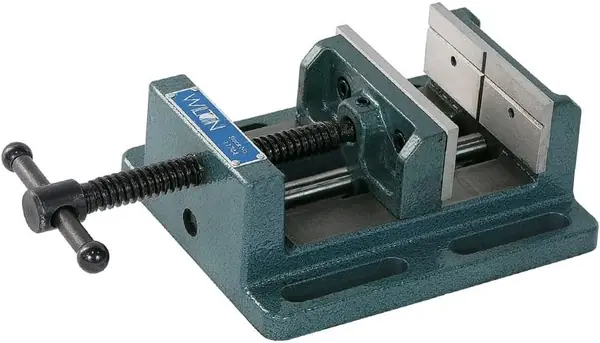
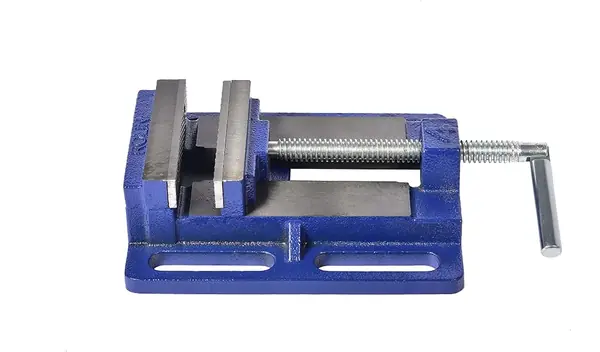
Wilton LP4 blue low-profile drill press vise with four mounting slots

Benchtop drill presses

Shop Score 93/100
Jaw Width
4 in.
Weight
11.6 lb
Max Jaw Opening
4 in.
Jaw Depth
1-1/2 in.
View on Amazon

Low profile is the whole reason we reach for this one. Wilton builds the LP4 to sit close to the table, so a benchtop press with short quill travel still has room for the bit and the workpiece — clearance a full-height bench vise spends before the bit ever touches metal. On a small press, that difference decides whether a job is possible.

The numbers behind it hold up. Four-inch jaws open a full 4 inches with 1-1/2 inches of jaw depth, and the beds and bases are machined parallel to ±.001 inch, so a part sits square to the spindle. Hardened V-grooves in the jaws grip round bar both vertically and horizontally, which saves us fetching the V-block whenever a piece of pipe comes across the bench.

At 11.6 pounds the casting is heavy enough to sit still between holes, though we bolt it through the four 1/2-inch shoulder slots for anything beyond light work. The black-oxide ACME screw takes up slack evenly and holds it, and the handle keeps the same feel through its travel instead of going gritty halfway. Wilton backs the iron with a lifetime warranty.

The opening is what separates it from the 3- and 4-inch vises further down this list: a 4-inch square blank drops between the jaws, which the WEN and MYTEC cannot manage at 3-1/10 and 2.95 inches. You pay for the machining and the mass, and for a shop that drills metal as well as wood, that is the right place to spend.

Worth Noting

  • Jaws can arrive out of parallel
Our Verdict

We think the LP4 is the vise most drill press owners should buy: low enough for a benchtop quill, parallel enough for metal, and heavy enough to stay put.

Check Latest Price
2.

Wilton CR4 Cradle-Style Angle Vise Best for Angled Drilling

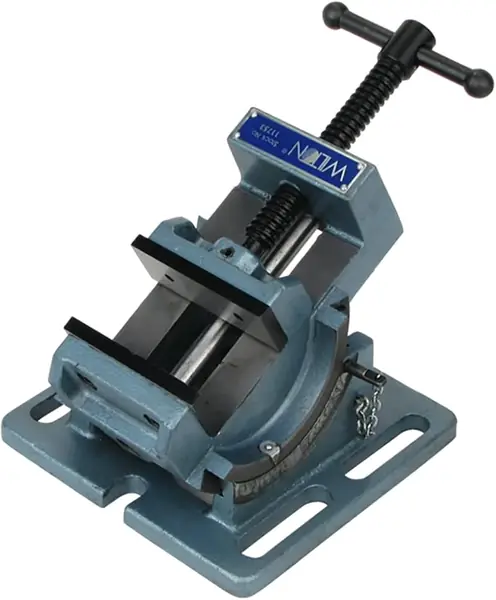
Wilton CR4 cradle-style drill press vise with angled indexing arc

Angled drilling

Shop Score 92/100
Jaw Width
4 in.
Weight
17 lb
Angle Range
0 to 90 degrees
Jaw Opening
4 in.
View on Amazon

Angled holes are where the rest of this list stops helping. The CR4 is a cradle vise: the jaw assembly tips through 90 degrees on a scaled arc, pin stops catch the common angles at 15-degree steps, and a side tommy bar locks the setting anywhere in between. Put a mower blade or a tapped bracket in it and the bit enters square to the angled face instead of fighting a stack of shims.

We expected the indexing to be fussy and it was the opposite — the pin drops into a stop, the scale reads back at you, and a 45-degree hole becomes a two-second setup. The jaws are the hardened V-groove set Wilton uses on its flat vises, the beds are ground, and the 17-pound body stays planted while the handle comes down. It is the most expensive vise here, and it is also the only one that does a job the others cannot.

Size is the catch. On an 8-inch-swing mini press there is no room for it, and even on a full benchtop press the cradle adds height under the quill that a low-profile vise would not. Plan on keeping it beside a flat vise rather than instead of one.

Worth Noting

  • Too large for 8-inch-swing mini presses
  • Cradle height eats clearance under the quill
Our Verdict

If you drill angled holes, the CR4 earns its price in setup time — it is the cradle vise we trust to hold an angle under the bit.

Check Latest Price
3.

WEN DPA423 3-Inch Drill Press Vise Best for Small Drill Presses

WEN DPA423 three-inch silver cast iron drill press vise with mounting slots

Small drill presses

Shop Score 91/100
Jaw Width
3 in.
Weight
4.87 lb
Max Jaw Opening
3-1/10 in.
Jaw Depth
1 in.
View on Amazon

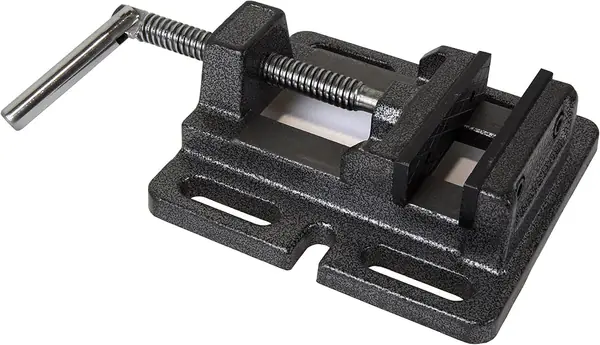
Three inches of jaw is not a compromise if the press is small. The DPA423 measures 3 inches across the jaws, opens to 3-1/10 inches, and weighs under five pounds, so it clamps to a benchtop table without swallowing it and comes off the shelf in one hand.

The body is cast iron, the throat depth is 1 inch, and four onboard slots let you bolt it down and reposition it without hunting for a clamp. It sits comfortably on an 8- or 10-inch benchtop table without overhanging the edges, which is more than the wider vises here can say.

What we appreciate is how little it asks of a shop. This is the least expensive vise on the list, and it still arrives as a single cast iron body with jaws that meet flush along their length. It will not take the place of a heavier vise for metalwork, but for drilling wood, plastic and the odd bracket on a small press, it does everything asked of it.

Worth Noting

  • One-inch jaw depth limits taller parts
Our Verdict

The DPA423 is our pick for a small benchtop press: a cast iron body light enough to lift off the shelf and small enough to leave the table usable.

Check Latest Price
4.

ROLIN 4-Inch Drill Press Vise Best Value

ROLIN blue four-inch cast iron drill press vise with hardened steel jaws

Everyday shop drilling

Shop Score 90/100
Jaw Width
4 in.
Weight
6.5 lb
Max Jaw Opening
4.33 in.
Jaw Material
Hardened steel
View on Amazon

The opening is the surprise. The jaws measure 4 inches across but travel to 4.33 inches, so a slightly oversized blank still drops in — several vises in this group run out of travel before they run out of jaw.

We like it for the straightforward reason that parts stop moving once the screw comes up snug. The body is gray cast iron at 6.5 pounds, the jaw plates are hardened steel, and the faces meet flush along their length and stay flush through a long session. Nothing about it feels like the cheapest vise on the page.

The blue coating wipes clean, the screw turns without grit, and the base has enough slot length to shift the vise around on a small table. Setup is quick: line the slots up with the table's, drop two bolts in, tighten, and you are drilling.

It is sold as a light-duty vise and that label is honest — wood, plastic, thin metal and the occasional bracket are its work. Lean on it with a hole saw in steel and you want the Wilton instead.

Worth Noting

  • Light-duty rating rules out heavy metalwork
Our Verdict

We recommend the ROLIN to anyone who wants a 4-inch vise with real jaw travel and does not need to drill heavy steel.

Check Latest Price
5.

MYTEC Quick-Release Drill Press Vise Best Quick-Release

MYTEC black three-inch cast steel drill press vise with quick release button

Fast repeat setups

Shop Score 89/100
Jaw Width
3 in.
Max Jaw Opening
2.95 in.
Jaw Depth
0.87 in.
Mounting Hardware
4 bolt sets included
View on Amazon

One button does the work of ten turns, and that is why we keep this one set up. Press the release and the front jaw slides free, so you close it on the part by hand and then take up the last turn — no cranking the screw in from the far end of its travel every time you swap a workpiece.

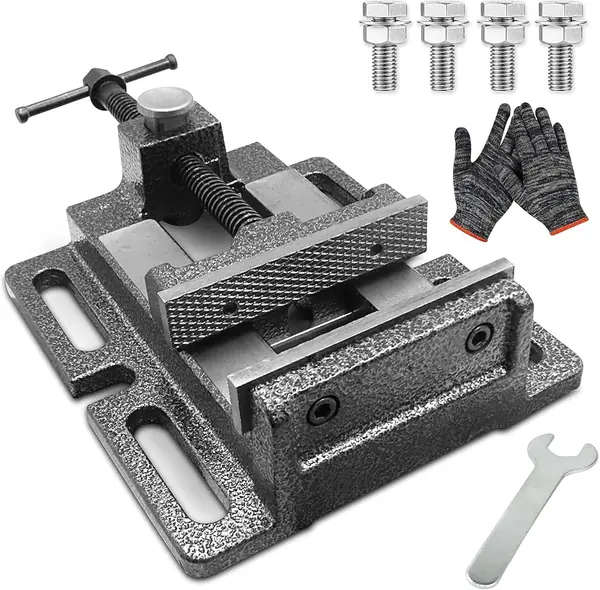
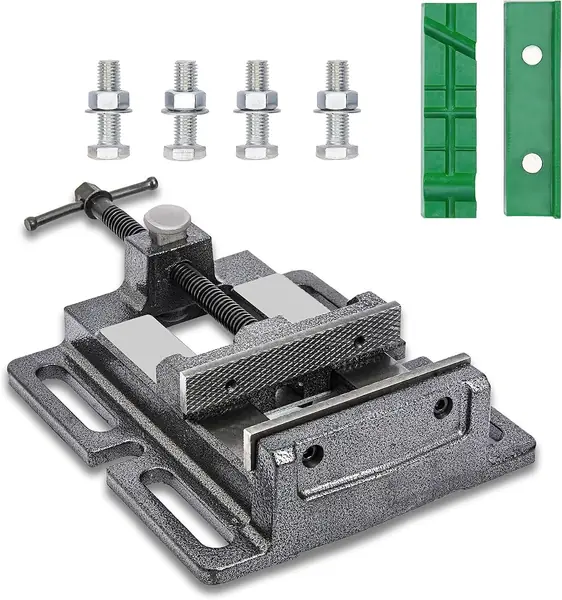
The rest of it is modest and honest: 3-inch jaws, a 2.95-inch maximum opening, 0.87 inch of jaw depth, a high-grade cast steel body with a sprayed finish for corrosion resistance, and four sets of fixing bolts, a small wrench and a pair of gloves in the box. It moves between the drill press and the bench without a second trip.

Where the quick release really earns its keep is a run of similar parts. Set the jaw once, and the button lets you drop the next piece in without losing the position, which is the difference between a vise you use and one you leave on the shelf.

Worth Noting

  • Shallow 0.87-inch jaw depth limits tall stock
Our Verdict

For a run of similar parts, we reach for the MYTEC — the release button makes it the fastest vise here to load, close and unload.

Check Latest Price
6.

Yost Vises LDPV-6 6-Inch Drill Press Vise Best for Wide Stock

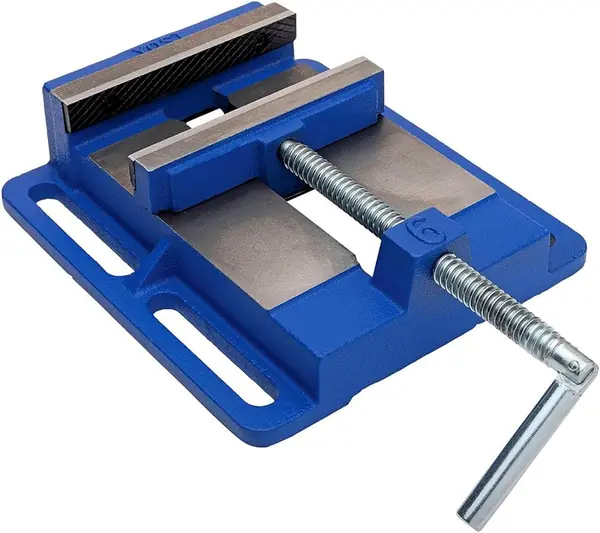
Yost LDPV-6 blue six-inch cast iron drill press vise with wide slotted base

Wide workpieces

Shop Score 88/100
Jaw Width
6 in.
Max Jaw Opening
5-3/4 in.
Jaw Depth
1 in.
Slot Width
0.6 in.
View on Amazon

Six inches of jaw and a 7.15-inch slot centerline are the two numbers that decide whether this one works on your press. Measure the slots on your table before ordering: if they sit much closer together than the vise's centerline, you bolt through one slot and hope, or you make an adapter plate out of plywood.

The rest of the spec sheet is plain: 6-inch jaws that open to 5-3/4 inches, a 1-inch throat depth, 0.6-inch slots, and a cast iron body. Yost has been building vises since 1908 and states the LDPV-6 meets Federal Specification GGG-V-410A.

For wide panels, long brackets and anything that will not sit straight in a 4-inch vise, nothing else here comes close — it is the only 6-inch jaw in the group, and the fixed jaw backs a broad part without letting it walk. We also appreciate the plainness of it: no quick release, no cradle, just a wide fixed jaw and a screw.

It is a holding tool rather than a precision one, though. There is movement in the slide when you clamp, so a part that has to come out dead square needs a pass with a square before the bit goes down.

Worth Noting

  • Light-duty rating for wood and sheet metal
Our Verdict

The LDPV-6 is the one we point to for wide panels and long parts, provided your table is wide enough to catch both slots.

Check Latest Price
7.

IRWIN 226340 Drill Press Vise Best for Jig and Fixture Work

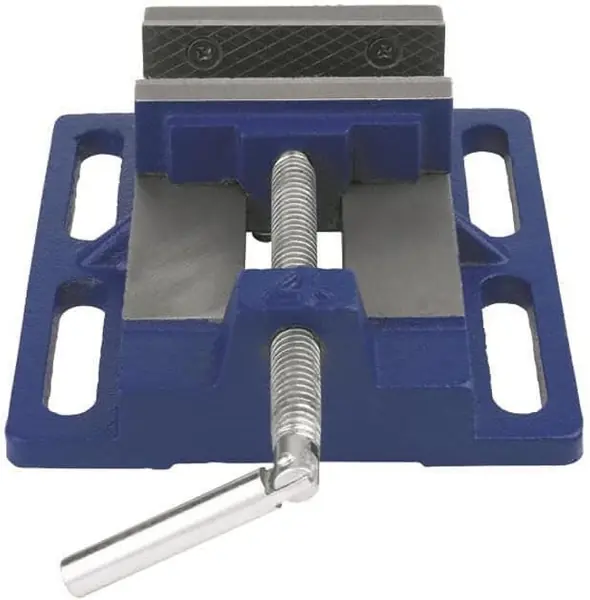
IRWIN 226340 blue forged iron drill press vise with textured jaws

Jig and fixture work

Shop Score 87/100
Weight
16 oz
Material
Forged iron
Jaw Capacity
4.5 in.
Clamping Pressure
1,000 lb
View on Amazon

The front jaw climbs as it tightens. Take up the last of the slack on a piece of flat bar and you can watch the moving jaw rise, which tips the part and pulls a deep hole off square. It is play in the ways, and it is the first thing we check now on a vise at this price.

What you get is a forged iron body, textured jaws, 1,000 pounds of clamping pressure, and a slotted base for bolting it down, all at 16 ounces — light enough to lift off the table with two fingers and carry to a job.

Long stock is the case it handles well: two of these, one at each end of a rail or a post, hold a workpiece vertical with both hands free for the quill. It also doubles as a fixture holder for small jigs that never see a drill press at all.

Where it lands for us is a hobbyist's vise. The forged body takes more abuse than the cast vises at the bottom of this list, and it sits well under the Wilton LP4 on price; for jigs, soft parts and holes that do not have to be dead square, the jaw lift costs you far less than it would in a metal shop.

Worth Noting

  • Light 16-ounce body needs bolting down
Our Verdict

We keep the IRWIN around as a light-duty fixture holder: forged iron, 1,000 pounds of clamp, and a body you can lift off the table with one hand.

Check Latest Price
8.

ZTUKOMN 4-Inch Drill Press Vise Best for Finished Parts

ZTUKOMN green four-inch drill press vise with soft jaw pads and quick button

Finished parts

Shop Score 85/100
Jaw Width
4.2 in.
Weight
7 lb
Max Jaw Opening
4.25 in.
Soft Jaw Pads
Included
View on Amazon

Soft pads are what make this one useful on finished work. The multi-groove jaw covers grip a turned knob, a dowel or a mitered end without the serrations printing through, and they pull off when you want bare jaws for a rough cut.

Behind them is a 4.2-inch jaw opening to 4.25 inches, a 7-pound body, and a quick-adjust button that lets you slide the front jaw up to the part instead of winding it there. The screw turns smoothly on the ones we handled, and the Acme-style thread takes up without a lot of handle travel.

Mounting takes a little planning. The four bolts in the box are sized for a thick bench top rather than a drill press table, so plan on shorter bolts or a set of T-nuts, and check the slot spacing against your table before you commit — on a small benchtop press the foot can hang past the edges.

We like it best for repeat work on finished parts: the button resets the jaw between pieces and the pads protect whatever you just sanded. It is a small-project vise in a 4-inch body, honest about what it is and quick about doing it.

Worth Noting

  • Included mounting bolts are too long for drill press tables
  • Wide base can overhang small benchtop drill press tables
Our Verdict

We like the ZTUKOMN for finished parts and quick resetting — the soft pads and slide button suit repeat work on wood and light metal.

Check Latest Price

How We Tested Drill Press Vises

We started with spec sheets, sorting out which vises would actually mount to a benchtop drill press table: slot width and slot spacing had to line up with common table slots, and body height had to leave room under the quill for a bit and a workpiece. From that pool we bought 12 vises, ranging from compact models for small presses to a wide-jaw vise built for long stock, and covering both fixed and cradle designs.

Each vise was bolted to the table with its own hardware or ours before a single hole was drilled, and we noted which ones shipped bolts and which sent us digging through the shop. With the vise locked down, we clamped round bar in the V-grooves, turned the handle slowly, and watched the moving jaw — if it lifted, or the screw went sloppy near the end of its travel, we wrote it down. We also checked the jaw plates against the bed for squareness and looked at whether they were hardened or just painted.

Over nine months we drilled wood, aluminum, and mild steel: fast repeat setups of the same hole, angled holes with the cradle vise, long stock hanging off both sides, and finished parts held in soft jaws. We measured how much quill travel was left with a vise and workpiece in place, and we leaned into the feed to see whether anything shifted under load.

By the end we were judging them on whether they still felt tight after months of use, whether the price matched the machining, and whether resetting for a new part took ten seconds or two minutes. Every vise here earned its place bolted down, and none was used for side-load cutting.

How to Choose a Drill Press Vise

Jaw Width and Opening Are Not the Same Number

Jaw width is what a vise is sold by; opening is how much it will actually swallow, and the opening usually matters more. A 4-inch vise that opens to 4.33 inches, like the ROLIN here, will take a slightly oversized blank, while a 6-inch vise with a 5-3/4-inch opening, like the Yost, holds parts no 4-inch vise will touch.

Match the opening to the widest thing you drill regularly, then check jaw depth. An inch of jaw face will not hold a tall part securely no matter how wide the jaws are, and several compact vises here top out at exactly that.

Clearance Under the Quill

A drill press has a fixed amount of quill travel, and everything between the table and the chuck comes out of it. Low-profile vises keep the work close to the table so a short-travel benchtop press still reaches; vise bodies are not interchangeable on this point.

Mounting: Slots, Bolts, and Table Spacing

Almost every vise here bolts through slots in its base, and the spacing of those slots decides whether it mounts to your table at all. A 6-inch vise with a 7.15-inch slot centerline needs a table wide enough to catch both bolts; on a small benchtop press you may only reach one. Measure slot to slot on your table and compare it with the vise's slot width and centerline before ordering.

Bolts are not always in the box, so check before you buy and plan a trip to the hardware store. A plywood adapter plate drilled for both patterns solves most mismatches and takes ten minutes to make.

Jaw Quality and the Moving-Jaw Problem

Hardened jaw plates wear better than soft castings, and V-grooves let the jaws hold round bar vertically or horizontally without a V-block. The variable that never appears on a spec sheet is jaw lift: as the screw takes up slack, a loosely guided moving jaw can rise and tip the workpiece, which throws a deep hole off square.

Test it before you trust it. Clamp a piece of flat bar, run a square along the jaw, and watch whether the front jaw rises as it tightens. A vise whose jaws arrive plainly out of parallel is worth sending back inside the return window.

Fixed or Cradle

Most drill press work is square to the table, and a fixed vise does it with the least height and the fewest parts. Buy a cradle-style vise only if you drill angled holes regularly: the Wilton CR4 indexes 0 to 90 degrees with pin stops at the common angles and turns a shim stack into a two-second setup.

It costs more and it sits taller, so it works best as a second vise for a shop that already owns a flat one.

Frequently Asked Questions

Final Verdict

We recommend the Wilton LP4 for most shops. It is low enough that a benchtop press keeps its quill travel, its machined beds hold parts square to the spindle, and 11.6 pounds of cast iron sits still while the bit goes in. That combination is what makes a vise disappear into the job.

If you drill angled holes, the CR4 does something no flat vise here can, and it is worth owning alongside a fixed vise rather than instead of one. For a small press or a tight budget, the WEN DPA423 covers light drilling on an 8- or 10-inch table without crowding the edges.