↑↓ navigate ↵ open Esc close All results →

Best Oil-Based Polyurethanes for Wood of 2026

Oil-based polyurethane rewards patience with a warm, tactile film that sinks into wood grain where water-based topcoats often look cool and flat, yet it demands real concessions in the shop. Long recoat windows, strong fumes requiring steady cross-ventilation, and an amber cast that deepens pale maple are the price of a finish that levels itself and stands up to daily wear on stair rails without leaving brush streaks.

Twelve cans of oil-based satin polyurethane tested across eight months on a walnut dresser, oak cabinet doors, a pine bookcase, and upright stiles highlighted two practical realities: satin hides modest brush flaws that gloss exposes immediately, and real-world coverage falls short of label estimates once a project reaches coat three. Covering wiping varnishes, brushing formulas, and thick gels that stay put on vertical trim, these four topcoats match the main ways woodworkers apply oil poly.

Our Top Picks

The Best Oil-Based Polyurethanes for Wood

1.

General Finishes Arm-R-Seal Best Overall
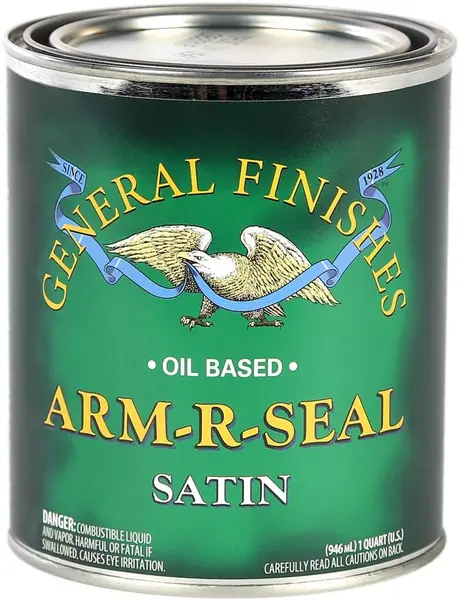
General Finishes Arm-R-Seal satin oil-based topcoat in a one-quart can

Furniture and cabinets

Shop Score 94/100
Finish
Satin
Coverage
100-125 sq ft
Container Size
1 quart (32 fl oz)
Application
Cloth or foam brush
View on Amazon

General Finishes Arm-R-Seal is the quart we reach for when a piece has to look hand-finished but stand up to daily handling. It wipes on with a cloth or goes on with a foam brush, and the 100-125 square feet in a quart is enough for a dining table and several chairs. The film builds into a satin sheen that flatters walnut and oak without looking plastic. That combination of control and durability is why it earns our top pick for furniture and cabinets.

What sold us is the working time: it stays open long enough to level out after you wipe it, so thin coats smooth down instead of setting up with lap marks. We also like that you can choose the application to suit the piece, with a cloth for a small tabletop and a foam brush for rails and stiles. On a finish meant for visible surfaces, that flexibility matters because it lets you keep the coat thin where you want the grain to show.

On a kitchen table or cabinet front, the film has to resist repeated wiping and the occasional wet glass. We were impressed by how solid the cured coat feels, not thick or gummy, just hard and smooth underhand. It is the one here we trust most for a surface that gets touched every day, and that confidence is worth the careful application it asks for.

Worth Noting

  • Can streak on large flat panels
  • Premium price for a quart
Our Verdict

We recommend General Finishes Arm-R-Seal as the best overall oil-based topcoat here: it wipes or brushes on, covers 100-125 square feet, and leaves a durable satin finish for furniture and cabinets.

Check Latest Price
2.

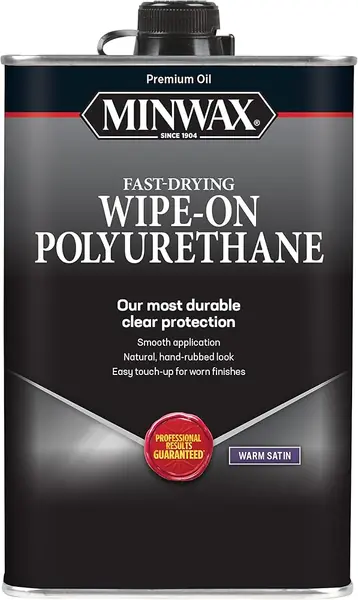
Minwax Oil-Based Wipe-On Polyurethane Best for Furniture

Minwax Oil-Based Wipe-On Polyurethane satin finish in a one-pint can

Furniture and trim

Shop Score 93/100
Finish
Satin
Coverage
62 sq ft per 16 fl oz
Container Size
1 pint (16 fl oz)
Recoat Time
2-3 hours
View on Amazon

A clean cloth is the applicator here, which is the whole appeal: you wipe the finish on, let it sit for a moment, and smooth it out before it tacks. That makes it a friendly choice for a dresser, a bed frame, or any piece with faces you do not want to sand back after a bad brush mark. The satin version leaves a soft sheen that looks more hand-rubbed than lacquered.

We found the 2-3 hour recoat window easy to work around: you can put on a couple of thin coats in an afternoon and sand lightly between them. We appreciate that the finish does not need a brush-cleaning session, since the cloth goes in the trash and cleanup is minimal. The satin sheen is soft enough for a dresser but still wipes clean with a damp cloth.

Where it asks for patience is build: wipe-on coats are thin, so you are trading speed for control. We are happy to make that trade on furniture, where a little extra sanding between coats keeps the surface even. For a big built-in or a floor, we reach for a brush-on gallon instead. On a chair, a side table, or a cabinet door, the cloth method is the one we keep coming back to.

Worth Noting

  • A pint covers about 62 square feet
Our Verdict

We recommend the Minwax wipe-on for furniture and trim where you want a satin hand-rubbed look without brush marks, especially on pieces with flat faces and edges.

Check Latest Price
3.

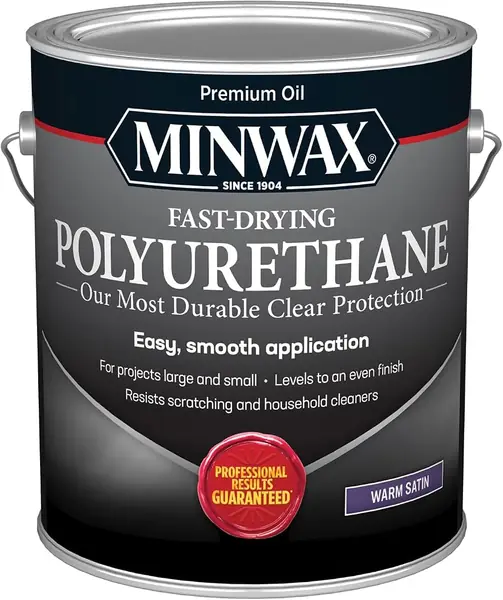
Minwax Fast Drying Polyurethane Gallon Best for Large Projects

Minwax Fast Drying Polyurethane clear satin finish in a one-gallon can

Large interior projects

Shop Score 92/100
Finish
Satin
Coverage
250-300 sq ft per gallon
Container Size
1 gallon (128 fl oz)
Recoat Time
4-6 hours
View on Amazon

The math is the reason to buy this can: 250-300 square feet per gallon means a single container can cover a run of built-ins, a set of doors, or a large table without constant refills. That makes it our choice for big interior projects, where a quart disappears before the job is done. The satin finish goes on thin enough to brush or spray, and the four-to-six-hour recoat keeps a multi-coat schedule moving.

We found the thin consistency forgiving with a foam brush, especially on flat panels where a heavier finish can leave ridges. It also sands cleanly between coats, which matters when you are building a smooth film over a big surface. On oak, walnut, or stained pine, the warm amber tone enriches the grain instead of sitting on top like a clear plastic sheet.

A gallon is a commitment, and we only reach for it when the square footage justifies it. For a single chair or a small cabinet door, the leftover finish will outlast the project. But when the job is a whole room's worth of trim or a long countertop, having enough in one can removes a lot of stop-and-start. We keep this one for the big days.

Worth Noting

  • Amber cast can show on white paint
Our Verdict

For shelves, doors, and other big interior runs, this gallon is our value pick: 250-300 square feet of satin protection with a four-to-six-hour recoat that keeps a multi-coat job moving.

Check Latest Price
4.

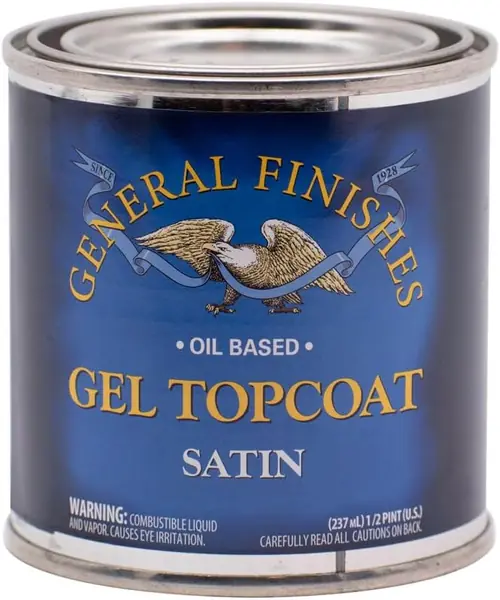
General Finishes Oil Based Gel Topcoat Best for Vertical Surfaces

General Finishes Oil Based Gel Topcoat satin in a half-pint can

Vertical surfaces

Shop Score 91/100
Finish
Satin
Coverage
25-40 sq ft
Container Size
1/2 pint (8 fl oz)
Dry Time
12-24 hours
View on Amazon

A finish that stays where you put it is worth a lot on a door or a cabinet frame. The General Finishes gel topcoat has a thick, no-drip consistency that lets you wipe it on a vertical face without chasing runs down the panel. It is also forgiving for a beginner: a cloth, foam brush, or pad applicator all work, and the satin sheen looks even without a spray setup.

We like the control on detailed pieces. The gel does not flood a corner or pool in a mortise the way a thin liquid can, so you can work right up to an edge and smooth it with a pad. On a stained banister or a paneled door, that means fewer repairs after the fact. The satin sheen brings out the color of the stain without looking wet.

On a paneled door or a built-in's face frames, the gel gives you time to work a section and move on before it sets. We were struck by how much it behaves like a hand-applied finish rather than a poured coating: you control the thickness, and the sheen stays even. For a small vertical project, that is the whole point.

Worth Noting

  • Long 12-24 hour recoat window
  • Half-pint covers only 25-40 square feet
Our Verdict

We reach for this gel topcoat on doors, trim, and other vertical faces where a run can ruin the finish; its thick consistency stays put and leaves an even satin sheen.

Check Latest Price

How We Tested Oil-Based Polyurethane, From Wipe-On to Gel

We started with every oil-based topcoat we could find in a satin sheen, then narrowed by applicator and container size: wiping formulas, brushing formulas, and thicker gels that hold their place on a vertical face. We set aside anything sold in only one size, anything needing spray equipment, and anything whose label skipped the recoat window. That left 12 containers, from a half pint to a gallon, all bought at retail rather than sent as samples.

Testing ran eight months, mostly in a garage with the door up and a box fan pulling air through. We laid each one on a walnut dresser top, oak cabinet doors, a pine bookcase, and the door frames and cabinet sides where a finish has to hang without sagging. Every product got a foam brush, a lint-free cloth, or both, and we noted how far a load of finish traveled before it began to drag.

We timed each recoat and recorded whether the film felt dry or still tacky at the label's window. To read the amber shift, we taped off a strip on maple and birch offcuts and compared finished and unfinished wood after the last coat. For coverage and value, we marked measured squares on scrap plywood and counted the square feet each ounce actually covered. Streaks and leveling we judged under a raking light; on the cured dresser top we dragged keys across it, set down a hot mug, and left a wet glass overnight.

Oil-based finishes demand cross-ventilation, so the fan ran the whole time and we shut off the pilot light on the shop heater before opening a can. Rags went flat on the driveway to dry before we bagged them, never wadded in a bucket where they can self-ignite. The finish that shrugged off all of it is the one we'd put on a stair rail and forget about for a decade.

How to Choose an Oil-Based Polyurethane

Match the Applicator to the Surface

Wipe-on polyurethane is the most forgiving route for furniture because a cloth lays down thin, even coats without brush marks; the Minwax wipe-on is the clear example here. A brush or foam brush builds faster on flat panels, which is where the Minwax gallon earns its keep. Gel is the one to choose for doors and trim, since its thick consistency resists runs on vertical faces. Spray is convenient for small crafts and repairs, but a standard aerosol can covers only about 50-60 square feet, so it is not a shortcut for a whole room.

Do the Coverage Math Before You Buy

Oil-based polyurethane usually needs at least three coats, and porous wood drinks more than a sealed surface, so the square footage on the can is a starting point rather than a promise. A quart of Arm-R-Seal lists 100-125 square feet; the Minwax gallon lists 250-300; the wipe-on pint lists 62. Buy for the whole job, including the inside faces and the edges you will sand between coats. A gallon is a false economy on a single chair, while a pint will run out on a run of built-ins.

Plan Around Recoat and Cure Time

Recoat time tells you when you can sand and add another coat; cure time tells you when the film is ready for real use. The Minwax liquids list 2-3 hours or 4-6 hours between coats, while the General Finishes gel calls for 12-24 hours and a 30-day cure. We plan the slower product for a door or vanity that can sit undisturbed, and the faster ones for furniture we need back in service. Do not confuse a dry-to-touch surface with a cured finish, especially under a hot mug or a damp plant.

Choose Sheen and Accept the Amber

Oil-based polyurethane warms wood as it protects it. On oak, walnut, or stained pine, that amber tone can look rich and deepen the grain; on white paint or pale maple, it can read as yellowing over time. If the piece is pale, finish an offcut and let it cure before committing. Satin is the safer choice for furniture because it hides dust and brush marks better than gloss, while semi-gloss gives trim and cabinets a crisper look. All four picks here are satin, so check the sheen on the exact can if you want more gloss.

Frequently Asked Questions

Final Verdict

For furniture, cabinets, and any surface that gets handled daily, we recommend General Finishes Arm-R-Seal. It gives us the most control of the picks here, with a satin film that levels to a hand-rubbed look and enough durability for tabletops and cabinet fronts.

The premium price is the trade for that finish quality, and we think it is worth it on a piece you will see and touch every day. If the job is measured in hundreds of square feet, the Minwax gallon is the practical switch.