↑↓ navigate ↵ open Esc close All results →

Best Water-Based Wood Stains of 2026

Water-based stain trades the worst hazards of refinishing—heavy fumes and solvent-soaked rags—for a much tighter clock. Because it begins setting before a slow wipe-back finishes, hesitation on a wide panel turns directly into lap marks.

To see how each formula behaved outside a swatch card, we worked 14 water-based stains across furniture panels, cabinet doors, vertical trim, and small craft blanks over eight months. A warm label chip can shift gray over figured grain, so every color was judged on real wood, with coverage calculated after rag wipe-back and recoat intervals timed closely so a second pass builds tone instead of lifting the first.

Thin liquids soak deep to keep grain crisp, whereas gels cling to vertical stiles and rails without running. Small bottles for detail touch-ups sit alongside full-project quarts here, each paired with a compatible clear topcoat.

Our Top Picks

The Best Water-Based Wood Stains

1.

Littlefair's Wood Stain Water Based Best Overall
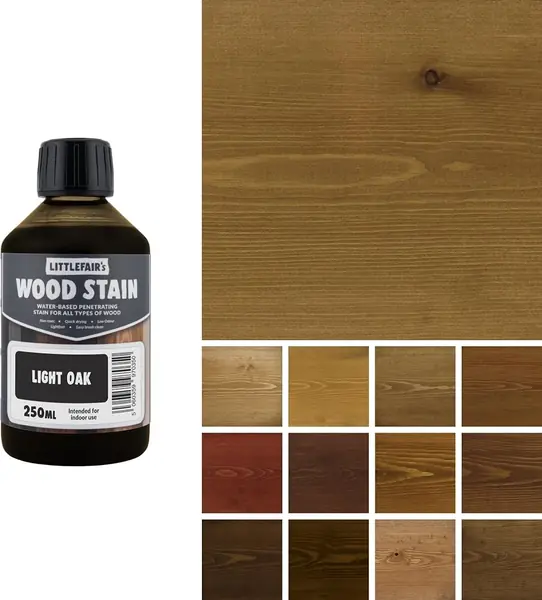
Littlefair's water-based wood stain in Light Oak, 8.5-ounce bottle for indoor furniture

Furniture and trim

Shop Score 91/100
Size
8.5 oz / 250 ml
Color
Light Oak
Coverage
Covers up to 3m²
Finish
Matte
View on Amazon

Fast drying is both the selling point and the catch here. It's what lets you stain a bookshelf in a spare room without opening every window in the house, and it's also why the clock starts the moment the brush touches the wood. We work in sections now — a leg, then a rail, then the top — wiping back as we go, because a wet edge left standing dries into a lap line.

Color is where it earned the top spot. Light oak deepens the grain instead of veiling it, so pine and oak still read as pine and oak — warmer, not orange-tinted, which is the complaint that usually sends a water-based stain back to the shelf. It builds in thin passes rather than jumping to full strength, so a second coat nudges the tone instead of committing you to something three shades off the sample.

A bottle covers up to three square meters, roughly 32 square feet, which is a dining table and its leaves but not a kitchen's worth of cabinets. It does need a topcoat, and it plays well with the brand's own waxes and varnishes as well as most water-based polyurethanes. With 23 colors in the line, matching an existing piece is realistic — and if you need more pigment per ounce for cabinet work, General Finishes is the step up.

Worth Noting

  • Color can fade in direct window light
Our Verdict

For furniture, shelves, and trim, this is the water-based stain we hand people first: grain-forward color in 23 shades, water cleanup, and no odor worth mentioning.

Check Latest Price
2.

General Finishes Water Based Wood Stain Best for Cabinets

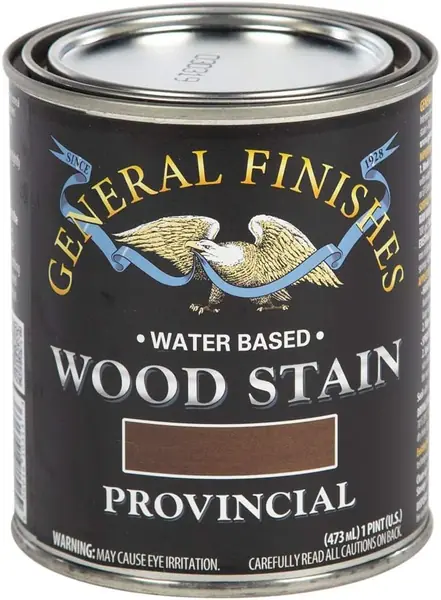
General Finishes water-based wood stain, one-pint bottle in Provincial for cabinets and interior wood

Cabinets and color matching

Shop Score 90/100
Size
0.5 quart / 1 pint
Color
Provincial
Coverage
50-75 sq.ft.
Use
Interior only
View on Amazon

This is one of the priciest bottles in the group, and the first stroke explains why: the pigment load is heavy. Provincial goes on dark and stays dark, so you can reach a deep tone without layering until the grain starts to mud up — the failure mode that turns a stained table into a painted one.

Mixing is the feature we didn't expect to lean on as hard as we do. The water-based stains intermix with each other, and with the brand's paints and topcoats, so a color that's close but not right becomes a starting point rather than a dead end. For cabinet work, where a door has to match a sample under kitchen light, that's worth paying for.

Two things to plan around. The color lands warmer and darker than the name suggests — Provincial carries a red undertone on oak — so test on a cutoff of your actual wood rather than trusting the label. And on blotch-prone species like cherry or maple, a heavy coat can dry uneven; thin coats wiped back promptly keep it even, which is the difference between a rich panel and a cloudy one.

For a kitchen's worth of cabinets, or a repair where the new color has to disappear into an existing finish, we think the pigment density and the mixing range justify the premium. That's a narrower brief than our top pick's, and for it nothing else here comes as close.

Worth Noting

  • Dries darker with a reddish undertone
  • Interior use only
Our Verdict

We point cabinet builders and anyone matching an existing finish here: the pigment load is the heaviest in this group and the colors intermix.

Check Latest Price
3.

Varathane Total Control Gel Stain Best for Vertical Surfaces

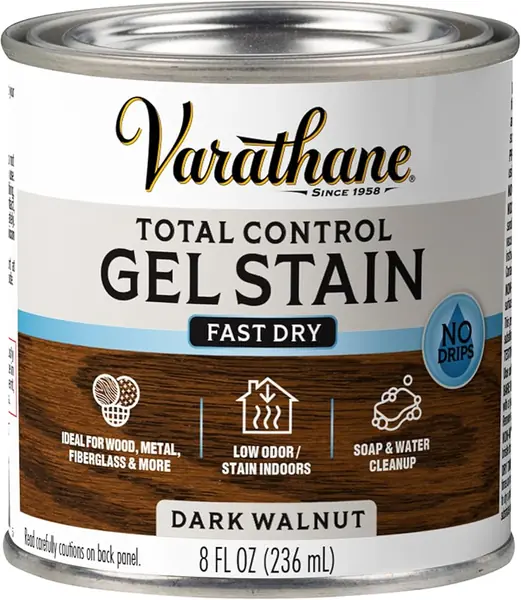
Varathane Total Control gel stain half-pint can in Dark Walnut for doors and trim

Doors and vertical trim

Shop Score 89/100
Size
Half pint / 8 fl oz
Color
Dark Walnut
Surfaces
Wood, metal, fiberglass
Consistency
No-drip gel
View on Amazon

Gravity is what makes staining a door miserable. A liquid stain sags, drips onto the drop cloth, and leaves a run you find after it's dry. Varathane's Total Control is thick enough to stay where the brush puts it, which is why it's the can we reach for on doors, banister rails, trim, and cabinet frames — anything standing up.

The gel consistency buys control in both directions. Work it in and wipe back right away for a light wash, or let it sit a few minutes for a deeper tone; wiped back over a raised panel it reads almost like a glaze. It's also formulated to bond to factory-coated fiberglass and metal, which puts exterior doors and metal trim in scope as long as you protect them with a topcoat.

Coverage is the less predictable part. How far a half pint goes depends on how hard you wipe back — a dark walnut over a lighter existing finish takes more than you expect, and a light wash barely dents the can. For a whole door package, buy the quart and save the half pint for touch-ups.

Worth Noting

  • Coverage varies with how hard you wipe back
Our Verdict

Staining a door, a rail, or any surface that stands up, this is the gel we trust — it stays where the brush puts it.

Check Latest Price
4.

Furniture Clinic Wood Stain Best Budget

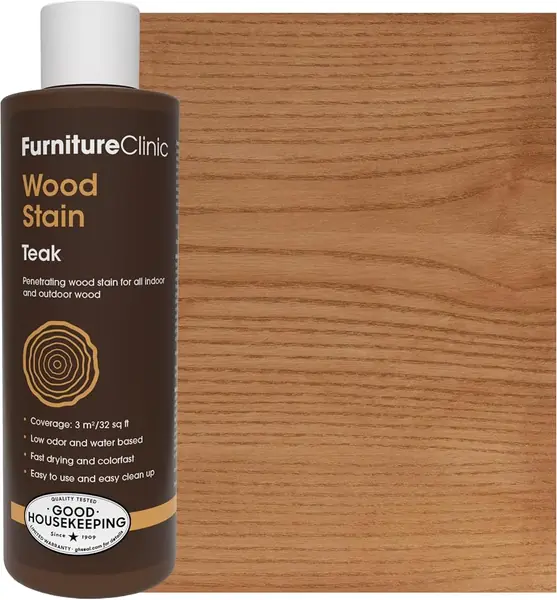
Furniture Clinic water-based wood stain in Teak, 8.5-ounce bottle with matte finish

Small repairs and touch-ups

Shop Score 88/100
Size
250ml / 8.5 Fl Oz
Color
Teak
Coverage
Up to 32.292 sq. ft. per 250ml bottle
Finish
Matte
View on Amazon

Eight and a half ounces covering about 32 square feet tells you what this bottle is for: a shelf, a side table, a set of cabinet doors, a repair — not a whole kitchen. It's a size that suits the jobs coming up between bigger projects, and it's the bottle that stays in the drawer because of it.

What we like is the lack of fuss. Low odor, water cleanup, and a matte finish that looks like wood rather than a coat of plastic. Teak lands warm without going orange, and because it's rated for exterior wood as well, one bottle covers the indoor and outdoor odd jobs of the same weekend.

It needs bare wood to do its best work. On dense species, or a surface still carrying an old sealer, the stain sits on top rather than sinking in and the result looks painted rather than stained; sand back to raw wood and it behaves the way the swatch promised. Give it a topcoat either way — the matte finish is the look, not the protection.

Worth Noting

  • Color can dry ashier than the swatch
Our Verdict

For touch-ups, small builds, and outdoor pieces, we keep this bottle on the shelf: modest coverage, low odor, matte finish.

Check Latest Price
5.

Birchwood Casey Walnut Wood Stain Best for Gun Stocks and Detail Work

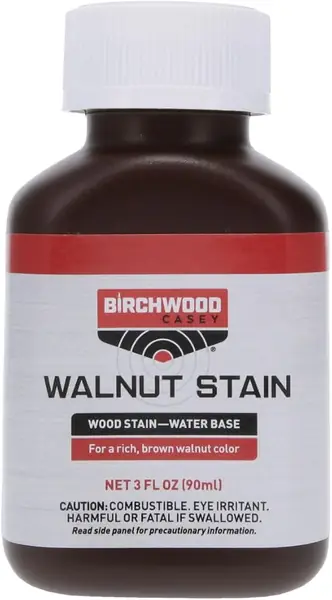
Birchwood Casey walnut water-based wood stain in a 3-ounce bottle

Gun stocks and detail work

Shop Score 87/100
Size
3 oz
Color
Brown (walnut)
Coverage
Limited/Small projects only
Base
Water-soluble concentrate
View on Amazon

Three ounces sounds like a sample, and in a sense it is: this is a concentrate, meant to be cut with water. Full strength it's dark enough for light-colored woods like birch and maple; add water and it walks back toward a light walnut. That dilution is the whole point of the bottle — you're buying the ability to tune the color instead of guessing at it.

Gun stocks are the home turf, and it shows. The stain is formulated to be non-bleeding and to color without clouding or smearing the grain, which is what you want on tight, dark walnut where a muddy finish has nowhere to hide. It's also handy for small antique repairs and craft pieces — the jobs where a few ounces is plenty and a pint would skin over in the shop.

We recommend it for exactly that: a stock, a repair patch, a small piece you want to tone rather than recolor. Give it a trial run on a cutoff first, because the walnut can dry cooler and grayer than the name suggests on dense woods; mix a batch at the strength you plan to use and check it on the same species before it goes near the project.

Worth Noting

  • Three-ounce bottle limits it to detail work
Our Verdict

We recommend it for gun stocks and small detail work, where a concentrate you thin to taste beats a full-size can.

Check Latest Price
6.

DecoArt Americana Gel Stain Best for Craft and Mini Projects

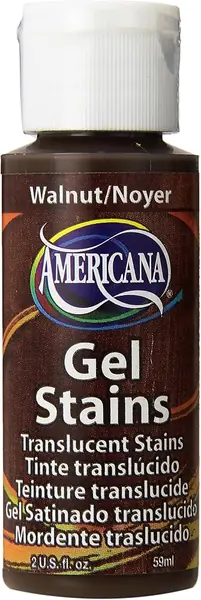
DecoArt Americana gel stain in Walnut, small two-ounce can for craft projects

Craft and mini projects

Shop Score 86/100
Size
2 fl oz
Color
Walnut
Cleanup
Soap and water while wet
Texture
Thick, creamy gel
View on Amazon

Two ounces will not refinish a table, and it isn't meant to. This is a craft-sized gel for drawer pulls, picture frames, dollhouse furniture, and the little box you're building for a gift — and at that scale the thick, creamy texture is genuinely pleasant, because it doesn't run off an edge before you can wipe it back.

It behaves more like a glaze than a penetrating stain. Brush it on, then wipe back with a rag to the depth you want; leave more for a dark antiqued look, wipe harder for a pickled or washed effect. Cleanup is soap and water while it's wet, which matters when the workbench is the kitchen table.

The trade-off is that a gel sits on the surface. On tight-grained stock it can look like thin paint rather than stain, and the walnut can dry lighter or darker than the label depending on how much you take off. On porous woods and small decorative pieces it's forgiving enough that a bad patch wipes away before it sets.

Worth Noting

  • Two-ounce can covers only a few square feet
Our Verdict

For a drawer pull, a frame, or a dollhouse build, we like this forgiving little gel and its soap-and-water cleanup.

Check Latest Price
7.

Retique It Wood'n Stain Best for Painted Cabinets and MDF

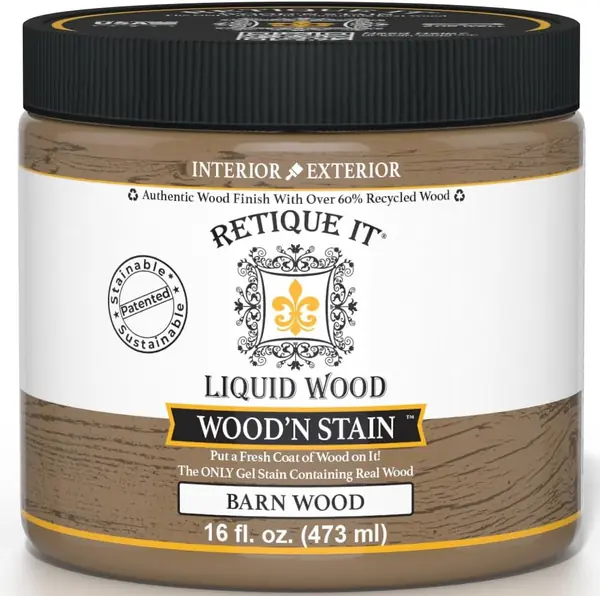
Retique It Wood'n Stain liquid wood coating in Barn Wood, 16-ounce jar

Painted cabinets and MDF

Shop Score 85/100
Size
16 fl oz
Color
45 Barn Wood
Surfaces
Wood, metal, other hard surfaces
Coats
2-3 for a full wood finish
View on Amazon

Strictly speaking this isn't a stain, and it's worth saying so up front: Wood'n Stain is a water-based liquid wood coating, so it lays down a new wood surface instead of coloring the one you have. The grain you see afterward belongs to the coating.

That makes it the answer for surfaces a stain can't help: painted cabinets, MDF, laminate, metal, and doors that already carry a coating. Two to three coats build a finish that reads as wood from a few feet away, it's rated for interior and exterior use, and cleanup is soap and water with very little smell in the room.

Where we reach for it is a basement bar built from MDF, or a set of painted cabinets someone wants to look like oak — jobs with no grain worth saving. On real wood with figure, a pigment stain does the work better and looks more convincing, because what you're seeing is the wood itself.

Worth Noting

  • Two to three coats for full coverage
  • Costs more than a true stain
Our Verdict

We recommend it for painted cabinets, MDF, and laminate — surfaces with no grain to bring out, where you need a wood look built from scratch.

Check Latest Price

How We Tested Water-Based Wood Stains

We built the shortlist from spec sheets, seller listings, and customer reviews, narrowing a long field of water-based formulas by container size, interior or exterior rating, liquid versus gel consistency, and how wide a color range each line offers. Fourteen of them came home with us and stayed in rotation for eight months.

The work happened on a garage bench and across a pair of sawhorses, windows open, gloves and safety glasses on. We brushed each stain onto matched panels, cabinet doors, and vertical trim pieces, clocking how long a wet edge stayed workable before it turned tacky, then wiped back with a clean rag and noted where lap marks showed. We also tracked how much came out of every container and figured coverage twice, once as advertised and once after the wipe-back took its share.

Panels sat side by side in daylight so we could compare each color to its swatch and see whether the grain stayed crisp or went muddy, and we looked again under a warm lamp. We timed the gap between coats, stood close to each open container to rate odor, and cleaned brushes with soap and water while the stain was still wet. Half of every sample got a water-based topcoat so we could watch for lifting or beading, and the boards spent the full eight months in a south-facing window to see how much color held.

How to Choose a Water-Based Wood Stain

Match the Format to the Surface

Flat panels want a liquid you can flood on and wipe back; vertical surfaces want a gel that stays where the brush puts it. A liquid on a door sags and leaves runs, and a gel on a big tabletop can skin over before you've wiped the far end.

If your project is both — a cabinet with a face frame and flat shelves — buy the gel and work the flat parts quickly, or keep a liquid and a gel on hand. Our Varathane pick exists for the standing-up half of that list, and Littlefair's covers the flat half.

Read the Color on Your Wood, Not the Label

Every stain here shifts with species and preparation: the same walnut can read warm on walnut and cool on maple, and dark tones pick up red on oak. The fix costs nothing but time. Sand a cutoff of the same wood the way you plan to sand the project, apply the stain at the strength and coat count you intend, and let it dry completely before judging.

Water-based stain also raises the grain. Dampen the piece, let it dry, and sand lightly before the first coat, or the finish will feel rough no matter how carefully you brushed.

Do the Coverage Math Before You Buy

Listed coverage assumes bare, sanded wood and a single pass, and it shrinks the harder you wipe back or the more porous the wood. A 250-milliliter bottle, about 8.5 ounces, is generally good for roughly 32 square feet; a pint runs 50 to 75.

Measure the surface, double it for two coats, and buy one size up if you're close. Running out mid-project and restarting with a different batch is the one mistake that shows in the finished piece.

Plan Around a Short Working Time

Water-based stain dries by evaporation, so the open time is minutes, not the half hour an oil stain gives you. Work in sections — one leg, one rail, one panel — keep a wet edge, and wipe back immediately. That's the entire technique, and it's why a fast-drying stain rewards preparation more than speed.

If you have to stop, stop at a joint or an edge rather than in the middle of a field, where a lap mark will be the first thing anyone sees.

Choose a Topcoat You Can Live With

Almost every stain here needs a topcoat for protection, and once it's fully dry a water-based stain takes a water-based polyurethane, a hard wax oil, or the maker's own varnish. Pick the topcoat for the abuse the piece will take: a poly for tabletops and kitchen cabinets, a wax or oil for shelves and anything you want to feel like wood.

Test the topcoat on a scrap first. A heavy gel stain seals more of the surface than a thin liquid, so it can need a lighter scuff between coats to give the finish something to grab.

Frequently Asked Questions

Final Verdict

For most furniture projects, Littlefair's is the bottle to buy: it colors the wood without flattening the grain, it cleans up with water, and it comes in enough shades that you can find your tone. Go to General Finishes when you're matching cabinets or spraying a kitchen and need the deepest pigment; go to Varathane's gel when the surface stands up.

Everything else here fills a narrower slot — a repair, a gun stock, a craft piece, or a surface that isn't wood at all. Buy the one that matches the job in front of you and the technique follows.