↑↓ navigate ↵ open Esc close All results →

Best Water Sealers for Wood of 2026

Bare wood rarely fails all at once. It goes a little silver at the edges, stops beading a spilled glass of water, and then one spring you're looking at a gray deck where red cedar used to be. A good water sealer buys those years back, though the wrong one leaves brush laps, a tacky film that never quite cures, or a fence turned a shade of orange no tree ever produced.

Clear or tinted is the question that trips up most first-timers. A clear sealer shows off the grain, but it does nothing about UV graying; a little pigment is what holds your color. We tested 14 water sealers over nine months on deck boards, fence pickets, a raised bed, and a set of outdoor chairs, and the picks below are the ones still beading water when we checked back.

They cover very different jobs: a sun-blasted deck, three fence pickets and a Saturday, a planter box growing tomatoes. What they share is that each one went into a second season still doing what it said on the can.

Our Top Picks

The Best Water Sealers for Wood

1.

Thompson's WaterSeal Semi-Transparent Wood Sealer Best Overall
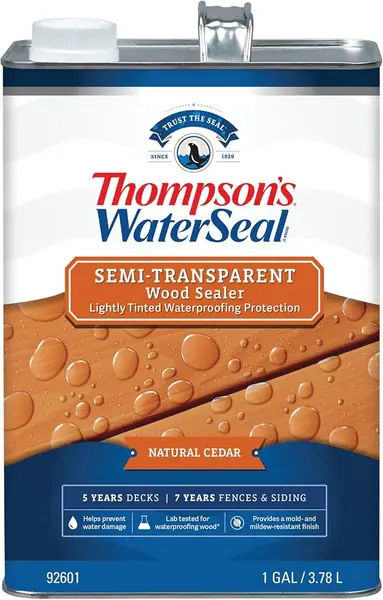
Thompson's WaterSeal semi-transparent wood sealer gallon in Natural Cedar for exterior decks

Decks and fences

Shop Score 92/100
Finish
Semi-transparent
Color
Natural Cedar
Warranty
5 years decks, 7 years fences and siding
Waterproofing Standard
Exceeds ASTM D4446
View on Amazon

Five years on a deck, seven on fences and siding: Thompson's puts real numbers on the warranty for this semi-transparent sealer, and the split tells you where the maker expects the coating to earn its keep. It's a water-based acrylic-alkyd that goes on in one coat, with no primer and no top coat to schedule around. Natural Cedar adds moderate color while the grain stays visible, which is exactly the combination a weathered, blotchy deck needs.

That combination is why this is our default for the big job. One coat is a weekend instead of three, and the waterproofing claim isn't a slogan — the label cites the ASTM D4446 water-repellency standard for it. We also like that the color does real work: semi-transparent pigment evens out the patchy gray that sun and rain leave behind, without the flat, painted look of a solid stain.

Expect a film, because that's what buys the warranty. Acrylic-alkyd coatings sit on the surface rather than soaking all the way in, so a deck already wearing a failing coating needs that coating off before this goes down, and the next recoat means cleaning first. Brush a test patch on a spare board or a hidden corner — cedar takes this tone warmer and browner than pine does.

Worth Noting

  • Tinted only, with no clear version in this line
Our Verdict

We recommend this as the default for a deck or fence: one coat, a warranty broken out by surface, and enough cedar color to make weathered boards look cared for again.

Check Latest Price

2.

Ready Seal Exterior Wood Stain & Sealer Turbo Spray Best for Small Projects

Ready Seal exterior wood stain and sealer Turbo Spray can in Natural Cedar

Small projects

Shop Score 91/100
Finish
Semi-transparent, Natural Cedar
Coverage
Up to 50 sq ft per can
Base
Oil-based
Dry To Touch
1 hour
View on Amazon

A gallon is the wrong tool for a gate, a railing, two chairs, and the chewed board at the bottom of the fence. This 24-ounce can is the right one: an oil-based stain and sealer in a turbo spray that fans about 10 inches wide, needs no back-brushing, and dries to the touch in an hour. We reach for it whenever setup time would otherwise be longer than the job itself.

The goof-proof claim is the reason. Laps, runs, and streaks are what wreck a stained fence — one pass drying darker than the next — and this formula is built so a second pass over a half-dry board blends instead of banding. The finish is semi-transparent, so grain reads through the Natural Cedar, and the can promises no cracking, chipping, flaking, or peeling, with UV protection on top.

Recoating is the pleasant surprise: no sanding or stripping, just another pass with the can, which is why we keep one on the shelf between big jobs. Two details to plan for. Oil-based means solvent cleanup, so set aside rags you can spread flat to dry rather than ball up. And test the fan pattern on a piece of cardboard first — 10 inches is fast on a fence and too wide for a chair leg.

Worth Noting

  • One can treats only about 50 square feet
Our Verdict

For railings, gates, and a couple of chairs, we keep this spray can on the shelf, because it makes a small job of what a gallon turns into a project.

Check Latest Price
3.

DEFY Extreme Wood Stain & Sealer Best UV Protection

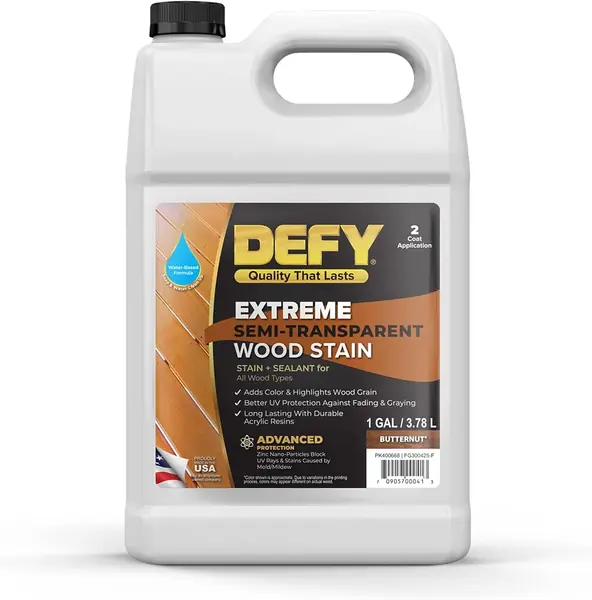
DEFY Extreme semi-transparent wood stain and sealer gallon in Butternut

Sun-exposed decks

Shop Score 90/100
Finish
Semi-transparent, matte
Coverage
100 to 150 sq ft per gallon
UV Protection
Zinc nano-particles
Cleanup
Soap and water
View on Amazon

Butternut is the color; zinc nano-particles are the reason to care. They sit in a water-based acrylic and block the UV that turns an unsheltered deck silver, which means the failure this product is built to stop arrives before water damage does. On a south-facing deck with no shade, that's the right thing to worry about.

Coverage is where DEFY asks for patience. A gallon covers roughly 100 to 150 square feet, about a third of what the thin penetrating products here will do, so a large deck takes a serious number of gallons. What the extra buys is a matte film that levels out, holds its color, and cleans up with soap and water instead of solvent.

We choose this when sun is the problem rather than water: on a deck that grays in a single summer, the zinc package earns the extra gallons. Peeling is the risk that comes with any film, though, and it's the caveat worth hearing before you commit. Some of these decks peel inside a season while others hold for several, and clean bare wood plus a test panel in a corner you don't look at are what separate the two.

Worth Noting

  • Color can read more transparent than expected
Our Verdict

We pick this one for decks that gray fast in full sun, where the zinc UV package is worth buying extra gallons for.

Check Latest Price
4.

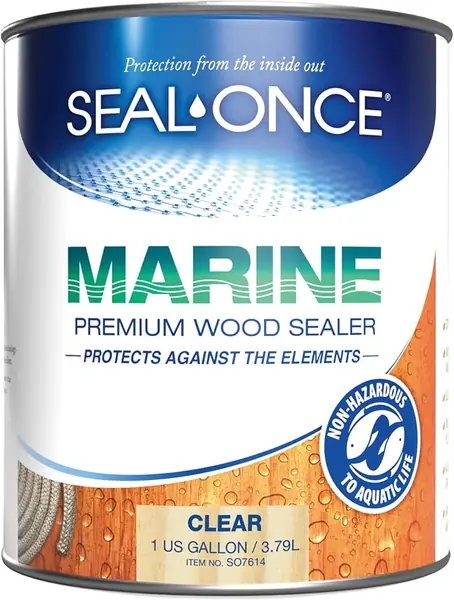
Seal-Once Marine Penetrating Wood Sealer Best for High-Moisture Sites

Seal-Once Marine clear penetrating wood sealer one-gallon can for docks and decks

Coastal and wet sites

Shop Score 89/100
Finish
Clear, penetrating
Coverage
300 sq ft per gallon
Formula
Water-based, ultra-low VOC
UV Protection
UV-stable coating
View on Amazon

The setting is the whole point: boat docks, decks a few feet from the water, retaining walls by a pond, wood that takes salt spray or sits in shade and never quite dries. Seal-Once builds this as a marine sealer and formulates for it — water-based and ultra-low VOC, UV-stable, and thin enough to soak in rather than sit on top.

Penetrating is the mechanic that matters. There's no film to crack, flake, or peel, so the deck can't fail the way a surface coating fails; the wood fibers themselves get the protection, and the barrier stays flexible and breathable as the boards move with the weather. It pours out milky and dries clear, which is a surprise the first time you watch it go on.

The clear finish is honest about what it can't do: it won't bring color back to silvered boards and it won't hide a patchy sanding job. It goes on at about 300 square feet per gallon, dries fast enough for a second coat the same morning, and cleans up with water.

We reach for it when moisture is the specific enemy and appearance is secondary — the dock, the shaded north deck, the ramp that stays damp. What you're buying is a barrier that never has to be stripped off, and on wood that lives near water that's worth more than a pretty finish.

Worth Noting

  • Beading can fade within a season in wet exposure
  • Priciest clear sealer in this group
Our Verdict

Our choice for wood that lives near water, where a film would fail and only a penetrating, breathable sealer makes sense.

Check Latest Price
5.

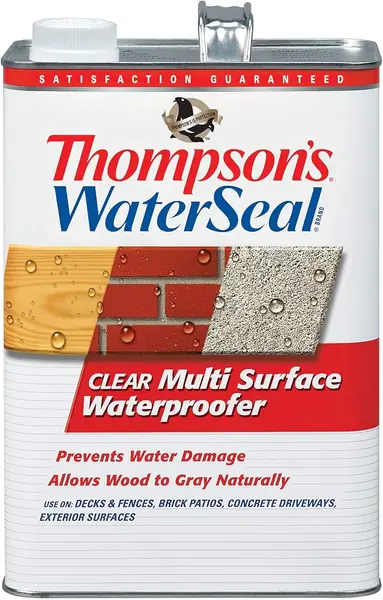
Thompson's WaterSeal Clear Multi-Surface Waterproofer Best Budget

Thompson's WaterSeal clear multi-surface waterproofer gallon for wood brick and concrete

Large flat surfaces

Shop Score 88/100
Finish
Clear
Coverage
375 sq ft per gallon
Base
Water-based
Surfaces
Wood, concrete, brick, masonry
View on Amazon

Cost per square foot is the argument, and it's a strong one: 375 square feet per gallon, the lowest cost per square foot in this group, and a formula that waterproofs concrete and brick as readily as wood. We keep a gallon for the jobs where coverage is the point — a long pressure-treated deck, a patio apron, a set of brick steps.

Multi-surface is the useful part. The same can seals wood, concrete, brick, and masonry, so one exterior weekend doesn't need three separate products; water beads and rolls off the treated surface instead of soaking in, and the coating resists UV damage rather than failing in a single season of sun.

Thin coats are the technique. This is a film-forming waterproofer, and a heavy pass is what leaves a surface feeling tacky underfoot for days. One thin coat worked in rather than puddled, applied in dry weather, and a full day before the furniture goes back solve nearly all of it. Roll it or spray it — just keep moving so nothing pools.

Worth Noting

  • No color, so silvered wood stays silver
Our Verdict

We buy this by the gallon when cost per square foot decides the job, and we accept a plain clear coat in exchange.

Check Latest Price
6.

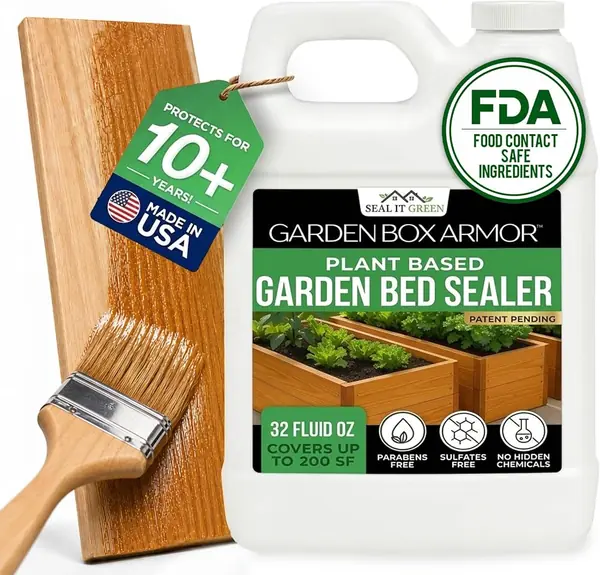
Seal It Green Garden Box Sealer Best for Raised Beds

Seal It Green plant-based garden box sealer quart can for raised beds and planters

Raised garden beds

Shop Score 87/100
Coverage
Up to 800 sq ft per gallon
Size
0.25 gallon
Formula
Plant-based, food-contact-safe claim
Application
Brush, roll, or spray; wipe excess
View on Amazon

Raised beds put a sealer somewhere nothing else in this guide goes: against soil you grow food in, under chickens, beside a dog that sleeps against the boards. Seal It Green is formulated for that spot. Its curing oils, carriers, and surfactants are plant-derived rather than mineral spirits, acrylics, or polyurethane, and the label carries a food-contact-safe claim for the ingredients.

It penetrates rather than coats, bonding to the wood fibers, which is why you can wipe the excess back after 15 to 30 minutes and leave no film behind. Two coats are recommended, and a gallon covers up to 800 square feet — the best coverage per gallon in this group by a wide margin. Planter boxes, coops, bird houses, pens, and the picnic table all suit it; a deck you want to look refinished does not.

What we like is how close to raw wood the result stays. No plastic sheen, no color shift, nothing to peel in a few seasons when the box has to be emptied and refilled. It's the pick for projects where what the wood touches matters more than how the wood looks, and where a couple of beds is the entire job.

Worth Noting

  • The quart treats only a couple of beds
Our Verdict

For raised beds, coops, and pet structures, we choose this because the wood touches soil, animals, and food, and the formula is built for that.

Check Latest Price
7.

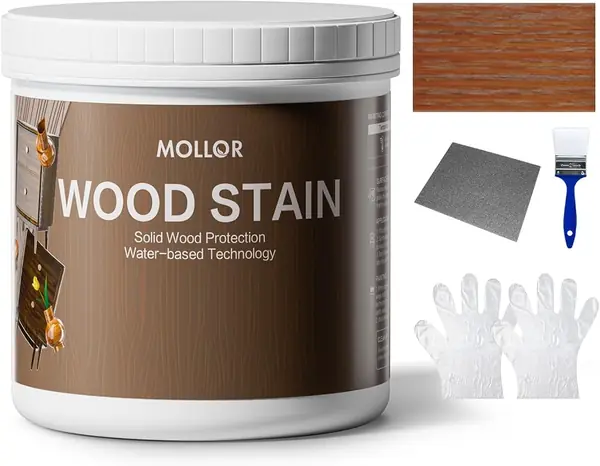
Mollor Water Based Wood Stain & Sealer Best for Furniture and Trim

Mollor water-based wood stain and sealer 16-ounce can in Teak

Furniture and trim

Shop Score 86/100
Base
Water-based, low VOC
Size
16 fl oz
Color
Teak
Dry Time
4 hours to handle, 7 days full cure
View on Amazon

Sixteen ounces, a Teak tone, and tools in the box: this is a furniture can, not a deck can, and it doesn't pretend otherwise. The formula is a water-based acrylic emulsion with no primer and no top coat, thin enough to work into a chair arm and low-odor enough that a basement or garage is a reasonable place to use it.

We keep it for the jobs a gallon makes no sense for — touching up a scratched tabletop, refreshing two chairs, matching a shelf to a floor. Four hours to a surface you can handle and a week to full cure is a working rhythm for furniture, and the Teak tone lands as a warm mid-brown rather than orange. Outdoors it belongs on furniture and trim that get recoated or brought in, not on a fence.

One technique note: it dries fast enough that lingering with a brush leaves streaks, so work in one direction, keep a wet edge, and test the color on the underside of the piece before you commit. The included brush is fine for edges and small runs, but it's also where the streaks come from — a foam brush or a lint-free rag on flat panels gives a cleaner line.

Worth Noting

  • Sixteen ounces is furniture-scale only
Our Verdict

We keep this small can for furniture and trim, where a teak tone, low odor, and a four-hour handle time are the whole job.

Check Latest Price

How We Tested the Best Water Sealers for Wood

We started with the sealers we already knew from hardware-store shelves and customer reviews, plus a handful of plant-based and food-contact-safe formulas that live in garden forums and nowhere else. We sorted them by finish (clear, semi-transparent, tinted) and by base, then priced each one by the square foot its label claims rather than by the gallon, since a cheap can that covers a third as much is not cheap. Fourteen made it onto real wood.

Every test board was cleaned, allowed to dry fully, and stripped of any failing old coating first, because judging a sealer on somebody else's peeling film tells you nothing. Half went on with a brush and half with a sprayer, and we back-brushed one side of every sprayed panel to see whether it changed the finish. We deliberately doubled back over wet edges and watched for lap marks, measured coverage on a taped-off patch, and pressed a paper towel to each surface at one, two, four, and eight hours to catch tackiness. Where a label called for solvent, we ventilated, wore gloves, and spread the rags flat to dry outside; where we sprayed, siding was masked and plants covered.

Then the wood sat through nine months of weather on a west-facing deck, fence pickets, garden beds, chairs, and a dog house, with one shaded fence run kept for the high-moisture formulas. Once a month we poured half a cup of water on each panel and timed how long it beaded, then hosed the board to see whether water sheeted off or sank in, and photographed the same panels in the same afternoon light to catch graying, blotching, and color shift. The raised beds got tomatoes and basil once the coating cured, and we watched for odor or staining where soil meets wood.

How to Choose a Water Sealer for Wood

Clear, Tinted, or Colored

Decide the finish first, because it's the one choice you can't undo without stripping. A clear waterproofer keeps whatever color the wood has right now, which on a deck that's gone silver means it stays silver. Semi-transparent products such as the Thompson's and DEFY picks add moderate pigment while the grain still reads, and that pigment is what evens out the blotchy patches sun and rain leave behind.

Solid color hides the grain completely and belongs on siding; we don't recommend it for a deck you want to look like wood.

Penetrating or Film-Forming

The two families fail differently, and that's the whole decision. Penetrating sealers — the Seal-Once and Seal It Green picks here — soak into the fibers, leave nothing to peel, and want recoating sooner. Film-formers such as the acrylic-alkyd Thompson's and the DEFY acrylic build a layer on top; they hold color and last longer, but they can peel, and a failed film means stripping rather than recoating.

The trap is putting a film-former over an existing penetrating sealer and expecting it to bond. Match the new product to whatever is already on the wood.

Coverage and Cost Per Square Foot

Price per gallon tells you almost nothing, because coverage swings by a factor of four or more. Divide the label's square footage into your deck's area and buy on the result: in this group, coverage runs from about 100 to 150 square feet per gallon for the DEFY film, to 375 for the Thompson's clear, to 800 for the Seal It Green penetrating oil. Then add 10 to 20 percent, because rough-sawn cedar and dry, thirsty boards drink far more than a smooth planed surface does.

Prep, Weather, and Drying

Most sealer failures start with the wood, not the can. Clean first, strip anything that's failing, and let the boards dry. A sprinkle test tells you where you stand: drops that bead mean the wood is still sealed or still wet, and drops that soak in within a minute mean it's ready.

Then pick your weather. Water-based products need a dry stretch and temperatures above the label's minimum, and a finish rained on before it cures can blotch. Give foot traffic a full day and furniture longer.

When the Wood Touches Food, Pets, or Soil

Raised beds, coops, and pet structures are their own category, because whatever goes on the wood ends up near something that eats or sleeps against it. Look for a plant-derived formula with a food-contact claim, as the Seal It Green pick has, apply it thin, and let it cure fully before filling the box — a cured film is not the same thing as the liquid in the can. An oil-based deck sealer has no business on a bed growing carrots.

Frequently Asked Questions

Final Verdict

For most decks and fences, we point people to Thompson's semi-transparent sealer: one coat, a warranty split by surface, and enough cedar tone to make a gray deck look cared for again. It's the pick that asks the least of you and promises something specific in return.

Change the priority and the pick changes. If the wood never dries — a dock, a shaded deck near water — the Seal-Once Marine is worth the premium for a barrier that can't peel. If cost per square foot is the whole decision, the clear Thompson's gallon covers the most area for the least money.