↑↓ navigate ↵ open Esc close All results →

Best Non-Toxic Wood Stains of 2026

Wood stain used to mean open windows, a respirator, and a headache by dinner. Water-based and zero-VOC formulas changed that, but do the gentler ones actually bite into the wood, or just smell better while the color goes patchy? What a good one fixes is the real problem: even, believable color on furniture you keep indoors, without turning the project into a ventilation exercise.

We tested 14 stains over four months — water-based liquids, no-drip gels, and a powder concentrate — on pine, maple, and oak boards, a flea-market dresser, interior doors and trim, weathered deck boards, and craft frames. Open time matters more than the shade on the label: a stain that stays workable lets you blend a lap mark, while one that flashes off leaves a seam you can't undo.

The picks run from a palm-sized bottle to a powder that mixes into a gallon, and each earned its place the same way: color lands where you expect and the fumes don't take over the room. Just remember that a low-toxicity stain doesn't make your topcoat low-toxicity, so read the sealer's label too.

Our Top Picks

The Best Non-Toxic Wood Stains

1.

Littlefair's Water Based Wood Stain Best Overall
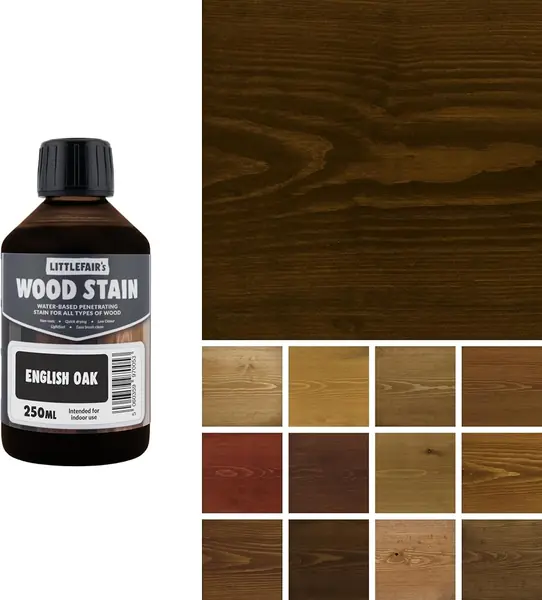
Littlefair's water-based wood stain in an 8.5-ounce can, English Oak color

Furniture and crafts

Shop Score 91/100
Size
8.5 oz / 250 ml
Color
English Oak
Coverage
Low to medium
Base
Water-based
View on Amazon

Speed is the first thing you notice. Brush this onto bare, sanded wood and it starts to set almost at once, which is both the best and the most demanding thing about it — keep a wet edge and work in small sections or the overlaps dry as darker bands. We kept a damp rag in one hand and wiped back as we went, and that turned out to be the whole technique.

The English Oak we used is a light, brownish shade straight from the can, and the listed coverage is low to medium. Read that honestly: one pass on pine gave us a pale wash, and the tone in the product photos took two to three coats, with the grain still reading through. That is the point of a stain rather than a paint, and it lets you stop when the color looks right. More than 20 shades and a spread of can sizes make matching an existing finish realistic.

Where it earns shelf space in a workshop is the cleanup and the smell, or the lack of it. Rinse the brush in water, wring the rag, done, and the room does not need airing out for a day. It is an interior product, so leave exterior work to a treatment built for weather. We reach for it on flat panels and tabletops; for anything vertical, the gel stain below is the easier tool.

Worth Noting

  • Fades indoors when a piece sits in direct sun
Our Verdict

We recommend this for indoor furniture and crafts: it is water-based, nearly odorless, and cleans up with water, with a color line wide enough to match almost any project.

Check Latest Price
2.

General Finishes Water Based Wood Stain Best for Blotch-Prone Woods

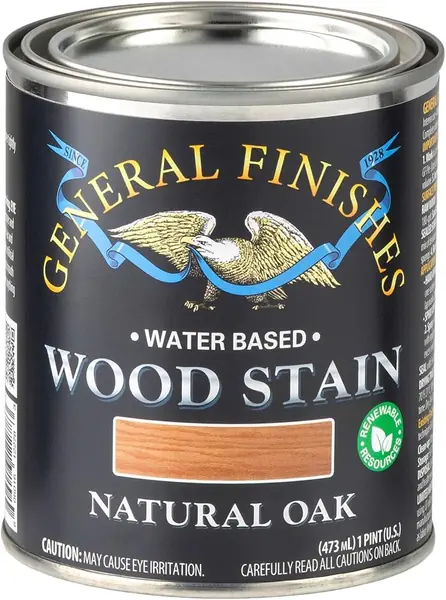
General Finishes water-based wood stain in a pint can, Natural Oak color

Blotch-prone softwoods

Shop Score 90/100
Size
1 pint (16 fl oz)
Color
Natural Oak
Formula
Water-based, low VOC
Use
Interior only
View on Amazon

The priciest bottle here buys working time. This stain sits on the surface long enough to blend out a lap mark, wipe back for a lighter tone, or shoot through a spray gun without flashing off in the air. If you came up on oil-based stains and resent how fast water-based products dry, this is the one that lets you keep the habit.

Where it justifies the premium is soft, blotch-prone wood. Pine, maple, and aspen take thin stains unevenly, and the heavier pigment load limits how deep the color sinks, so it sits more evenly across reversing grain. We saw far less of the patchiness that makes people give up on water-based stain, and on red oak it went on as smoothly as anything in this group. It is also the mixer of the set: blend it with other shades in the line, or tint a water-based topcoat with it to land a color nobody sells.

Two things to know before the can is open. The color lands darker than a swatch or a screen suggests, so test a scrap and plan to lighten with a paler shade if you are chasing a washed oak. And it has to be wiped back immediately with a rag — leave it pooling and it streaks. A pint is more stain than it sounds once coats go on thin, and a small tabletop takes far less than we expected.

Worth Noting

  • Color lands darker than swatches and screens suggest
  • Premium price for a single pint
Our Verdict

We pick this for blotch-prone softwoods and sprayed work: the thick pigment body buys oil-like working time, and the low-VOC formula cleans up with water.

Check Latest Price
3.

Varathane Total Control Gel Stain Best for Vertical Surfaces

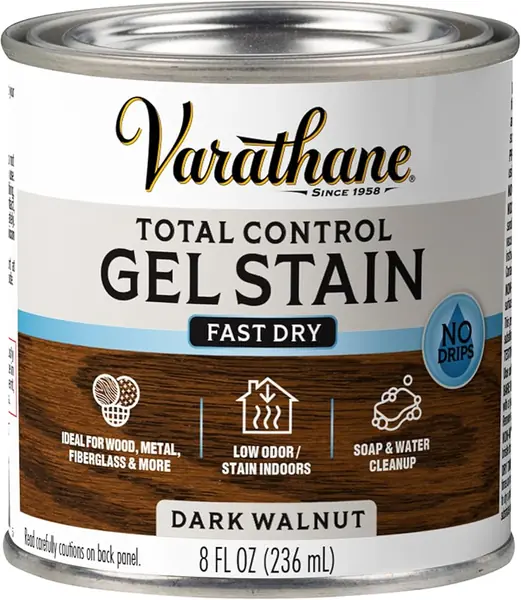
Varathane Total Control gel stain in a half-pint can, Dark Walnut color

Doors and trim

Shop Score 89/100
Size
Half pint (8 fl oz)
Color
Dark Walnut
Formula
Water-based no-drip gel
Surfaces
Doors, trim, banisters, furniture
View on Amazon

Doors are where a thin stain gives itself away — a run at the panel edge, a drip under the rail. This gel does not do that. We brushed it onto a vertical surface braced for drips and spent the time wiping edges instead, and that one behavior is why we keep it for anything that stands up rather than lies flat. It also levels without obvious brush marks, which is not something we can say for the liquid stains here.

Dark Walnut goes on deep and slightly rustic, closer to espresso than to red-brown, and it builds quickly — one pass gave us most of the color we were after. The formula stays workable long enough to wipe an edge back for a lighter look, odor is minimal, and cleanup is soap and water while it is still wet. The half pint handles trim and a door frame; it also comes in quarts, which is the size to buy for a cabinet run.

Coverage is the uneven part. Some boards take color in a single pass and others keep grabbing for more, so buy for two coats rather than one and test on the species you are using. On outdoor furniture, work over masking paper — the color can bleed onto the patio beneath. It is also not a finish on its own: on an exterior door it needs a protective topcoat over it.

Worth Noting

  • Coverage varies; some boards need a second coat
Our Verdict

Our pick for doors, trim, and banisters: the thick gel stays where you put it, so vertical work does not run, drip, or show brush marks.

Check Latest Price
4.

Eco Wood Treatment Best for Exterior Wood

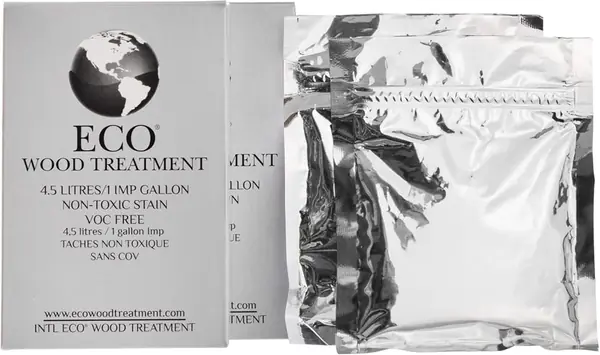
Eco Wood Treatment powder concentrate two-pack for mixing a silver-gray exterior wood stain

Decks and fences

Shop Score 88/100
Size
1 gallon powder, 2-pack
Color
Silvery patina
Use
Interior and exterior
Coverage
Up to 150 sq. ft. per gallon
View on Amazon

It arrives as a powder, not a liquid, and it does one thing: bare wood turns silver-gray. If you want walnut or golden oak, this is the wrong can. If you want a new cedar fence or a fresh raised bed to look like the weathered wood beside it, it is the simplest thing we tried.

Mix it with water and apply by brush, roller, or sprayer. We rolled it on and it went on like water, soaking in immediately and oxidizing to a patina quickly rather than over a season. The minerals stay in the wood and keep migrating as the surface checks and cracks, so there is nothing to recoat and nothing to peel. The listing covers up to 150 square feet per gallon, and this is a two-pack, which makes it one of the least expensive products here per square foot.

We like it most for jobs where longevity matters more than a furniture-grade look: raised beds, fence boards, a trellis, a birdhouse, a set of outdoor steps. It is mineral-based and zero-VOC with water cleanup, and it will not wear off the way a film-forming stain does. Mixing is the awkward part — powder that does not fully dissolve will clog a sprayer, so stir longer than feels necessary and strain it. Because the color keeps shifting with sun and weather, judge it on a weathered scrap rather than in the first hour.

Worth Noting

  • Only produces a weathered gray look
  • Undissolved powder can clog sprayers
Our Verdict

The only exterior pick here: mix the powder with water and bare wood ages to a silver-gray patina that never needs restaining.

Check Latest Price
5.

DecoArt Americana Gel Stain Best for Craft Projects

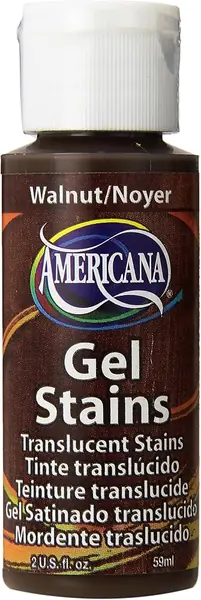
DecoArt Americana gel stain in a two-ounce can, Walnut color, for craft projects

Craft projects

Shop Score 87/100
Size
2 fl oz
Color
Walnut
Formula
Non-toxic acrylic gel
Cleanup
Soap and water while wet
View on Amazon

Two ounces sounds like a sample, and for a tabletop it is. For the work this bottle is actually for — a picture frame, a set of drawer pulls, a dollhouse floor, a scuff you are trying to hide — it is a season's supply, and it takes up almost no room in a drawer.

What makes it useful is the texture. The gel is thick and creamy, closer to a glaze than to a stain, and it sits on the surface instead of wicking away, so you can push it into a corner, wipe it back to a thin wash, or leave it heavy for an antiqued look. We found it most convincing on small parts where a brush and a rag reach everything at once. On a broad flat panel the same thickness works against you, and the color starts reading like thinned paint rather than stained wood.

Colors blend with each other, which is the real reason to keep two cans around: a walnut and a light oak mixed on the fly will get you closer to an odd existing finish than either bottle alone. Cleanup is soap and water while it is wet, and once it dries in a brush that brush is finished, so rinse it first. There is no solvent smell to carry up out of a basement workshop.

Worth Noting

  • Two-ounce can covers small projects only
Our Verdict

Worth keeping on the shelf for trim, touch-ups, and small crafts: a non-toxic gel that colors wood quickly and wipes off with soap and water.

Check Latest Price

How We Tested Non-Toxic Wood Stains

We started by pulling every stain whose label made a low-toxicity claim — water-based, zero-VOC, or explicitly non-toxic — across liquid, gel, and powder-concentrate formats, then narrowed it by what the fine print actually promised, interior versus exterior rating, and claimed coverage against price. From that pool we tested 14 stains over four months, at a bench in the garage and on a half-finished deck out back.

Each one went onto sanded pine, maple, and oak boards first, because that's where patchiness shows. We watched how long the wet edge stayed workable, brushed a second pass into a half-dry area to see whether lap marks blended or set into a dark line, and timed how long each coat stayed tacky. Then came real pieces: a flea-market dresser, interior doors and trim brushed vertically to see what dripped and ran, deck boards left out through rain and sun, and small craft frames.

For coverage, we marked off square footage on scrap plywood and counted coats until the tone read even — a better measure of value than bottle size. We judged color against the label at one, two, and three coats and noted how the grain and finish read once dry, and we logged odor while working with a window cracked and a fan running. Brushes and rags were cleaned per each maker's directions, and we wore N95 masks for every sanding session, since the dust is the bigger respiratory exposure in this project.

We also stopped assuming a low-toxicity stain means a low-toxicity topcoat; we read each sealer's own ventilation and cure guidance before finishing a piece.

How to Choose a Non-Toxic Wood Stain

Read the label for what is actually low-toxicity

Non-toxic is a marketing word more than a standard, so we look for the specifics behind it: a water base, low or zero VOC content, and pigments or minerals rather than solvents. The absence of a solvent smell is a good real-world signal — every stain here is close to odorless, and you notice it the moment you open the can.

What the claim does not cover is the topcoat. A water-based stain under a solvent-based polyurethane still means solvent in your shop, so read the second can with the same care as the first.

Interior or exterior decides more than color does

An interior stain on a deck is money thrown away — it has no UV protection and no way to move with wood that swells and dries. If the piece lives outside, buy a treatment built for weather: the Eco Wood Treatment here is the only one designed for full exposure, and Varathane's gel can go outdoors only under a protective topcoat.

For furniture, indoor-only is the honest label on three of these five, and that is fine as long as you are not planning to leave the piece on a porch.

Open time is the real skill gap

Thin water-based stains set quickly, which is why first-timers end up with lap marks: the section you started has already skinned over by the time you reach the next one. Work in small areas, keep a wet edge, and wipe back immediately with a rag rather than coming back later.

If the project is vertical, or big enough that speed becomes a problem, a gel stain buys you minutes of working time. Varathane's no-drip formula and the thicker body of General Finishes both exist for that reason, and both are easier for a beginner than a liquid.

Match the formula to the wood, not just the color

Softwoods — pine, maple, aspen — take stain unevenly and blotch where the grain reverses. A heavier, more controlled pigment load helps, which is where General Finishes earns its price, and a pre-stain conditioner does something similar for a thin stain. Open-grained oak is forgiving and will take almost anything here.

Whatever you pick, test on an offcut sanded the same way as the project. A color chip on a screen tells you very little about how a stain will read on your wood.

Buy for coverage, not bottle size

Sizes here run from a two-ounce craft bottle to a gallon of concentrate, which means nothing until you read coverage: a half pint of gel handles trim and a door frame, a pint of thin stain does a small table with some to spare, and the Eco concentrate covers up to 150 square feet per gallon once mixed.

Thin stains usually need two or three coats for a deep shade, so size the can for the whole job rather than the first pass. Running out mid-project is the one problem a color match cannot fix.

Frequently Asked Questions

Final Verdict

Two things settle this for most people: where the piece lives and how much working time you can handle. For furniture and crafts indoors, we recommend the Littlefair's water-based stain — near-odorless, water cleanup, and a color line wide enough to match whatever you are repairing or building.

If you are staining pine or maple and want to avoid blotching, General Finishes is worth the premium; if the project is vertical, the Varathane gel is easier to control. Outdoors, skip all three. The Eco Wood Treatment is the only one here built for weather, and it gives you a single look — silver-gray — which is right for a fence or a raised bed and wrong for anything you want to stay brown.