↑↓ navigate ↵ open Esc close All results →

Best Portable Table Saws of 2026

Clamping a straightedge for a circular saw works in a pinch, yet any flex in the guide leaves cabinet panels creeping out of square and needing a second trim pass. A portable table saw anchors a parallel rip fence so stock feeds past the blade cleanly—provided the stand carries enough mass to stay planted on concrete rather than skating across the floor mid-rip.

Unfolding stands, hoisting saws into truck beds solo, and ripping oak and maple across eight months with eight models confirmed that cut quality and easy carrying pull in opposite directions. Weight is the spec buyers most often overlook: the heft that dampens vibration in hardwood is the same load felt every time you lift the frame.

Spanning tight home shops, first-time setups, deep rip cuts, and one-person job-site transport, all five saws below lock their fences square and hold alignment under load.

Our Top Picks

The Best Portable Table Saws

1.

DEWALT DWE7491RS 10-Inch Table Saw Best Overall
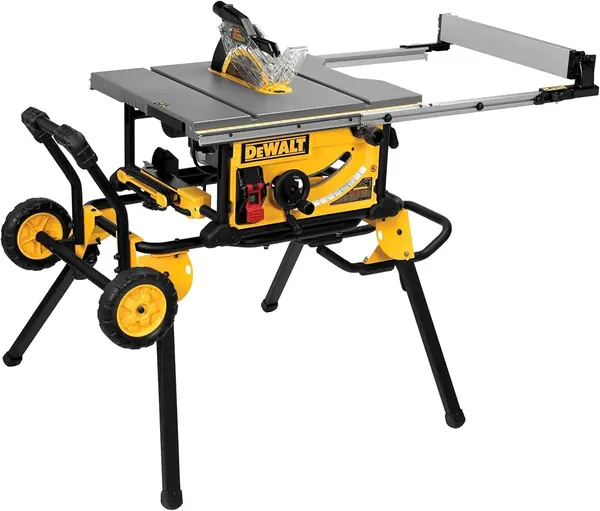
DEWALT DWE7491RS 10-inch table saw on yellow and black rolling stand

Serious home shops

Shop Score 96/100
Blade Size
10 inches
Saw Weight
110 lb
Rip Capacity
32-1/2 inches
Stand Type
Folding rolling stand
View on Amazon

A 32-1/2-inch rip capacity puts the DEWALT DWE7491RS in a different class from the compact saws here: it can rip sheet goods and wide trim without the workarounds a smaller table demands. That capacity, plus the 10-inch blade and 15-amp motor, is why it is our top pick. We like the rack-and-pinion fence because it lets you dial in a setting and keep it parallel to the blade, which matters more than a few extra rpm on a portable saw.

The rolling stand is the other half of the story. It folds for storage, rolls to the work area, and gives the saw a wide, stable platform once it is locked open. We appreciate that because the stand does the positioning work for you. The 24-tooth blade that comes installed is a ripping blade, so plan on a finer blade for smooth crosscuts in trim or plywood.

On-board storage keeps the guard, riving knife, miter gauge, wrenches, and push stick with the saw, so the parts you need for a safe setup do not wander off between jobs. We were glad to see the fence and cord wrap included in that storage, too. That organization is a small thing until you are packing up in a hurry, and then it is the reason the saw goes back in the truck complete.

For a shop that builds cabinets, shelving, or decking, the fence opening is the difference between wrestling a sheet and simply cutting it. The DWE7491RS is the one we want when the work is bigger than the table.

Worth Noting

  • Heavy 110-pound saw for stairs and truck beds
Our Verdict

The DEWALT DWE7491RS earns our top recommendation because it pairs a 10-inch blade and 32-1/2-inch rip capacity with a rolling stand that makes a full-size saw manageable.

Check Latest Price
2.

DEWALT DWE7485 8-1/4-Inch Table Saw Best Compact

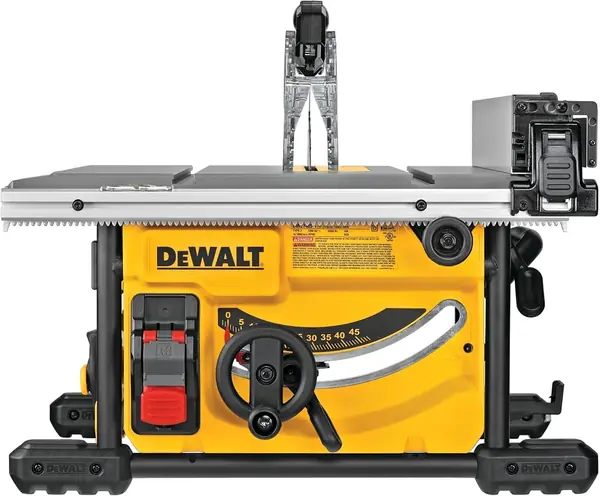
DEWALT DWE7485 compact yellow 8-1/4-inch jobsite table saw

Small shops

Shop Score 95/100
Blade Size
8-1/4 inches
Saw Weight
54 lb
Rip Capacity
24.5 inches
Motor
15 Amp
View on Amazon

At 54 pounds, the DWE7485 is the saw we can lift onto a bench or carry through a narrow shop door without a second pair of hands. The 8-1/4-inch blade and 24.5-inch rip capacity put it in compact territory, while the 15-amp motor and 5,800 rpm speed give it enough power for trim, shelving, and cabinet parts.

We like the rack-and-pinion fence because it is the same style of adjustment as the bigger DEWALT, and it makes repeat rips easier than the saw's size suggests. The table is small, so long boards need an outfeed support, but that is the trade for a saw that stores on a shelf. For a garage shop where the saw comes out for a project and goes away again, that trade makes sense.

We were glad to see on-board storage for the blade guard, riving knife, anti-kickback pawls, miter gauge, wrenches, and push stick; loose guards are how safety parts get left behind. The installed 24-tooth blade is a ripping blade, so a finer blade is the first upgrade for plywood and finish trim. The DWE7485 is the saw we take down from a shelf, not the one we build a shop around.

Worth Noting

  • No stand or wheeled base included
Our Verdict

For a bench-sized shop, the DEWALT DWE7485 is the compact saw we reach for: 54 pounds, a 24.5-inch rip capacity, and the same rack-and-pinion fence as its bigger sibling.

Check Latest Price
3.

SKIL TS6307-00 10-Inch Table Saw Best Value

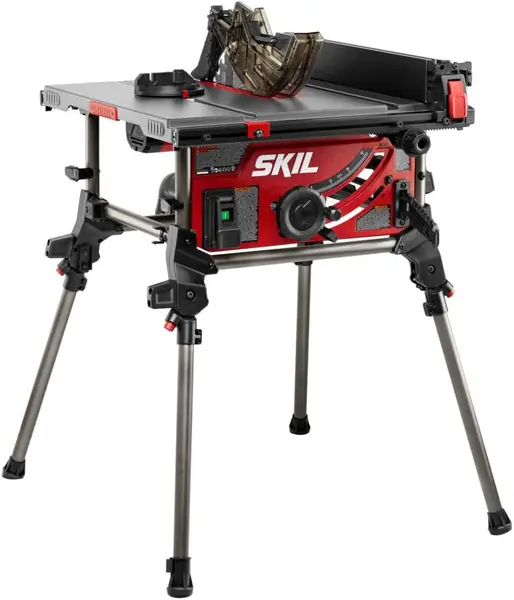
SKIL TS6307-00 10-inch table saw with integrated folding legs

First table saw

Shop Score 91/100
Blade Size
10 inches
Saw Weight
51.2 lb
Rip Capacity
25-1/2 inches
Stand Type
Integrated folding legs
View on Amazon

The integrated folding legs are the first thing we notice on the SKIL TS6307-00: they let the saw collapse into a compact package without a separate stand to store. That convenience, plus a budget price tier, is why it earns a place for a first table saw or a garage shop that has to clear the floor at the end of the day. The 10-inch blade, 15-amp motor, and 25-1/2-inch rip capacity give it more capacity than the compact DEWALT.

We like the rack-and-pinion fence for the same reason we like it on the DEWALT: you can make a small adjustment without tapping the fence into place. The folding legs have an adjustable foot that helps on a sloped garage floor, and the saw is light enough to shift around a shop. The stand is not as rigid as a full rolling cart, so we take a minute to settle it on uneven concrete.

The dust port elbow is a useful detail because it directs debris toward a container instead of letting it spray off the back of the table. We also appreciate that the 4x4 cutting capacity at 90 degrees gives this saw a little more range than its footprint suggests. When the project ends and the car needs the garage back, the folded package is the part we value most.

Worth Noting

  • Loud motor needs hearing protection
Our Verdict

We see the SKIL TS6307-00 as the smart first table saw for a garage woodworker who wants 10-inch capacity and folding legs without a premium price tier.

Check Latest Price
4.

SKILSAW SPT99-11 Worm Drive Table Saw Best for Heavy-Duty Ripping

SKILSAW SPT99-11 worm drive table saw on large-wheel rolling stand

Heavy stock

Shop Score 90/100
Blade Size
10 inches
Saw Weight
94.3 lb
Rip Capacity
30-1/2 inches
Max Cut Depth
3-5/8 inches
View on Amazon

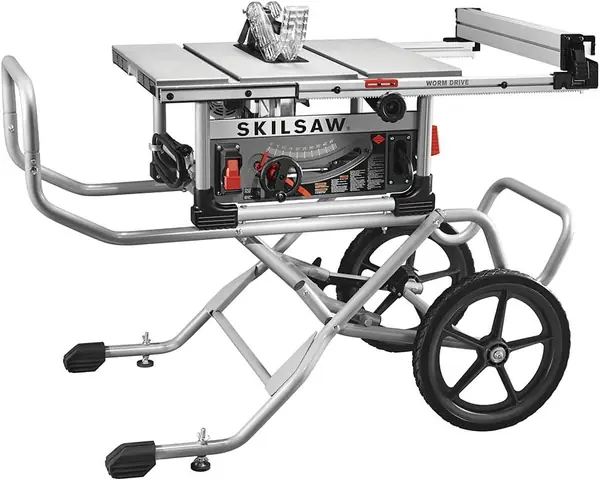
Worm drive gearing is the reason the SPT99-11 can take a 3-5/8-inch depth of cut and keep pulling through thick hardwood, treated lumber, and material that bogs a direct-drive saw. The 10-inch blade and 30-1/2-inch rip capacity give it the size for decking and timber work, and the 15-amp motor runs at 5,000 no-load rpm. This is the heavy-duty option in the group.

We choose it when the material is thick or wet and the saw has to roll across rough ground. The 16-inch wheels and easy-load handles make the rolling stand the part that earns its keep, and the outfeed and left-side support let one person manage longer boards. We appreciate that because wrestling a long 2x10 alone is where a portable saw usually feels too small.

The rack-and-pinion fence moves smoothly and holds its setting, which is the detail that makes repeated rips in hard stock less of a fight. The dust port elbow contains debris in one area, and the metal construction is meant for jobsite abuse rather than a clean basement shop. For deck framing, thick hardwood, and material that has already fought back, this is the saw we want on the cart.

Worth Noting

  • Weighs 94.3 pounds for a two-person lift
  • Assembly is more involved than the others
Our Verdict

The SKILSAW SPT99-11 is the saw we choose when the material is thick, wet, or stubborn and the saw has to roll across rough ground.

Check Latest Price
5.

Bosch GTS15-10 10-Inch Table Saw Best for One-Person Setup

Bosch GTS15-10 blue 10-inch table saw on gravity-rise wheeled stand

One-person setup

Shop Score 89/100
Blade Size
10 inches
Saw Weight
103 lb
Rip Capacity
32-1/8 inches
Stand Type
Gravity-Rise wheeled stand
View on Amazon

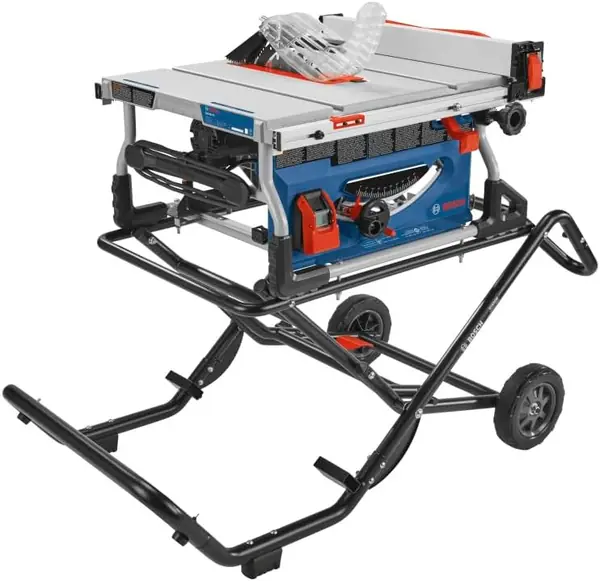
The Gravity-Rise wheeled stand is the reason to look at the Bosch GTS15-10. A foot pedal releases the stand so the saw rises into position, and the 8-inch treaded rubber-composite tires roll over a garage floor or a gravel path. The 10-inch blade and 32-1/8-inch rip capacity put it in the same size class as the DEWALT, while soft-start circuitry and a brake that stops the blade in about three seconds add control.

We like the color-coded index pins on the rack-and-pinion fence because they make a fence change easier to repeat without hunting for the scale. The Gravity-Rise frame is doing real work here, and that is why the foot pedal matters: it lets one person raise the saw without lifting it onto a separate cart. The stand folds for storage, but it is a larger package than a pair of folding legs.

The DEWALT remains our default because its 32-1/2-inch rip capacity is a touch wider and we prefer its fence adjustment, but the Bosch's gravity-rise stand is the easier one to live with in a tight shop. For a one-person shop where the saw comes out and goes away every session, that stand is the feature that earns its floor space.

Worth Noting

  • 103-pound saw is not a bench-top carry
Our Verdict

We like the Bosch GTS15-10 for a one-person shop where the Gravity-Rise stand and 32-1/8-inch rip capacity make setup easier.

Check Latest Price

How We Tested Portable Table Saws

We started with research, reading specs and owner reviews for more than two dozen saws and narrowing to eight that cover what people actually buy: compact 8-1/4-inch models for tight shops, 10-inch saws on folding or gravity-rise stands, and heavier saws meant for thick stock. Rip capacity, fence design, and whether one person could set the saw up alone mattered as much as price.

Those eight saws lived in a garage shop and rolled out to the driveway whenever a full sheet had to come down. We timed one-person setup from truck bed to first cut, folding and unfolding each stand and noting where a leg needed a second pair of hands, where a wheel caught on a threshold, and how much lifting the job really took. Before cutting anything, we checked each table with a straightedge and ran the blade through its full height and bevel range to see whether the mechanism bound or wandered.

Every through cut was made on a level surface with the stand or legs locked, the blade guard, riving knife, and anti-kickback pawls in place, and a push stick for narrow rips. We ripped hard maple and oak to see which motors bogged and which stands shook, then measured front-to-back fence distance at the blade before and after locking to catch a fence that crept. We also noted how much dust landed on the floor versus in the port, and how many trips it took to gather the push stick, wrenches, and guard at the end of a day.

At the end we weighed cost against capability, and we kept every saw around for follow-up cuts weeks later to see what rattled loose.

How to Choose a Portable Table Saw

Start With the Stand and the Carry

Portability is a system, not a number on a scale. Integrated folding legs are the simplest option and store in the saw's own footprint; a rolling stand adds bulk and expense but lets a heavier saw move like a cart. The 8-1/4-inch DEWALT is 54 pounds, while the 10-inch saws here range from about 51 to 110 pounds, so wheels matter most at the heavy end. Check the folded footprint against your vehicle and the path to your work area before you choose.

Blade Size Sets the Real Capacity

An 8-1/4-inch blade is the compact compromise: it keeps the saw light and is fine for trim, cabinet parts, and repeated rips in 3/4-inch stock. A 10-inch saw gives you more depth of cut and usually more rip capacity, which is what you want for plywood, wide shelving, and thick hardwood. Rip capacity matters as much as blade size: 24.5 inches covers most cabinet and shelf work, while 30 inches or more lets you rip wider sheet goods with less repositioning. The top pick's 32-1/2 inches is the widest here; the compact DEWALT stops at 24.5. Measure the widest rip you make, then add a few inches of margin.

The Fence Is the Accuracy Tool

A table saw's fence is the part you use on every rip, so its adjustment matters more than a few extra amps. Rack-and-pinion fences move smoothly and hold a setting; a fence that toes in or out will bind the blade or leave a tapered cut no matter how powerful the motor is. On a new saw, check the fence against the miter slot and make a test rip before you trust the scale. We prefer a rack-and-pinion design for repeat work, and we accept a basic miter gauge as a starting point rather than a precision crosscut tool.

Power, Dust, and Storage

Most portable saws use a 15-amp motor, so the practical difference is torque under load, not the amp number alone. Worm drive gearing, as on the SKILSAW SPT99-11, is worth the extra weight when you cut thick or wet stock; a standard direct-drive saw is fine for plywood and trim. Dust collection on a jobsite saw is basic: use the port elbow and a shop vac if you can, and wear hearing protection because these saws are loud. Keep the guard, riving knife, push stick, and wrenches stored on the saw so they travel with it.

Frequently Asked Questions

Final Verdict

For most woodworkers, the DEWALT DWE7491RS is the portable table saw we recommend. Its 10-inch blade and 32-1/2-inch rip capacity handle sheet goods and wide trim, and the rolling stand makes a full-size saw practical to move and set up. It is the widest-capacity saw here that still packs onto a rolling stand.

If you need to carry the saw to a bench, the DEWALT DWE7485 is the compact alternative; if your work is thick stock and rough ground, the SKILSAW SPT99-11 is the step up.