↑↓ navigate ↵ open Esc close All results →

Best Thin Rip Jigs for Table Saws of 2026

Thin ripping is the cut that makes even old hands slow down. A quarter-inch strip has nowhere to go once it's pinched between the blade and the rip fence, and most of us have heard one leave the saw at speed. A thin rip jig puts the reference in the miter slot, so the strip falls away free and repeats at the same width all afternoon.

The catch is fit. Bars come in a few slot profiles, and one that rocks by a few thousandths will cut a tapered strip from the first foot to the last. Feed control matters just as much — one-way rollers are what keep the stock from being snatched back — and so does reach when the miter slot is short. We tested 12 jigs over nine months, on three saws.

Measure your slot before you order, and skip any jig that only fits with the blade guard or riving knife removed; we ruled those out. What's left covers the common slots and strips down to a thirty-second of an inch.

Our Top Picks

The Best Thin Rip Jigs for Table Saws

1.

GOINGMAKE GM8 Thin Rip Jig Best Overall
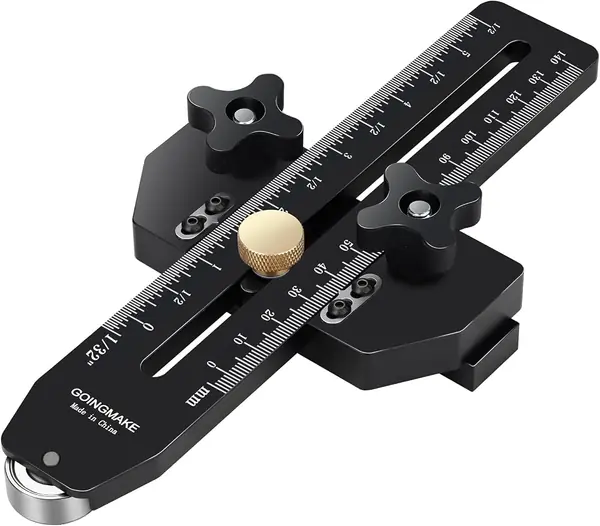
GOINGMAKE GM8 black aluminum thin rip jig with roller bearing and engraved scales

Most table saws

Shop Score 91/100
Feed Control
One-way roller bearing
Miter Slot Fit
3/8" x 3/4" T slot and U slot and 1/4" x 3/4" T slot
Extension Range
2-5/8 to 8 inches
Minimum Strip Width
1/32 inch
View on Amazon

The one-way roller bearing is the first thing we look for on a thin rip jig, and the GOINGMAKE GM8 pairs it with an 8-inch reach without charging premium money. In our test cuts we liked how the bearing let stock travel forward while resisting the backward pull that can turn a narrow offcut into a missile. The zero-adjustment design made it quick to bring the roller close to the blade, and the dual inch and metric scales are easy to read without squinting. The listed minimum strip width is 1/32 inch, which covers everything from edge banding to thin splines.

What earns it our top pick is the combination of broad slot coverage and a stable aluminum body. The listing covers 3/8" x 3/4" T slot and U slot and 1/4" x 3/4" T slot, so it has a better chance than most here of fitting a contractor saw or a cabinet saw without adapters. At 1.08 pounds it feels solid in the slot, and the lock is easy to reach. The laser-engraved scales are the detail that keeps it pleasant to use: you can reset a width without deciphering a painted mark.

Worth Noting

  • Tight in some 3/4-inch miter slots
Our Verdict

The GOINGMAKE GM8 is our default thin rip jig for most table saws, thanks to its one-way roller and broad stated slot coverage.

Check Latest Price
2.

Gohelper Thin Rip Jig Best for Long Reach

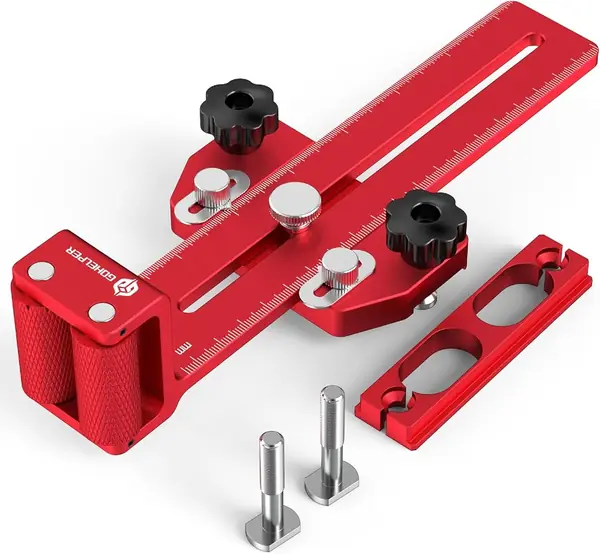
Gohelper red aluminum thin rip jig with long telescopic arm and two roller bearings

Deep miter slots

Shop Score 89/100
Feed Control
Two one-way roller bearings
Miter Slot Fit
3/8" x 3/4" T slot and U slot; 1/4" x 3/8" T slot
Weight
1.23 lb
Extension Range
2.5 to 9.4 inches
View on Amazon

Reach is the reason to look at the Gohelper LLT1043US. Its arm extends from 2.5 to 9.4 inches, and that extra length matters when the miter slot sits far from the blade or when you want to keep your hands farther back from the cut. The dual one-way roller bearings spread contact across the stock, and the tool-free scale indicator lets you set width without hunting for an Allen key. We also like the reversible miter clamp, which is designed to fit both 3/8" x 3/4" T-slots and U-slots, with two extra T-bolts for 1/4" x 3/8" tracks.

The long arm is what makes this our runner-up for deep or wide setups. On a saw where a compact jig barely reaches the blade, the Gohelper gives you room to position the rollers and still read the scale. We were pleasantly surprised by how solid the anodized aluminum body feels for its 1.23 pounds, though the longer arm puts more leverage on the slot. Stability is the trade-off to watch: the jig can feel less planted on a saw with a sloppy miter slot, so check that the clamp pulls it down flat before you trust a batch of strips.

Worth Noting

  • Longer arm can feel less planted in a loose miter slot
Our Verdict

When a standard jig cannot reach the blade, we choose the Gohelper for its 9.4-inch arm and two-roller feed.

Check Latest Price
3.

TANYO Thin Rip Jig Best Budget

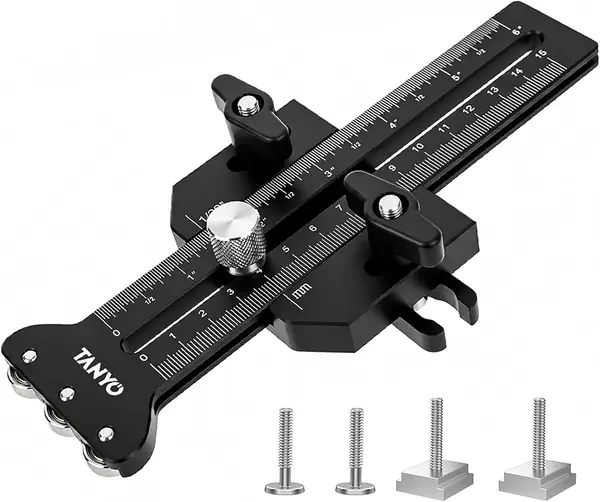
TANYO black aluminum thin rip jig with three pulleys and dual scales

Tight budgets

Shop Score 88/100
Feed Control
Three pulleys
Miter Slot Fit
3/8" x 3/4" U slot and 1/4" x 3/8" T slot
Weight
12.3 oz
Accuracy
1/32 inch
View on Amazon

The TANYO FG13S is the least expensive way into a three-pulley jig in this group, and it does not feel like a stripped-down tool. Three pulleys give the stock a wider contact patch than a single roller, which helps keep a narrow strip moving straight as you push it past the blade. The dual imperial and metric scales are laser engraved, and the stated accuracy is 1/32 inch. It is light at 12.3 ounces, and the interchangeable sliders cover 3/8" x 3/4" U-slot and 1/4" x 3/8" T-slot tracks.

We think the TANYO makes the most sense for a small shop or a first jig because it delivers repeatable three-pulley feed without a premium. The trade-off is a shorter track record than the top pick, so the simple design has to carry more of the case. Setup is straightforward, and the markings are easy to read at the saw. For trim, splines, and edge banding, it gives you the core job without extra fuss.

Worth Noting

  • Not for unusual miter-slot sizes
Our Verdict

We send budget-minded woodworkers to the TANYO for its three-pulley feed and clear dual scales.

Check Latest Price
4.

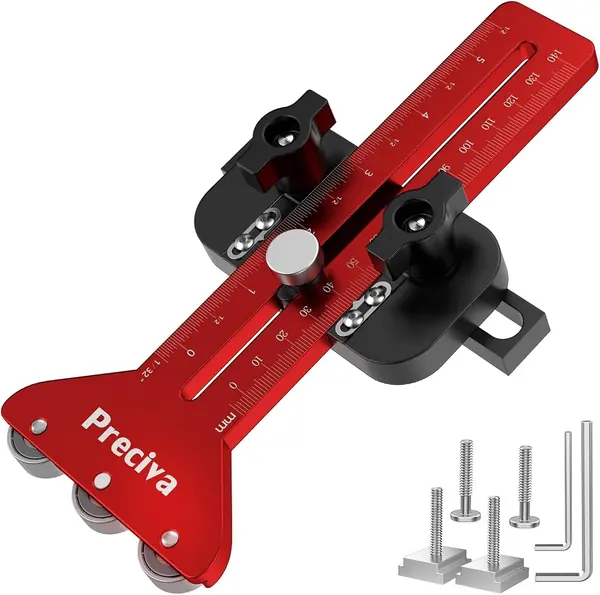
Preciva Thin Rip Jig Best Three-Pulley

Preciva red aluminum thin rip jig with three pulleys and T-slot sliders

Dedicated saws

Shop Score 87/100
Feed Control
Three pulleys
Miter Slot Fit
3/8" x 3/4" U slot and T slot and 1/4" x 3/8" T slot
Accuracy
1/32 inch
View on Amazon

Three pulleys are the Preciva's calling card. The wider contact patch is meant to keep the workpiece moving forward without letting it lift or chatter, and the anodized aluminum body has a rigid feel that suits repetitive strip cutting. The listing covers 3/8" x 3/4" U-slot and T-slot and 1/4" x 3/8" T-slot tracks, and the laser-engraved scales read in both inch and metric. The stated measurement accuracy is 1/32 inch.

Where it differs from the cheaper three-pulley TANYO is in the details. The Preciva feels like a jig you leave set up on a dedicated saw, with a compact body and a finish that shrugs off shop dust. We appreciated the simple adjustment: bring the pulleys close to the blade, lock the bar, and make your test cut. The red body is easy to spot in a crowded shop, and the compact size stores in a drawer.

We reach for the Preciva when the jig will live on one saw and the finish matters as much as the cut. The compact body is easy to leave in a drawer, and the three pulleys give a reassuringly wide contact patch on long strips. The adjustment is simple enough to set by eye and confirm with a test cut, and the scales stay visible in ordinary shop light. It is a satisfying step up for a shop that already knows it cuts thin stock often.

Worth Noting

  • Premium price buys finish not features
Our Verdict

For a dedicated saw, we pick the Preciva because its compact three-pulley body stays steady on long strip runs.

Check Latest Price
5.

DCT Thin Rip Jig Best for Dual-Purpose Use

DCT aluminum thin rip jig with dual-locking knob and ball-bearing roller

Dual-purpose shops

Shop Score 86/100
Feed Control
Ball-bearing roller
Locking
Dual-locking knob
Dimensions
8.6 x 5.1 x 2.75 inches
Body Weight
1.5 lb
View on Amazon

The DCT 1339 is the heaviest jig in this group at 1.5 pounds, and that mass is the first thing you notice when you set it in the miter slot. A heavier body can feel more settled, and the dual-locking knob is designed to pull the bar down firmly instead of letting it skate. We like that the same guide can work as a cutoff stop in the other miter slot, which makes it more useful in a small shop than a single-purpose jig. The ball-bearing roller keeps stock moving, and the measurement markings are easy to read.

The dual-purpose trick is what earns the DCT a place for a shop that cuts strips and repeated crosscuts. It is not as refined as the top pick: the fit and adjustability are more variable, so a saw with a worn or unusual miter slot can leave the bar feeling loose or hard to clamp. We paid close attention to the lock during setup because a jig that shifts between cuts is worse than no jig at all. Once it is seated, the weight and dual lock give it a planted feel that suits chair slats and cabinet parts.

Worth Noting

  • Fit and adjustability vary in worn or unusual miter slots
Our Verdict

The DCT is the one we choose when a shop wants a thin rip guide that also works as a cutoff stop.

Check Latest Price
6.

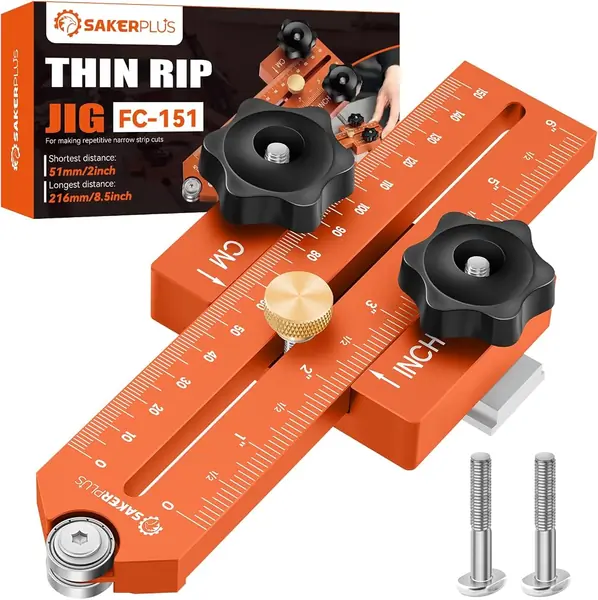
SakerPlus Thin Rip Jig Best for T-Track Saws

SakerPlus anodized aluminum thin rip jig with telescoping arm and T-track bolts

T-track saws

Shop Score 85/100
Miter Slot Fit
3/8" x 3/4" and 1/4" x 3/8" T-track (not U-slot)
Weight
15.8 oz
Extension Range
2 to 8-1/2 inches
Accuracy
1/32 inch
View on Amazon

The SakerPlus FC-151 is a T-track jig, not a universal one. It fits 3/8" x 3/4" and 1/4" x 3/8" T-track tables, and the listing says plainly that it does not fit U-slot. That is not a flaw if your saw has a T-shaped miter slot, but it is the first thing to check before you order. The CNC-machined anodized aluminum body has a rigid feel, and the telescoping arm runs from 2 to 8-1/2 inches with dual imperial and metric scales. Stated accuracy is 1/32 inch.

We like the tool-free adjustment. The intuitive mechanism lets you change cutting width without hunting for a wrench, and the reinforced T-bar is meant to lock the arm securely once you set it. The two different guide holddowns are a nice touch for matching different track profiles. For trim pieces and small repetitive strips, the SakerPlus has the reach and the scale readability to get you set up quickly.

Our verdict is conditional: this is a good jig for a T-track saw and the wrong one for a U-slot saw. The price is low for CNC aluminum, but the compatibility limit is real, and the slider may not seat in every saw that looks like a T-track. Measure the slot before buying. If your saw is T-track and you want a compact jig, it is a solid value; if your slot is U-shaped, choose one of the jigs that lists U-slot support.

Worth Noting

  • Does not fit U-shaped miter slots
  • Slider may not seat in every T-track-style table slot
Our Verdict

We rate the SakerPlus a solid T-track jig for compact saws, provided your miter slot matches its stated fit.

Check Latest Price
7.

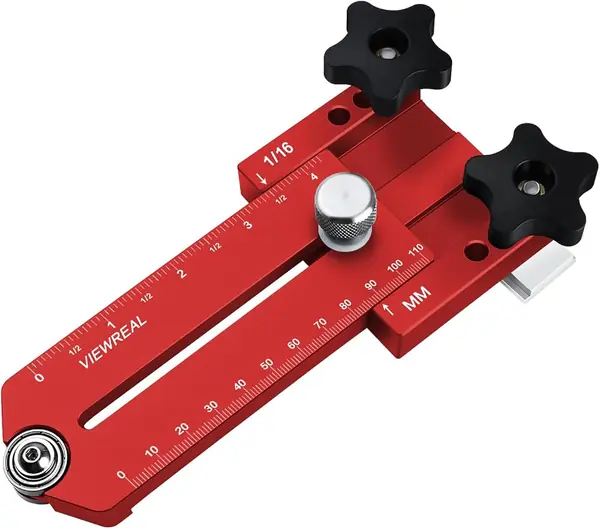
ViewReal Thin Rip Jig Best for Compact Saws

ViewReal red aluminum thin rip jig with two bearing noses and T-slot bolts

Compact saws

Shop Score 84/100
Feed Control
Two bearing noses
Miter Slot Fit
3/4" x 3/8" standard miter T-track
Weight
1 lb
Extension Range
6.89 inches/175 mm
View on Amazon

The ViewReal thin rip jig is the compact option here. Its telescopic arm reaches up to 6.89 inches, which is enough for many contractor saws and router tables but not for the deepest miter-slot layouts. Two bearing noses at the tip drive the stock forward, and the sliding mortise design is meant to keep the arm stable as you adjust it inside and outside. The body is aluminum alloy with an anodized finish, and the package includes two T-slot bolts and four screws.

That compact reach is not a drawback for every shop. On a saw where the slot is close to the blade, the shorter arm is easier to position and less likely to get in the way of a guard or a push stick. We found the scale readable and the adjustment simple, though the setup benefits from a test cut before you trust the width. The two bearing noses give the stock a steady push without the wider contact patch of a three-pulley jig.

The fit is the part to check. The listing says it works with 3/4" x 3/8" standard miter tracks and several T-track profiles, but some saws have slots that look standard and are not. The compact body is easy to position around a guard, and the two bearing noses keep a short strip moving once the bar is seated. The arm can also move slightly if the lock is not tight, so check that the bar sits flat and does not rock before you cut a batch. For a compact saw and occasional strips, those are manageable conditions.

Our judgment is that the ViewReal is a good low-cost jig for a small saw, not a universal replacement for a long-reach model. It suits trim, splines, and short batches where the blade is close to the slot. If you need to guide wide stock or reach past a guard, the longer Gohelper is the better fit. For a compact setup, the ViewReal earns its place on reach and simplicity.

Worth Noting

  • 6.89-inch reach misses deeper miter-slot saw layouts
  • Arm can shift slightly unless the lock is tightened firmly
Our Verdict

Our pick for a compact saw is the ViewReal, a low-cost jig with two bearing noses and a 6.89-inch reach.

Check Latest Price

How We Tested Thin Rip Jigs

We sorted every thin rip jig we could find by stated slot profile, reach, and feed hardware, then bought 12 of them — enough to cover both common bar sizes and every price point in the category. Testing ran for nine months in a garage shop on a contractor saw with a worn miter slot, a jobsite saw with a short one, and a cabinet saw. Each jig stayed mounted for a whole session of strip cutting, not one test cut.

The first step with any jig was calipers on the bar and a check against all three slots. We seated each one, locked it down, and pushed it sideways with the heel of a hand to see if it shifted. We also raised the blade to full height to confirm the body cleared the guard and riving knife; anything that only fit with either removed came off the list.

Then we cut, feeding with a push stick and keeping hands behind the jig: 1/32-inch, 1/8-inch, and 1/4-inch strips in poplar and white oak, ten strips per setting. We measured every strip at both ends to catch taper and noted which jigs crept out of adjustment after a handful of passes. On each pass we watched the rollers — whether they grabbed the stock in one direction, let it slide back, or let the strip lift off the table.

Setup was timed from pulling the jig out of the box to the first cut, and we read each scale from a standing position under shop light to see whether the marks were legible without crouching. Finally we flexed the arm and fence by hand to feel how much the body gave, and weighed what each jig cost against how well it held a setting.

How to Choose a Thin Rip Jig for Your Table Saw

Start With the Miter Slot

The most common buying mistake is assuming every table saw has the same miter slot. Many cabinet and contractor saws use a 3/4-inch slot with a wider bottom, while some jobsite saws and router tables use a T-track or a U-shaped channel. A jig that lists only a T-slot may not seat in a U-slot, and a bar that is slightly too wide will not clamp at all. Measure the slot's top width, bottom width, and depth, then compare those numbers with the jig's stated fit. If the listing is vague, ask the seller before ordering.

Match Reach to the Cut

Reach decides how close the guide can sit to the blade and how far it can extend past the slot. For very thin strips, the jig must bring its roller or pulleys close without touching the blade; for wide stock, a longer arm keeps the guide clear of the guard and gives your push stick room. The Gohelper's 9.4-inch reach is the longest here, while the ViewReal stops at 6.89 inches. Check the distance from your miter slot to the blade and compare it with the jig's minimum and maximum extension. A long arm that flexes is worse than a short one that locks.

Look at the Feed

Thin strips are unstable because there is little material for the blade to push against. A one-way roller bearing lets the stock move forward but resists backward motion, which helps control kickback. Three-pulley jigs spread contact over a wider area, which can steady a long strip, though the extra wheels give sawdust more places to collect. We prefer a one-way bearing for safety and a three-pulley design for long production runs. Whichever you choose, check that the wheels turn freely and clear the blade path.

Repeatability Is the Lock and Scale

A thin rip jig is only as good as its lock. The bar must pull down flat in the slot and stay there while you feed stock, or the width changes between cuts. Look for a locking knob you can reach without moving the fence and a scale that stays legible under sawdust. Zero-adjustment designs are quicker to set because you can bring the roller to the blade and read the width directly. The DCT uses a dual-locking knob for this reason. After setup, make one test cut and measure both ends of the strip before you cut a batch.

Build and Weight: What the Body Buys

Aluminum bodies in this group run from about 1 pound to 1.5 pounds. A heavier jig can feel more planted in the slot, but the lock matters more than the scale weight: a light jig that clamps flat is safer than a heavy one that rocks. Weight also affects how often you leave the jig installed. If you move it between saws, a compact body is easier to handle; if it lives on one saw, the extra mass of the DCT is reassuring. Check that the underside is smooth and the lock pulls the bar flat.

Frequently Asked Questions

Final Verdict

Most table saws are best served by the GOINGMAKE GM8. It combines a one-way roller, an 8-inch reach, and stated slot coverage for common T-slots and U-slots at a midrange price, and it has the strongest record in this group. Measure your miter slot first, because fit is the one thing that can spoil the purchase.

If you need more reach, choose the Gohelper; if you want three-pulley feed on a tight budget, choose the TANYO.