↑↓ navigate ↵ open Esc close All results →

Best Miter Gauges for Table Saws of 2026

Relying on the stamped miter gauge included with most table saws—or ordering an upgrade without measuring the table's miter slot first—sets up crooked crosscuts and fitment headaches. Stock gauges typically rock a degree or two in the slot, whereas an accurate aftermarket gauge eliminates bar slop and holds repeatable angles cut after cut; just remember that while 3/4 by 3/8 inch is common, T-slots and plain slots require matching bars.

Testing nine miter gauges over eight months on 2x4s, picture-frame miters, and plywood shelves across both a garage cabinet saw and a jobsite saw showed that sheer angle-stop count matters far less than bar adjustability. Dialing out side play and clamping a stop block against a rigid fence made the real difference in repeatable length and squareness.

Once dialed in, each of the six gauges below cuts dead square, trading setup time, fence length, and price depending on whether the tool stays on one saw or travels between jobs.

Our Top Picks

The Best Miter Gauges for Table Saws

1.

VEVOR Precision Miter Gauge with 18-Inch Fence Best Overall
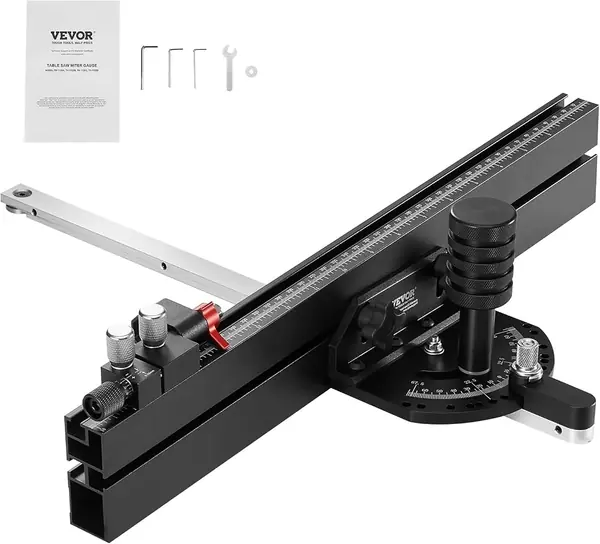
VEVOR precision miter gauge with black aluminum head, steel bar, and 18-inch fence

Stock gauge replacement

Shop Score 93/100
Angle Stops
15
Weight
3.54 lb
Fence Length
18 inches
Miter Slot Fit
3/4 x 3/8 in, T-slot and U-slot
View on Amazon

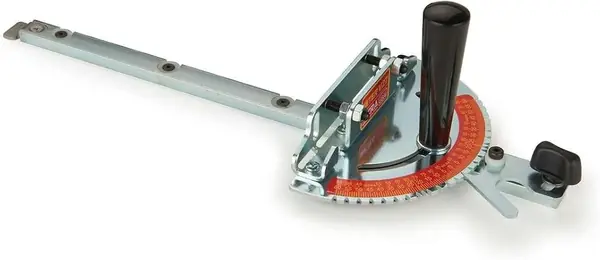
The lowest price in this group buys the most complete package. An 18-inch aluminum fence rides along with the gauge, and that fence is what turns an angle-setting accessory into a real crosscutting tool, because it gives the workpiece a straight edge to register against instead of letting it pivot on a small head. That combination is why we send most shoppers here first: the improvement over a stock gauge is immediate, and nothing about it asks you to spend like a professional shop.

Fitting it is straightforward. The bar is sized for the standard 3/4 by 3/8 inch slot, a spring-loaded plunger on the steel bar takes up side play, and a removable disc lets the same gauge sit in either a T-slot or a plain U-slot track. Fifteen positive stops index the head at 90 degrees and at 15, 22.5, 30, 35, 45, 60, and 67.5 on both sides of it, which covers everything from picture frames to chamfers. At 3.54 pounds it is not a burden to lift off the saw, and it arrives partly assembled, so setup is mostly a matter of dialing in fit.

Two things to do before your first cut. Seat the bar, lock the head at 90 degrees, and check it against a machinist's square, because the detents can feel stiff and the stops on some examples do not click in as crisply as an Incra's — verify rather than assume. Then snug the plunger until the bar glides with no side rock. Do that and the gauge repeats; skip it and you will chase ragged cut edges for an afternoon. If you cut a lot of unusual angles, the finer indexing of the Incra gauges is the better spend.

Worth Noting

  • 18-inch fence is short for wide panels
Our Verdict

We recommend it as the default buy: the lowest price in this group, and the only one that pairs it with a fence long enough for everyday crosscuts.

Check Latest Price
2.

Incra Miter V27 Miter Gauge Best Compact Precision

Incra Miter V27 miter gauge with silver metal head and compact protractor

Compact saws

Shop Score 92/100
Angle Stops
27
Weight
2.87 lb
Miter Bar
GlideLOCK with 4 expansion points
Fence Mount
Universal bracket for shop-made fence
View on Amazon

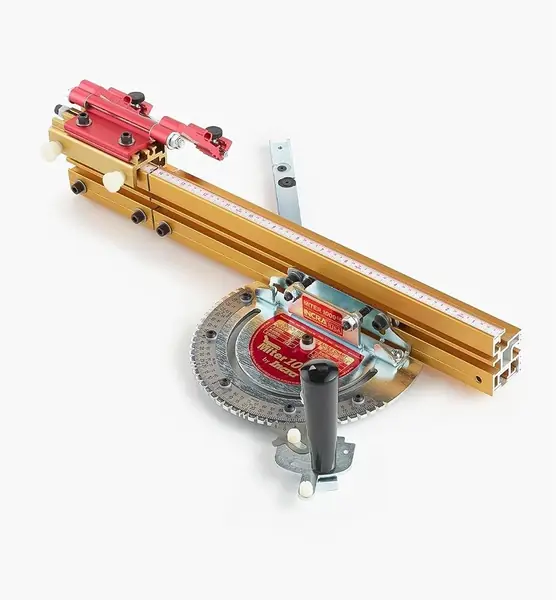
Twenty-seven angle stops, an indexing lock, and a bar that spreads to fit the slot: the V27 is the no-nonsense end of the Incra line, and it is the one we reach for on a saw with a short table. The head runs 17 inches long and weighs 2.87 pounds, compact enough to leave working room beside the blade, and a universal bracket on the back takes a fence you cut yourself.

What sold us is the indexing. Release the lock, swing the head to a stop, and it lands there; 90 degrees checked square against a machinist's square, and the 45 stop cut a miter that closed. The GlideLOCK bar's four expansion points are the other half of that, because spreading them until the bar glides with no side rock keeps the head from hunting in the slot. We also appreciate that the bracket takes any shop-made fence, since a straight edge you sized for your own work often beats a bundled one.

One maintenance note: keep the expansion points snug. Left loose, the head can lift slightly in the slot, and the symptom is not an obviously wrong angle but a ragged cut edge you end up blaming on the blade. A few minutes with an Allen key after you mount it, and again after the gauge has been in service a while, prevents that entirely. Past that, this is a gauge that asks nothing of you — no fussing, no calibration rituals.

Worth Noting

  • No fence or flip stop in the box
Our Verdict

We pick it when a big fence is in the way: compact, finely indexed, and light enough to lift out of the slot with two fingers.

Check Latest Price
3.

Incra Miter1000SE Miter Gauge Best for Wide Stock

Incra Miter1000SE miter gauge with engraved stainless scale and telescoping aluminum fence

Wide panels, repeats

Shop Score 91/100
Angle Stops
41
Weight
8.3 lb
Fence
18 to 31 inches, telescoping
Expansion Points
6
View on Amazon

Eighteen inches of fence, extending to 31 — that span is the argument for this gauge. Slide it out and the fence reaches past the widest board most of us crosscut on a table saw, and two flip shop stops ride the extrusion so you can set a cut length once and repeat it without measuring again. That is the upgrade worth paying for over a bare head, and it is why we rate this the pick for long runs of identical parts.

The rest of the tool is built to match. Forty-one laser-cut V-stops index the head, the primary scale is engraved stainless steel rather than printed, and the GlideLOCK bar carries six expansion points — the most of any gauge here — so you dial out side play in the slot instead of shimming it. A heavy head on a locked bar is what keeps a wide panel from chattering as it crosses the blade, and this one feels planted from the first cut.

The 8.3 pounds is the trade for that rigidity. This is a gauge that lives on one saw rather than riding in a toolbox, and moving it from the left slot to the right means unbolting and re-squaring, which is a job you do on a Saturday morning, not between cuts. If your work happens on one machine in one spot, neither costs you anything. If you share a shop or shuttle between a saw and a router table, the V27's lighter head is the smarter buy.

Worth Noting

  • Micro-adjustment takes patience to learn
Our Verdict

We recommend it for wide, repeated crosscuts, where the telescoping fence and twin flip stops justify the highest price in this group.

Check Latest Price
4.

WEN WA1401 Steel and Brass Miter Gauge Best All-Metal Build

WEN WA1401 miter gauge with steel plate, brass lock knobs, and laser-etched scale

All-metal budget upgrade

Shop Score 88/100
Angle Stops
27
Material
Steel and brass
Warranty
2 years
Miter Slot
3/4 x 3/8 in
View on Amazon

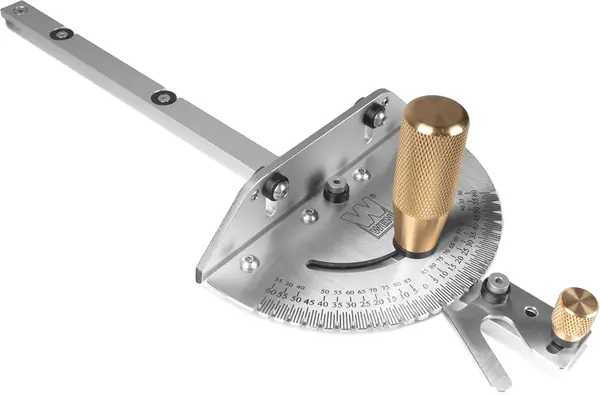
A machined steel plate, knurled brass lock knobs, a scale laser-etched into the metal: the WA1401 is the only gauge here built this way, and the difference shows the moment you lift it out of the box. Nothing on it flexes. The knobs turn with a solid mechanical feel instead of the plastic click of a stock gauge, and the oversized brass handle fills a hand nicely.

Twenty-seven positive stops are cut into the plate, including the 22.5 and 30 degree settings that picture frames and segmented turnings need, and the scale runs all the way to the edge of the plate so an angle between stops is set against a real line instead of a decal. Expansion discs take up side play in a standard 3/4 by 3/8 inch slot, and WEN backs the whole thing with a two-year warranty — the longest coverage anyone states on a gauge here.

What we like most is that nothing about it feels like a compromise: the plate is thick, the markings are optical-clean, and the locking action is firm enough that the head does not creep mid-cut. The exception is the lock handle, which threads onto a stud rather than snapping over with a cam, and that is slower when you are changing angles all afternoon. It is the one place we noticed where the money went instead into the metal.

Worth Noting

  • No fence or flip stop included
Our Verdict

We think the steel-and-brass build makes it the most satisfying gauge here to handle, and it costs less than most of the others.

Check Latest Price
5.

GOINGMAKE Compact Table Saw Miter Gauge Best for Jobsite Saws

GOINGMAKE compact miter gauge with black aluminum fence and flip stop

Jobsite saws

Shop Score 85/100
Angle Stops
11
Weight
3.54 lb
Fence Length
14 inches (360mm)
Miter Slot Fit
3/4 x 3/8 in, T-slot and U-slot
View on Amazon

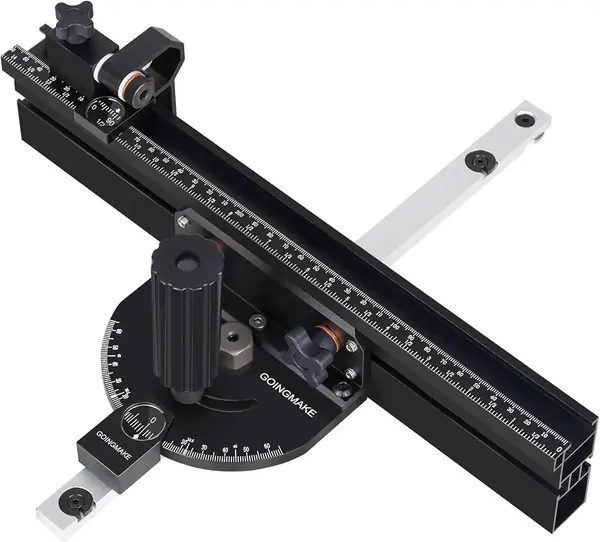
Benchtop and jobsite saws have short tables and short miter slots, and a full-size gauge with a long fence tends to hang off the edge. The GOINGMAKE is built for that saw: a 360mm bar, a 14-inch aluminum fence, 3.54 pounds, and a flip stop that slides in the fence track. It is the pick for anyone whose table saw folds up and gets wheeled into a corner at the end of the day, and it is sized so it does not fight the saw for space while you work.

Eleven positive stops will not cover every angle you will ever want, but the ones woodworkers actually use are all there, and the flip stop is the feature we kept reaching for, because it turns a one-off cut into six identical ones. The fence carries both millimeter and inch scales, which saves converting when you work from a metric plan, and the bar drops into 3/4 by 3/8 inch slots in both the T and U shapes. If your saw is older or an oddball, measure the slot before ordering.

Worth Noting

  • 14-inch fence limits long stock
Our Verdict

Our pick for a benchtop or jobsite saw: short bar, light body, and a flip stop that small saws usually go without.

Check Latest Price
6.

POWERTEC 71391 Miter Gauge System

POWERTEC 71391 miter gauge system with silver fence, engraved scale, and flip stop

Budget complete system

Shop Score 84/100
Angle Stops
27
Weight
5.8 lb
Fence
24 x 3 inches
Flip Stop
3-inch T-track
View on Amazon

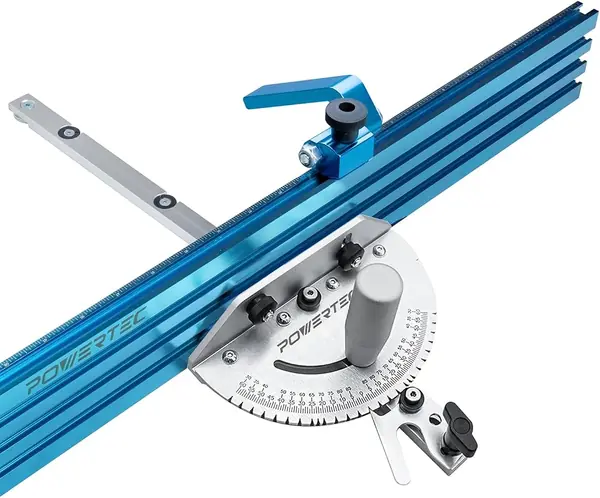
Three pieces arrive in the box: a gauge with 27 indexing stops, a 24-by-3-inch multi-track fence with a laser-engraved scale, and a 3-inch T-track flip stop that locks without a wrench. Assembled, it is a miter gauge system in the fullest sense — you get the fence and the length stop that the bare gauges here leave you to build or buy separately, and the fence accepts standard t-bolts and hex bolts for adding your own hold-downs and stops later.

The gauge uses four expansion discs to take up side play, and a removable plate lets it run in a T-slotted miter channel as well as a plain one. Expect to spend real time squaring it. The multi-track rail will flex if you crank the fence bolts down hard, so snug them and check the fence against the slot before you trust a cut; a light hand is the whole trick, and it is worth the ten minutes it takes to learn. The flip stop moves to either side of the blade, which we appreciated most on narrow stock.

Where it lands for us is a good first system with one honest compromise. The positive stops have play in them, so treat an indexed angle as a starting point and square the head on anything that has to close. Buy it because the fence and flip stop are the parts that make angled cuts repeatable, and because the assembly is an evening rather than a weekend. Buy something else if you want to set an angle and never think about it again.

Worth Noting

  • Index stops have noticeable play
Our Verdict

We like it as a first system: fence, flip stop, and 27 stops in one box, with the fiddling that implies.

Check Latest Price

How We Tested These Miter Gauges

We built the shortlist on specs before anything came out of a box: bar size and whether it was cut for a T-slot or a plain slot, the number and spacing of positive stops, fence length, and whether a flip stop came with it. We ordered nine gauges across the price range, from bare heads you bolt your own fence to, up to full fence-and-stop systems, and we bought every one at retail.

For eight months they lived in a two-car garage shop and on a jobsite saw that came out of the truck bed on deck-building weekends. Each bar went into the same 3/4-by-3/8 slot, where we snugged the expansion points until the head stopped rocking, then pushed and pulled the gauge the length of the slot to feel for slack. We noted which bars needed their removable T-slot plate off to sit in a plain slot, and which were still loose after full adjustment.

Angle stops got checked against a machined square and a digital angle finder at 90 and 45 degrees, then we cut 2x4s and frame stock and slid a feeler gauge into the gap. We set each stop, swung the head away, came back, and cut again to see whether it repeated. Setup was timed with a stopwatch — squaring the head to the bar, dialing out play, verifying the 90-degree stop — and only a couple came in under an hour.

Fence work meant crosscutting plywood shelves as wide as each fence allowed and clamping a stop block to the gauge fence for runs of identical parts, never to the rip fence. We weighed every gauge, noted which ones stayed mounted on the saw versus going back into a case, and compared what each one gave you at its price against the rest of the set.

How to Choose a Miter Gauge for a Table Saw

Start With the Slot, Not the Gauge

Almost every table saw sold in the United States uses a 3/4 by 3/8 inch miter slot, and almost every gauge here is built to that number. The differences that bite are in the details: a T-shaped channel with a lip under the surface needs a removable disc or retaining clip, while a plain U-channel does not, and a bar that sits proud of the table rocks the work no matter how many angle stops it has.

Measure the slot width and depth on your own saw before you order, and choose a gauge with expansion points or discs you can snug up to that measurement. A slightly loose bar is fixable; a bar that will not enter the slot is not.

How Many Angle Stops Do You Need?

The stops in this group run from 11 to 41. Most of the work a table saw miter gauge does happens at 90 degrees, 45, 30, and 22.5, and every gauge here covers those. The extra stops buy speed on segmented turnings, eight-sided frames, and repeated odd angles, where you would otherwise be setting the head against a scale and hoping.

We care more about whether the scale is readable and permanent than about the count. An engraved or etched scale that reaches the edge of the plate saves real time between stops; a printed sticker does not survive a shop for long. If you build frames, confirm there is a 22.5 stop before anything else.

The Fence and Flip Stop Earn Their Space

The head sets the angle, but the fence is what keeps a board from rotating as it crosses the blade, and a flip stop on that fence is what makes a cut length repeatable. Fences here run from 14 inches on the compact GOINGMAKE to a 24-inch rail on the POWERTEC, with the Incra 1000SE telescoping from 18 out to 31.

Match the fence to the widest stock you actually crosscut. A fence that runs out halfway across a wide panel gives you repeatability you cannot trust. If you prefer to cut your own fence to your own height and length, buy a bare gauge with a mounting bracket, like the Incra V27, and save the money.

Plan on an Hour of Setup

No gauge arrives ready to cut accurately. You have to seat the bar in the slot, snug the expansion points until the side play disappears, and then check the 90-degree stop against a machinist's square and a test cut. That last step is the one people skip, and it is the reason a good gauge gets blamed for a bad blade.

The heavier and more adjustable the gauge, the longer this takes. Budget the time once, write the settings down, and re-check after the first few projects; a bar that was tight in January can loosen by summer.

Weight and Where the Gauge Lives

The gauges here range from 2.87 to 8.3 pounds, and the weight tells you what the tool is for. A heavy head feels planted and stays in one slot on one saw; a light one lifts out with two fingers and moves between a table saw, band saw, and router table without complaint.

If your saw folds up and gets wheeled away, stay under four pounds and favor a short bar, because a long fence on a small table is in the way more than it helps. If the saw never moves, weight is free rigidity — take it.

Frequently Asked Questions

Final Verdict

Our answer is the VEVOR. It is the least expensive pick here, it arrives with an 18-inch fence, and its fifteen stops hit every angle most of us cut, which makes it the upgrade we recommend without hesitation to anyone who has only ever used the gauge that came with the saw.

Spend more when the work changes. The Incra 1000SE is the one for wide panels and long runs of identical parts, the V27 for a short table where the gauge comes off between jobs, and the WEN if you want steel and brass in your hand without paying premium money for it.