↑↓ navigate ↵ open Esc close All results →

Best Rubber Mallets of 2026

Driving a laminate plank home with a steel claw hammer teaches the value of a rubber mallet in one dent, yet the wrong mallet bounces off workpieces or streaks gray marks across painted trim. A well-balanced head delivers a broad, controlled blow that seats flooring, joinery, and tent stakes without bruising finished wood.

From 8-ounce craft sizes up to 2-pound paver heads, 16 rubber mallets went through four months of flooring installs, deck framing, camp stakes, and workbench joinery. What separated reliable mallets from throwaways was basic construction: heads that stayed tight after hundreds of strikes, faces soft enough to spare trim, and handles that damped sting over a full afternoon.

Head weight shapes every swing—8 ounces suits light assembly, 16 ounces handles most flooring and camp jobs, and 32 ounces drives pavers in fewer swings at the cost of extra wrist fatigue—with the eight models below covering that range.

Our Top Picks

The Best Rubber Mallets

1.

Edward Tools 16 oz Rubber Mallet Best Overall
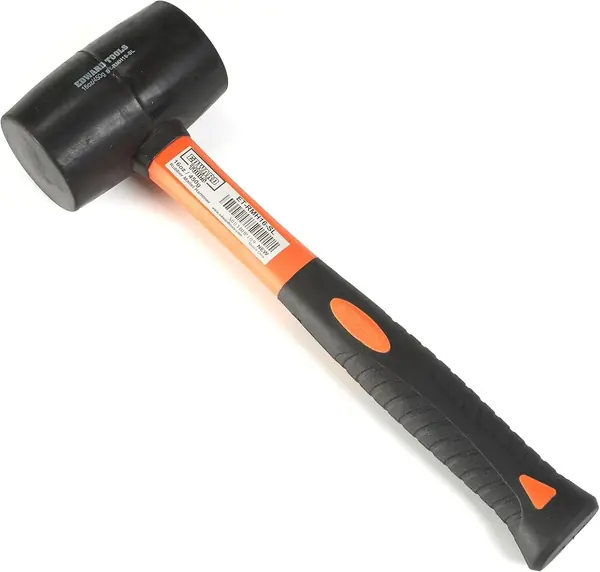
Edward Tools rubber mallet with orange rubber grip and black double-faced rubber head

All-purpose striking

Shop Score 97/100
Handle
Fiberglass with rubber grip
Head Weight
16 oz
Overall Length
13 in
Head
Double-faced rubber
View on Amazon

Sixteen ounces is the size most rubber mallet jobs are written around — laminate planks, tent stakes, fence boards, furniture knock-down — and this is the mallet we point people to when they want one tool and no debate. The head is double-faced rubber on a fiberglass shaft with an orange rubber grip, and at 13 inches overall it swings like a hammer rather than a sledge.

What made it our default is how little it asks of you. The fiberglass handle takes the sting out of a firm strike, the grip stays put in a sweaty hand, and the faces land flat enough to move a plank without skating off its edge. Tapping composite decking home, we never felt the head rebound into the next swing.

Weight distribution is the quieter advantage. With a 16-ounce head on a 13-inch handle, the balance sits forward where the work is, so a short controlled tap is easy to place and a full swing is there when a stake fights back.

Where it runs out is mass. Pavers, thick timber, and anything that needs real seating force want two pounds, and this is not that tool. For everything short of it, this is the mallet we hand over first, and the low price means a second, heavier one is not a budget decision.

Worth Noting

  • Handle runs shorter than most full-size mallets
Our Verdict

For one mallet that covers flooring, stakes, and furniture assembly, we recommend this one: 16 ounces, a shock-absorbing fiberglass handle, and a price that leaves room for a second tool.

Check Latest Price
2.

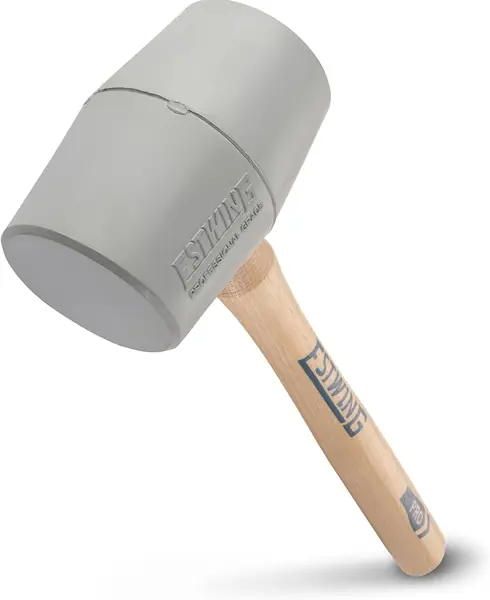
Estwing DH-18N Deadhead Mallet Best for Finish Work

Estwing DH-18N rubber mallet with gray deadhead head and hickory handle

Finish work

Shop Score 96/100
Handle
Hickory
Head Weight
18 oz
Head Length
4-1/2 in
Face Diameter
2.5 in
View on Amazon

A bouncy mallet makes you fight your own swing, and the DH-18N is the pick here if that bothers you as much as it bothers us. Estwing's deadhead rubber head is built to stop on contact instead of rebounding, and the effect on cabinet parts and finished trim is immediate: one tap, one movement, no second correction.

The numbers are modest — 18 ounces, a 2.5-inch face, 1.1 pounds overall — but the proportions are what make it useful. The face is small enough to place precisely on a stile or a dowel, the rubber is soft enough to leave a finish alone, and the hickory handle gives you a palm swell to push against on light taps.

Hickory is also the upkeep question. It is a wood handle on a tool that lives in a shop, and it will pick up dents and dirt the way wood does, where fiberglass shrugs both off. We think the feel is worth that, and the 18-ounce head is heavy enough to seat a joint yet light enough to choke up on for detail work. Against the DFH-24, the softer face is the whole difference; against the Edward Tools, it is the control.

Worth Noting

  • Premium price compared with the other picks
Our Verdict

We reach for the DH-18N when a strike has to land and stay put; the deadhead head and hickory handle justify the premium for finish and assembly work.

Check Latest Price
3.

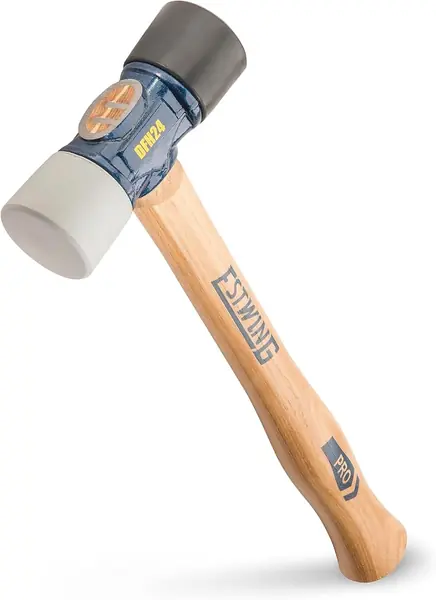
Estwing DFH-24 Double Face Mallet Best for Woodworking

Estwing DFH-24 double face mallet with red and yellow faces and hickory handle

Woodworking joinery

Shop Score 95/100
Handle
Hickory, triple wedge
Head Weight
24 oz
Overall Length
13.94 in
Faces
One soft, one hard
View on Amazon

Two faces of different hardness on one head sounds like a gimmick until you are setting a dowel and don't want to put one tool down and pick up another. The DFH-24 puts a softer face on one end and a firmer one on the other, so you can start gentle and finish with authority.

The build is the part woodworkers ask about. A 24-ounce head sits on a hickory handle with triple wedge construction locking it down, and 13.94 inches of length leaves room to choke up for control. In a shop it covers ground that otherwise takes both a rubber hammer and a soft-faced mallet.

We like it best for joinery and knock-down furniture, where a firm flat strike moves a part without bruising it. What it is not is a soft mallet: both faces are firm, and on pale trim or a finished cabinet side you want the softer rubber of the DH-18N or a scrap block between head and work. At 2.1 pounds it is also a two-handed tool for anything precise.

Worth Noting

  • Thick hickory handle may not suit small hands
Our Verdict

If your strikes involve dowels, joints, and furniture frames, this is the mallet we suggest: two firm faces, a locked-down head, and a handle that fills the hand.

Check Latest Price
4.

Goldblatt 16 oz Low Recoil Mallet Best for Flooring

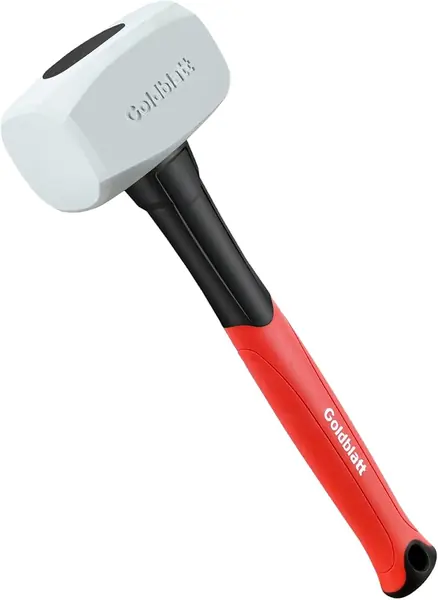
Goldblatt 16 oz rubber mallet with white double face and soft grip handle

Flooring installs

Shop Score 94/100
Head Weight
16 oz
Overall Length
13-3/8 in
Head Diameter
2-3/8 in
Rubber Hardness
HA60-75
View on Amazon

A flooring mallet has one job: move a plank into its joint without denting the edge you just paid for. Goldblatt's 16-ouncer goes at it with a 2-3/8-inch white face and low-recoil rubber that is meant to stop where it lands rather than kick back.

Face size matters more than weight here. A 2-3/8-inch diameter covers a wide band of a plank's edge, so the force spreads out and the tongue slides home instead of a corner digging in. The white rubber is the other half of the idea — it is the face you want on pale laminate and painted trim.

In the hand it is a 13-3/8-inch tool with a soft-grip handle and a stated rubber hardness of HA60-75, which puts it in the firm-but-giving range: enough bite to move a floor, not enough to mark one.

We keep this one for flooring and laminate specifically. It is not the mallet for tent stakes or fence posts, where a wide face and lighter head favor flat finished surfaces over brute force, and if you want a single tool for everything the Edward Tools covers more ground. On a flooring project, the non-marking face is worth the step up in price.

Worth Noting

  • Wide face and 16-ounce head lack brute force for driving stakes
Our Verdict

We choose this one for plank-by-plank flooring because the wide non-marking face keeps a laminate joint moving without a dent.

Check Latest Price
5.

LEGLO 32 oz Rubber Mallet Best Heavy-Duty

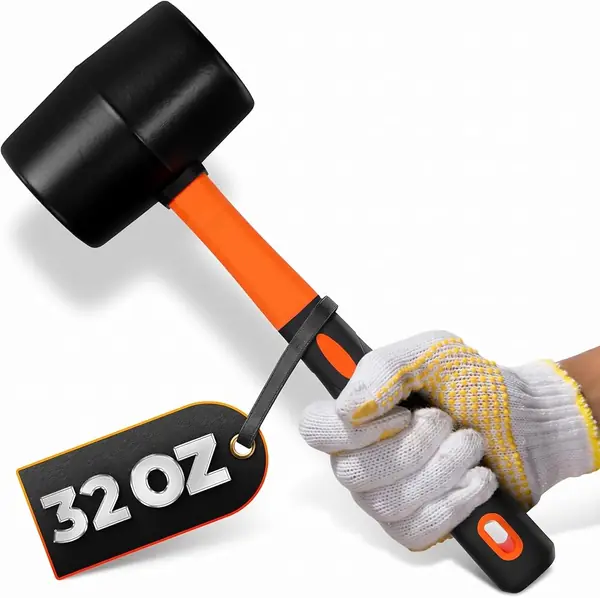
LEGLO heavy duty rubber mallet with black head and orange handle

Pavers and decking

Shop Score 93/100
Handle
Metal core, rubber grip
Head Weight
2 lb (32 oz)
Overall Length
13.8 in
Head Size
4.5 x 2.7 in
View on Amazon

Two pounds of head changes the arithmetic of a swing. Instead of three or four taps to seat a paver, you drop the mallet once and move to the next one, and the 4.5 x 2.7-inch head spreads that force across the block instead of concentrating it in a divot.

The handle is a metal core wrapped in a textured rubber grip, which keeps the shaft rigid when you lean into a strike and gives you something to hold when your hands are wet.

We reach for it on pavers, deck boards, and fence pickets, and we are glad of the mass every time. On trim and light assembly it is simply too much tool, and a 16-ounce mallet does that work better; the 13.8-inch length is what keeps the heavy head controllable for anyone used to a smaller mallet.

One limit applies to every mallet this size: soft blows only. It is not a sledge substitute for driving steel stakes or splitting anything, and prying with the head is how these tools get ruined.

Worth Noting

  • Head edges can crack under repeated hard blows
Our Verdict

When the work is stone, pavers, or thick fence boards, this two-pound mallet is the one we hand over; it seats material in fewer swings.

Check Latest Price
6.

WOTAHI 2-Piece Mallet Set Best Set

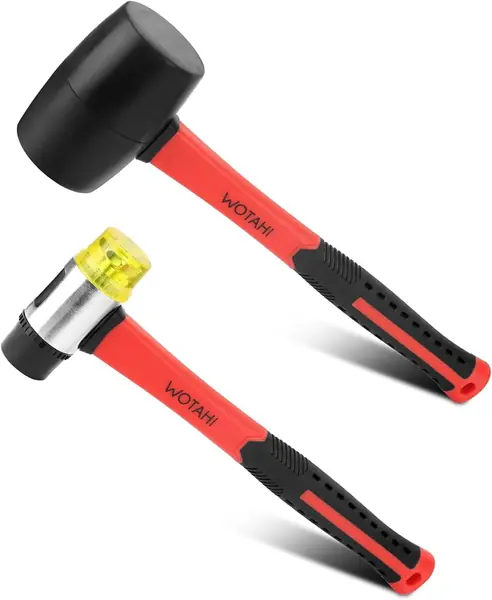
WOTAHI two-piece mallet set with red fiberglass handles and rubber heads

Two-size kit

Shop Score 92/100
Heads
Double-faced rubber
Handles
Fiberglass with rubber grip
Set Contents
16 oz mallet and 35 mm soft mallet
View on Amazon

Two mallets arrive in this box — a 16-ounce rubber mallet and a 35 mm double-faced soft mallet — and that pairing is what earned the set a place. We like not having to choose between a full-size tool for stakes and a small one for snaps, craft work, and jewelry taps.

Both have fiberglass handles with molded rubber grips, and the heads are set into the shafts with an embedding process the maker says keeps them from loosening. The red grips are easy to spot on a bench full of tools. The 16-ounce does the work of any standard mallet — stakes, flooring, furniture — while the small one earns its keep on detail.

The honest limitation is scale: 35 mm is a small head, and it is a detail tool rather than a second striking mallet for anything with weight behind it. That is the point of the pair, but it is worth knowing before you buy two tools expecting two of the same. If you need only one mallet, the Edward Tools is cheaper and covers the same ground.

Worth Noting

  • Small 35 mm detail head cannot handle heavy striking jobs
  • Costs more than buying a single general-purpose mallet
Our Verdict

We keep this set in mind for anyone who wants one mallet for stakes and another for delicate taps without buying twice.

Check Latest Price
7.

Coleman Rubber Mallet with Tent Peg Remover Best for Camping

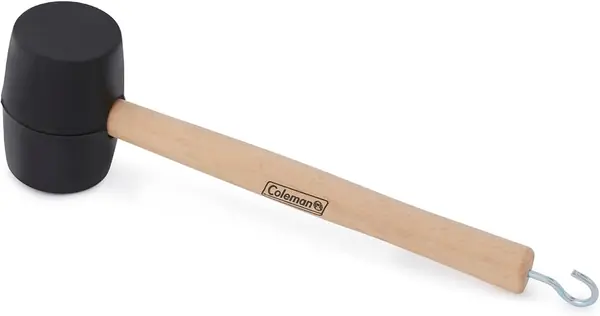
Coleman camping mallet with wooden handle rubber head and stake hook

Camping

Shop Score 91/100
Handle
Wood
Overall Length
14 in
Head
Double-sided high-impact rubber
Extras
Built-in tent peg hook
View on Amazon

Pulling a tent stake is worse than driving one, and the end hook on this Coleman mallet is why it made the list. You pound the peg with the double-sided rubber head, then hook the shaft and lever back — no kneeling in wet grass, no pry bar left behind in the car.

The rest is simple. It is a 14-inch tool with a wooden handle and high-impact rubber faces, sized to disappear into a camp bin, and the head is broad enough to cover a plastic peg without chewing it up. There is no cushioning in the handle and not much heft, which is fine for a few dozen stakes and less fine for a deck.

For occasional camping and tailgating we think it is the right call, because that hook does something none of the other mallets here can. Treat it as a camp tool rather than a jobsite one, though; it is not the mallet to hand a flooring crew.

Worth Noting

  • Head can work loose under repeated hard pounding
  • Stake hook is light-duty on stubborn pegs
Our Verdict

For camping and tailgating we like the stake-pulling hook that no other mallet here has, and the gentle rubber faces that suit plastic pegs.

Check Latest Price
8.

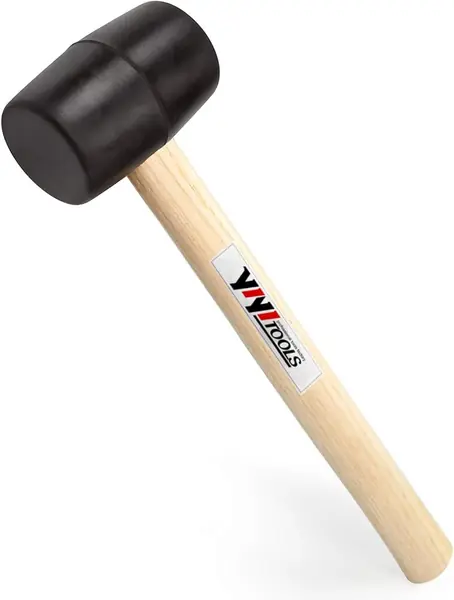
YIYITOOLS 8 oz Wood Handle Mallet Best for Light Craft Work

YIYITOOLS small rubber mallet with black rubber head and solid wood handle

Light craft work

Shop Score 90/100
Handle
Solid wood
Head Weight
8 oz
Overall Length
12.6 in
View on Amazon

At 12.6 inches with an 8-ounce head, this is a small mallet, and the honest way to describe it is as a light tapper rather than an all-purpose striker.

The parts are straightforward: a solid wood handle, a rubber head with some give to it, and a size that drops into a kitchen drawer or the tray of a toolbox. Seating a shelf pin, leveling a drawer front, or convincing a small part to sit down is easier with this than with a 16-ounce tool, particularly one-handed.

Where it stops is hard ground. An 8-ounce head will not drive a tent stake into anything but soft soil, and it has no business on laminate or pavers.

We keep ours for craft and household taps, and it is inexpensive enough that a second one for the kitchen drawer is not a decision. It is not the mallet to buy if you are only buying one — but as the small one in a pair, it earns its space.

Worth Noting

  • Wood handle can arrive rough and need sanding
Our Verdict

We like this one for light tapping, craft work, and small assembly, where an eight-ounce head is an advantage rather than a compromise.

Check Latest Price

How We Tested Rubber Mallets

Our shortlist started with research, not swings. We collected the rubber mallets shoppers actually compare, then filtered by head weight, face material, handle construction, and price so the group ran from 8-ounce craft sizes up to a 2-pound paver head instead of six versions of the same mid-weight tool. Sixteen of them arrived and went to work.

Testing ran four months and happened wherever the tool gets used: a hallway flooring install, a backyard deck and fence repair, a weekend of tent pitching, a workbench where we separated joints, and a kitchen table full of craft projects. We weighed each mallet on a kitchen scale to see how close the head came to its stated weight, then put several hundred swings through each one, into flooring planks, hardwood offcuts, paver blocks, and wooden stakes. Safety goggles went on before the first swing, and anyone standing nearby wore a pair too.

Along the way we noted what we saw: whether the rubber left a gray smudge when pressed against finished oak and white trim, how much the handle kicked back and whether we had to regrip between swings, and how the grip felt bare-handed and through work gloves. We marked the head-to-handle seam before the first blow and checked it after every session, retiring any mallet that developed a gap; the ones that lasted the full four months got a closer look at the joint, the seams, and the finish.

Mallets with a stake hook went on peg-pulling duty in ground that had been rained on. We also measured overall length and tried each tool in a standard toolbox and a camping bin, then weighed price against how each one performed to settle value.

How to Choose a Rubber Mallet

Match Head Weight to the Job

Eight ounces is a detail tool, 16 ounces is the general-purpose standard, and 24 to 32 ounces is for stone, pavers, and thick timber. Start from the heaviest blow your work needs and work back, because a mallet you can control beats one you have to muscle. Our top pick is a 16-ouncer for exactly that reason, and the LEGLO's two pounds only make sense once the material under the head is stone.

The trap is assuming heavier is better. A 2-pound head on cabinet trim and laminate is a dent waiting to happen, and the mallet you can place accurately will finish the job before the heavy one is up to speed.

Face Softness Is Not the Same as Rubber

Every mallet here has rubber faces, and they do not strike alike. The Goldblatt states a rubber hardness of HA60-75, the Estwing DFH-24 ships with one soft face and one firm one, and the Coleman uses high-impact rubber built for tent pegs. If a surface has to stay pristine, favor a soft, non-marking face and use it flat.

A rubber hammer can still bruise softwood or leave a gray scuff on pale stock, so test on an offcut and keep a scrap block between the head and anything you cannot refinish. The white face on a flooring mallet exists for that reason.

Handles, Shock, and the Joint That Fails

Fiberglass damps vibration and shrugs off weather; hickory gives a warmer feel and a palm swell at the cost of a little upkeep. We pick fiberglass for wet or rough work and wood for shop work where feel matters.

The joint deserves more attention than the handle. Look for a pinned or wedge-fastened head, and check it before each use. When a rubber mallet dies young it is usually the head working loose rather than the rubber wearing through, so don't pry with the head or strike off-angle.

Length, Grip, and Where It Lives

Most full-size mallets run 13 to 14 inches. That is the length for a tool that lives in a shop or a truck; a shorter handle is handier in a drawer, and the Coleman's hook is worth having if you pull as many stakes as you drive.

Grip material is a small thing that shows up over a long day: textured rubber when your hands are wet, plain wood if you prefer the feel. If the mallet rides in a backpack, check the length and the weight against your pack rather than trusting the word compact.

Frequently Asked Questions

Final Verdict

The Edward Tools 16-ounce mallet is the one we recommend to almost everyone: it covers flooring, stakes, and furniture assembly, its fiberglass handle softens the strike, and nothing about it feels like a compromise for the money. Move to the Estwing DH-18N when the work is finished trim and you want the head to stop dead instead of bouncing, and to the LEGLO when the material under the head is stone.