↑↓ navigate ↵ open Esc close All results →

Best Miter Box Saws of 2026

A miter box that shifts even a fraction of an inch mid-stroke turns a tight 45-degree baseboard corner into an open gap waiting for caulk. Because the box itself is simply a slotted guide, cut accuracy depends entirely on keeping the base anchored and pairing those slots with a blade that tracks dead straight.

Cutting pine and poplar trim, picture-frame stock, plastic, and soft aluminum across five months with 14 miter box saws showed how quickly blade tooth count and slot geometry catch first-time buyers off guard. A coarse blade splinters the back edge regardless of box rigidity, while boxes lacking opposing 45-degree slots cannot cut matched inside and outside corners cleanly.

Covering full-width casing jobs down to compact benchtop molding, the five sets ranked below span wide-capacity clamping boxes and small precision guides.

Our Top Picks

The Best Miter Box Saws

1.

Stanley 1-20-600 Saw Storage Miter Box Best Overall
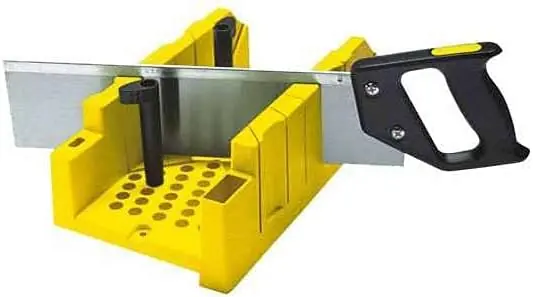
Stanley black saw storage miter box with backsaw and cam pins

Baseboard and trim

Shop Score 88/100
Miter Angles
90° and 45°
Face Angles
45° and 22.5°
Box Length
11.81 inches
Workholding
Twist-lock cam pins
View on Amazon

The first thing we check on a miter box is whether the work stays put while the saw starts. Stanley's twin cam pins twist into the honeycomb base and press the trim flat, which is the difference between a clean shoulder and a piece that creeps. The base also has an extended lip and two mounting holes, so you can steady it against the bench edge or screw it down for a longer run of molding.

What makes this our top pick is the combination of those clamps with a full set of slots: 90 degrees, 45 degrees, and a 22.5-degree face angle for octagonal shapes. We also appreciate the molded storage for the pins and pencil because small parts disappear fast in a shop. The 11.81-inch box is compact enough to keep on a shelf, yet it gives the saw a longer guide than the mini boxes here.

We noticed some flex in the housing when we leaned into a cut, which is why we keep this kit for trim and light stock rather than thick posts. The light weight is a fair trade: it is easy to carry to a room and set on a pair of sawhorses. For casing, baseboard, and picture-frame stock, the box has enough support to keep the saw tracking.

The backsaw has a reinforced spine that keeps it stiff, and that same spine sets the depth limit. You will not cut through a deep block with it. Used as intended, though, it is the one we reach for before dragging out a power miter saw for a short trim run.

Worth Noting

  • Backsaw spine limits depth on thick stock
Our Verdict

We recommend the Stanley for anyone cutting standard trim who wants a box that clamps the work and adds 22.5-degree slots without jumping to a power saw.

Check Latest Price
2.

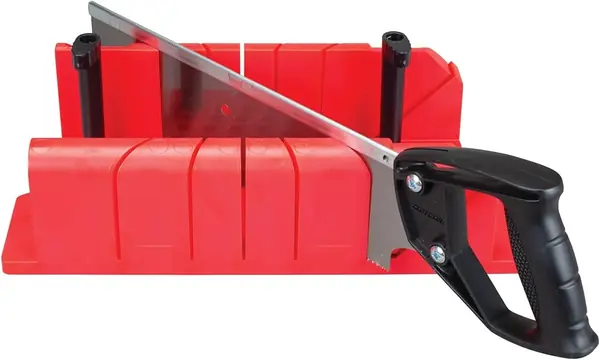
CRAFTSMAN 12-Inch Clamping Miter Box Best Budget

CRAFTSMAN red and black miter box with 12-inch saw and cam pins

Occasional DIY

Shop Score 87/100
Miter Angles
45° and 90°
Face Angles
45° and 22.5°
Blade Length
12 inches
Included
Miter box, saw, and two cam pins
View on Amazon

The CRAFTSMAN set earns its budget place by including the box, the 12-inch saw, and two cam pins in one purchase. That matters if you are cutting a few pieces of baseboard or casing and do not want to buy a power miter saw or hunt down a separate backsaw. The layout is familiar: cam pins twist into the base, and the slots cover 45- and 90-degree miters plus 45- and 22.5-degree face cuts.

We like the molded bins for the pins and pencil because they keep the small parts with the tool. The built-in saw stop also does its job, stopping the blade before it reaches the bottom of the box. For a one-room trim job, the setup is easy to understand and quick to move from the bench to the floor.

The included saw is best reserved for softwood trim. On harder stock it cuts slowly and leaves a rougher edge, so plan on replacing it if you care about finish cuts. That is the main reason we see this as a starter kit rather than a daily user. Keep the cuts light and the kit is a sensible value; it is the one we hand to someone trying a manual box for the first time.

Worth Noting

  • Plastic housing flexes under heavy pressure
Our Verdict

We keep this kit in the budget slot because it gives occasional DIYers the saw, box, and cam pins needed for 45- and 90-degree trim cuts.

Check Latest Price
3.

GARTOL 4-Piece Miter Box and Pull Saw Set Best Compact Kit

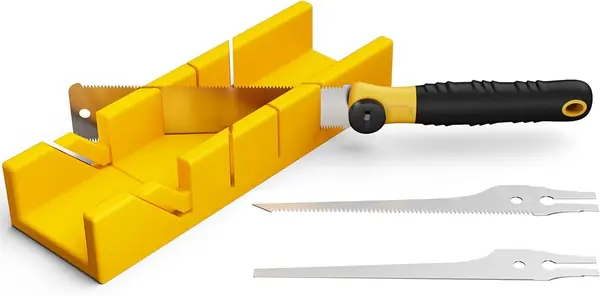
GARTOL yellow miter box with pull saw handle and three blades

Small-space projects

Shop Score 86/100
Miter Angles
45°, 90°, and 135°
Handle
Rubberized anti-slip grip
Blade Length
9.65 inches
Blade Changes
Tool-free
View on Amazon

The three-blade setup is what sets this GARTOL kit apart. One blade is for fine woodwork, one for flush cuts, and one for PVC, drywall, and soft metal; the handle swaps between them without a wrench. For a small shop or an apartment bench, that covers a lot of odd jobs without a drawer full of separate saws.

We were surprised by how complete the set feels for its size. The miter box has 45-, 90-, and 135-degree slots, the pull saw cuts on the pull stroke, and the rubberized grip is comfortable for longer sessions. The compact footprint is the other advantage: it stores in a toolbox and comes out for picture frames, narrow trim, and craft work. Replacement blades are available, so a dull edge does not retire the handle.

What we appreciate most is how quickly the kit changes roles. A fine wood blade handles a picture-frame miter, then a coarser blade takes on a PVC repair without a trip back to the toolbox. That flexibility is why it earns a place for small sections and mixed materials. It is the most versatile compact set here, and we keep it in a drawer for quick cuts.

Worth Noting

  • Compact box limits wide or tall trim
Our Verdict

We like this set for small shops and mixed-material jobs, where three quick-change blades and a compact box cover more than a single trim saw.

Check Latest Price
4.

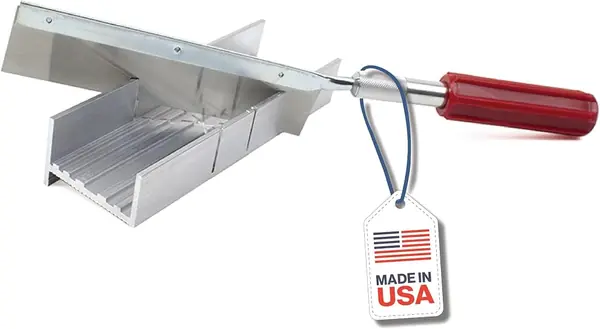
Excel Blades Mini Miter Box Kit Best for Miniatures

Excel Blades red mini miter box with K5 handle and razor saw

Miniatures and models

Shop Score 85/100
Miter Angles
45° and 90°
Saw
5-inch 46 TPI pull saw
Handle
K5 heavy-duty
Box Material
Aluminum
View on Amazon

The six-inch scale is the point of this Excel kit. The aluminum box has 45- and 90-degree slots, and the 5-inch pull saw cuts with 46 teeth per inch, so it leaves a clean edge on dollhouse trim, plastic model parts, and thin stripwood. We reach for it when a full-size miter box is more tool than the job needs.

The K5 handle is the pleasant part: it locks the blade securely and feels more substantial than the tiny saw suggests. The pull stroke gives us control on thin stock, and the aluminum box resists the flex we have felt in plastic mini boxes. The box is light enough to hold with one hand while you position a small piece with the other.

This is not the tool for room trim. The cutting capacity is miniature-scale, the blade is short, and a tall baseboard will not fit. We keep it for parts measured in inches and for detail cuts where a clean edge matters more than speed. If your work is small, the Excel's aluminum box and fine-tooth pull saw are a precise, tidy combination; if you need baseboard or casing, choose a full-size kit.

Worth Noting

  • Handle can loosen during use
Our Verdict

We reach for the Excel kit when the job is miniature work, because its small aluminum box and razor saw suit delicate parts.

Check Latest Price
5.

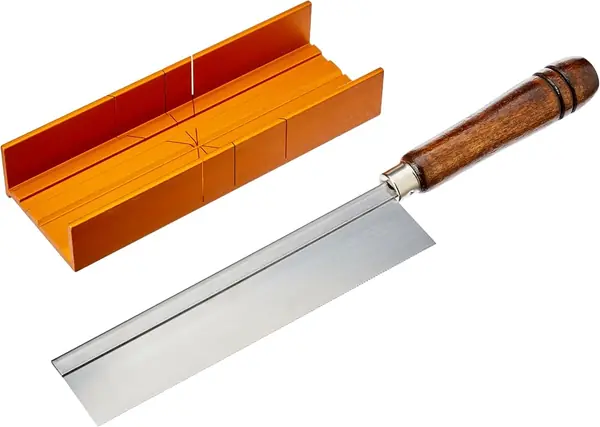
Zona 35-241 Fine Kerf Saw and Miter Box Best for Fine Detail Work

Zona gold aluminum miter box with fine kerf saw

Fine detail work

Shop Score 84/100
Miter Angles
45°, 60°, and 90°
Saw
42 TPI fine-kerf
Box Material
Aluminum
Cutting Depth
7/8 inch
View on Amazon

The narrow slot and the 42-TPI saw are what make this Zona set feel different from the general-purpose boxes. The aluminum box is only 6-1/2 inches long, and the thin kerf leaves a clean edge on thin molding and plastic that needs very little cleanup. You can feel the difference when the saw enters the slot. This is a detail tool, not a baseboard kit.

We recommend it for fine detail work where the cut is short and the finish matters. The 45-, 60-, and 90-degree slots cover picture-frame miters and small assemblies, and the aluminum body stays rigid under a light stroke. The catch is the 45-degree slot: it cuts one direction only. For room trim that needs left and right miters, this is the box that does not serve you; for one-off detail cuts, it is a precise tool.

We keep it for delicate work and reach for a full-size kit when a long shoulder or a deep cut is needed. The 7/8-inch depth suits thin stock, and the box stays set up on a bench for a run of picture-frame parts. If your projects are small and you value a clean kerf over capacity, the Zona earns its place.

Worth Noting

  • Two-inch width limits wide molding
Our Verdict

We recommend the Zona for fine work in thin stock, where its 42-TPI saw and aluminum box make clean, controlled cuts.

Check Latest Price

How We Tested Miter Box Saws

We built the shortlist the way a trim carpenter shops: maximum stock width and cutting depth first, then whether the box cut 45 degrees in both directions, then tooth count and kerf, then box material and how the base was held, then what actually came in the kit for the money. That filtered a long list down to 14 boxes and saw sets we bought ourselves; anything that couldn't clear a standard baseboard, or that only mitered one way, was out.

Testing ran five months across a garage bench, a dining table covered in newspaper, and a desk where the smallest kits handled model parts. We cut pine and poplar trim, frame stock, plastic channel, and soft aluminum, and every box was clamped or mounted before the first stroke — none were held by hand. Each slot got squared before we trusted it, and on every box that claimed both 45-degree directions we cut both, then checked whether the two pieces actually met.

We measured kerf width on the offcut instead of taking the listing's word for it, watched the back edge for tear-out on each pass, and noted whether the saw ran straight or wandered in a slot cut too wide. Short offcuts were pinned with the cam pins or a clamp while both hands stayed clear of the blade path.

We also watched how much each box flexed when a saw bound mid-cut, how the base sat on a benchtop, how a blade change went, and how much shelf space the whole thing ate between projects. Dull blades were replaced rather than forced, and that turned out to matter more than most shoppers expect: a sharp, high-tooth-count blade in a plain box outcuts a dull saw in a good one.

How to Choose a Miter Box Saw

Start With the Stock, Not the Saw

The first decision is capacity. A full-size box such as the Stanley or CRAFTSMAN is built around a 12-inch backsaw and has room for casing and baseboard; a mini box such as the Zona or Excel is made for thin molding, dowels, and model parts. Check both cutting depth and width before you buy, because a box that cannot clear the height of your baseboard will not improve with a better blade. If you are between sizes, buy for the deepest cut you make often, not the one rare cut you can make with a handsaw.

Confirm Both 45-Degree Slots

A 45-degree slot on one side of the box is not the same as two 45-degree slots. For baseboard, casing, and picture frames, you usually need to cut left and right miters, so look for a guide that accepts the work from both directions. Extra angles are useful too: 22.5 degrees helps with octagonal shapes, 60 degrees appears on some fine-work boxes, and 135 degrees can help with outside-corner layouts. The Zona 35-241 is the caution here: its 45-degree slot runs one direction, so it suits detail cuts rather than a full room of trim.

Look at How the Box Holds the Work

A miter box only cuts accurately if the stock stays against the back fence and flat on the base. Cam pins or hold-down pegs are the most convenient solution for trim; mounting holes let you screw the box to a bench for longer runs. An extended lip can catch the edge of a worktable and keep the box from walking. We put more value on a stable base than on a long list of angles, because a box that shifts turns a good saw into a crooked cut. Clamp or mount it even if it feels steady.

Match the Saw to the Finish

Tooth count controls speed and finish. A 42- to 46-TPI fine-kerf saw leaves a clean edge in thin stock but cuts slowly; a coarser backsaw moves faster through trim but needs more cleanup. A backsaw's reinforced spine keeps the blade stiff, though it also limits how deep the saw can reach. Pull saws can be easier to control on delicate parts. Check that the blade can be replaced or sharpened, because a dull saw makes every box feel inaccurate. For most trim work, we prefer a fine-tooth backsaw with a stiff spine; for delicate or mixed-material work, a pull saw with replaceable blades is easier to control.

Frequently Asked Questions

Final Verdict

For most trim work, we recommend the Stanley Saw Storage Miter Box. Its cam pins hold stock flat, the 22.5-degree face slots add useful capacity, and the box stores its own saw and small parts. It is the one we reach for on a short baseboard run.

If the budget is tighter, the CRAFTSMAN kit covers 45- and 90-degree trim for occasional work; for miniature parts, the Excel set is the better scale. Whichever you choose, clamp or mount the box before the first cut. None of these is steady enough to hold by hand.