↑↓ navigate ↵ open Esc close All results →

Best Ryoba Saws of 2026

Push a ryoba like a Western saw and the thin steel bows and skates across the layout line. Pull it, and the blade draws taut, letting the teeth shave a narrow kerf you can steer through pine dovetails or oak tenons. Because the plate only needs stiffness under tension, it can run half as thick as a Western saw and leave a cut face that needs minimal cleanup.

Over six months of cutting dovetails, tenons, flush dowels, and a sticking door across 14 ryoba saws, the pull stroke felt backwards at first before clicking into place. First-time users often overlook that the two edges work as a matched pair rather than a spare: finer crosscut teeth slice cleanly across the grain, while larger rip teeth clear waste fast along it.

Poorly made saws announce themselves quickly through kinked blades and loosening handles. Across eight top-scoring models — spanning compact folding handles for a tool bag and full-length bench saws — blade retention, straight tracking, and straightforward blade swaps set the dependable options apart.

Our Top Picks

The Best Ryoba Saws

1.

SUIZAN Ryoba Double Edge Saw 9.5 Inch Best Overall
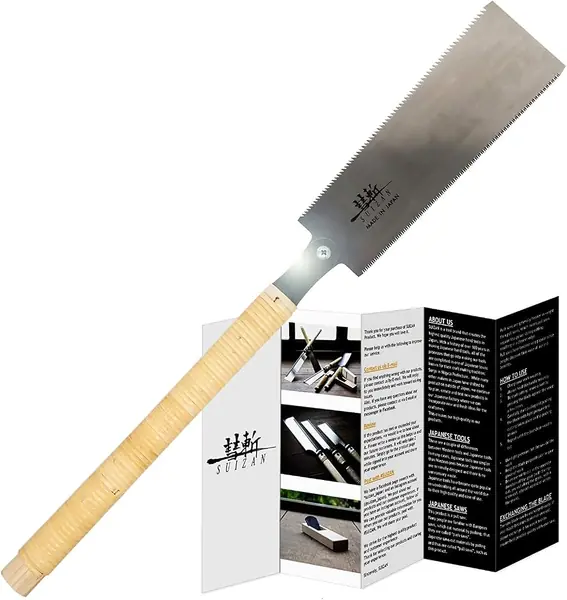
SUIZAN double-edge ryoba pull saw with brown wrapped wood handle and 9.5-inch blade

General workshop cutting

Shop Score 96/100
Blade Length
9.5 inches
Rip Teeth
9 TPI
Crosscut Teeth
15 TPI
Blade Thickness
0.02 in (0.5 mm)
View on Amazon

The first thing we do with any new ryoba is sight down the blade, and this one came straight, with even tooth spacing on both edges. That matters more than any single feature, because a 9.5-inch blade with 9 rip teeth per inch on one side and 15 crosscut teeth on the other is the shape most woodworkers actually need: fine enough for tenon shoulders and dovetail waste, coarse enough to break down a board. It is the saw we reach for when we do not want to think about which saw to reach for.

At 0.02 inch thick, the blade leaves a kerf around 0.03 inch wide, so it lifts out very little wood and slides through a cut with the light pull these saws reward. Spring it slightly mid-cut and it comes back straight. The rip side is the compromise: 9 TPI is fine for a rip edge, which buys a clean surface along the grain but asks for patience in thick hardwood. If most of your work is ripping 2x stock to width, a coarser saw will be quicker.

The blade is held by a single screw, so a dull saw becomes a fresh one in under a minute, and it arrives assembled with a guard over the teeth. At 7.05 ounces it is light enough that a long session of joinery does not leave your forearm aching, and the weight sits close to the handle where it does not fight the pull. We have used ours on tenon cheeks, door bottoms, and trim, and it has stayed true.

Worth Noting

  • Wrapped handle can arrive with small manufacturing cracks
  • Thirty-day warranty is short for a hand tool
Our Verdict

Our pick for most woodworkers: a 9.5-inch blade with 9 TPI rip and 15 TPI crosscut edges covers joinery and general cutting, and one screw swaps the blade when it dulls.

Check Latest Price
2.

Gyokucho Razorsaw Hardwood Ryoba 9-1/2 Inch Best for Hardwoods

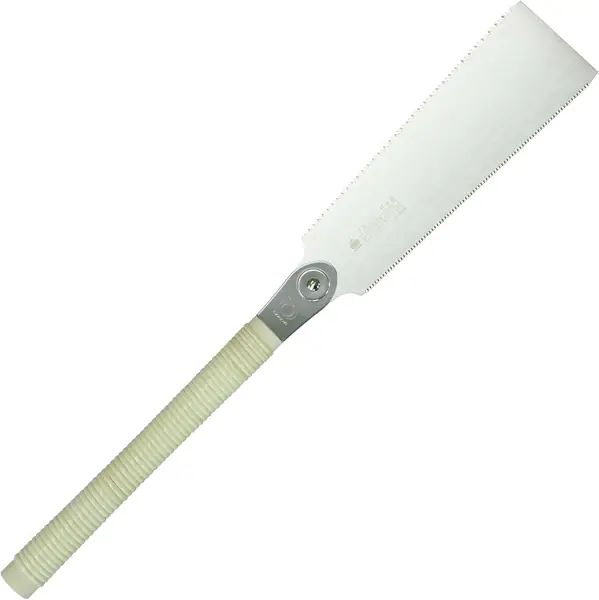
Gyokucho Razorsaw 9.5-inch ryoba pull saw for hard and abrasive woods

Hardwoods and abrasives

Shop Score 95/100
Blade Length
9-1/2 inches
Rip Teeth
9 TPI
Crosscut Teeth
22 TPI
Blade Thickness
0.018 in
View on Amazon

Twenty-two teeth per inch on the crosscut edge is the highest count here, and it is the entire reason to buy this one. The blade is 0.018 inch thick — also the thinnest in this set — so it lifts out the least wood of any saw on this page and leaves a surface that needs almost no sanding before a finish goes on.

We like it as the saw for hard, figured, or abrasive stock, where a clean shoulder matters more than the clock. The rip edge runs 9 TPI, the same count as our top pick, so ripping behaves much the same; it is the crosscut side that separates the two, and 22 TPI is noticeably slower through soft pine. Own this and a 15 TPI saw and you have the whole workshop covered.

At 23 inches overall it gives a long stroke for a 9.5-inch blade, and the balance keeps it tracking once the kerf is established. What a short run cannot tell us is how long 22 fine teeth hold their edge in white oak — every tooth is doing more work than a coarser one does. Buy it for the finish and keep a rougher saw for anything with grit or old nails in it.

Worth Noting

  • Fine 22 TPI crosscut teeth cut slower through soft pine
  • Delicate teeth are vulnerable to grit and old nails
Our Verdict

If you work oak, maple, and other hard or abrasive stock, this saw's 22 TPI crosscut edge and 0.018-inch blade give the cleanest shoulder in this set.

Check Latest Price
3.

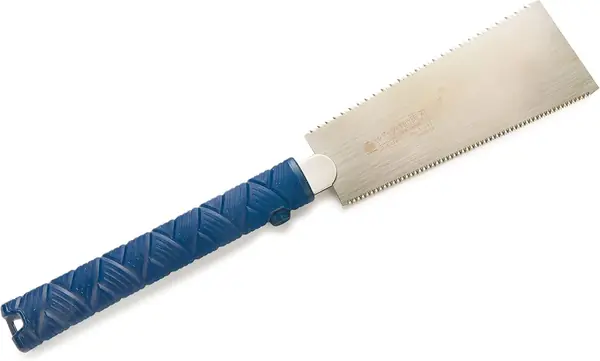
Jorgensen 10 Inch Double Edge Pull Saw Best for Long Cuts

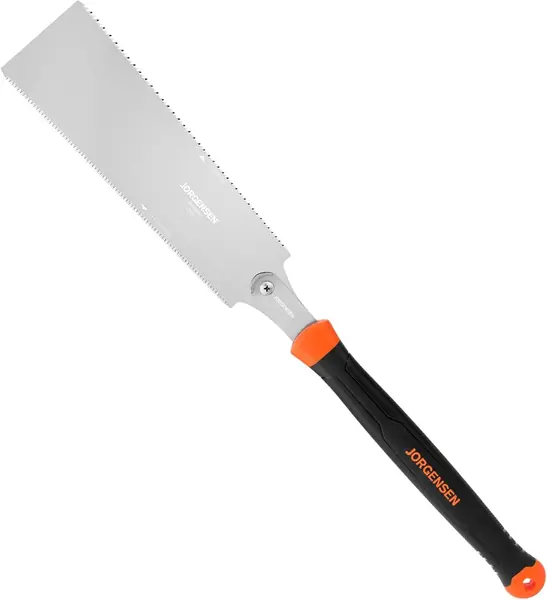
Jorgensen 10-inch double-edge pull saw with black plastic ergonomic handle and SK5 blade

Wide boards

Shop Score 94/100
Blade Length
10 inches
Rip Teeth
7-12 TPI
Crosscut Teeth
18 TPI
Weight
9.88 oz
View on Amazon

Ten inches of blade is the pitch: fewer, longer pulls, and on a wide board or a long tenon cheek that shows up as a straighter line with less correction partway through. The saw weighs 9.88 ounces and carries its length in the handle, so it feels bigger in the hand than that number suggests.

The tooth counts are worth reading twice. The rip edge runs 7 to 12 TPI, coarse where the cut starts and finer where it finishes, so it bites aggressively and cleans up as it goes. The crosscut edge sits at 18 TPI — between our top pick's 15 and the 22 on the hardwoods Razorsaw. For one saw that has to handle a wide rip in the morning and a joinery cut in the afternoon, that spread is generous.

Control is where it gives ground. The SK5 blade is deliberately flexible, and a rushed stroke lets it wander off the line. Slow down for the first inch, let the teeth establish the kerf, and it tracks as well as anything here; that habit is worth learning on any pull saw, and this one punishes skipping it more than most.

Worth Noting

  • Plastic handle where the others use wood
Our Verdict

A 10-inch blade and a progressive 7-to-12 TPI rip edge make this the saw for wide boards and long cuts, without stepping up to a premium price.

Check Latest Price
4.

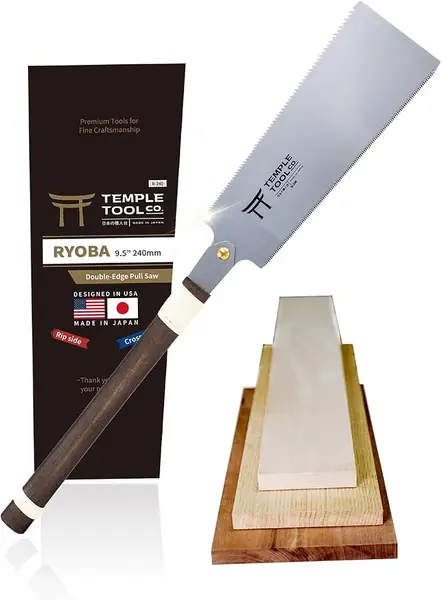
Temple Tool Japanese Pull Saw 9.5 Inch Best Traditional Handle

Temple Tool ryoba pull saw with dark wingnut wood handle, brass fittings and case

Traditional feel

Shop Score 93/100
Blade Length
9.5 inches
Weight
11.3 oz
Handle
Wingnut wood with brass
Included
Case
View on Amazon

The handle is what you notice first: a dark wingnut-wood grip with brass fittings, long enough for two hands and shaped so the saw hangs naturally from your fist. It is the best-looking saw in this group by a wide margin, and it does not read like a tool that lives in a bucket.

It cuts the way the handle promises. The blade arrives sharp, and once the teeth are set the pull tracks straight; on cherry and maple the kerf stays narrow and the surface needs little more than a card scraper. Under a cabinet or between studs, the 9.5-inch blade is short enough to work without crowding your knuckles.

Two details we appreciated: it ships in a case, which none of the others here do, and the rip and crosscut edges are properly distinct, so you flip the saw rather than compromise on the cut. The handle is also the longest of the fixed saws here, which makes a two-handed pull on wide stock feel natural.

What we keep coming back to is that this is the ryoba for someone who wants the object as much as the cut — made in Japan by a workshop with a century of saw-making behind it, with both edges doing their job. If the saw lives in a bucket and cuts plywood all day, spend less. If it hangs on a wall between projects and you want to enjoy picking it up, this is the one.

Worth Noting

  • Heaviest of the full-size saws at 11.3 ounces
Our Verdict

The best-looking saw here, with a wingnut-wood handle and brass fittings, and it cuts as well as it looks — a storage case comes in the box.

Check Latest Price
5.

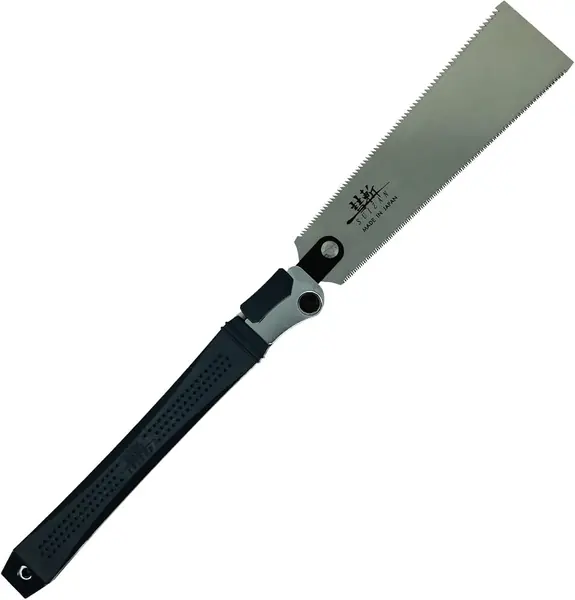
SUIZAN Folding Ryoba Saw 9.5 Inch Best Folding

SUIZAN folding ryoba pull saw with black elastomer handle shown closed to 12.4 inches

Travel and storage

Shop Score 92/100
Blade Length
9.45 in (240 mm)
Rip Teeth
9 TPI
Crosscut Teeth
15 TPI
Folded Length
12.4 in (315 mm)
View on Amazon

Folded, it is 12.4 inches — short enough for a toolbox drawer, a dry bag, or a truck door pocket, which is more than you can say for any fixed ryoba here. We like it for exactly that reason: it is the saw that is actually with you. Open it and you get a full 9.45-inch blade with the same 9 TPI rip and 15 TPI crosscut edges as our top pick.

The lock decides whether a folding saw is worth owning, and this one holds the blade open with no play we could find. The cover that comes with it means the teeth do not chew the inside of a bag. At 14.64 ounces it is roughly twice the weight of the fixed 9.5-inch SUIZAN, and you feel that on a long cut.

The blade swaps with one screw, and the elastomer grip stays put in a wet hand better than varnished wood does. If the saw never leaves the bench, the fixed version saves you weight and money. If it rides in a bag from job to job, this is the one we grab.

Worth Noting

  • 14.6 ounces is heavy for a saw you carry
  • Fine 9 TPI rip edge is slow in thick stock
Our Verdict

For a saw that travels, this folds to 12.4 inches and still gives you a full 9.45-inch blade with 9 and 15 TPI edges.

Check Latest Price
6.

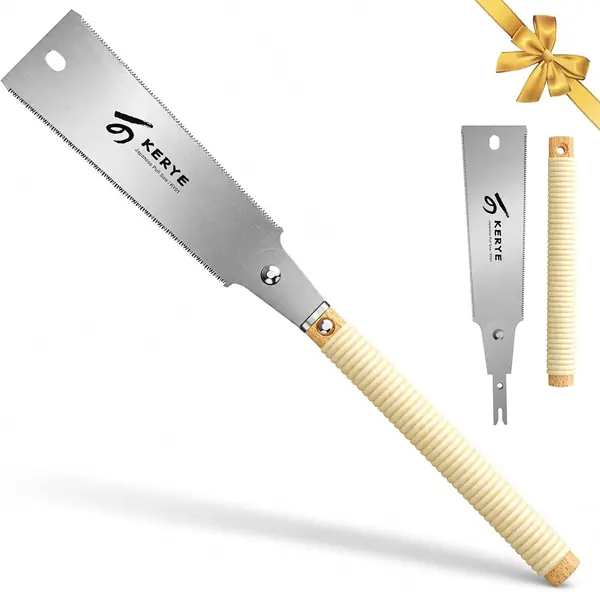
KERYE Japanese Pull Saw 9.5 Inch Best Value Full-Size

KERYE 9.5-inch double-edge pull saw with light beech handle and SK5 steel blade

First full-size ryoba

Shop Score 91/100
Blade Length
9.5 inches
Rip Teeth
10 TPI
Crosscut Teeth
17 TPI
Blade Thickness
0.02 in
View on Amazon

The edges are where the money goes. KERYE grinds 10 TPI on the rip side and 17 on the crosscut side, both coarser than our top pick's 9 and 15, and the result is a saw that clears waste faster and leaves a slightly rougher surface. For trimming door bottoms, sizing reclaimed lumber, and cutting stock to rough length, that is the right trade.

We think it is the best first full-size ryoba here, and the reason is not the price. The 0.02-inch SK5 blade and the tooth grinding are close enough to the more expensive saws that a beginner learning the pull stroke will not be able to tell the difference, and the blade is replaceable with the wrench KERYE includes in the box.

A 2-year warranty covers it, the longest on any wood-handled saw here, and replacement blades are sold separately when the teeth finally go. Ours has held its line through door bottoms and a stack of reclaimed oak without needing more than a light stroke. It is not the saw for a showcase finish — 17 TPI is clean, not glassy.

Worth Noting

  • Spiral-wrapped handle feels lumpy where it crosses
  • Thin blade can bend if the cut is forced
Our Verdict

Coarser 10 and 17 TPI edges cut faster and slightly rougher than our top pick, at a lower price — the right first full-size ryoba for most beginners.

Check Latest Price
7.

Gyokucho 770-3600 Razor Ryoba

Gyokucho Razorsaw compact ryoba pull saw with contoured silver plastic grip

Trim carpentry

Shop Score 90/100
Rip Teeth
6 TPI
Crosscut Teeth
17 TPI
Weight
5.29 oz
Blade Thickness
0.5 mm
View on Amazon

This is a smaller saw than the rest of the group, and the maker says so plainly: it is built for crosscutting and ripping smaller stock. The tooth counts explain the intent — 17 TPI across the grain for a clean finish, 6 TPI along it for fast waste removal on narrow boards.

The plastic grip is functional rather than handsome, contoured and comfortable for a short session, and at 5.29 ounces the whole saw is one of the lightest here. The 0.5 mm blade takes a fine kerf, and pine, cherry, walnut, and hard maple all cut cleanly.

Where it earns a place is trim carpentry and small-part work: notching a casing, taking a dowel down, trimming a shim. On anything wide the short blade runs out of stroke, so as a first and only ryoba for furniture work we point you to the 9.5-inch SUIZAN instead. As the second saw in a trim carpenter's bag, it pulls its weight.

Worth Noting

  • No sheath and no hang hole
Our Verdict

A light, compact ryoba for trim carpentry and small parts; it handles notching, dowels, and shims well and runs out of stroke on wide boards.

Check Latest Price
8.

RUITOOL Japanese Hand Saw 6 Inch Best for Detail Work

RUITOOL 6-inch double-edge Japanese hand saw with brown beech handle and SK5 blade

Detail work

Shop Score 89/100
Blade Length
6 inches
Weight
3.88 oz
Teeth
14 and 17 TPI
Blade Material
SK5 steel
View on Amazon

Six inches is a different tool from a 9.5-inch ryoba, whatever the shared vocabulary suggests. This one measures 12.2 inches overall and weighs 3.88 ounces, so it disappears into an apron pocket and comes out for the cuts a full-size saw cannot reach.

That is where it earns its keep: taking a dowel down flush, cleaning a tenon cheek in a corner, cutting a vent opening between studs, shortening a 1x3. The SK5 blade is thin and flexible, and the flex is the point — you can bow it slightly into a spot where a stiffer blade would bind.

The edges run 14 and 17 TPI rather than a coarse rip and a fine crosscut, so read them as a fast side and a clean side. That is worth knowing before you order: this will not rip a wide board to width the way the full-size saws here will, and 17 TPI on a six-inch blade is a detail count, not a finish count.

What it is not is an only saw. For dimensioning anything wider than a 2x4 it runs out of blade and out of stroke, and the small scale is the thing to be ready for. As the second saw that lives in the toolbox and handles the fiddly end of a project, we are glad to have it.

Worth Noting

  • Feels smaller in the hand than expected
Our Verdict

A 6-inch flexible blade for flush trimming, dowels, and corners a full-size saw cannot reach; it is a second saw, not an only saw.

Check Latest Price

How We Chose and Tested Ryoba Saws

We built the shortlist from spec sheets before touching a saw: blade length and usable stroke, tooth counts on both edges, blade thickness, how the blade fastens, handle material, weight, and whether it folds. That narrowed a long list to 14 saws spread across a wide range of prices, which we then lived with for six months.

Most of that time happened at a benchtop with the workpiece clamped down, and at a pair of sawhorses in the garage. We crosscut pine, cherry, and white oak to length, ripped 1x6 stock down to width, cut dovetails and tenons, flushed dowels on a shelf, and trimmed a door that had swelled shut. With each saw we counted strokes to cross a 6-inch board on the rip edge and again on the crosscut edge, then inspected the exit side for tearout. Calipers went on every kerf, and we noted whether a blade tracked the line or wandered when we deliberately forced it.

We swapped blades on every saw that allows it, checking whether the fastener held the blade flat and how long the change took, and we weighed and folded each one to see how it rode in a tool bag. After an hour of steady cutting we looked at palm and thumb hotspots. Each saw also went into the hands of a confirmed Western-saw user for ten strokes, since the pull stroke is where most people fight the tool. Saws that kinked, dulled early, or let teeth poke through the guard in storage fell out of the running.

How to Choose a Ryoba Saw

Blade Length Comes First

A 9.5-inch blade is the size we point most people to, and it is what most of these saws carry. It is long enough to crosscut a 2x4 in a few strokes and short enough to steer with one hand at a tenon shoulder. Ten inches, as on the Jorgensen, buys a longer stroke and a straighter line on wide boards in exchange for a little control at the start of a cut.

Six inches is a separate tool, not a smaller version of the same one. A short ryoba is for flush trimming, dowels, and corners, and it will not dimension a board however sharp it is. The trap in the listings is the word compact: it means the saw fits a drawer, not that it does the work of a full-length one.

Read Both Tooth Counts

Every Japanese pull saw has a rip edge and a crosscut edge, and the two numbers describe different jobs. Crosscut counts here run from 15 to 22 teeth per inch: more teeth means a cleaner shoulder and a slower stroke through softwood. Rip counts run from 6 to 12, and fewer teeth clear waste faster along the grain while leaving a rougher surface.

The pairing matters more than either number alone. Our top pick's 9 and 15 sit in the middle of both ranges, which is why it handles almost anything; the Gyokucho hardwoods saw runs 9 and 22 for a fine crosscut. The compact saws pair 14 and 17, close enough together that they read as a fast side and a clean side rather than a true rip-and-crosscut pair.

Blade Thickness and Kerf

Thin is where the precision comes from. A 0.018-inch blade, like the Gyokucho hardwoods saw, lifts out less wood and leaves an edge that needs almost no sanding; a 0.02-inch blade with a 0.03-inch kerf, like the SUIZAN, is the common middle. The trade is stiffness — the thinner and more flexible the blade, the more it rewards a light, straight pull and the more it wanders if you force it.

If kerf width is part of your joinery — fitting a tenon shoulder, cutting a slot to width — go thin. If you cut construction lumber and trim all day, you will not notice either, and the slightly thicker blade is the more forgiving choice.

Handles, Weight, and Where It Lives

Handles here come in wrapped wood, plain beech, plastic, and elastomer. The wrapped wood handle on our top pick is the nicest in the hand and the one that asks for care; plastic and elastomer shrug off weather and job-site treatment. Weight runs from 3.88 ounces on the six-inch saw to 14.64 on the folding one, and that range is the difference between a saw you carry and a saw you keep at the bench.

Then decide how it is stored. A folding saw carries a hinge and a cover for the teeth; a fixed saw wants a hang hole or a case, and not every one of these has either.

Frequently Asked Questions

Final Verdict

We tested these on tenon shoulders, door bottoms, dowels, and thick stock, and the SUIZAN 9.5-inch is the one that kept coming back off the bench. The 9 and 15 TPI pairing covers both grain directions, the 0.02-inch blade leaves a 0.03-inch kerf, and one screw gets you a fresh blade when the teeth go.

If your work runs to hard and abrasive woods, the Gyokucho Razorsaw's 22 TPI crosscut edge is the finer choice. If the saw has to travel, the folding SUIZAN gives up nothing but weight.