↑↓ navigate ↵ open Esc close All results →

Best Japanese Pull Saws of 2026

A Japanese pull saw cuts on the backstroke, and almost everything useful about it follows from that geometry. Pulling keeps the thin plate under tension instead of bowing it, so the blade stays light, the kerf stays narrow, and the sawn surface comes off clean enough to head straight to a block plane. That leaves less sanding, less paring, and fewer do-overs after the cut.

Across six months with 14 pull saws — double-edge ryobas, backed dozukis, and zero-set flush-cut saws from 5 to 10 inches — the small ergonomics mattered as much as the steel. We paid attention to how a handle felt after an hour of dovetails, whether the blade swapped out cleanly and what replacement plates cost, and how the teeth held up in hard oak. For woodworkers raised on western push saws, the pull stroke feels backward for about twenty minutes before it settles in.

Each style below fits a different bench task, from rough joinery to trimming dowels flush, while holding a marked line without wandering.

Our Top Picks

The Best Japanese Pull Saws

1.

SUIZAN Ryoba Double Edge Saw 9.5 in Best Overall
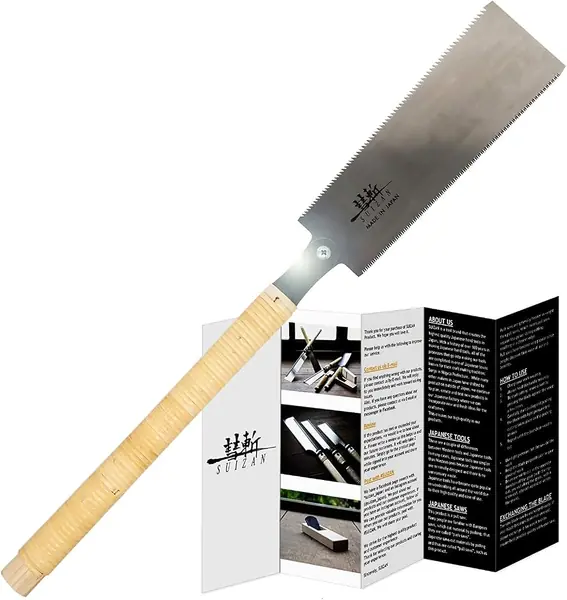
SUIZAN Ryoba 9.5-inch Japanese pull saw with rattan-wrapped wood handle

General bench work

Shop Score 97/100
Blade Length
9.5 inches
Weight
7.05 oz
Teeth
9 TPI rip / 15 TPI crosscut
Blade Thickness
0.02 in (0.5 mm)
View on Amazon

Two edges, 9 teeth per inch on one side and 15 on the other, are the reason this is the saw we reach for first. Rip a tenon cheek, turn the blade over, crosscut a shoulder, and there is no hunt for the saw with the right teeth. Because it cuts on the pull, the plate stays in tension through the stroke and tracks a marked line with far less effort than a push saw of the same length.

The plate is 0.02 inch thick and leaves a kerf around 0.03 inch, so you are removing a sliver rather than a slot, and on narrow trim the wood you keep is visible. At 7.05 ounces it is light enough to run one-handed at the bench. The blade is held by a single screw, which means a replacement goes on in seconds once the teeth give out.

The handle is wood wrapped in rattan and shaped for a full grip, and the wrap has stayed comfortable through long sessions; small cracks can appear in it from new, which is normal for the material. For fine dovetail work the 9.5-inch plate is more saw than the job needs, and the backed dozuki further down is the better instrument there.

Worth Noting

  • Ships with a blade guard but no case
Our Verdict

We recommend this as the first Japanese pull saw for most shops: two tooth patterns, a thin blade, and a plate you can replace when it dulls.

Check Latest Price
2.

SUIZAN Flush Cut Saw 5 in Best for Flush Cutting

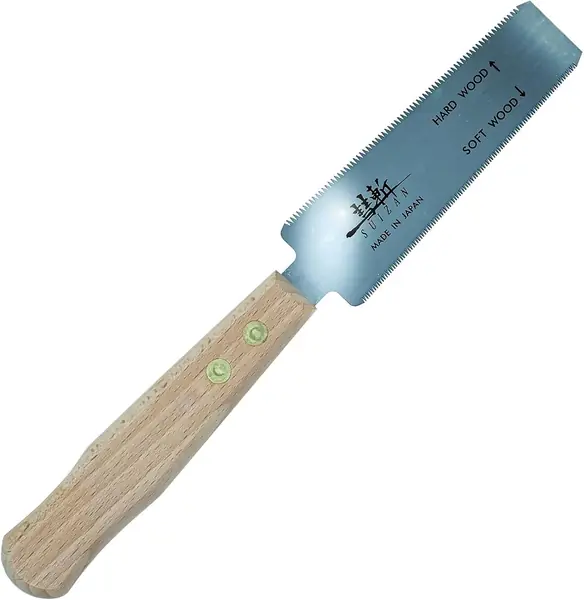
SUIZAN 5-inch flush cut Japanese pull saw with beech handle

Flush trimming plugs

Shop Score 96/100
Blade Length
5 inches (120 mm)
Weight
1.76 oz
Teeth
17 TPI hardwood / 25 TPI softwood
Blade Thickness
0.012 in (0.3 mm)
View on Amazon

Trimming a dowel plug flush is a job where the cut is easy and the damage is not, because one slip of the plate scars the surface beside the plug. This 5-inch saw is built around that problem. The teeth carry no set at all, so the blade lies flat against the work and takes the plug down to nothing without touching what sits next to it.

At 0.012 inch it is the thinnest plate here, and that flex is the point: it reaches into a corner or along a curved face where a backed saw cannot sit. We treat it as a specialist. It lives with the dowel jig rather than in the saw till, because it is not the tool you grab to break down a board.

Two edges cover the woods you meet most, 17 TPI for hardwood plugs and 25 TPI for softwood, and at 1.76 ounces it disappears in an apron pocket. The plate is fixed to the beech handle rather than screwed on, so the life of the saw is the life of the blade. On a saw this useful for one recurring job, we do not mind that trade.

Worth Noting

  • Blade is fixed and cannot be replaced
Our Verdict

This is the one we hand to anyone trimming plugs: zero-set teeth, a featherweight body, and a fixed blade we can live with at the price.

Check Latest Price
3.

Gyokucho Razorsaw Ryoba for Hardwoods 9.5 in Best for Hardwoods

Gyokucho Razorsaw 9.5-inch ryoba pull saw with wooden handle

Hardwood joinery

Shop Score 95/100
Blade Length
9.5 inches
Weight
6.53 oz
Teeth
22 TPI crosscut / 9 TPI rip
Blade Thickness
0.018 in
View on Amazon

Twenty-two teeth per inch on the crosscut edge is a lot for a 9.5-inch saw, and the count tells you what it is for. Hard, abrasive stock such as maple, oak, and teak punishes a coarse saw with torn shoulders and a surface that has to be planed back. The fine edge takes a smaller bite and leaves the wood closer to finished.

The plate measures 0.018 inch, thinner than the 0.02-inch blade on our top pick, and the teeth are impulse hardened so they hold an edge in woods that dull ordinary steel. Blades interchange, and a short use guide comes in the box, which is worth having if the pull stroke is new to you.

What earned it a place in our till is the finish on hard stock. Crosscuts in oak and maple come off this saw needing very little cleanup before glue-up, and that is the whole reason to own a fine-toothed ryoba rather than a general one.

It is the most expensive saw in this group, and the premium only pays off if you cut hardwoods regularly. In pine and construction lumber the fine teeth are slower than the 15 TPI edge of our top pick, and the extra teeth buy you nothing.

Worth Noting

  • Slow going in soft pine and construction lumber
Our Verdict

For oak, maple, and teak we take this saw: the fine crosscut edge and thin plate leave a surface that needs almost no cleanup.

Check Latest Price
4.

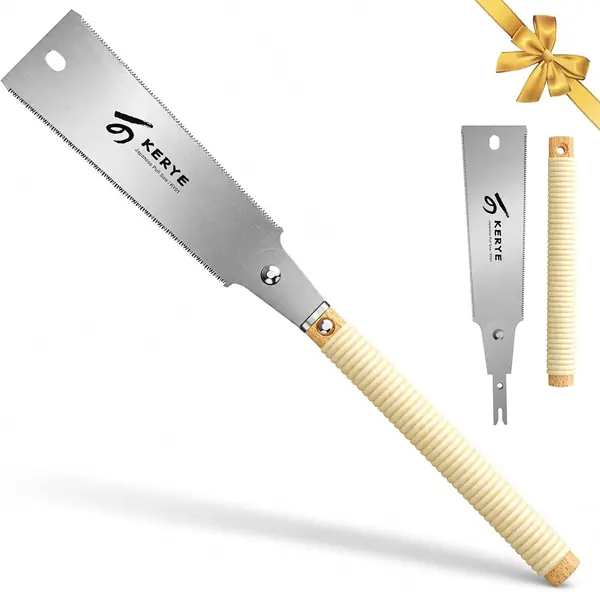
KERYE Japanese Pull Saw 9.5 in Best Value Ryoba

KERYE 9.5-inch double-edge Japanese pull saw with beech handle and wrench

General woodworking

Shop Score 94/100
Blade Length
9.5 inches
Weight
9.6 oz
Teeth
10 TPI rip / 17 TPI crosscut
Blade Thickness
0.02 in
View on Amazon

The KERYE sells for noticeably less than our top pick and gives up surprisingly little on paper: a 9.5-inch blade, a 0.02-inch plate, 10 TPI on the rip edge and 17 on the crosscut, and a replaceable SK5 blade with the wrench included in the box.

The hand is where the difference shows. At 9.6 ounces it is the heaviest saw we tested for this guide, and over a long run of tenon cheeks that mass starts to tell. What the weight buys is stability: the extra heft keeps the plate flat in the cut, and a beginner is less likely to tip it off the line.

The blade is long enough to crosscut a 2x4 in a single stroke, and the coarse rip edge drops a cheek to a line quickly. This is the saw we name when the budget is settled and the work is general rather than specialized.

Treat it with a little care. The plate is thin, heavy-handed use can bend or break it, and the wrap on the handle can work loose over time. Kept in a case between jobs, it holds up like a shop saw should.

Worth Noting

  • Heaviest saw in this set at 9.6 ounces
Our Verdict

We point value-minded woodworkers here: a full-size ryoba with a replaceable blade that costs less than our top pick.

Check Latest Price
5.

Gyokucho Razor Dozuki 180 mm Best Dovetail Saw

Gyokucho Razor Dozuki 180 mm pull saw with steel back and wood handle

Dovetails and tenons

Shop Score 93/100
Blade Length
180 mm
Blade Thickness
0.3 mm
Spine
Rigid steel back
View on Amazon

The steel back is the whole argument for a dozuki, and it is why we reach for this one when a cut has to land on a line and stay square. The spine holds the 0.3 mm plate rigid, so the saw starts exactly where you set it and runs straight through a tenon shoulder instead of following the grain.

Rigidity costs depth. The back stops the blade at a fixed depth, which makes this a joinery saw and not a saw for breaking down stock. What you get in return is a kerf fine enough to sit inside a pencil line, and at 180 mm the blade steers easily in a small joint such as a dovetail or a drawer side.

It is made in Japan with a wood handle and weighs less than the full-size ryobas here. It is also the least forgiving of a heavy hand: the fine teeth and thin plate want light pressure, and forcing this one through a cut is where a dozuki goes wrong.

Worth Noting

  • Back limits how deep the blade can cut
Our Verdict

If your work is dovetails and tenon shoulders, this is the saw: a backed plate that starts precisely and costs less than most here.

Check Latest Price
6.

JORGENSEN Double Edge Pull Saw 10 in Best Long Blade

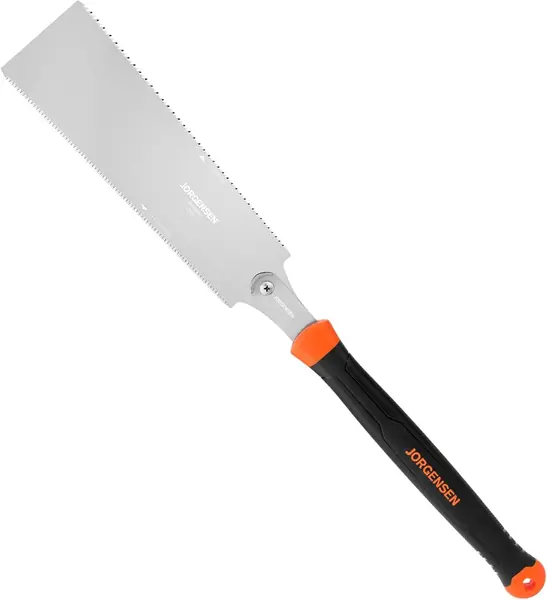
JORGENSEN 10-inch double-edge Japanese pull saw with black plastic handle

Framing and trim

Shop Score 92/100
Blade Length
10 inches
Weight
9.88 oz
Teeth
7-12 TPI rip / 18 TPI crosscut
Handle
Plastic
View on Amazon

Ten inches of blade is a full stroke, and that is the case for this saw: crosscutting a 2x4 or trimming a door bottom without running out of teeth halfway through. One edge graduates from 7 to 12 TPI so the coarse teeth clear waste and the finer ones behind them clean up the cut, and the other edge runs a uniform 18 TPI.

The SK5 plate is thin, flexible, and replaceable with a screw, and the handle is molded for a full grip. At 9.88 ounces it sits among the heavier saws here, and the plastic handle is the plainest in the group, functional rather than handsome.

A plate this flexible rewards a light, flat stroke. Push it and it wanders off the line; let the teeth work and it tracks where you aim it. That trade comes with every thin blade on this list, and it is the reason a pull saw feels unfamiliar for the first few cuts.

What settled it for us is reach. On anything wider than a tenon the long blade keeps a full stroke going, so trimming a door or cutting a rafter tail stays quick and needs no cord, no setup, and no room for a power tool.

Worth Noting

  • Plastic handle feels less refined than wood
Our Verdict

For stock bigger than a tenon, we take this one: the 10-inch blade keeps a full stroke going and the coarse rip edge clears waste fast.

Check Latest Price
7.

Temple Tool Japanese Flush Cut Saw 6 in Best for Pegs and Plugs

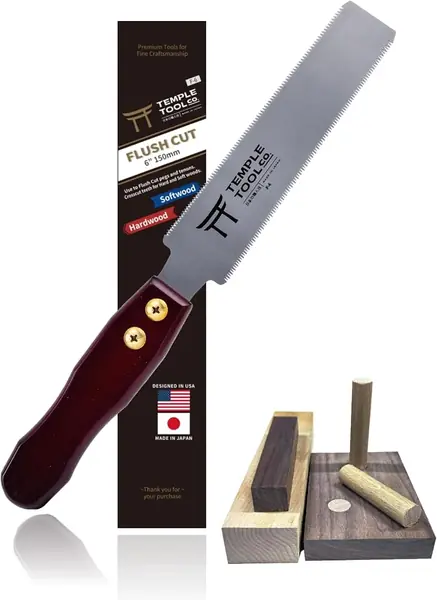
Temple Tool 6-inch flush cut pull saw with brass-fitted beech handle and case

Pegs and plugs

Shop Score 91/100
Blade Length
6 inches
Weight
3.17 oz
Handle
Beech with brass
Included
Hard case
View on Amazon

Brass fittings and dark beech make this the best-looking saw in the group, and it is the one that tends to stay out on the bench instead of going back in a drawer. It comes out of a Japanese saw-making city, and the fit shows in the handle and the hardware.

It is a flush-cut saw first. The teeth take pegs, wedges, and tenon ends down to the surface without scratching what sits beside them. At 3.17 ounces and 6 inches it steers easily along a narrow face or a curve, and the high-carbon plate is thin enough to lie flat with very little downward pressure. A replacement blade is sold separately, so the handle is not a one-shot purchase.

The hard case is what we appreciated most. Thin plates get knocked around in a toolbox, and this is the only saw in this group that arrives with somewhere to live, which is why it travels while the others stay in the shop.

Worth Noting

  • Costs more than the other flush-cut pick
Our Verdict

We like this for trim and plug work: a brass-and-beech handle, a thin plate, and a hard case none of the others here include.

Check Latest Price
8.

RUITOOL Japanese Hand Saw 6 in Best for Small Projects

RUITOOL 6-inch double-edge Japanese pull saw with beech handle

Small projects

Shop Score 90/100
Blade Length
6 inches
Weight
3.88 oz
Teeth
14 TPI / 17 TPI
Blade Thickness
0.67 mm
View on Amazon

Six inches of blade, 12 inches overall, 3.88 ounces: this is a small saw, and the photographs make it look bigger than it is. What a short plate buys is access, whether that is a vent opening in a tight corner, a cut in a cabinet side, or a length of PVC under a sink.

We keep one in the toolbox for exactly those jobs. The 14 TPI edge is quick on 1x stock and the 17 TPI side leaves a cleaner crosscut, the beech handle is comfortable in a smaller grip, and the SK5 plate flexes enough to follow a shallow curve without digging in.

It carries a lifetime warranty, which suggests the maker expects it to be around a while, and the blade is only 0.67 mm thick, so the kerf is trim and the effort low. Anything wider than a 2x4 or longer than a shelf bracket is beyond it, though, and a 9.5-inch ryoba will do that work with less effort.

Worth Noting

  • Short 6-inch blade limits it to small work
Our Verdict

Buy this one as a second saw: it slips into tight spots a 9.5-inch blade cannot reach, and it is the least expensive saw here.

Check Latest Price

How We Chose and Tested the Best Japanese Pull Saws

Before cutting anything, we read through listings and spec sheets and gathered the pull saws that come up again and again in woodworking forums and shop classes — double-edge ryobas, backed dozukis, and zero-set flush-cut saws from brands like Suizan, Gyokucho, and Jorgensen — then narrowed that group to 14 saws covering a genuine spread of blade lengths, plate thicknesses, tooth patterns, and prices. Every one of them got the same six-month run, mostly at a bench in a garage shop but also on a bookshelf build, a set of drawer dovetails, and a stretch of framing and trim cuts. We noted weight and handle shape before the first cut and again after an hour of work.

We measured blade length and plate thickness, and logged whether the blade could be replaced and what a spare plate cost, since a cheap saw with an expensive replacement blade is not a value. For sharpness and cut quality, we crosscut white oak and ripped pine, then ran a square against the finished end and looked along the kerf walls for tear-out. To judge how squarely a saw starts, we cut to a marked line with no guide and watched how far the plate wandered in the first inch. Flush cutting got its own test: we trimmed dowels and plugs proud of a panel and checked the face beside the cut for scratches, with eye protection on every time.

Ease of use showed up over long sessions rather than single cuts — an hour of dovetails tells you more about handle shape and balance than a dozen quick trims. We counted how the teeth held up in hard maple across the whole period, and we kept each saw in its guard or case between sessions to see which covers survived life in a toolbox. Any saw that snagged, needed real muscle to keep moving, or left a ragged edge came off the list.

How to Choose a Japanese Pull Saw

Match the teeth to the cut

Three saws cover almost everything. A ryoba carries two edges, coarse rip teeth on one side and finer crosscut teeth on the other, and it is the one saw to buy if you are buying one. A dozuki adds a steel back for joinery that has to be square, at the cost of cutting depth. A flush-cut saw has zero-set teeth so the plate lies flat and takes a plug down without touching the surface beside it.

Buy for the cuts you actually make. If dovetails and tenon shoulders are the work, the backed saw earns its keep. If you build shelves and fit trim, the ryoba does more per dollar, and a 15 TPI crosscut edge is coarse enough to be quick and fine enough to leave a presentable surface.

Match blade length to the work

Length is a reach decision, not a quality one. A 5- or 6-inch plate fits between cabinet parts, trims plugs, and steers around curves. A 9.5- or 10-inch plate gives a full stroke on 2x4 stock and holds a long cut straight.

The trap is the product photograph. A 6-inch saw reads nearly as large on screen as a 9.5-inch one, and shoppers who order the short saw expecting a general-purpose tool end up owning two. If only one saw is coming into the shop this year, make it the 9.5-inch.

Expect a thin plate to ask for a light hand

Japanese saws cut on the pull, which keeps the plate in tension rather than compression, and that is what allows a blade between 0.012 and 0.02 inch thick. The payoff is a kerf narrow enough to save visible wood and a cut that starts on the line and stays there.

The cost is flex. Push a thin plate and it wanders; twist it inside a kerf and hardened teeth can chip or snap. Long, light strokes with the weight of the saw doing the work are the whole technique, and it takes a few cuts to unlearn the push-stroke habit.

Weigh the saw in your hand

Weights in this group run from 1.76 ounces to 9.88 ounces, and that gap shows up at the end of a session. A light saw is easier to hold flat and steers in small work; a heavier one feels steadier pushing through thick stock on a long cut.

Handle material matters less than handle shape. A plastic grip that fills the palm beats a handsome wood one that leaves hot spots, though a wood handle is the more pleasant thing to hold over an afternoon. If you can, close your hand around the saw before you buy it.

Buy a blade you can replace

Teeth on these saws are impulse hardened, which is why they stay sharp for a long time and why they do not come back with a file. The mounting is the detail that decides the saw's working life: a plate held by a screw swaps out in seconds, while a blade riveted or fixed to the handle ends the tool when the teeth go.

Before you buy, confirm that the maker lists a replacement blade for that exact model, and check what it costs against the price of the saw. On the saws here with screw-held plates, a spare is a reasonable add-on to the first order and saves a wait later.

Frequently Asked Questions

Final Verdict

The SUIZAN 9.5-inch ryoba is the saw we point most woodworkers to. Two tooth patterns on a 0.02-inch plate, a blade that unscrews for replacement, and control that makes the pull stroke feel natural within an afternoon of bench work.

If your stock is hard maple and oak rather than construction lumber, the Gyokucho Razorsaw for hardwoods is the upgrade and the finer crosscut edge is worth the extra. If the job is trimming plugs, the SUIZAN flush cut saw does something none of the others here do as cleanly.