↑↓ navigate ↵ open Esc close All results →

Best Drawknives for Woodworking of 2026

A drawknife removes wood faster than almost anything else in the shop, and it can ruin a blank just as fast. A dull blade skates instead of biting, a steep bevel bounces off every knot, and a loose handle turns a controlled pull into a wobble you feel in your wrist. Set up right, though, a drawknife peels a bark-covered log into long, clean shavings and makes an afternoon of shaping feel easy.

We tested 11 drawknives over six months, peeling green pine, flattening dried oak billets, and hollowing birch spoon blanks, with every piece clamped down before the first pull. The mistake first-time buyers make is shopping for one knife that does everything. A short, slightly flexible blade belongs over a spoon blank; a long, stiff straight blade belongs on beams and fence posts. Steel names sell tools — bevel geometry and out-of-box sharpness are what your hands actually feel.

Our picks cover debarking, curved shaping, spoon carving, and straight work on a budget, and each one earned its place at the bench rather than in the box. The right drawknife should feel like an extension of your pull, not a fight you're losing.

Our Top Picks

The Best Drawknives for Woodworking

1.

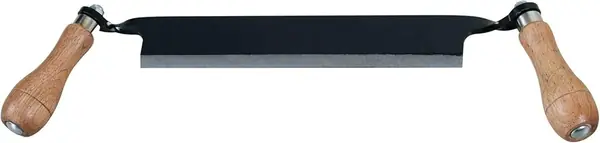
Stubai 336003 Draw Knife Best Overall
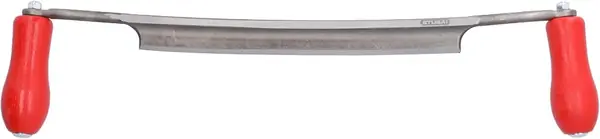
Stubai 336003 draw knife with straight steel blade and wooden handles

Logs and beams

Shop Score 91/100
Blade Length
240 mm
Blade Shape
Straight
Weight
12.7 oz
Edge Grind
Concave
View on Amazon

A forged 240 mm straight blade and a plain wooden handle are the whole idea behind the Stubai 336003, and that is exactly why it is our top pick. It is the drawknife we reach for when a project starts with a beam, a fence post, or a piece of furniture stock that needs to lose material in long, controlled strokes. The straight profile gives you a clear line to follow, and the cutting length is enough to cover a broad face without repositioning the tool every few inches. No other drawknife here balances that reach with the same light, steady feel.

At 360 g, the Stubai is light enough to steer with your wrists for a long session, which we appreciate on vertical work where the tool spends as much time in the air as in the wood. The concave grind gives the edge a slight scoop that helps it bite and roll a shaving, and the forged steel has a solid, dense feel that inspires confidence on hard stock. The 240 mm blade is long enough for debarking a pole and precise enough for shaping a chair leg, though it is not a carver's tool for tight hollows.

The PVC guard is basic and the handles are plain, but the blade is where the attention went. It is also the wrong shape for spoon bowls and other tight curves; for those, the Flexcut's flexible blade is the better companion. As a first serious drawknife for general shop work, it gets the important part right.

Worth Noting

  • Premium price for a general-purpose tool
Our Verdict

We recommend the Stubai 336003 as the best all-around drawknife here for anyone shaping beams, posts, or furniture parts who wants a light, forged straight blade.

Check Latest Price
2.

Flexcut KN16 Draw Knife Best for Curved Shaping

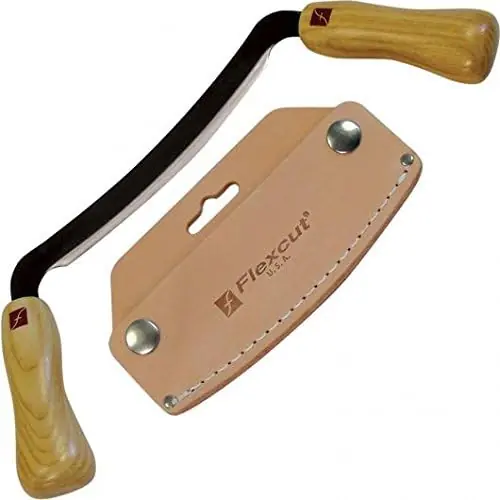
Flexcut KN16 draw knife with flexible steel blade and ash wood handles

Curved carving work

Shop Score 90/100
Blade Material
1095 high carbon steel
Handle Material
Ash wood
Sheath
Leather
Blade Profile
Flexible
View on Amazon

A chair seat is where the Flexcut KN16 makes its case: the flexible blade follows the dish instead of fighting it, so you can take a controlled shaving across a curved surface and blend it into the next pass. That flexibility is the point of this tool. The 1095 high-carbon blade has enough spring to ride a contour but enough stiffness to hold a line, and the ash handles sit close to the blade for a direct, carver's feel. It is a different animal from the long straight drawknives in this guide.

We like it best for chair seats, spindles, and the kind of curved shaping where a stiff blade chatters. The short blade gives you more control in tight work, and the leather sheath is a practical addition for a tool that will live in a bench drawer. The 1095 steel takes a keen edge, though it is not the steel we choose for gritty bark or a log full of knots. For those jobs, the Stubai's longer straight blade is the more efficient tool.

The handles are the part we watch. Hard pulling can work them loose, and a drawknife with a moving handle costs control exactly when you need it. Check the fit before each session and tighten or reattach as needed. The short blade also limits this one to smaller stock and detail work; it is not a debarking tool for a pile of big logs. If your work is mostly curved, though, the trade is worth it.

Worth Noting

  • Handles can work loose under hard pulling
  • Short blade limits work to smaller curved stock
Our Verdict

We pick the Flexcut KN16 when the work curves; its flexible blade follows chair seats and spindles in a way a straight drawknife cannot.

Check Latest Price
3.

Beendou 10-Inch Curved Draw Knife Best for Large-Log Debarking

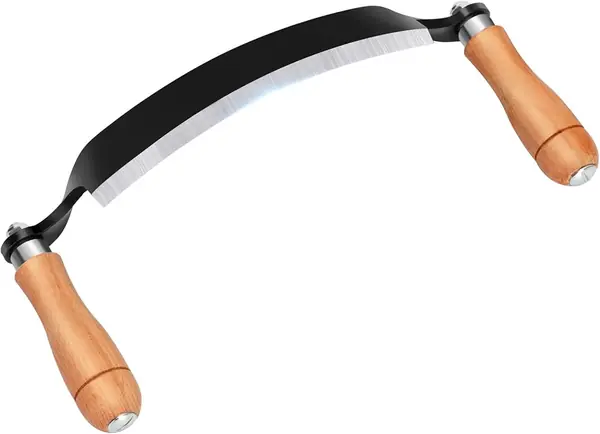
Beendou 10-inch curved draw knife with manganese steel blade and wood handles

Large-log debarking

Shop Score 89/100
Blade Length
10 inches
Blade Material
Manganese steel
Blade Shape
Curved
Bevel
30 degrees
View on Amazon

Ten inches of curved manganese steel at a budget price is the Beendou's pitch, and as a draw shave for big logs it makes sense. The long curve follows the round of a trunk or a fence post, so you can strip bark in broad, overlapping strokes instead of nibbling at the surface. That combination of width and low cost is why we make it our pick for heavy debarking work. It is not the finish tool in this group, but it is the one that covers the most ground per pull.

The 30-degree bevel is ground for controlled removal, and the dual wooden handles give you room for a two-handed grip. We like the length for pine poles and firewood; the blade reaches across a knot instead of stalling on it. The manganese steel has a tough, workmanlike feel, and the painted finish is there to keep moisture off the blade. It is a rough tool, not a finish tool, and that is fine for the job it is built to do.

The edge is less consistent than the best tools here; some examples need a session on the stones before they bite cleanly. We accept that because the blade is long, curved, and inexpensive, and a few minutes with a hone gets it working. It is not the one we hand a beginner who wants a perfect edge out of the box. For a pile of logs and a limited budget, it earns its place.

Worth Noting

  • Handles can twist under a hard pull
Our Verdict

On a pile of big logs and a tight budget, we choose the Beendou 10-inch for its wide curved blade and broad shaving strokes.

Check Latest Price
4.

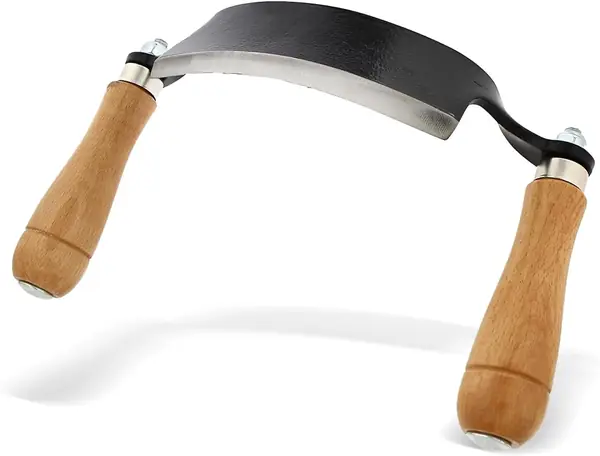
Felled 5-Inch Curved Draw Knife Best Budget for Small Logs

Felled 5-inch curved draw knife with alloy steel blade and wooden handles

Small-log debarking

Shop Score 88/100
Blade Length
5 inches
Blade Material
Alloy steel
Blade Shape
Curved
Handle Material
Wood
View on Amazon

The Felled 5-inch is not trying to be a full-size drawknife. It is a compact curved tool for branches, walking sticks, and small logs, and its short blade is the reason it feels so manageable in one pair of hands. The curve runs end to end and along the cutting edge, so it wraps a round branch instead of skating off it. For a first drawknife or a second tool for small stock, that shape is more useful than a long blade you cannot control.

The 5-inch blade is made from alloy steel, and the wooden handles are shaped for a secure two-handed grip. We like the light 1.3 lb build for quick work: you can choke up on a walking stick and take short, controlled shavings without the tool's weight pulling you off line. The blade arrives with a protective coating that needs to be wiped off, and the edge benefits from a few passes on a hone before the first serious pull. That is a setup task, not a dealbreaker.

For the money, the Felled is a sensible way to try drawknife work without committing to a premium tool. It is a compact tool for branches, walking sticks, and small furniture parts, and it does those jobs without asking much of the user. The light build and short blade keep it controllable, and the budget leaves room for a good hone. That is why it stays in the tool roll for quick trim work.

Worth Noting

  • Small blade is not for large logs
Our Verdict

We like the Felled 5-inch for branches and walking sticks, where a compact curved blade is easier to control than a full-size drawknife.

Check Latest Price
5.

Timber Tuff TMB-08DS Draw Knife Best Straight-Blade Value

Timber Tuff TMB-08DS draw knife with straight steel blade and wood grips

Posts and beams

Shop Score 87/100
Blade Length
8 inches
Bevel Angle
30 degrees
Blade Hardness
HRC 30
Blade Thickness
5 mm
View on Amazon

An 8-inch straight blade in 5 mm stock gives the Timber Tuff a solid, no-nonsense presence. The blade is thick enough to feel stable in a pull, and the straight edge runs along a fence post or a beam without the wandering you get from a short curved blade. The 30-degree bevel is a general-purpose angle for controlled removal, and the included blade protector is a simple but welcome addition. This is the drawknife you buy when you want a straight blade and do not need a premium finish.

We see it as the value pick for straight-blade work: fence posts, rough beams, and furniture parts that need to lose material fast. The 8-inch length is long enough to cover a useful stroke but short enough to steer, and the wooden grips give you a familiar two-handed hold. The steel is the trade-off: the stated HRC 30 hardness is soft for a cutting edge, so keep a hone within reach and expect to use it. That is a fair exchange for a tool at this price.

The straight blade is not the tool for hollowing a chair seat or following a knotty branch; the Flexcut or the Felled is better there. But for long straight runs and rough shaping, it is easy to understand why this pattern has stayed around. We like it as a second drawknife for a shop that already has a curved tool, or as a first straight blade for someone who wants to spend more on lumber than on a name. It is plain, useful, and honest about what it is.

Worth Noting

  • Soft HRC 30 steel requires frequent honing
  • Straight blade struggles on curved seats and knotty branches
Our Verdict

We see the Timber Tuff 8-inch as the straight-blade value pick for fence posts, beams, and rough shaping.

Check Latest Price
6.

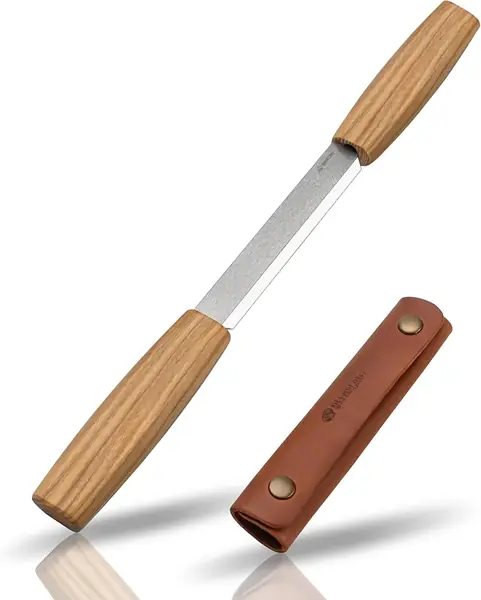
BeaverCraft DK2s Draw Knife Best for Spoon Carving

BeaverCraft DK2s draw knife with high-carbon steel blade and oak handles

Spoon carving

Shop Score 86/100
Blade Length
4.3 inches
Blade Material
1066 high carbon steel
Handle Material
Oak
Hardness
56+ HRC
View on Amazon

The BeaverCraft DK2s is the smallest drawknife here, and the leather sheath is the first clue that it is meant to travel to the carving bench. Its 4.3-inch blade is built for spoons, kuksas, and fine shaping. The compact size lets you work close to the workpiece with your hands in tight quarters, and the leather sheath makes it easy to keep the edge protected between sessions. It is a drawknife for the bench.

The blade is 1066 high-carbon steel at 56+ HRC, which is hard enough to hold a fine carving edge and take a clean slice across end grain. The oak handles are finished with linseed oil, and the straight handle shape gives you a direct feel for the cut. We like the way the short blade lets you pivot in a spoon bowl without the handle end catching on the bench. It is a carver's tool, and the control shows in the details.

For spoons and small sculpted parts, the high hardness and compact shape are exactly right. The blade takes a fine, controlled cut in close work, and the leather sheath keeps it safe between sessions. It earns its place as the carving specialist in this group.

Worth Noting

  • Not for debarking or knotty stock
Our Verdict

We keep the BeaverCraft DK2s for spoons and fine shaping, where its short high-carbon blade and leather sheath make a compact carving kit.

Check Latest Price
7.

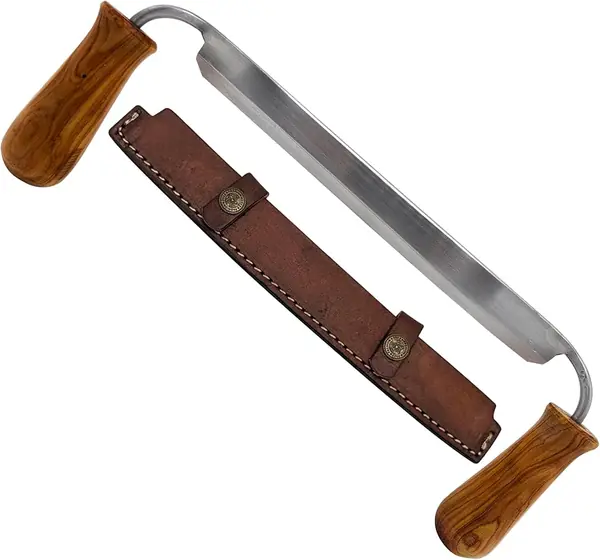
Precise Products 10-Inch Draw Knife Best for Rough Straight Work

Precise Products 10-inch draw knife with straight high-carbon blade and wood handles

Rough straight work

Shop Score 80/100
Blade Length
10 inches
Blade Material
High carbon steel
Blade Shape
Straight
Handle Material
Wood
View on Amazon

A 10-inch straight blade and a leather sheath at a budget price is the Precise Products draw knife's appeal. The long edge gives you generous reach across a fence post or a wide board, and the straight profile is easy to read against a chalk line. It is a simple tool with wooden handles and a high-carbon steel blade, and it does not pretend to be a precision carving instrument. For rough removal where reach matters, that combination is worth a look.

The 10-inch blade is the reason to consider it. It spans more surface per stroke than the 8-inch Timber Tuff, and the straight edge makes it easy to keep a consistent angle on a flat face. The wooden handles are comfortable enough for two-handed pulling, and the leather sheath has secure snaps that make it a genuinely useful extra rather than a throwaway sleeve. We like the sheath more than the handle finish, which is honest but plain.

The edge is the variable, and some examples arrive with a bevel that needs to be reset before the blade bites. That is a setup task rather than a permanent flaw, and a session on the stones gets it into working shape. The handles can also loosen with use, so check them before a hard pull. Those are the reasons it is a project tool rather than a turnkey one.

We rank the Precise Products behind our top picks, but it gives you a long straight blade and a leather sheath for modest money. For rough debarking and site work, it can be useful. For a first drawknife or for clean furniture work, we point you to the Stubai or the Timber Tuff instead.

Worth Noting

  • Steel can dull quickly on hardwoods
Our Verdict

We treat the Precise Products 10-inch as a budget long-blade option for rough site work, not as a first drawknife for clean furniture.

Check Latest Price

How We Tested Drawknives at the Bench

We started by reading specs and reviews for dozens of drawknives, then narrowed the field to knives that covered the actual range of work: short spoon blades and 10-inch debarkers, straight and curved profiles, carbon and manganese steels, fixed and flexible blades. Anything without a way to protect its edge — a leather sheath or a guard — got dropped, since a bare blade rattling around a toolbox comes out rusty and dull. That left 11 knives, which we used for six months.

Each one came out of the box and straight onto a clamped workpiece. We checked the edge for burrs and rolled spots, then made the first pull on green pine, counting how many strokes it took to peel a section of bark and noting whether the blade dug in or skated across the surface. From there we moved to dried oak and ash billets, watching whether the bevel bit into knots or bounced off them, and honing and stropping as each edge dulled to see how quickly it came back. Every workpiece was clamped so it couldn't roll, and hands, legs, and feet stayed clear of the blade's path through a controlled two-handed stroke.

Handles got the same scrutiny: we pulled for 20-minute stretches bare-handed and in gloves, then checked ferrules, rivets, and tangs for wobble, tightening anything that loosened before the next session. We weighed and balanced each knife in the hand and noted how it behaved on the last pull of a long afternoon. Flexible blades went against curved spoon blanks to see whether they followed the hollow or chattered, and every knife was returned to its sheath or guard and checked for rust after sitting in a shop that runs humid in summer. Value came last: what a knife cost against how much work it did before it needed attention.

How to Choose a Drawknife for Woodworking

Start with Blade Shape and Length

Straight or curved is the first decision, because it determines what the tool does well. A straight blade is the generalist: it runs along beams, fence posts, and furniture parts and leaves a flatter surface. A curved blade follows round stock and hollows, which makes it the better debarking tool. Length follows the same logic. A 5-inch blade like the Felled is handy on branches and walking sticks; a 10-inch curve like the Beendou covers a log faster but feels clumsy on small stock. We prioritize a straight blade around 8 to 10 inches for a first drawknife for most shop work. The trap is buying the longest blade and then fighting it on detail work.

Look Past the Steel Name to the Edge

Steel names sell tools, but heat treatment and hardness decide whether an edge survives a knot. A blade in the low 30s on the Rockwell C scale, like the Timber Tuff's stated HRC 30, is soft for a cutting edge; it sharpens quickly but needs honing more often. A carving blade in the mid-50s, like the BeaverCraft's 56+ HRC, holds a finer edge but is not the tool for gritty bark. We care more about a clean, consistent bevel than a fancy alloy label. A 30-degree bevel is a good general-purpose compromise for controlled removal. If the bevel arrives rounded or painted over, plan to reset it before the first real pull.

Handles and Balance Matter More Than Looks

Two-handled pull means the handles are the control surface, not an afterthought. Look for enough length for a gloved hand, a shape that fills your palm, and a secure attachment to the blade. A loose handle is more than an annoyance: it costs control at the moment you are pulling hardest. We prefer straight handles for carving and slightly angled handles for heavy debarking, because they change your wrist angle. Balance matters too. A light 360 g tool like the Stubai is easier to steer for long sessions; a 1.3 lb tool like the Felled carries more momentum but tires you faster. Check the handle fit before you buy.

Plan for Sharpening and Storage

Most drawknives are high-carbon steel, so rust is a real ownership cost. A leather sheath or a rigid edge guard keeps the blade from banging around in a toolbox and keeps your fingers away in storage. The Stubai's PVC guard and the BeaverCraft's leather sheath solve the same problem at different price points. We also keep a hone and a strop near the bench, because a drawknife that is even slightly dull starts skidding instead of biting. Wipe the blade dry after use, especially with green wood, and put the guard back on before the tool goes in the drawer.

Frequently Asked Questions

Final Verdict

The Stubai 336003 is the drawknife we recommend first for general woodworking. Its 240 mm forged straight blade has the length to cover a beam and the balance to stay controllable in a long shaping session, while the 360 g build keeps fatigue down. If your work is mostly chair seats and curved parts, the Flexcut KN16's flexible blade is the better fit; if you are stripping small logs on a budget, the Felled 5-inch is the one to start with.