↑↓ navigate ↵ open Esc close All results →

Best Card Scrapers for Woodworking of 2026

A properly tuned card scraper peels glue lines, reversing grain, and old finish in gossamer shavings without raising dust or leaving random-orbital swirl marks, yet few cards arrive in the package ready to cut. What separates a card that sings across a tabletop from one that chatters and skips is factory edge squareness and steel tempered soft enough to take a clean hook from a burnisher.

Across four months of dressing panel glue-ups, tabletops, and painted trim with 14 single cards and multi-piece sets, steel hardness proved to be a balancing act rather than a race to the highest number. Overly hard steel resists rolling a fresh burr on the bench, while a thinner, more compliant blade flexes cleanly into slight hollows.

From individual rectangular plates for flat panels to curved gooseneck profiles and kits that bundle a burnisher in the box, the six options below match different bench setups and trim tasks.

Our Top Picks

The Best Card Scrapers for Woodworking

1.

DFM Tool Works Blue Card Scraper Set Best Overall
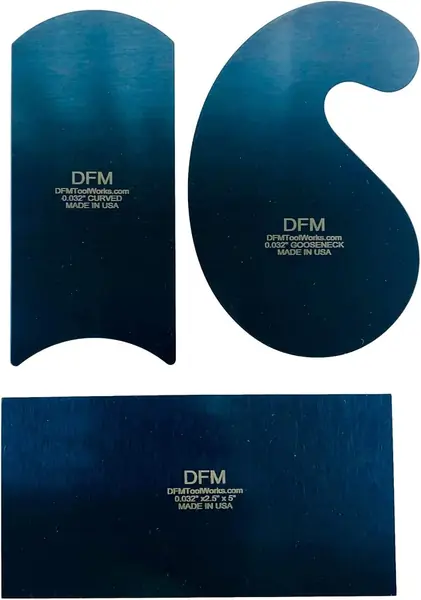
DFM Tool Works three-piece blue spring steel card scraper set in different profiles

General woodworking

Shop Score 94/100
Thickness
0.032 in (0.81 mm)
Card Size
5 x 2.5 in
Cards Included
3
Hardness
50 HRC
View on Amazon

Three cards of different profiles in one pack is the reason this DFM set leads our list. Each is 5 by 2.5 inches, 0.032 inch thick, and cut from American blue spring steel hardened to 50 HRC — the same stock DFM uses in its two-packs, but finished in a range of shapes rather than two identical rectangles. That range is what a beginner actually needs: one card for the flat of a panel, another for a curve or a molding, and a third when the first one goes dull in the middle of a glue-up.

What sold us is how little you give up for the range. A 50 HRC edge turns an even burr and keeps it through a hardwood panel without a touch-up, and on a board a hand plane kept tearing, a few passes left a surface that needed only a light sanding. You also pay less per card than either single card in this guide, so the set is the easier recommendation over buying one card at a time.

Where the set earns its keep is the division of labor. We keep one card at a fine burr for the last pass and leave a second coarser for glue lines and old finish, so a project does not stall while an edge goes; the third becomes the loaner, which is the highest compliment a tool gets in a shared shop.

Worth Noting

  • Cards arrive needing a joint and a hone
  • Burnisher sold separately
Our Verdict

We recommend the DFM set to most woodworkers: three profiles of American spring steel at a lower cost per card than either single card here.

Check Latest Price
2.

Bahco 474 Cabinet Scraper Best Single Card

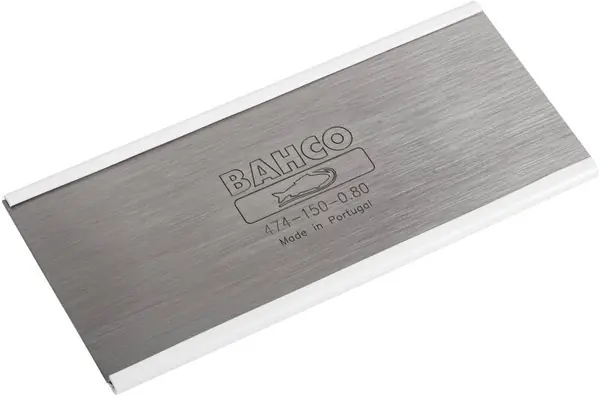
Bahco 474 single chrome-nickel steel cabinet scraper with white plastic edge protector

Flat panel work

Shop Score 93/100
Thickness
0.8 mm
Card Size
6 x 2.5 in
Cards Included
1
Steel Type
Chrome-nickel steel
View on Amazon

The Bahco is the card we hand someone who wants one scraper and no set to manage. At 6 by 2.5 inches it runs an inch longer than the 5-inch cards here, which gives you a longer stroke down a stile or across a tabletop, and 0.8 mm of chrome-nickel steel keeps it flat under pressure. A plastic edge protector comes in the bag, which matters more than it sounds — a burred card thrown loose in a toolbox arrives at the next job with its edge rolled over.

Stiffness is the whole personality of this one. Press it into a hollow and it fights you, so it is not the card for shaped work; on flat stock that same rigidity keeps the burr in contact with the surface instead of letting it skate. The steel takes a burr without a fight and holds it a long time, and a scraper that outlasts a stack of sandpaper on a refinishing job pays for itself in an afternoon.

It is also the lowest price in this group, which makes it the least expensive way to find out whether scraping suits the way you work. One card is plenty for that experiment. If the ribbons of shaving turn out to be the point, that is the moment to look at a set.

Worth Noting

  • One card only, no curved or gooseneck profiles
Our Verdict

If you want one card instead of a set, we point you to the Bahco: a stiff six-inch plate that takes a burr easily and keeps it.

Check Latest Price
3.

Fulton 6-Piece Card Scraper Set Best All-In-One Kit

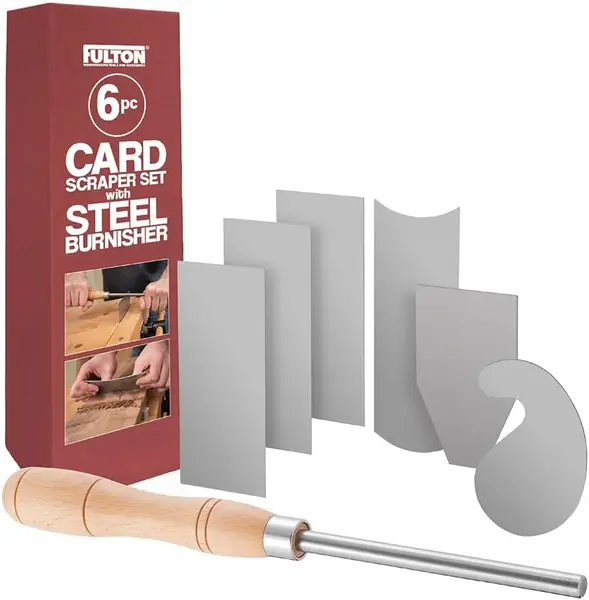
Fulton six-piece card scraper set with wooden-handled burnisher and four scraper profiles

First scraper purchase

Shop Score 91/100
Profiles
Flat, curved, gooseneck, beveled
Burnisher
Hardened steel rod, wood handle
Scrapers Included
Six
View on Amazon

The reason to buy the Fulton set is the rod lying next to the scrapers. You cannot raise a burr without a hardened burnisher, and this kit packs a 3/8-inch hardened steel rod on a hardwood handle in with six scrapers: three rectangles, a curved card, a gooseneck, and a beveled card.

The shapes are the second half of the argument. A gooseneck reaches into the bottom of a rabbet or around a chair spindle where a flat card simply cannot go, and the beveled card gets into an inside corner without gouging the face beside it. Three rectangles sound like filler until you are mid-project with a dull edge, and then the spare is the most valuable thing in the bag.

As a first purchase we think the combination is worth more than the steel alone: the tool that makes the scrapers work ships in the same box, so there is no second order and no guessing which rod to buy. At this price, with the burnisher included, the kit costs less than a good card plus a rod bought separately.

The printed instructions do more work than the paper suggests. They walk through jointing the edge flat, honing, and turning the burr in that order, which is the sequence most people get wrong on their first card; follow them once and the second scraper goes quickly. The whole kit weighs 1.28 pounds and travels in its own bag between projects.

Worth Noting

  • Cards arrive rough and need full preparation
Our Verdict

We hand this set to anyone buying their first scraper: six shapes and the burnisher you need to put an edge on them.

Check Latest Price
4.

Crown Hand Tools 375 Cabinet Scraper Set Best for Flat-Panel Finishing

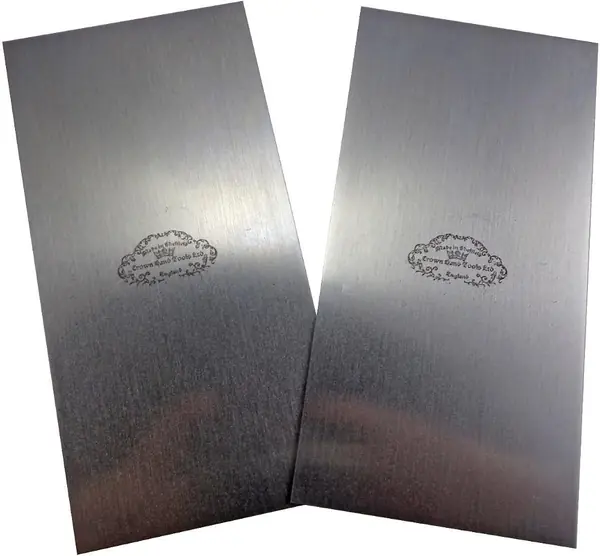
Crown Hand Tools two-piece rectangular high carbon steel cabinet scraper set from Sheffield

Finish passes

Shop Score 90/100
Thickness
0.032 in
Card Size
5 x 2.5 in
Hardness
40/42 HRC
Edge Type
Milled, not stamped
View on Amazon

Two cards come in a bag under a light film of oil, and the first thing you notice at the stone is the edges. They are milled rather than stamped, so they arrive flat and square and jointing takes a few strokes instead of a session with a file. Both cards are 5 by 2.5 inches at 0.032 inch, rolled from medium carbon steel hardened to 40/42 HRC in Sheffield.

That 40/42 hardness is the softest steel here, and we like what it buys. Press a thumb into the middle of a card and it bows, so you can lighten a pass across a broad panel where a stiffer card's corners want to dig in. For the last pass before finish these are the cards we pick up first: the flex lets you feather pressure at the end of a stroke instead of leaving a chatter mark.

The trade is edge life. A soft burr rolls over sooner than the 50 HRC edges on the DFM cards, so on a run of panels you are back at the burnisher between boards rather than between projects. For a furniture maker turning out a few pieces at a time that is an easy exchange; a production shop feels that difference by mid-morning.

Worth Noting

  • Both cards are flat, so no curved profiles
Our Verdict

For flat panels and a final pass before finish, we choose the Crown pair: milled edges, springy Sheffield steel, and the least prep of anything here.

Check Latest Price
5.

DFM Tool Works Rectangle Card Scraper 2-Pack Best for Flat Panels

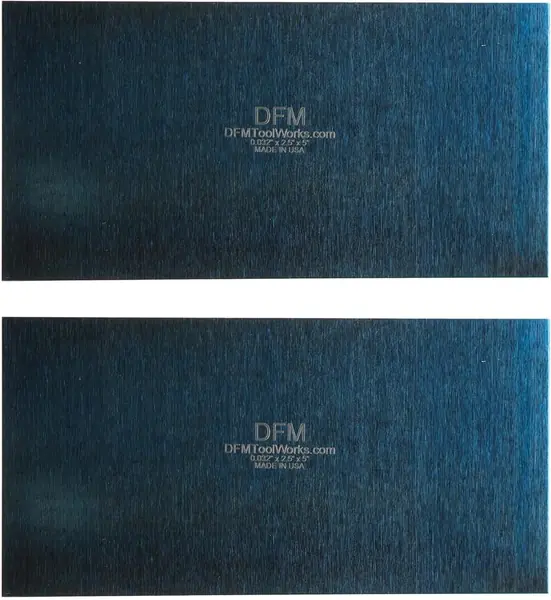
DFM Tool Works two blue rectangular card scrapers in 0.032-inch spring steel

Flat panels

Shop Score 89/100
Thickness
0.032 in
Card Size
5 x 2.5 in
Cards Included
2
Hardness
50 HRC
View on Amazon

If the top pick's steel is what appealed and you do not need the shapes, this two-pack is the cheaper way in. Same 0.032-inch American blue spring steel at 50 HRC, same 5 by 2.5 inch face, two identical rectangles instead of three profiles. If you already own a burnisher and work almost entirely on flat panels, we think that is all you need.

What we noticed in use is how little time they take to bring back. DFM files the long edges smooth before shipping, so the first honing goes faster than on a card straight off a shear, and a burr comes up in a handful of strokes. Check the working edges for nicks before you joint them, though — a card with a ding telegraphs it into the surface long after you have forgotten where it came from.

Worth Noting

  • Costs more per card than the three-card set
Our Verdict

We keep this two-pack for flat work: two identical 0.032-inch cards that hone fast, provided you already own a burnisher.

Check Latest Price
6.

HERMIT TOOLS 4-Piece Scraper Set with Burnisher Best for Trim and Repairs

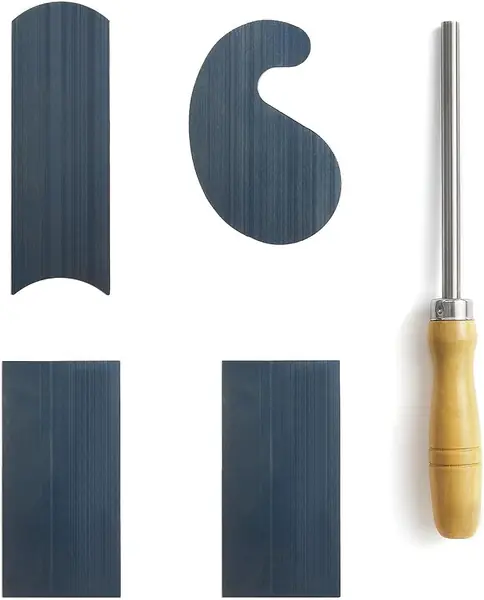
HERMIT TOOLS four-piece blue spring steel scraper set with wooden-handled burnisher rod

Trim and repairs

Shop Score 84/100
Thickness
0.031 in (0.80 mm)
Cards Included
4 (two rectangle, one curved, one gooseneck)
Burnisher Length
11 in
View on Amazon

Four cards and a burnisher in one bag: two rectangles, a curved card that works convex on one face and concave on the other, and a gooseneck, all in 0.031-inch blue spring steel. The burnisher is an 11-inch rod with a wooden handle thick enough to fill your palm.

The curved card is the sleeper of the four. It shapes a cove on one face and a roundover on the other, so a molding comes together without swapping tools between passes, and the gooseneck takes shavings out of a recess that no flat card can reach. The handle is more help than it looks, too — two hands on an 11-inch rod steady the burr on a narrow card.

We reach for this set on trim, repairs, and small parts rather than panel work, and it is the cheapest route here to both shapes and a burnisher in a single order. One thing to watch at checkout: the listing is sold in several configurations, so confirm the version in your cart is the burnisher plus the four cards before you pay.

Worth Noting

  • Hard steel takes patience to burnish
Our Verdict

We recommend this set for trim and repair work: the cheapest way here to get four profiles and a burnisher in one order.

Check Latest Price

How We Tested Card Scrapers

We started by reading the listings closely, then reading the reviews, and shortlisted cards on steel type, thickness, size, profile range, and whether a burnisher came in the box. Anything whose photos or specs looked inconsistent got dropped. We ended up buying 14 cards, singles and sets alike, and put them into rotation for four months.

Before any of them touched wood, we looked at each edge under a raking light: whether it was milled or stamped, whether it sat square, and whether it would take a shaving straight out of the package. Then we prepped every card identically — jointed the edge flat on a diamond stone, honed the face, rolled a burr — timing the job and counting burnisher passes so we could tell which cards needed five minutes and which needed twenty.

From there they went to work: glued-up panels with squeeze-out, a maple tabletop with raised grain, painted trim, and a repair on a chair rail. We counted passes before a burr gave out and the card started to skip, watched for chatter on end grain, and noted how each one felt after an hour — hot spots, flex, cramping. Cards stayed in holders between passes, we kept our fingers behind the cutting edge, and when an edge dulled we burnished it back rather than leaning harder on the steel.

We also compared what arrived against what the listing promised, read whatever instructions were included (several came with none), and checked whether the supplied burnishers were hard enough not to gall the edge. Finally, we weighed cost per card and counted how many grits of sanding each scraper actually let us skip.

How to Choose a Card Scraper

Every Card Needs Prep, Even the Sharp-Looking Ones

Cards ship with a square, filed edge, and that edge does not cut. What cuts is the burr you roll over with a hardened rod after jointing the edge flat and honing the face. Even a card that feels sharp out of the bag is only a card with a good edge to start from.

A milled edge arrives flatter and saves you file work; a stamped one takes longer to true up. Budget a mill file, a fine stone, and a burnisher with your first order, and plan a bench session before the first shaving.

Stiffness and Hardness: Match the Card to the Work

Almost every card is about 0.032 inch thick, so feel comes from hardness as much as thickness. A 50 HRC card like the DFM holds a stiff, long-lasting burr and stays flat across a panel; it also resists flexing into shaped work and tires your hands sooner. A 40/42 HRC card like the Crown bows under thumb pressure, follows a crowned surface, and gives up its burr faster.

Decide by your work: panels and glue lines want the stiff card, edges and curved parts want the springy one.

Which Profiles Are Worth Having

A rectangle does most of what a card scraper is for: panels, glue squeeze-out, old finish, leveling a joint. Add shapes only when the work asks. A curved card shapes coves and roundovers, a gooseneck reaches into recesses and around spindles, and a beveled card works an inside corner without scarring the face beside it.

The trap is a big set of profiles you never touch. Two rectangles and one curved card cover a furniture maker's year more completely than nine shapes in a bag.

Count the Burnisher in the Cost

A card without a burnisher is a flat piece of steel. You need a hardened rod — roughly 3/8 inch at 62 to 64 HRC — to roll the burr, and a screwdriver shank is soft enough that it polishes the edge instead of hooking it.

Some sets here include one, and the rest do not, so add a rod to the order before the cards arrive. It is the difference between a tool and a shim.

How Many Cards, and What They Cost

One card is enough to learn on. Two is where most woodworkers settle, because you can keep one at a fresh burr while the other goes back to the stone, and pairs usually cost less per card than singles.

Sets of four to six make sense when they add a profile you will use or a burnisher you need anyway. Pay for steel and edge preparation first; a pile of shapes in soft, rough-edged steel is the most expensive way to buy a card scraper.

Frequently Asked Questions

Final Verdict

The DFM three-card set is what we tell most woodworkers to buy first: three profiles, American spring steel, and a cost per card below the single cards here. Add a burnisher to the same order, since none of the cards come with one.

If your work is flat panels and you want a card that arrives closer to ready, the Crown pair fits better. If you are starting from nothing and want the rod in the box, the Fulton set covers you.