↑↓ navigate ↵ open Esc close All results →

Best Woodworking Awls of 2026

The awl is the cheapest tool on a woodworking bench and the one that quietly decides whether the layout holds. A dull or off-center point walks off the line as you press down, and you find out when the joint goes together crooked. A good one puts the mark exactly where the pencil went and starts a hole in the same motion.

We kept 16 awls by the bench for four months, pressing them into white oak and pine, scribing plywood, starting screw holes, and carrying a couple in an apron pocket between cuts. Buyers shop by brand; point geometry changes the mark more than any logo does, and the blade-to-handle joint matters almost as much.

Nothing here is expensive, so the money question is whether a cheap one holds its point and comes back on a stone. Some take a light mallet tap and some don't, and every one wants a cork over the tip in storage. They suit different benches — joinery layout, punching, rough chores — but they all put the mark where you aimed it.

Our Top Picks

The Best Woodworking Awls

1.

Klein Tools 650 Scratch Awl Best Overall

Klein Tools 650 scratch awl with yellow and black cushion grip handle

General woodworking layout

Shop Score 95/100
Handle
Cushion-Grip
Blade
One-piece forged steel, heat-treated
Weight
4 oz
Shank Length
3-1/2 inches
View on Amazon

A one-piece forged blade that runs into a bolster at the handle is why the Klein 650 sits at the top of this list. There is no press fit and no cap to work loose, and the heat-treated shank holds a hard point that scribes sheet metal as readily as it marks a board.

In the hand it behaves like a good screwdriver, which is high praise for an awl. The cushion grip is broad enough to push against when you are starting a hole for a #8 screw, and the point stays in a penciled line instead of skating off it. We ended up using it for hinge layout, starter holes, and lifting a splinter off a shoulder, which is more than we expected from a tool this simple.

The one place it gives ground is delicacy. This is a stout, hard-pointed awl aimed at people who work with their hands all day, and if your bench time is mostly knife-wall joinery on thin stock, a slimmer tool gives you more feel for the line.

Klein builds it in the USA and covers material and workmanship with a lifetime warranty. At four ounces it sits on the bench without tiring your hand, and after a few weeks it became the awl we stop noticing while we work, which is exactly what we want from a tool this basic.

Worth Noting

  • Costs more than the other round-handle picks
Our Verdict

We recommend the Klein 650 as the default woodworking awl: a forged one-piece build that will not loosen and a grip that stays comfortable through a long layout session.

Check Latest Price

2.

Malco A20 Scratch Awl Best for the Tool Bag

Malco A20 scratch awl with steel blade and orange handle

Tool bag carry

Shop Score 94/100
Handle
Regular grip, orange
Overall Length
7.5 inches
Weight
2.72 oz
Blade Size
1/4 inch
View on Amazon

Less money than our top pick, with a lifetime warranty attached to it: that is the trade the Malco A20 offers, and it is a good one. The 1/4-inch steel blade runs 7-1/2 inches overall at 2.72 ounces, and the orange handle is easy to find in a drawer full of dark-handled tools.

Malco expects you to maintain it. The blade is meant to be resharpened, and a few passes with a fine file bring a dulled point back to something that bites. We appreciated that more than we expected to, because an awl is a small tool and being able to restore it rather than replace it is the difference between a consumable and a keeper.

There is an 1/8-inch version for finer scribing; we chose the 1/4-inch because the heavier shaft stands up to hole starting and to scribing sheet goods. It is the awl we leave in the tool bag, where the slim handle takes up no more room than a pencil, rather than in the bench drawer.

Worth Noting

  • Hard plastic grip, not a cushioned one
Our Verdict

Our value pick: a slim, USA-made scratch awl backed by a lifetime warranty, with a steel blade you can bring back to a point yourself.

Check Latest Price
3.

Narex Square Blade Birdcage Awl Best Birdcage Awl

Narex birdcage awl with stained beech handle and steel ferrule

Fine joinery layout

Shop Score 93/100
Handle
Stained beech
Blade
Square high-carbon steel
Blade Length
3-1/2 inches
Handle Length
2-1/2 inches
View on Amazon

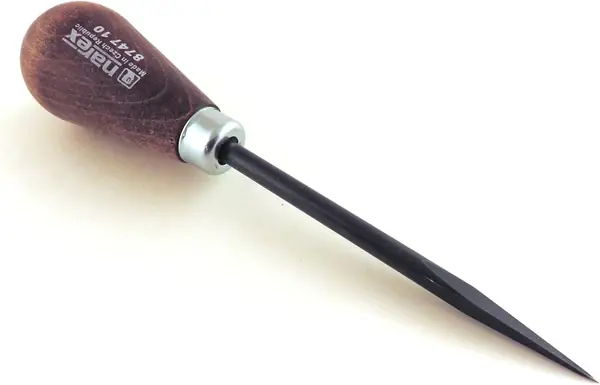
A square blade cuts where a round one pushes fibers aside. That is the whole argument for the Narex birdcage awl: the tapered square blade slices a crisp line across the grain and leaves a groove you can drop a chisel into.

The blade is high-carbon tool steel, 3-1/2 inches long, seated through a stained beech handle with a steel ferrule at the joint. In maple and oak the square taper starts a hole without skating, and the corners ream the walls slightly as you turn the blade, which gives a screw an easier start near an end-grain edge.

We reach for this one when a line has to stay readable under a straightedge, and it is the best-looking awl in the group by some distance: turned beech, a plated ferrule, and the proportions of something a small European shop has been making for a very long time. It is also the most expensive tool here, and that is the honest trade — you are paying for a square blade, hardwood, and a maker who does nothing else.

Worth Noting

  • Point may need truing before first use
  • Handle feels small for the long blade
Our Verdict

Buy the Narex if your layout work is furniture-grade: the tapered square blade leaves a line you can cut to, and it reams a clean starter hole in hardwood.

Check Latest Price
4.

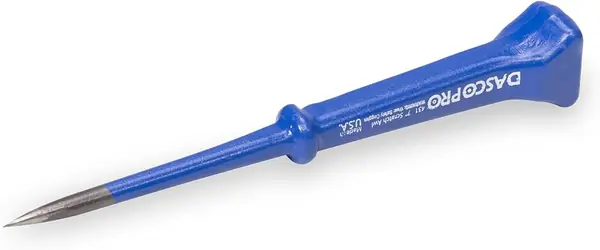
Dasco Pro 7-Inch Scratch Awl Best for Mallet Work

Dasco Pro one-piece steel scratch awl with blue finish and knurled grip

Punching and tapping

Shop Score 92/100
Overall Length
7 inches
Grip
Knurled
Material
High carbon steel
Construction
One-piece drop forged
View on Amazon

When you want to tap the end of an awl with a mallet, the Dasco Pro is the one that does not care. The whole 7-inch tool is a single piece of drop-forged high-carbon steel, so there is no handle to drive loose and no cap to rattle off onto the floor.

The point is ground on that same piece of steel, and the knurled handle gives you something to hold when your hands are slick with sweat or finish. It is a plain, blue, industrial-looking tool, and nobody will mistake it for a fine woodworking instrument.

Seven inches is the useful middle of this set: long enough to reach past a chisel into a mortise, short enough to keep the point where you put it. As a punch it is excellent — set the point, tap once, and the drill bit has a seat that keeps it from wandering across a panel.

We keep it in the drawer with the mallet rather than with the marking tools, and that is the honest read on it: this is the awl we pick when the job is closer to site work than to cabinetmaking, and it is priced to be an easy second awl for the bench.

Worth Noting

  • Point can arrive less sharp than expected
  • Shaft is thicker than a fine layout awl
Our Verdict

We pick the Dasco Pro when the awl has to take a tap: one-piece drop-forged steel with no handle to drive loose and nothing to fall off.

Check Latest Price
5.

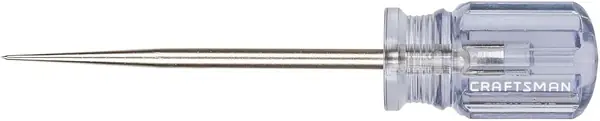
Craftsman CMHT65012 Scratch Awl Best Budget

Craftsman scratch awl with clear acetate handle and steel blade

Budget toolbox awl

Shop Score 91/100
Handle
Clear acetate
Overall Length
7.44 inches
Blade Steel
Heat-treated alloy steel
View on Amazon

Every toolbox drawer deserves one awl that nobody worries about, and the Craftsman is that awl here. It runs 7.44 inches overall with a clear acetate handle and a heat-treated alloy blade in a satin-nickel finish.

The point is fine enough for layout and stout enough for starting holes, and the clear handle has a practical upside we did not expect to care about: you can see how far the shank runs into it, so there is no guessing how much of the handle is actually holding the blade.

Where it earns its keep is alignment. Set the point into a screw hole, walk the panel until the next hole lines up with the framing, and drive the screw — the kind of small job that is maddening with a drill bit and easy with an awl. That is why it is the one that lives in the garage toolbox and the one we hand to a neighbor.

Worth Noting

  • Acetate handle is slicker than a rubber grip
Our Verdict

Our budget pick: a simple, sharp awl that covers layout and hole starting without asking much of your wallet.

Check Latest Price
6.

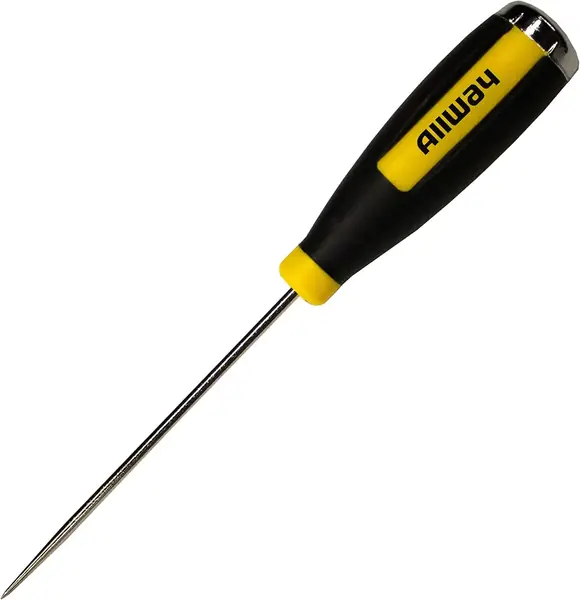
Allway IPS Scratch Awl Best for Rough Shop Chores

Allway IPS scratch awl and ice pick with black soft-grip handle

Rough shop chores

Shop Score 90/100
Handle
Soft grip
Overall Length
10.5 inches
Blade
High-carbon steel
Butt End
Diecast hammer end
View on Amazon

The diecast hammer end is the detail most shoppers skip past, and on the Allway it is the reason to buy. Soft grip in one hand, a hammer end at the other: you can set the point and tap it without putting the awl down to hunt for a punch.

At 10.5 inches overall it is the longest tool in this group, which cuts both ways. You get real reach into a wall cavity or a deep hole, and you give up some of the fine control a six-inch awl gives you at the bench. The high-carbon steel point is a working point rather than a jewel — this is a tool also sold as an ice pick, and it is finished accordingly.

What we like is that it does not pretend to be anything else. It is a shop tool for punching drywall, starting anchors, and clearing a hole that has closed up, and it is the least expensive way into an awl with a striking end.

Worth Noting

  • Long 10.5-inch length trades away fine bench control
  • Coarse working point lacks refined finish of layout awls
Our Verdict

Pick the Allway for rough shop work: a soft grip and a hammer end at the low end of this group's prices.

Check Latest Price
7.

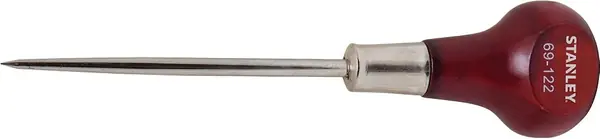
Stanley 69-122 Scratch Awl

Stanley 69-122 scratch awl with hardwood handle and chrome ferrule

Light bench layout

Shop Score 89/100
Handle
Machined hardwood
Overall Length
6-1/16 inches
Weight
2.08 oz
Blade Length
3-3/8 inches
View on Amazon

In the palm, the Stanley 69-122 is the most old-fashioned tool here, and that is meant as praise. A large, rounded hardwood handle, a chrome ferrule, and a 3-3/8-inch alloy blade on a body of about six inches: nothing about it looks like it was designed in the last forty years.

The handle shape is what we like most. It gives you leverage without digging into your palm the way a skinny punch does, and the wood stays warm in a cold shop. At 2.08 ounces it is light enough to forget you are holding it, and for light layout work — a pencil line, a hinge leaf, a row of pilot marks — it does everything you ask.

It is also a sensible first wood-handled awl, and a good second one for the bench. The blade is heat-treated alloy steel with a plated finish that resists corrosion, so it will live in an unheated shop without much fuss, and the ferrule keeps the grip from splitting the way a bare wood handle eventually can.

Worth Noting

  • Ferrule and cap can work loose over time
Our Verdict

We like the Stanley for light bench layout: a light, traditional hardwood-handled awl that feels natural in the hand.

Check Latest Price

How We Chose and Tested These Awls

We started by pulling every scratch awl we could find from brands we already trust at the bench, then filtered by point shape, how the blade meets the handle, blade and overall length, and price against the rest of the field. That left 16 awls, and we spent four months with them.

Each one lived in the shop rather than on a bench mat. We pressed the point into pine and white oak, end grain and long grain, and checked the mark against the knife line; we dragged each point along a steel rule to see whether it wandered; we scribed plywood for hinge locations and started screw holes in softwood and hardwood. Between cuts, a couple rode in an apron pocket and one in a tool bag, cap on, to see how the handle sat against a hip and whether the point survived being jostled.

Sharpness was judged on arrival and again after a few hundred marks, then we tried bringing each point back on a diamond stone to see which took an edge and which just wore down. An hour of dovetail layout per awl showed where the grip started to bite — knurled and acetate handles read very differently at the fiftieth mark than at the fifth.

We checked the joint by twisting each handle under pressure and watching for movement, tapped the butt end lightly with a mallet only on the awls built for it, and never levered or pried with a tip, since a bent point is how these fail. Every awl got a cork or a wrap of tape before it went back in the drawer, and at the end we weighed each one's price against the rest of the set.

How to Choose a Woodworking Awl

Start With the Point Shape

Most awls sold for woodworking are scratch awls, with a round, tapered point that scribes soft stock, starts a screw hole, and punches through drywall. A birdcage awl is different: its blade is square in cross-section, tapering to a point, so it cuts a cleaner line across the grain and reams a slightly tapered hole as you turn it.

Check the blade's cross-section, not the name on the box — plenty of round-point awls get called birdcage. If you cut joinery to a knife line, the square blade is worth the extra money; if you mostly start holes, a round point is easier to control.

Look Hard at the Handle Joint

Where the blade meets the handle is where an awl eventually fails. Traditional awls press the blade through a wood or plastic grip and hold it with a ferrule and a cap, and those joints can loosen after repeated mallet taps or a season in a damp shop. A one-piece forged awl has nothing to loosen because the steel runs from point to butt.

Our rule: if you plan to tap the end, buy a one-piece design or one with a hammer end, like the Dasco Pro or the Allway. If you only mark and start holes by hand, a wood handle is fine and feels better in the palm.

Match Length and Grip to the Work

Overall lengths in this group run from about six inches to ten and a half, and the shorter tools are not the lesser ones. A six-inch awl sits in the hand like a pencil and gives fine control at the bench; a longer, heavier awl reaches into a wall cavity or a deep mortise but feels vague on a delicate line.

Grip material follows the same logic. Rubber and soft grips are kinder during long sessions of pushing; hardwood stays warm and slim and slips into an apron pocket. Buy for the work you do most weeks, not the work you imagine doing.

Plan on Sharpening It

Every awl here is high-carbon or alloy steel, and every one of them can be brought back to a point with a fine file or a stone. Expect to touch up a new awl before its first serious job: a factory point is often ground for shipping rather than for paring a line. A square blade sharpens on three faces, a round point on a rotating stroke.

Keep a cork or a wrap of tape over the point in a drawer, and never lever with the tip. A bent point is the most common way these tools die, and it usually happens on a job a screwdriver should have done.

Frequently Asked Questions

Final Verdict

The Klein Tools 650 is the awl we recommend to almost everyone: a one-piece forged blade that will not loosen, a cushion grip that stays comfortable through a long session, and a hard point that handles scribing and hole starting without complaint. It costs more than the budget picks here, and we think the difference buys a tool you stop thinking about.

If your work is furniture-grade and you cut to a knife line, the Narex birdcage awl earns its premium with a square blade that leaves a groove worth cutting to. And if the awl is going into a tool bag rather than a bench drawer, the Malco gives you most of the Klein's usefulness, a lifetime warranty, and a blade you can sharpen yourself.