↑↓ navigate ↵ open Esc close All results →

Best Coping Saws of 2026

On paper, a coping saw could not be simpler: a C-shaped frame, a handle, and a pinned blade. Yet flimsy frames flex under tension, pins slip out of shallow slots, and cheap saws turn a routine trim cope into a chewed-up corner.

Cutting with 14 coping saws over six months showed where real control comes from. A blade that rotates cleanly inside the frame proves genuinely useful when coping long runs tight against a wall with no swing room for the handle, while frame depth and blade length balance each other—deep throats clear tall molding, but longer blades are harder to steer through tight curves.

Included spare blades also carry more value than most buyers expect, since hardwoods chew through cheap stock blades quickly compared with frames engineered to keep tension high and cuts true.

Our Top Picks

The Best Coping Saws

1.

Olson SF63510 Deluxe Coping Saw Best Overall
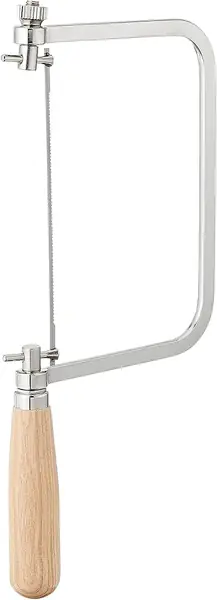
Olson SF63510 Deluxe coping saw with chrome frame and hardwood handle

All-around coping

Shop Score 91/100
Blade
15 TPI high-speed steel
Blade Length
6-1/2 inches
Frame Depth
4-3/4 inches
Blade Tension
Adjustable at both ends
View on Amazon

Tension is the whole game with a coping saw, and the Olson gives you two places to set it: a thumb screw at the front and the handle at the back. That two-end adjustment lets you get the blade taut without overtightening one end. The blade also turns a full 360 degrees, so you can change cutting direction without unclamping the work, and the 6-1/2-inch size is a common one to replace.

For trim and small cutouts, this is the saw we reach for first. The 4-3/4-inch frame keeps the saw compact and easy to steer, and the 15 TPI high-speed steel blade leaves a controlled edge in wood. The hardwood handle adds a sure grip when you are turning a tight profile, and at 9.6 ounces the saw feels balanced rather than nose-heavy. We especially like that the front screw and rear handle work together; tensioning feels like one adjustment, not a fight between two ends.

The same frame is a practical match for plastic and thin metal, though we switch to a finer-tooth blade for metal than the stock 15 TPI. For a shop that cuts curves in several materials, the Olson is the most straightforward starting point.

Worth Noting

  • Shallow 4-3/4-inch frame limits deep cutouts
Our Verdict

We recommend the Olson as the default coping saw for anyone who wants a stiff frame, easy two-end tensioning, and a blade that turns 360 degrees without fuss.

Check Latest Price
2.

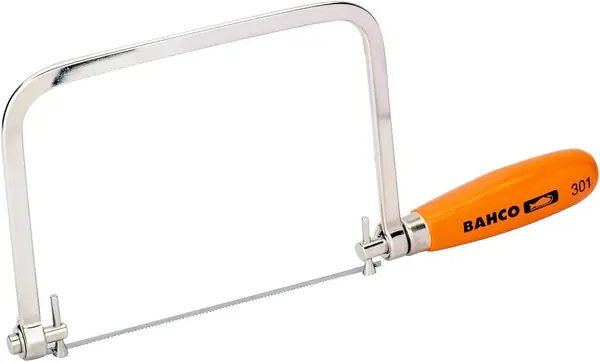
Bahco BAH301 Coping Saw Best for Joinery

Bahco BAH301 coping saw with nickel-plated frame and beech handle

Joinery and dovetails

Shop Score 90/100
Blade
14 TPI hardened carbon steel
Blade Rotation
360 degrees
Frame
Nickel-plated steel
Handle
Beechwood
View on Amazon

A coping saw frame does not need to be heavy to feel planted, and the Bahco's nickel-plated steel frame has a rigidity we noticed as soon as we put it under tension. We prefer that planted feel for dovetails and other joinery, where a wandering blade shows up immediately. The beech handle screws down tightly and sits comfortably in the palm, and the blade rotates a full 360 degrees on its retaining pins.

The supplied 14 TPI carbon-steel blade is hardened and tempered, and it leaves a controlled surface in hardwood when you let the teeth work. We like that the blade can be turned to cut from an awkward angle without repositioning the work, which is the sort of small convenience that matters when you are fitting a joint. The frame stays out of the way on shallow curves, and the simple screw-and-handle tensioning is easy to repeat.

At 8.8 ounces it is light enough to keep in a toolbox without noticing, and the wood handle gives it a traditional feel that plastic grips do not match. We reach for it when the cut is joinery rather than a mixed-material errand, and the 14 TPI blade leaves a clean surface in hardwood.

Worth Noting

  • Only one blade supplied
Our Verdict

Choose the Bahco if you want a notably rigid frame and a comfortable beech handle for dovetails and other fine joinery; we prefer its planted feel.

Check Latest Price
3.

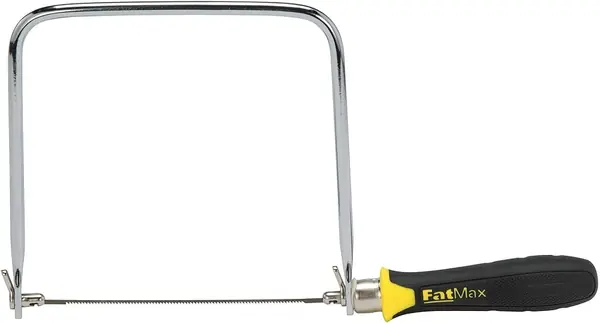
Stanley 15-106A Coping Saw Best Budget

Stanley 15-106A coping saw with steel frame and cushion-grip handle

Budget trim work

Shop Score 89/100
Blade
Hardened carbon steel
Blade Rotation
360 degrees
Included Blades
4
Blade Indexing
45-degree increments
View on Amazon

The value case for the Stanley is easy to see: it is the least expensive saw here, and it arrives with four blades rather than one. The steel frame and cushion-grip handle are simple, and the 360-degree blade indexes in 45-degree steps so you can return to a repeat angle without guessing.

What we like for occasional trim work is how little fuss the saw asks for. The hardened carbon blade cuts cleanly enough for baseboard copes and light craft work, and the indexed rotation is more useful than a free-spinning blade when you are making the same cut again and again. The cushion grip is comfortable in a gloved hand, and the saw is light enough to use overhead without tiring.

This is not the saw for a full day of coping thick stock; the lighter frame gives up some stiffness to the Bahco and Olson. For a homeowner or weekend woodworker who needs a capable saw for a few projects a year, that is a fair trade. The four included blades also mean you can keep working after the first one dulls.

Worth Noting

  • Frame can snap under heavy use
Our Verdict

We think the Stanley is the smart buy for occasional trim work, especially if four included blades and indexed rotation matter more to you than a premium frame.

Check Latest Price
4.

KAKURI No.7260 Coping Saw Set Best for Mixed Materials

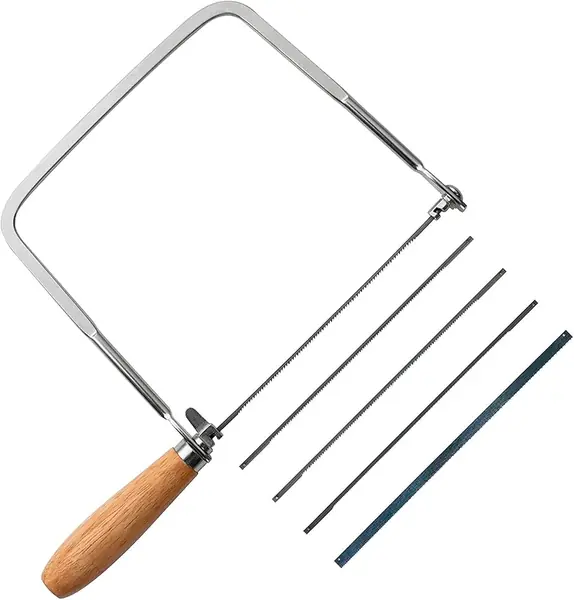
KAKURI No.7260 coping saw set with wooden handle and five blades

Mixed-material cutting

Shop Score 88/100
Blade Length
5.1 inches
Frame Depth
6.3 inches
Included Blades
Five assorted blades for wood, plastic, and light metal
Blade Change
Keyless handle release
View on Amazon

The KAKURI set arrives as a small blade library: two general woodworking blades plus one each for wood board, plastic, and light metal. That is the practical answer for a shop that cuts more than trim, and the 6.3-inch frame gives you enough depth to work across wider stock.

Blade changes are keyless: you rotate the handle, slip the old blade out, and seat the new one without hunting for a wrench. The wooden handle is comfortable, and the saw weighs 7.4 ounces, so it is easy to keep in a drawer or toolbox. The 5.1-inch blades are shorter than the 6-1/2-inch blades on several other saws here, which is why we treat it as a kit rather than a blade-aisle saw.

What earns it a place for us is the way it removes the blade-shopping question from mixed-material work. If you cut plastic trim or light metal often, you can keep the right blade on the frame and stop improvising with a wood blade. We also appreciate that the deep frame lets you start a cut farther from the edge of a wide board. For hobby work and small repairs, that combination is more useful than another plain woodworking saw.

Worth Noting

  • Uses shorter 5.1-inch blades instead of standard 6-1/2-inch sizes
Our Verdict

For cutting plastic and light metal alongside wood, we reach for the KAKURI kit because its five blades and deep frame cover more materials than the others here.

Check Latest Price
5.

Jorgensen Pro Coping Saw Set Best for Beginners

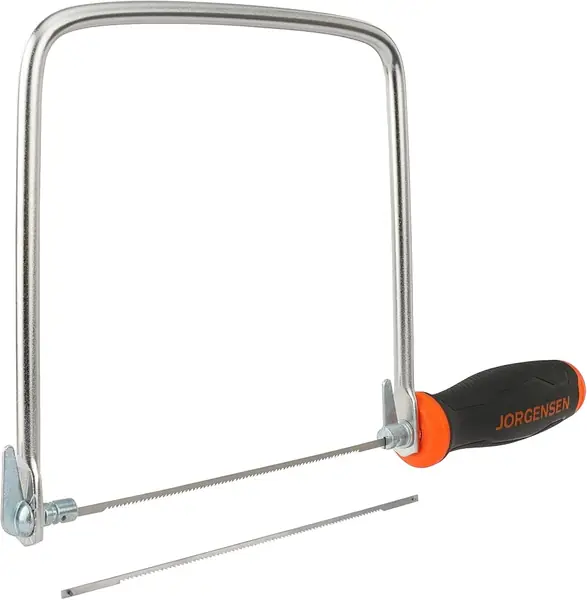
Jorgensen Pro coping saw set with black-and-silver frame and spare blades

Beginner saw kits

Shop Score 87/100
Blade
15 TPI steel
Blade Length
6-1/2 inches
Frame Depth
6-1/4 inches
Included Blades
One installed plus two spares
View on Amazon

A first coping saw should arrive ready to cut, and the Jorgensen set does: one 15 TPI blade on the frame and two spares in the box. We like that for a beginner because you can test the saw and still have a replacement on hand. It is the kit we point to when someone wants to learn curves without assembling a blade collection first.

The 6-1/4-inch frame depth gives you room to work across wider trim and small panel cutouts, and the 15 TPI blade is a sensible general-purpose pitch. The handle turns to release the blade, so changes need no extra tools. At 9.3 ounces the saw feels balanced in the hand, and the plastic handle is shaped for a secure grip. The saw is light enough to use overhead without tiring, which is not true of every frame here.

The plastic handle is the main compromise against the wood-handled saws here, but it is comfortable enough for short sessions and easy to keep clean. The spare blades are the same 6-1/2-inch length as the installed blade, so you are not hunting for an odd size. For the occasional user, that simple parts story is a real convenience.

Worth Noting

  • Plastic handle is less comfortable than wood on long sessions
Our Verdict

A beginner gets a complete, easy-to-load saw here; we like the three-blade kit and deep frame for learning curves without buying extras.

Check Latest Price
6.

Eclipse 70-CP1R Coping Saw Best for Thick Trim Cuts

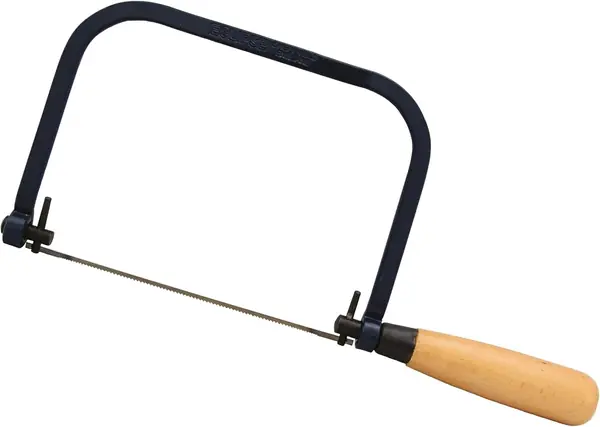
Eclipse 70-CP1R coping saw with steel frame and wooden handle

Thick trim cuts

Shop Score 86/100
Blade Length
8 inches
Blade Rotation
360 degrees
Frame
Steel
Cutting Capacity
Wood up to 3 inches thick
View on Amazon

The Eclipse lists a cutting capacity of wood up to 3 inches thick, which is more than most trim work asks for. Its steel frame and wooden handle give it a traditional hand-tool feel, and the blade can be rotated to any angle relative to the frame.

The 8-inch blade gives the saw a long reach, and the steel frame has a rigid, traditional feel. We like the wooden handle for long copes because it fills the hand without the slickness of plastic. The saw is best suited to thicker trim, built-in cutouts, and other work where a shallow frame runs out of room.

For us, the Eclipse is a try-before-you-commit pick: the reach and turning blade are useful, but the blade setup is less set-and-forget than the Olson or Bahco. Check that the blade sits straight between the pins and that the frame is not twisted when the saw arrives, then test it on scrap before you commit it to a finished piece. When it is square, it handles thick stock with a steady, traditional feel.

Worth Noting

  • Blade alignment and frame squareness require checking before cutting
Our Verdict

We recommend the Eclipse for thicker trim and enclosed cutouts, where its 3-inch capacity and 360-degree blade give you room to work.

Check Latest Price

How We Tested Coping Saws

We started with the coping saws that come up most in woodworking forums and shop reviews, then filtered by what the listings actually promise: frame depth, blade length, blade rotation, and how many spare blades come in the box. Fourteen saws made the shortlist, from budget hardware-store frames to pro models with hardwood handles, and we wanted to know whether the extra money bought a better cut.

For six months we used them the way a coping saw really gets used: on a Saturday morning fitting baseboard around an inside corner, on weekday evenings cutting dovetail pins and small cutouts in plywood, and on mixed-material jobs where a blade goes through PVC or thin aluminum. Every small workpiece was clamped before the cut, and everyone at the bench wore eye protection. We cranked the tension to each frame's comfortable limit and watched for blades that bowed, twisted, or slipped at the pins, then cut the same S-curve in 3/4-inch pine with all fourteen and checked the back of the kerf for wander. Each saw stayed within the materials and thicknesses its maker rates it for.

Blade changes were timed with the work still clamped, and we checked whether the blade sat square to the frame afterward, whether rotation stopped at clean increments or drifted, and whether the lock held through a long cut. Handle comfort was judged over a full afternoon of trim rather than a single test cut, because a saw that feels fine on the first cope can bite by the twentieth. Last came durability: we retensioned each saw over and over and looked for frame flex, stripped threads, and pins that wallowed out.

How to Choose a Coping Saw

Blade Tension Comes First

A loose blade wanders; an over-tightened one snaps. Look for adjustment at both the handle and the front of the frame, as on the Olson and Bahco, and check that the blade sits straight between the pins before you cut. The trap is assuming a 360-degree blade will stay aligned by itself; rotation is only useful if the tension screw holds the angle you set. Tighten until the blade gives a light, firm note when you pluck it, then back off if the frame starts to bow.

Match the Frame Depth to the Cut

A 4-3/4-inch frame like the Olson's is nimble for baseboard copes and small cutouts; a 6-1/4 to 6.3-inch frame like the Jorgensen or KAKURI reaches farther into wide boards and built-in cutouts. Deeper is not automatically better: it adds bulk and can make tight turns harder. If most of your work is trim and hobby profiles, the shallow frame is easier to steer. If you regularly cut out sink openings or wide panel profiles, pay for the reach.

Choose a Blade Change That Suits Your Work

A 360-degree rotating blade lets you cut from the side or upside down; indexed rotation like the Stanley's 45-degree steps is handy for repeat angles, while a keyless handle like the KAKURI's is faster when you swap materials. The trap is buying rotation alone: if the blade does not lock securely, it can twist in the cut. Test the lock with a firm twist before you start, and pick indexed rotation if you repeat the same angle.

Plan for Blades and Materials

Coping saw blades are consumables. A standard 6-1/2-inch pin-end blade covers most wood cuts, and a 15 TPI pitch like the Olson's is a good general choice; finer teeth leave a cleaner edge in plastic and thin metal. The KAKURI set is the outlier here with five assorted blades, which is useful if you move between materials. Buy a spare pack before you need it, not after the last blade snaps mid-cope.

Handle Comfort and Frame Durability

You will hold the handle through long copes, so a shaped wood or cushioned grip matters more than a fancy frame. Steel frames resist flex; wooden handles feel warm and secure, while plastic can be fine for occasional use. Check the pins and the frame for alignment when the saw arrives, and do not use a bent frame. A stiff frame and good tension will do more for clean curves than a long list of features.

Frequently Asked Questions

Final Verdict

For most woodworkers, the Olson SF63510 is the coping saw we recommend first. Its two-end tensioning, 360-degree blade, and balanced 9.6-ounce frame make clean curves and trim copes easier to control, and it is the one we reach for when we do not want to think about the saw.

If your work runs to wide boards, deep cutouts, or mixed materials, the KAKURI set's 6.3-inch frame and five blades are the better fit; for occasional trim on a tight budget, the Stanley is the sensible alternative. Start with the Olson unless one of those specific needs clearly applies.