↑↓ navigate ↵ open Esc close All results →

Best Claw Hammers of 2026

Most homeowners buy a claw hammer once and treat every model as interchangeable—until a head loosens while hanging a gate or a chipped face sends steel flying past safety glasses. A bent claw, slick handle, and mushroomed striking face usually trace back to mismatching the hammer to the work, whereas a balanced tool lets the head carry the blow.

Over six months of driving nails into scrap beams, pulling stubborn fasteners from salvaged lumber, and hanging doors and shelves with 14 hammers, head weight shaped usability more than total weight. An 8-ounce stubby fits inside tight cabinet boxes where a 20-ounce framing hammer cannot swing, and handle length determines whether a hammer rides neatly in a toolbox drawer.

Higher prices did not guarantee better performance, sometimes paying only for an upgraded grip on the same head rather than cleaner forging, though dependable models all drive nails straight and pull bent ones cleanly.

Our Top Picks

The Best Claw Hammers

1.

Estwing E3-16S Rip Hammer Best Overall
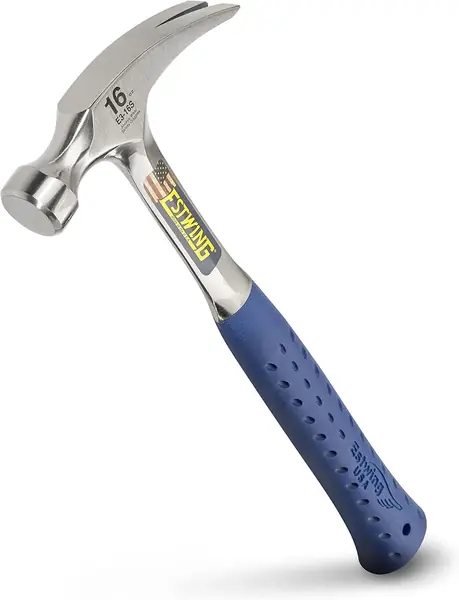
Estwing E3-16S rip claw hammer with forged steel shaft and molded shock-reduction grip

All-around shop use

Shop Score 99/100
Handle
One-piece forged steel
Head Weight
16 oz
Claw
Straight rip
Grip
Molded shock-reduction nylon vinyl
View on Amazon

A claw hammer usually fails at the joint between head and handle, and this one does not have a joint. Estwing forges the head and the shaft from a single piece of steel, so there is no eye, no wedge, and no epoxy to work loose after a few seasons of hard swings. Run a thumb over the transition where the head meets the neck and you feel one continuous piece of metal.

Sixteen ounces is the weight we reach for most, and the E3-16S swings it better than anything else in this group. The balance sits close to the head, so the hammer comes down where you aim it instead of pulling your wrist along for the ride. The smooth face leaves fewer marks on trim, door casing, and cabinet work than a milled face, and the molded shock-reduction grip takes enough sting out of a long session that our hand minded this hammer least of the group.

The straight rip claw is the one design call worth thinking about. It is slim enough to slide under a trim board or between a nail head and a joist, which a curved claw cannot always manage; what it gives up is the curl that rolls a nail out with a flick of the wrist. If pulling nails is most of your work, the Stanley is the better shape.

What we do not love: the grip is bonded to the steel and cannot be replaced, so when it eventually wears you retire the whole hammer. Everything else about the tool argues that will take a long while. Ours has been through picture hooks, a fence repair, and one regrettable afternoon of demolition, and the head still feels like part of the same piece of steel it started as.

Worth Noting

  • Molded grip cannot be replaced when it wears
Our Verdict

We recommend the Estwing E3-16S to anyone who wants one claw hammer that stays tight at the head and swings where they aim it.

Check Latest Price
2.

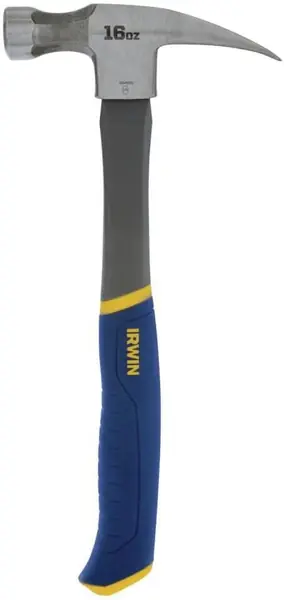
Irwin 16 oz Fiberglass Claw Hammer Best Value

Irwin 16 oz fiberglass claw hammer with forged steel head and textured ProTouch grip

First toolboxes

Shop Score 98/100
Handle
Fiberglass
Head Weight
16 oz
Grip
Textured ProTouch
Head Material
Forged alloy steel
View on Amazon

The Irwin is the hammer we point a new woodworker toward, because it gets the two things that matter most right without charging for the rest. The head is forged steel rather than cast, and the face is smooth, so it drives a nail cleanly and leaves fewer marks in a pine board. For a price well below the premium hammers in this guide, that is a lot of tool. We think it is the best value on this list.

The grip is the part we noticed on the second or third swing: textured, slightly tacky, and molded with a curved base so your hand does not creep down the shaft when you swing hard. Under it, the fiberglass handle ends in a hardened cap, which is the detail that matters, because the neck just below the head is where fiberglass hammers break when a swing lands too high.

The claw is a straight rip pattern, happiest with a nail head you can get under; deep prying is a job for a flat bar, and a fiberglass shaft is the wrong tool for levering a stud apart. For the punch-list work most of us actually do, hanging a door, tapping trim home, pulling a bent nail out of a fence, the Irwin has never been the hammer that slowed us down.

Worth Noting

  • Head coating scuffs early in use
Our Verdict

We think it is the best value here: a forged head and smooth face for far less than the premium picks.

Check Latest Price
3.

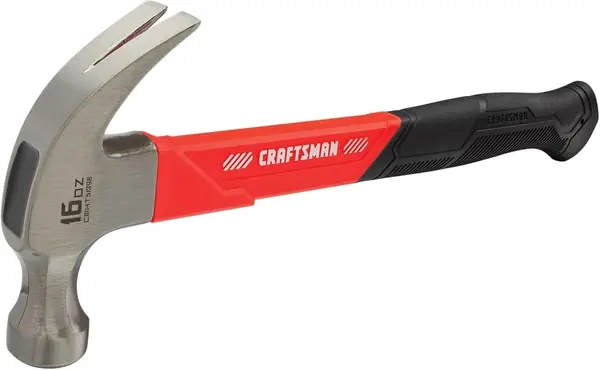
Craftsman 16 oz Fiberglass Hammer Best Budget

Craftsman 16 oz fiberglass hammer with red overmold grip and overstrike collar

First tool kits

Shop Score 97/100
Handle
Fiberglass with overstrike collar
Head Weight
16 oz
Grip
Overmold
Overall Length
12 in
View on Amazon

Fiberglass hammers tend to die in the same place: the couple of inches of shaft below the head, where a swing that lands high slams the neck into the wood. Craftsman molds a raised collar over that spot, and it is the single most useful thing about this hammer.

The rest is standard issue done well. Sixteen ounces of head, an overmold grip that stayed put through a warm afternoon, and a 12-inch overall length that drops into a toolbox without a fight. The balance is ordinary rather than special, so this is not the hammer that makes you a better carpenter, but nothing about it felt cheap in the hand.

Where it earns a place is the price. If the budget is the deciding factor, this is the hammer we reach for: it handles the light carpentry and repair jobs most households actually have, and the money you save is real. An all-day framer wants more mass and a longer handle, though; the Craftsman is a punch-list tool, not a production one.

Worth Noting

  • Face shows marks early in use
Our Verdict

We point budget-minded buyers to the Craftsman, which protects its handle and grips well for very little money.

Check Latest Price
4.

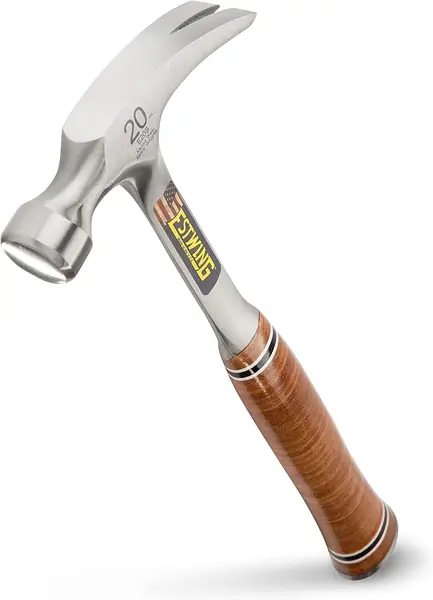
Estwing E20S Leather-Grip Rip Hammer Best for Heavier Work

Estwing E20S rip hammer with polished steel shaft and stacked leather grip

Heavy carpentry work

Shop Score 96/100
Handle
One-piece forged steel
Head Weight
20 oz
Grip
Lacquered stacked leather
Overall Length
12.5 in
View on Amazon

Stacked leather, hand-sanded and lacquered, over a fully polished forged steel shaft: this is the hammer that looks like a tool handed down from a grandfather. It is also the only pick here with a leather grip, and that is as much a reason to consider it as the way it swings.

Twenty ounces of head does more of the work for you. On bigger fasteners and anything headed into old, dense lumber, the extra mass means fewer swings and less effort per nail. The one-piece forging means no loose head, and the polished steel sends out a bright ring on every strike that the leather grip only partly quiets, which is worth knowing if you work in a quiet shop or a basement.

We like it for heavier carpentry, for demolition, and for anyone who wants a hammer to keep for a very long time. It costs a premium over the fiberglass picks, and the finish is part of what you are paying for; if you would rather not care about scratches, buy the Irwin instead. One practical annoyance: the decals on the shaft come off in frustrating little pieces, so peel them the day it arrives.

Worth Noting

  • Heavier head tires you on overhead work
Our Verdict

We reach for the E20S when a job needs more mass, and its leather grip makes it the nicest hammer here to hold.

Check Latest Price
5.

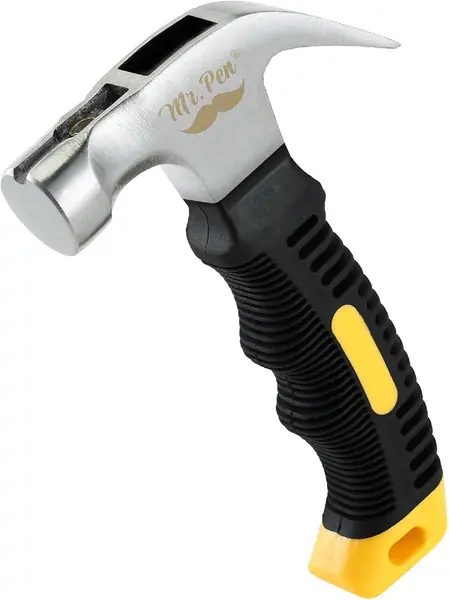
Mr. Pen 8 oz Stubby Claw Hammer Best Compact

Mr. Pen 8 oz stubby claw hammer with yellow grip and magnetic nail starter

Small repairs

Shop Score 95/100
Handle
Plastic non-slip grip
Head Weight
8 oz
Head Material
Carbon steel
Nail Starter
Magnetic
View on Amazon

Picture hooks, carpet tacks, a loose cabinet hinge: the jobs that do not need a 16-ounce hammer, and the ones where a full-size head is more likely to dent the wall than set the nail. The Mr. Pen is built for that list. It is small enough to live in a kitchen drawer and light enough that you will actually walk over and get it.

What we like most is the magnetic nail starter in the head, which holds a small nail straight while you get your fingers out of the way, a real help when you are balanced on a step stool with one hand on the frame. The non-slip grip stays comfortable in a small hand, and the 8-ounce head is heavy enough to drive a thin nail into plaster without bouncing back at you.

Know what you are buying. Eight ounces will not drive a large nail into a stud, and this is not the hammer for a deck build or an afternoon of swinging; it is for the small, awkward jobs a full-size hammer makes harder. We treat ours as a drawer tool we do not have to be precious about, and it has more than paid for itself in hanging hardware and furniture touch-ups.

Worth Noting

  • Handle can chip under hard striking
Our Verdict

We keep the Mr. Pen in a kitchen drawer for hooks and tacks, where its small head and magnet earn their place.

Check Latest Price
6.

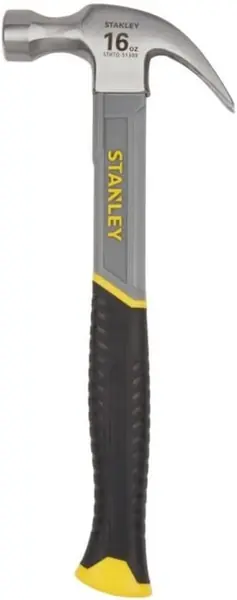
Stanley 16 oz Fiberglass Curved Claw Hammer Best for Nail Pulling

Stanley 16 oz fiberglass curved claw hammer with black and stainless handle

Pulling stubborn nails

Shop Score 94/100
Handle
Fiberglass core
Head Weight
16 oz
Claw
Curved
Overall Length
13.78 in
View on Amazon

A curved claw is a lever, and the Stanley's is the best-shaped one here. The curl rolls under a nail head and gives you somewhere to put your weight; where a straight claw slides off a nail set flush to the surface, this profile digs in and lifts.

The rest of the hammer is built to survive the pull. The fiberglass core runs the length of the handle, the head is epoxy-bonded rather than wedged, and there is an overstrike patch on the shaft where a high swing lands. At 13.78 inches it is the longest hammer in this guide, and that length is where the extra leverage on a stubborn nail comes from.

It is also the most expensive fiberglass-handled hammer here, and you are paying for the reach, the finish, and the anti-slip bi-material grip rather than for a one-piece forged body. Whether that is worth it comes down to how much of your work is taking nails out rather than putting them in.

Our take: this is the hammer for renovation, where nails are as likely to come out as go in, and for anyone whose grip has gotten less sure, since the tacky handle and long lever do a lot of the work for you. For a drawer hammer or a first toolbox, the Irwin or the Craftsman covers the same ground for less.

Worth Noting

  • Long handle will not fit shallow drawers
Our Verdict

We choose the Stanley when nails have to come out, because its curved claw gives the best leverage in this group.

Check Latest Price
7.

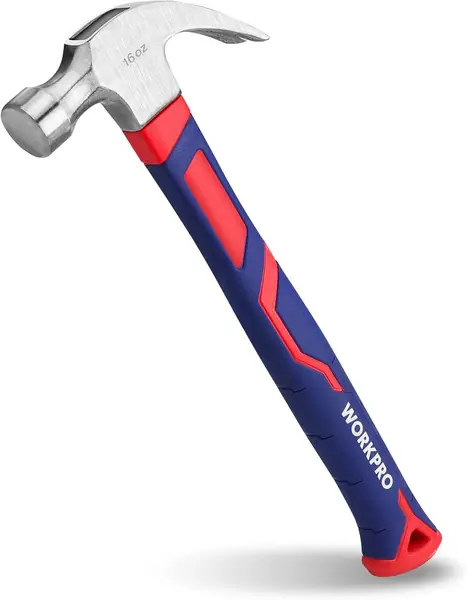
WORKPRO 16 oz Fiberglass Claw Hammer Best for Regular Home Repairs

WORKPRO 16 oz fiberglass claw hammer with blue and red handle

Regular home repairs

Shop Score 93/100
Handle
Fiberglass
Head Weight
16 oz
Claw
Curved rip
Head Material
Forged alloy steel
View on Amazon

The head on the WORKPRO is polished and clear-coated, and it is the best-looking finish in the fiberglass half of this guide: bright, smooth, and unlikely to rust on a garage wall. Under the shine it is a forged alloy steel head on a fiberglass shaft, with a curved rip claw for pulling and a smooth face for trim work, and at a mid-range price we think it is the sensible middle of this list.

In the hand it feels quicker and more compact than a full 16-ouncer, which is pleasant overhead and less pleasant when you are driving a big fastener into old lumber. The fiberglass handle does what a fiberglass handle should on repeated strikes, and the non-slip texture held its grip through a warm afternoon. It does not feel as planted as the one-piece Estwing in a hard swing, but it also does not cost like one, and for regular home repairs that trade is easy to live with.

Worth Noting

  • Feels less planted than one-piece steel hammers in hard swings
  • Less effective driving large fasteners into old lumber
Our Verdict

We think the WORKPRO is the best of the mid-priced fiberglass hammers, with a forged head and a polished, coated finish.

Check Latest Price
8.

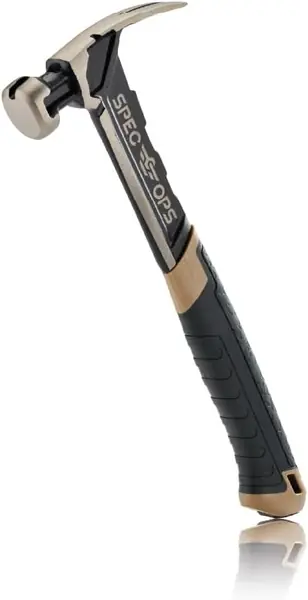
Spec Ops 16 oz Nailing Hammer Best for One-Handed Nailing

Spec Ops 16 oz nailing hammer with black and tan grip and magnetic nail holder

One-handed nailing

Shop Score 92/100
Handle
Bi-material MOA-textured grip
Head Weight
16 oz
Claw
Rip with side puller
Nail Starter
Magnetic
View on Amazon

Two features set the Spec Ops apart: a magnetic nail starter set into the head and a removable rubber cap that turns the butt end into a soft-face mallet. The starter earns its keep when you are nailing overhead or holding a board with your other hand, and the cap is the thing you do not think about until you need to tap a joint closed without marking it.

The rest of the tool is thoughtfully shaped. The head is high-carbon steel with a rip claw on one side and a side puller on the other, which gives you a second way at a nail that sits below the surface. The handle runs 13.25 inches with a textured grip that stayed comfortable through a morning of driving.

It is also the busiest hammer here, and busy has a cost. The Spec Ops sits at a mid-range price that would buy the forged one-piece Estwing, so you are trading away some outright toughness for the extras, and the head-to-handle junction does not have the seamless feel of a single forging.

Our judgment: the Spec Ops makes sense for someone who works alone, nails overhead, and wants the magnet and the mallet cap on the same handle. If your hammer mostly lives in a bag and comes out for repairs, the extras rarely earn their keep, and the plain Irwin does the same jobs with less to go wrong.

Worth Noting

  • Claw tips can round over under heavy prying
Our Verdict

We recommend the Spec Ops to anyone who nails overhead or alone and wants a magnet and a mallet cap in one tool.

Check Latest Price

How We Tested the Best Claw Hammers

We started by rounding up every claw hammer we could find in the range a home toolbox can justify, then narrowed the field on head weight, how the head is joined to the handle, claw shape, face style, and overall length. We dropped anything whose owner reviews kept flagging a head that worked loose or a face that chipped early. That left 14 hammers, and we used them for six months.

They lived in a garage workbench drawer and a canvas tool bag and went to work on a fence rebuild, a run of interior doors and shelves, and a pile of salvaged pallet lumber that needed the nails pulled. We drove framing nails into scrap beams and counted swings to seat each one, timed how long a bent nail took to come out and whether the claw chewed the wood around it, and swung 60 nails in a row to see where a grip rubbed and whether it twisted in a sweaty hand.

Every hammer got weighed on a kitchen scale and balanced on a finger to see where it hung, and we measured overall length against an actual toolbox drawer before handing them to people with different hand sizes to choke up and swing. After each session we checked the face and claw under a magnifier for chips, mushrooming, and overstrike marks on the collar, and looked at the grips for polishing and slipping. Eye protection stayed on the whole time, and no hammer was used on hardened steel.

Price came last and counted twice: we asked what the money actually bought — a one-piece forging, a fiberglass shaft with an epoxied head, or a nicer grip on the same construction — and whether the extras, such as a magnetic nail starter or a side puller, earned their keep holding a nail one-handed on a ladder.

How to Choose a Claw Hammer

Match the Head Weight to the Work

An 8-ounce head is for tacks, picture hooks, and reaching into a cabinet, not for driving nails into studs. Sixteen ounces is the standard general-purpose weight and covers the widest range of jobs, which is why most of our picks carry one. Twenty ounces drives bigger fasteners with fewer swings, at the cost of fatigue when you are working overhead or swinging all afternoon.

Buy the weight that matches the heaviest thing you will actually drive. If you own one hammer, make it a 16 and add a stubby 8-ounce for small work; you may never need the big one.

How the Head Stays on the Handle

A one-piece forging, with head and shaft drawn from a single bar of steel, is the most secure construction you can buy because there is no joint to loosen. Fiberglass hammers bond an epoxy head to a shaft and add an overstrike collar over the neck, the spot where a misjudged swing breaks them. Wood handles are still made and still handsome, but they need a wedge and occasional attention.

If you swing hard, favor a forged one-piece or a fiberglass model with overstrike protection. The Estwing's forging is why it tops this list, and the Craftsman's collar is why it survives at its price.

Curved Claw or Straight Rip Claw

Curved claws roll under a nail head and give you leverage to lift it out; straight claws, often sold as rip hammers, are slimmer, so they slide into tight spaces and pry trim. Neither is better, and the question is whether more of your nails come out or go in. The face matters just as much: a smooth face leaves fewer marks on finished wood, while a milled face grips a nail head when you start it.

Balance, Grip, and Fit in the Hand

A weight on a spec sheet tells you very little about how a hammer swings; where that weight sits matters more. A hammer balanced close to the head comes down where you aim it, and a nose-heavy one pulls your wrist through every stroke. Handle length does similar work: longer handles add pulling leverage, shorter ones fit drawers and small hands.

Check the overall length against the toolbox or drawer the hammer will live in before you buy, and hold it if you can. A tool that is awkward to store is a tool you stop reaching for.

What You Get as the Price Climbs

At the low end you can still get a forged head and a smooth face, as the Irwin and the Craftsman prove. More money buys one-piece steel, better balance, longer handles, and finishes that hold up, things you notice over years rather than minutes. We spend on construction and fit first and treat magnetic nail starters, side pullers, and mallet caps as conveniences that only pay off when they match how you work.

Frequently Asked Questions

Final Verdict

The Estwing E3-16S is the hammer we hand to anyone who wants one claw hammer and no more: a single forging means no loose head, and the balance makes a 16-ounce swing feel almost effortless. It is the pick we would put in our own box, and the one we expect to still be swinging in ten years.

If the budget is tighter, the Irwin gives you a forged head and a smooth face for substantially less. If your work runs to demolition and bigger fasteners, the leather-handled Estwing E20S puts 20 ounces behind every swing.