↑↓ navigate ↵ open Esc close All results →

Best Spokeshaves of 2026

Two spokeshaves can look nearly identical on a tool wall and behave like opposites on a curved chair leg. One bites cleanly and peels translucent ribbons along a sweep; the other chatters across the grain, slips mid-stroke, and demands an hour of sole lapping and blade honing before taking a predictable shaving.

Eight months of shaping curves with 12 flat-soled and round spokeshaves confirmed that first impressions in soft wood lie. An iron sharp enough to shave pine right out of the box can roll its edge halfway through a piece of oak, making steel quality, adjuster precision, and straightforward fettling far more telling than the name cast into the body.

Picking the right sole profile for convex versus concave curves and deciding how much bench tuning feels reasonable ahead of the first cut keeps the tool moving smoothly from rough shaping to final fairing.

Our Top Picks

The Best Spokeshaves

1.

Stanley 12-951 Flat Base Spokeshave Best Overall
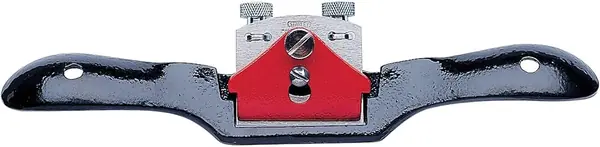
Stanley 12-951 flat-base spokeshave with black and yellow cast iron body and two handles

Curved chair parts

Shop Score 85/100
Body Material
Cast iron
Cutting Width
2-1/8 inches
Base Type
Flat
Item Weight
13.6 oz
View on Amazon

It makes shavings on the first pass out of the box, with no filing, no lapping, and no hour at the stones before you can start shaping. That is not a small thing in a category where tuning is normal. The 12-951 is the familiar 151 pattern: a 2-1/8 inch iron bedded in a cast iron body, two handles set for push or pull strokes, a flat sole that covers both flat and convex work, and a vinyl pouch for storage between projects.

What we appreciate most is the mass. At 13.6 ounces the body sits on the stock instead of skittering across it, so long strokes down a chair leg stay steady and the cut follows your hands rather than the grain. The twin thumbscrews are where it tests our patience: depth changes come in coarse jumps, and the blade shifts if the cap is not seated squarely. Set it barely snug, take a test pass, and expect to readjust between cuts.

Where it earns its keep is on the long curves — chair legs, paddle shafts, the chamfer along a table edge — where the flat sole registers on the work and both handles give you somewhere to push. The iron is a standard size, so a chipped edge costs you a blade rather than a tool, and the whole shave is light enough to hang within reach of the bench. Proven pattern, low outlay, replaceable iron: that is why it stays our default.

Worth Noting

  • Iron often arrives needing honing
  • Mouth clogs on very fine shavings
Our Verdict

We recommend the 12-951 as the default spokeshave: it cuts real shavings out of the box and has the strongest record of satisfied use here, provided you accept a little tuning.

Check Latest Price
2.

WoodRiver Adjustable Spoke Shave Best Upgrade

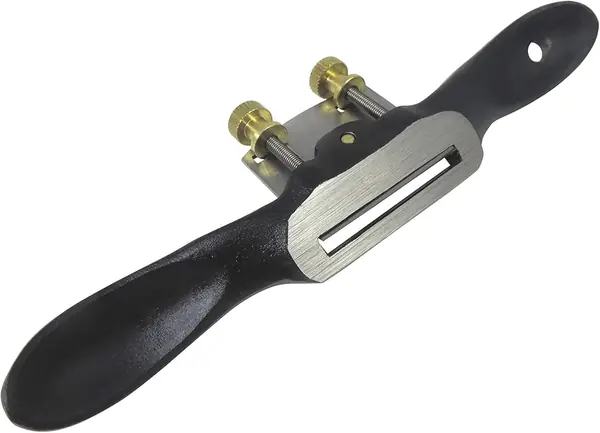
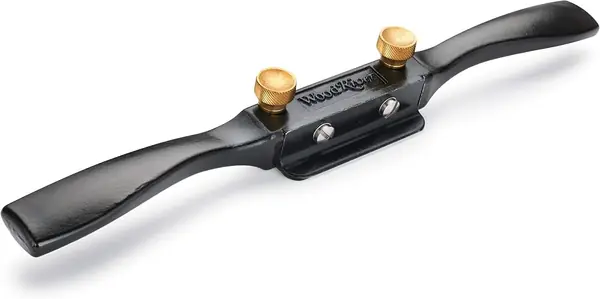
WoodRiver adjustable spokeshave with a black cast iron body and dual handles

Fine finish cuts

Shop Score 84/100
Body Material
Cast iron
Blade
Included, replaceable
Adjustable Mouth
Yes
View on Amazon

It is the most expensive shave here, and it buys exactly one thing: an edge that is ready when you are. No lapping the sole, no honing before the first cut, no filing the mouth — the WoodRiver arrives cutting, which is more than we can say for most of the tools on this page.

The cut is fine and glassy, thin shavings that leave a surface barely needing sandpaper. We also like the adjustable shoe: close it down and the shave takes a whisper of a cut for the finishing pass; open it and the same tool roughs out a curve in a few strokes.

In the hands it feels like a block plane with handles. The cast iron body carries enough weight to keep a long stroke from lifting at the end, and the handles sit wide enough that a pull stroke feels as natural as a push, which is what you want when the grain runs the wrong way and the shave starts to tear.

It has the best quality record of anything in this guide and the highest rating, and for a hand tool that matters more than a feature list. What settles it for us is the throat: with the mouth closed the shave takes a shaving thin enough to read through, and that is the cut that finishes a chair back or a paddle blade.

Worth Noting

  • Adjustment screws take practice to dial in
Our Verdict

For buyers who want to shape wood rather than fettle iron, this is the one we point to: sharp out of the box and the smoothest cut in this set.

Check Latest Price
3.

Robert Larson Kunz 151 Flat Spokeshave Best for Beginners

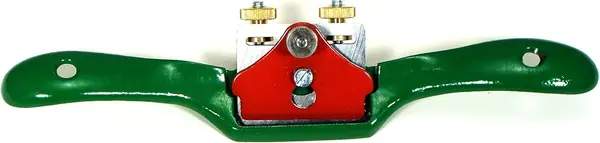
Robert Larson Kunz 151 flat spokeshave in green cast iron with two handles

First-time users

Shop Score 82/100
Body Material
Cast iron
Cutting Width
2 inches
Base Type
Flat
Blade Material
Hardened steel
View on Amazon

Two adjustment knobs, a flat cast iron sole, and a blade that arrives close to ready — that combination makes the Kunz 151 the easiest shave here to hand to someone who has never used one. Set the depth shallow, take a pull stroke, and it starts cutting without a lesson.

Once it is tuned the cut is smooth and even, and the shave handles hard and soft stock without much fuss. It is also the tool in this set that most often cuts well as received, which is why we keep recommending it to people setting up a first bench.

One thing is worth knowing before you order. The sole can arrive rougher than you want, and a few minutes of lapping on fine paper over a flat surface makes a visible difference to how it glides. Past that, it covers chair seats, tool handles, and any convex profile you put in front of it.

Worth Noting

  • Blade can drift out of alignment in use
Our Verdict

We hand this one to first-time spokeshave users: two knobs, a flat sole, and a blade that arrives close to cutting, all for midrange money.

Check Latest Price
4.

Taytools 469560 Flat Bottom Spokeshave Best Value

Taytools flat-bottom spokeshave with black cast iron body and brass adjustment knobs

Chatter-free stock removal

Shop Score 80/100
Body Material
Ductile cast iron
Cutting Width
2 inches
Overall Length
9-1/2 inches
Blade Thickness
0.0750 inches
View on Amazon

A 2-inch blade that measures a full 0.0750 inch thick, seated in ductile cast iron, with brass knobs and stainless screws — for midrange money this is more tool than the price suggests. Blade thickness is the number we check first, because a thin iron flexes under a heavy cut, and that flex is what chatter feels like in your hands.

The rest of the design follows the same logic. The body is heavy enough, just over a pound, to stay planted through a long stroke, and the sole is only an inch wide, so it drops into tighter curves than a wider shave will follow.

We keep this one set up coarse and reach for it when there is real material to remove: hogging a paddle shaft down to a line, taking the corners off a blank before refining with something finer. The adjustment is the part we like best, because the screws move in small, predictable increments and the blade stays where you put it, which is not something we can say about every shave on this page. It suits a woodworker who already owns stones and a flat reference surface and wants a second shave without paying premium prices.

Worth Noting

  • Blade bed can arrive less than flat
  • Wide mouth clogs on fine shavings
Our Verdict

Ductile iron, a thick blade, and brass knobs at a fair price — we keep this one set up coarse for real stock removal.

Check Latest Price
5.

Spear & Jackson SSROUND Round Spokeshave Best Round Base

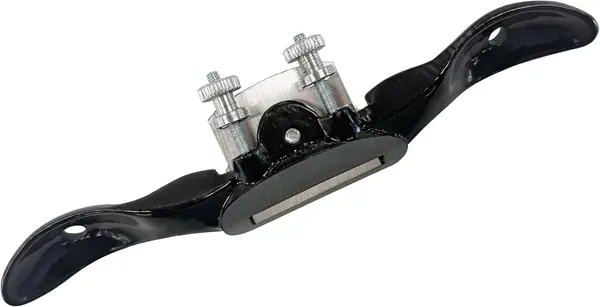
Spear & Jackson round spokeshave with cast iron body and two shaped handles

Hollows and spindles

Shop Score 79/100
Body Material
Cast iron
Base Type
Round
Item Weight
13.4 oz
Blade Material
Carbon steel
View on Amazon

Point a flat shave at a hollow and it bridges the gap, cutting air on both sides of the dip. The round sole on this Spear & Jackson drops into that hollow and cuts, which is the whole reason we keep it on the rack beside the flat ones. Spindles, chair back rails, the inside of a handle opening: those are the profiles a round shave is made for.

The body is cast iron and runs about 13.4 ounces, enough to hold a line through a curved cut instead of skipping out of the grain, and the shaped handles put your hands wide enough apart to steer with both wrists. The carbon steel iron adjusts for depth and lifts out for honing.

We treat it as a specialist's second tool rather than a first one. A round sole rocks on an outside curve where a flat one registers, so it cannot flatten a seat rail or clean up a straight chamfer. Buy it when a project actually has hollows in it, a chair back or a curved rail, and it earns its space.

Worth Noting

  • Round sole rocks on outside curves and straight edges
Our Verdict

We keep this one for hollows and spindles: the round sole reaches profiles a flat shave cannot touch, and it is the only concave model in this guide.

Check Latest Price
6.

Klmnduo 9-Inch and 10-Inch Spokeshave Kit Best Starter Set

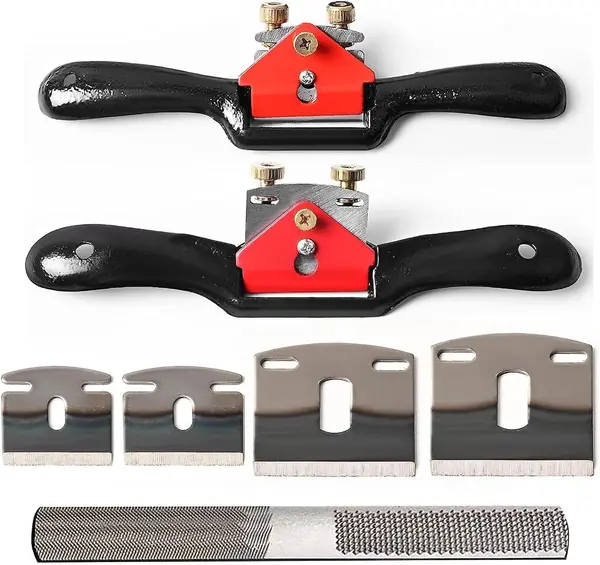
Klmnduo spokeshave kit with nine- and ten-inch black shaves, blades, and a rasp file

Starter kits

Shop Score 78/100
Body Material
Alloy steel
Includes
Spare blades and four-way rasp
Blade Hardness
58-60HRC
Spokeshave Lengths
9 inches and 10 inches
View on Amazon

Two shaves, nine inches and ten inches, plus spare blades and a four-way rasp in one box — that is the deal here, and it is a sensible one for anyone starting to shape curves. The longer body handles long sweeps along a paddle shaft or a table edge; the shorter one gets into tighter arcs without the handles fighting each other.

The irons are SK2 steel hardened to 58-60HRC, which is a workable spec for a starter kit, and the double screws adjust depth without a wrench. The contoured handles fall naturally under the fingers, which matters when you are taking shaving after shaving.

For a hobbyist who wants to try curved work without committing to a premium tool, we like the arithmetic: spare blades keep you cutting while one sits on the stone, and the rasp takes care of the rough shaping before the shave ever touches the work. Do not expect heirloom quality, because this is a starter kit and it behaves like one, but the rasp alone earns a place on the pegboard.

Worth Noting

  • Blades need honing and frequent touch-ups
  • Adjustment knobs can be stiff to turn
Our Verdict

We think this kit is the smart first buy for a hobbyist: two shave sizes, spare blades, and a rasp in one box.

Check Latest Price
7.

Minatee Adjustable Spokeshave Best for Budget Spare Blades

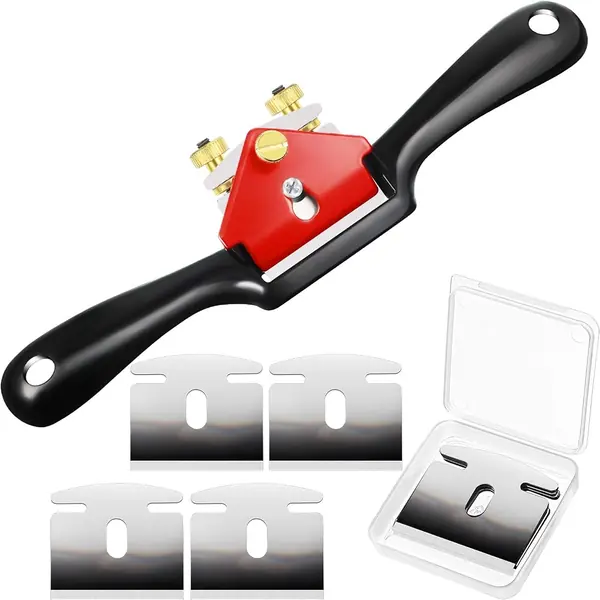
Minatee adjustable spokeshave with black manganese steel body and spare metal blades

Budget spare blades

Shop Score 77/100
Body Material
Manganese steel
Cutting Width
1.73 inches
Includes
Spare blades
Length
9 inches
View on Amazon

Nine inches long with 1.73 inches of cutting width, a manganese steel body, and spare blades in the box, the Minatee is aimed at someone who wants a shave on the bench without spending much to get there.

Our honest read is that the finish is the gamble. Castings can arrive rough enough that the edges need filing, and the sole may need work before it glides. All of it is fixable at the bench, but it is an evening's work before the tool behaves, and that evening is the price of the low outlay.

For a single job, a sticking door or one small curve on a project, the trade can be worth making, especially with spare blades included. For anything regular, we point to the Stanley or the Klmnduo kit, both of which ask less of you before the first shaving.

Worth Noting

  • Depth screws may not contact the blade cleanly
  • Blades can arrive pitted or chip
Our Verdict

We see this as a try-it-out shave: affordable, with spare blades, provided you expect to file and hone it before the first cut.

Check Latest Price

How We Tested Spokeshaves, From Box to Bench

We built the shortlist from current catalogs and spec sheets, then filtered by sole type, cutting width, whether the depth setting could be adjusted, and whether spare irons came in the box — because the real price of a spokeshave is the tool plus the bench time it demands. We bought 12, flat-soled and round, adjustable and fixed, and kept them in rotation for eight months.

Every tool got the same first hour. We unwrapped it, took a paring cut on a scrap of pine straight out of the box, and wrote down whether the iron sliced, skidded, or crushed the fibers. Then we checked the sole and bed against a straightedge, noted how much lapping the casting needed, and honed whatever arrived dull, working with the iron off the body and the edge turned away from us. After that we set the depth, took twenty strokes on a clamped ash blank, and checked whether the setting had drifted.

Real work came next: chair legs and back slats clamped at elbow height and shaped over several evenings, hands kept behind the blade path on both the push and the pull stroke, plus spindles and hollows for the round-soled models. We weighed each tool, measured blade thickness, and ran the irons across knots and reversing grain in maple, listening for chatter and counting strokes before an edge tore instead of sliced. Resharpening through the eight months showed us which steels held up. At the end we set each tool's price against the hours it had taken to make it cut.

How to Choose a Spokeshave

Start With the Sole: Flat or Round

The sole decides which curves the tool can reach. A flat sole registers on flat and convex surfaces — chair legs, paddle shafts, chamfered edges — and bridges a hollow, cutting air on both sides of the dip. A round sole is the reverse: it drops into hollows and spindles, and it rocks on an outside curve where a flat shave would sit steady. Most woodworkers end up with one of each, and the flat one comes first.

Watch for kits that advertise two shaves without saying what you actually get; two flat shaves in different lengths are useful, but they will not cover a hollow. Our round pick is the Spear & Jackson, sold as a round spoke shave, and it is a companion rather than a replacement. If you only buy one tool, buy flat and add the round later.

Decide How Much Tuning You'll Do

A spokeshave is a small plane, and small planes arrive in different conditions. Cheaper tools commonly need the sole lapped flat, the mouth filed, and the iron honed before they cut their best; a premium shave can arrive sharp and square. Neither is wrong. It is a question of which evening you would rather spend, at the bench or on the project.

We prioritize an iron that arrives sharp if you do not own sharpening stones, because a dull shave is unusable no matter how good the body is. If you do own stones and a flat reference surface, a budget shave that needs fettling is money well spent.

Check How the Blade Holds Its Setting

Depth adjustment on a 151-pattern shave is a friction fit: two thumbscrews pull a cap down onto the iron, and the iron moves when the cap is not seated evenly. That is why one shave holds a setting all afternoon and another drifts after three passes, and the difference is often the seating rather than the screw. Set the depth with a light hand, tighten evenly, and take a test pass before committing to a workpiece.

We care more about repeatability than range. Small, predictable turns beat a wide adjustment window that jumps, which is why we like the brass-knobbed screws on the Taytools. Skewing the iron deliberately is a real technique for difficult grain, but it is something to learn once the setting stops moving on you.

Blade Thickness, Chatter, and Body Weight

Chatter is a thin iron ringing under a heavy cut. A thicker blade — the Taytools iron is a full 0.0750 inch — and a heavy body damp it, which is why cast iron shaves in the 13- to 16-ounce range feel steadier than light alloy ones. Steel hardened in the 55-60 HRC range is normal for the pattern and will serve as long as you do not chip it on a knot.

Light shaves are not worse, they are different: at under nine ounces a tool is easier to steer on small parts and less tiring overhead, at the cost of some momentum through a long stroke. Pick the weight for the work you do most, and keep a strop or a fine stone within reach either way.

Frequently Asked Questions

Final Verdict

For most woodworkers, the Stanley 12-951 is the shave to buy first: it cuts on the first pass, it takes a standard iron, and its faults — a fiddly cap and an iron that wants honing — are the faults of the pattern rather than the tool. If bench time is the thing you want to avoid, the WoodRiver arrives sharp and holds the finest cut here.

Add the Spear & Jackson round shave only when a project has a hollow in it. Until then, one flat shave, a stone, and a strop will handle almost everything you shape by hand.