↑↓ navigate ↵ open Esc close All results →

Best Crosscut Hand Saws of 2026

A crosscut saw doesn't slice wood so much as sever fibers: the teeth score a line ahead of the kerf and lift the waste clear, so a sharp one leaves an edge that meets a square and a dull one leaves fuzz and a wandering line. Most of us are cutting with the saw that came with the house.

I assumed hand-sawing was supposed to hurt until we put 14 crosscut saws through six months of real cutting, clamped to sawhorses in the garage and carried out back for branches. Pull saws cut on the backstroke with a thin plate that tracks beautifully but kinks if you lean on it sideways; push saws want a stiffer blade and a different rhythm. Your hands will tell you which camp you're in after ten cuts.

Tooth count is the other half: eight teeth per inch eats a stud fast and rough, eighteen takes its time and leaves a shoulder ready for glue. What these picks share is a blade that goes where you point it and teeth that are sharp out of the box.

Our Top Picks

The Best Crosscut Hand Saws

1.

SUIZAN Ryoba Double Edge 9.5-Inch Saw Best Overall
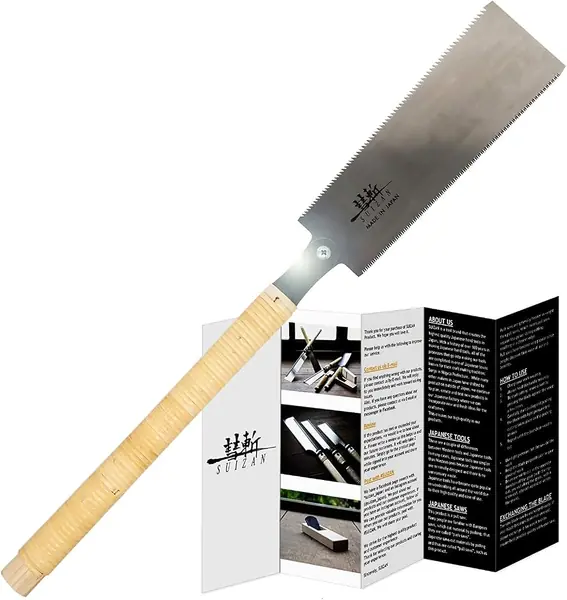
SUIZAN Ryoba double edge Japanese pull saw with wood handle and blade guard

One-saw general woodworking

Shop Score 97/100
Weight
7.05 oz
Crosscut Teeth
15 TPI
Rip Teeth
9 TPI
Blade Thickness
0.02 in
View on Amazon

Two rows of teeth on one blade is why this saw holds the top spot. The 15 TPI edge crosses the grain; flip it over and the 9 TPI edge rips. The plate is 0.02 inch thick and leaves a kerf of about 0.03 inch, so it lifts very little wood and the blade goes where the line goes.

What kept us coming back is how little the pull stroke asks. The blade cuts on the pull, which holds the thin plate in tension instead of letting it buckle, and at 7.05 ounces the whole saw is light enough to steer with your fingertips. One screw holds the blade, so dull teeth mean a new blade rather than a new saw.

It arrives assembled with the guard on, and the handle, wood wrapped by hand in vinyl rattan, differs slightly from saw to saw, which we like on a tool that hangs in plain sight.

Among the two SUIZAN saws we cover, this is the generalist and the Kataba is the specialist. Buy this one when you want a single saw that handles whatever the bench throws at it.

Worth Noting

  • 30-day warranty is short for a hand tool
Our Verdict

Our default pick: one light, thin-kerf SUIZAN that crosscuts and rips, with a blade you replace instead of a saw.

Check Latest Price
2.

SUIZAN Kataba 10.5-Inch Saw Best Dedicated Crosscut Saw

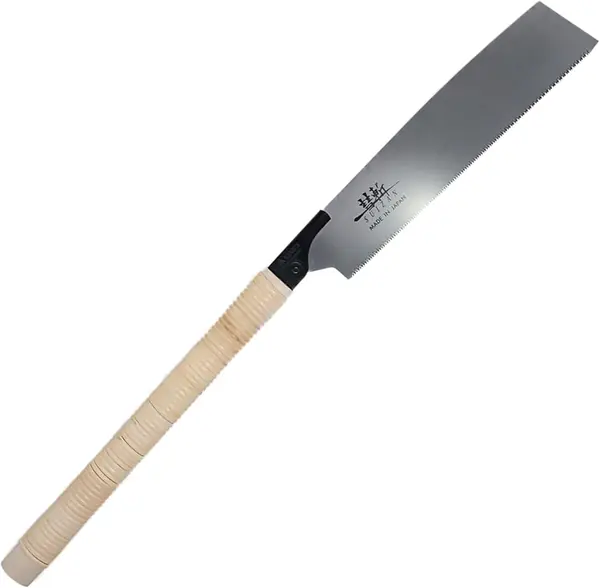
SUIZAN Kataba single edge Japanese pull saw with rattan-wrapped wood handle

Clean crosscuts only

Shop Score 96/100
Blade Length
10.5 in
Crosscut Teeth
14 TPI
Blade Thickness
0.024 in
Handle Length
11.81 in
View on Amazon

A single row of 14 TPI crosscut teeth, nothing to flip, a 10.5-inch plate that spans a wide board in one pass: this is the saw we reach for when the far side of a cut is going to be seen. It is a specialist, and it behaves like one.

The geometry does the work. At 0.024 inch the plate is thin enough to sink without effort, and with no stiffened spine it keeps going through stock that would stop a backed saw. The handle runs 11.81 inches and is wrapped in rattan, long enough to get two hands into a full-length pull, which is how these saws want to be used. Short, choppy strokes waste the design.

Where it earns its space is visible work: trim, tenons, a shelf edge, anywhere a crisp exit matters as much as the entry. SUIZAN sells the 10.5-inch blade on its own, so the saw keeps going after the teeth go.

Worth Noting

  • Crosscut teeth only, with no rip edge
Our Verdict

For crosscutting and nothing else, we choose the Kataba: a longer single-edge blade and a full-length handle that make clean, square cuts routine.

Check Latest Price
3.

Temple Tool Ryoba Pull Saw Best Wood-Handle Pull Saw

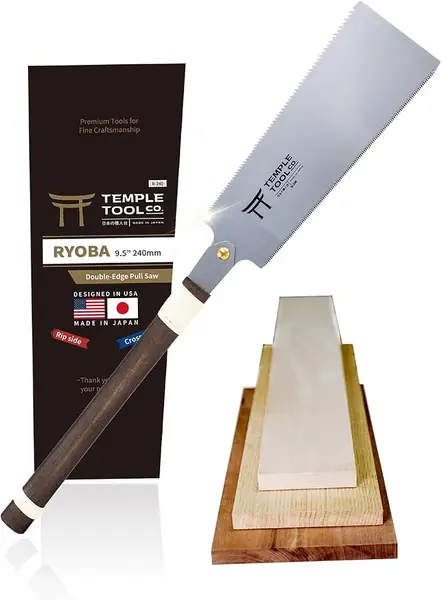
Temple Tool ryoba Japanese pull saw with wood handle and brass fittings

Traditional hand-tool work

Shop Score 95/100
Blade Length
9.5 in
Weight
11.3 oz
Blade Material
High carbon steel
Edges
Rip and crosscut
View on Amazon

The handle is the first thing anyone picks up, and here it is worth picking up: solid wood from the walnut family, brass fittings, a shape that fills the palm. At 11.3 ounces it carries more heft than the SUIZANs, which shows up as momentum at the end of a stroke rather than as weight in the hand.

We like it for the same reason we like a good chisel. It is a tool you do not mind leaving out on the bench. Rip teeth run down one edge and crosscut teeth down the other, so the blade turns over for the job, and in moderate hardwoods it cuts fast and stays true. Made in Japan, and the fit and finish show it.

The high carbon blade arrives sharp, and replacement blades are sold separately, so a dull edge does not retire the handle. Expect to pay more than the molded-handle saws here, and readers who simply want to try a pull saw should start with the Jorgensen 10-inch. This is the one you leave on the bench because it looks as good as it cuts.

Worth Noting

  • Costs more than molded-handle pull saws
  • Heavier at 11.3 ounces than lighter ryoba saws
Our Verdict

We recommend the Temple Tool to woodworkers who want a Japanese-made ryoba with a wood-and-brass handle and will pay for the pleasure of it.

Check Latest Price
4.

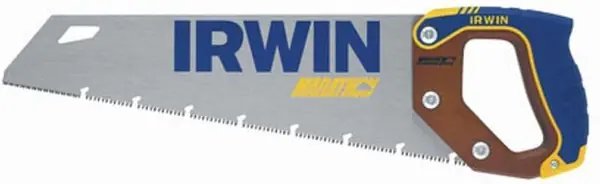
IRWIN ProTouch 15-Inch Hand Saw Best Traditional Push Saw

IRWIN ProTouch 15-inch hand saw with coarse-cut steel blade and grip handle

Push-saw habits

Shop Score 94/100
Blade Length
15 in
Weight
16 oz
Warranty
Limited lifetime
Blade Material
Alloy steel
View on Amazon

Fifteen inches is short for a carpenter's saw, since full-size handsaws usually run 20 or more, and that is the reason to buy this one. A shorter plate is stiffer for its thickness, so it tracks a line instead of wandering, and at 16 ounces the saw is easy to hold on the mark overhead with one hand.

The teeth are M2 with a tapered-pitch nose that starts a cut without skating, and deep gullets throw chips clear instead of packing the kerf. The thick body gives you something to push against, which is the whole appeal of a western saw.

We expected a coarse saw to feel crude and were pleasantly surprised by how controlled it is. This is the push saw we hand to someone who has never got along with a pull stroke. The ProTouch grip stays comfortable over a long session, and a limited lifetime warranty sits behind it.

It is the saw for the jobs a circular saw cannot reach: a stud already in place, a branch over the driveway, trim nailed to the wall. Sixteen ounces swinging from a hook by the door is about right for that kind of work.

Worth Noting

  • Coarse teeth leave a rougher cut edge
Our Verdict

We hand the IRWIN to anyone raised on a push saw: a stiff 15-inch blade, coarse fast teeth, and no new technique to learn.

Check Latest Price
5.

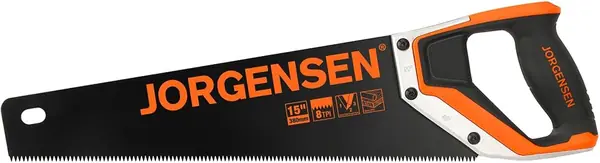
JORGENSEN 15-Inch Hand Saw Best for Fast Rough Cutting

JORGENSEN 15-inch hand saw with black coated blade and aluminum handle

Framing and green wood

Shop Score 93/100
Blade Length
15 in
Weight
1.34 lb
Teeth
8 TPI
Blade Coating
Teflon
View on Amazon

Eight teeth per inch is coarse for a general-purpose saw, and Jorgensen leans into it: triple-ground teeth that bite on the first stroke and throw sawdust rather than powder. We keep this one for framing cuts, green branches and pressure-treated lumber, where speed matters more than a glassy edge.

The SK5 plate wears a black Teflon coating that cuts friction and keeps pitch from grabbing the blade, which is what you want in wet or resinous wood, and the plate is thick enough to push straight without shimmy. The aluminum-framed handle has 45 and 90 degree guides molded in, so repeated cuts need less marking. A plastic edge protector comes with it; leave that on in the toolbox, because the teeth are the aggressive part.

Worth Noting

  • Heaviest saw here at 1.34 pounds
Our Verdict

We keep the Jorgensen 15-inch for fast, rough cutting in framing lumber and green branches, where 8 TPI teeth earn their aggression.

Check Latest Price
6.

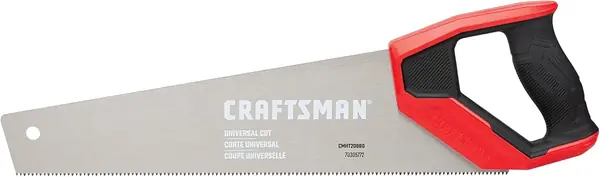
CRAFTSMAN 15-Inch Hand Saw Best for Branches and Rough Carpentry

CRAFTSMAN 15-inch hand saw with composite handle and induction-hardened teeth

Branches and rough carpentry

Shop Score 92/100
Blade Length
15 in
Warranty
Lifetime
Teeth
6 TPI
Handle Guides
45 and 90 degrees
View on Amazon

Molded into the handle are 45 and 90 degree angle guides, a feature most 15-inch saws skip. On repeated cuts, baseboard, fence pickets, anything trimmed to a mark, you can sight the angle in your hand instead of hunting for a square.

The rest is plain and well done. Induction-hardened teeth hold an edge, the 15-inch blade is short enough to control one-handed, and the bi-material handle stays put in a sweaty grip. At 6 TPI it is a fast, coarse cutter built for saplings, posts and rough carpentry.

It is light and short enough to keep on a hook by the door and grab for a two-minute job, and the composite handle shrugs off weather that would raise the grain on a wood one.

We like it as the second saw in a garage: the one that handles branches and 2x4s so the pull saws stay sharp for furniture. Do not ask it for joinery; ask it for firewood and fence repairs.

Worth Noting

  • Blade flexes when forced through dead branches
Our Verdict

We like the Craftsman as the garage saw: short, light, guided by angles in the handle, and made for branches and 2x4s rather than joinery.

Check Latest Price
7.

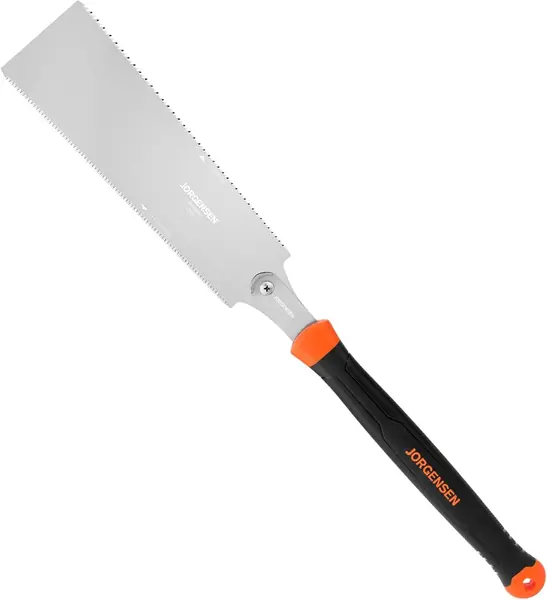
JORGENSEN 10-Inch Pull Saw Best for Flush Cuts and Trim

JORGENSEN 10-inch double edge Japanese pull saw with plastic handle

Flush cuts and trim

Shop Score 91/100
Blade Length
10 in
Weight
9.88 oz
Crosscut Teeth
18 TPI
Rip Teeth
7 to 12 TPI
View on Amazon

The cut this saw is made for is the one you cannot get a full-size saw into: a dowel trimmed flush between two boards, a plug set deep in a mortise, a piece of trim already nailed up. Ten inches of blade reaches into gaps where a 15-inch panel saw has no room to stroke.

The fine side is the one we use most. Eighteen teeth per inch leave a surface that wants a light sanding rather than a plane, and the thin plate bends into corners and around curves that would stop a rigid blade. Crosscut teeth on one edge and a graduated 7-to-12 TPI rip side on the other mean a small shop gets both jobs from one handle.

We like that the blade is a screw-and-replacement part rather than the whole tool, and that a saw this thin still feels like a tool and not a toy. It lives beside the block plane rather than on the sawbench, and for small, visible work that is the right place for it.

Worth Noting

  • Flexible plate needs a light touch to stay on line
Our Verdict

We reach for the Jorgensen 10-inch when a cut has to happen in a tight space, where its thin 18 TPI blade trims flush and fine.

Check Latest Price
8.

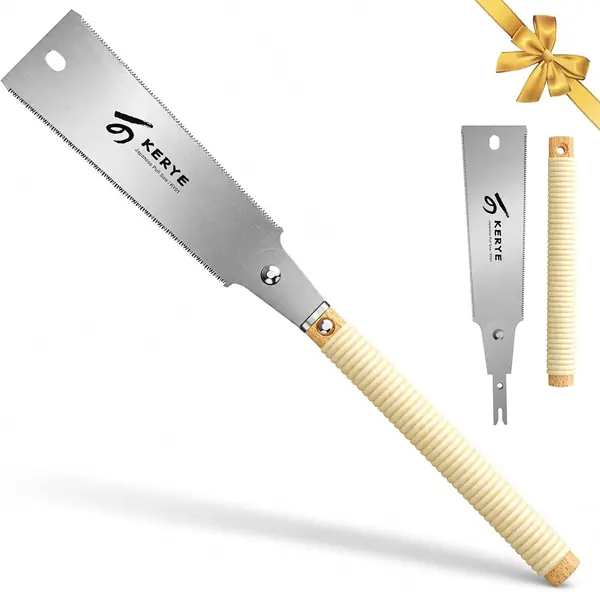
KERYE 9.5-Inch Pull Saw

KERYE 9.5-inch double edge Japanese pull saw with beechwood handle

First pull saw

Shop Score 90/100
Crosscut Teeth
17 TPI
Warranty
2 years
Rip Teeth
10 TPI
Blade Thickness
0.02 in
View on Amazon

KERYE backs this saw for two years, longer than SUIZAN's 30-day coverage and a fair signal of what the maker expects it to survive. The rest of the package is familiar: a double-edge blade, a beech handle, and a wrench in the box for the blade screw.

The tooth split is what we like. Seventeen teeth per inch across the grain leaves a clean shoulder on a tenon; 10 TPI with the grain gets through a board without turning into a wrestling match. The 0.02-inch plate leaves a narrow kerf and cuts faster than the tooth count suggests.

It is not a saw to force. The blade is thin, so let the pull do the work and it stays straight; at 9.6 ounces it is light enough to run one-handed on a ladder, and the handle stays comfortable through a run of cuts.

The two-year warranty is the most generous coverage on any Japanese saw here, and it is why we are comfortable pointing a beginner at this one. What it will not do is teach the lighter stroke.

Worth Noting

  • Handle wrap can loosen over time
Our Verdict

We like the KERYE for a first pull saw: 17 TPI crosscut teeth, a two-year warranty, and a blade that asks to be used gently.

Check Latest Price

How We Tested Crosscut Hand Saws

We built the shortlist by sorting the category on the things that actually change a cut: crosscut tooth count, push versus pull stroke, blade length and plate thickness, handle shape, and whether the blade can be replaced or the saw is finished once the teeth dull. Then we ordered 14 saws, Japanese pull saws and thin-plate flush saws alongside traditional 15-inch push saws, and moved them into a garage shop for six months. Specs narrowed the field; cutting decided the rest.

Every board was clamped to a sawhorse before the first stroke, which kept hands clear of the line and stopped the offcut from dropping and pinching the blade. We crosscut white oak, pine, and PVC against a square, cut tenon shoulders and dovetail cheeks, trimmed dowels flush, and carried a few saws into the yard for green branches, eye protection on for anything above waist height. We counted strokes through the same 1x4 of oak with each saw and noted where the blade skated at the start, whether it tracked or wandered off the line, and how much force the cut demanded.

We checked every cut edge against a square and ran a thumb along it, since a crosscut that looks clean can still leave torn end grain. Each saw got twenty minutes of continuous cutting bare-handed to find where a grip bit or a handle set the wrist at an awkward angle, then was hefted one-handed for overhead trim and two-handed at the bench to judge weight and balance.

Plate flex showed up during long cuts; we never pried with a blade, since that is how a thin pull-saw plate kinks. After six months we checked handles for wrap wear and loose hardware, and noted which blades had dulled, whether replacements were sold, and what that added up to over the life of the tool.

How to Choose a Crosscut Hand Saw

Start With the Stroke: Push or Pull

Western saws, often sold as carpenter saws or panel saws, cut on the push stroke, and their thicker plates need that stiffness to work without buckling. Japanese saws cut on the pull, which keeps a thin plate in tension and lets the blade be far thinner; the trade is a stroke you have to learn. If you grew up with a carpenter's saw, an IRWIN or a Craftsman feels instantly familiar.

If you are starting fresh, a pull saw is the more forgiving teacher: less force, more control, and a kerf narrow enough to correct a wandering line. Neither style is better. They are different habits, and the one you already have is worth something.

Match Tooth Count to the Finish You Need

Crosscut teeth sever wood fibers at the edge of the kerf. The more of them per inch, the cleaner the exit side and the slower the cut. The pull saws here run 14 to 18 TPI and leave edges ready for a light sanding; the western saws run 6 to 9 TPI and trade that finish for speed.

The trap is the word crosscut on a coarse saw. A 6 TPI blade will cross the grain, but it will tear it too. Choose 14 TPI and up for trim, tenons and visible work, and 8 or 9 TPI for framing, branches and anything you plan to sand anyway.

Blade Length, Plate Thickness and Kerf

Every saw here has a blade between 9.5 and 15 inches, which is short by traditional standards and deliberate: a shorter plate is stiffer, easier to steer, and you give up reach rather than accuracy. Thickness matters just as much. The pull saws run 0.02 to 0.024 inch and cut a kerf of roughly a thirty-second of an inch, so they remove little wood and ask little effort, but they flex and reward a light hand.

The western saws here use thicker plates that resist bending and suit a two-handed push. If your cuts are in installed trim and tight corners, favor the thin end. If you are sawing green branches and framing stock, favor the stiff end.

Handles, Warranties and Replacement Blades

A hardpoint western saw is a closed system: when the teeth dull, the saw is done, so buy a good one and expect years of use. Pull saws are the opposite. Most here take a replacement blade held by a single screw, which makes the handle the part you keep.

Check that the blade you want is sold separately before you commit, and look at the coverage, which ranges from 30 days on the SUIZANs to two years on the KERYE and a limited lifetime on the IRWIN and Craftsman. We care more about a replaceable blade than a long warranty, because the blade is the part that wears out.

Frequently Asked Questions

Final Verdict

The SUIZAN Ryoba is the saw we recommend for most hands: light, thin-kerfed, and edged for both crosscuts and rips, so one purchase covers the cuts a small shop actually makes. It is the rare tool that asks nothing of your technique and gives you a clean line anyway.

Choose the Kataba instead if you already own a rip saw and want the cleanest crosscut in this group. And if a pull stroke has never felt natural, the IRWIN will meet the habits you already have.