↑↓ navigate ↵ open Esc close All results →

Best Sprayers for Lacquer of 2026

Lacquer is the least forgiving finish in the shop: thin as water, tacky in minutes, and merciless about uneven spray. A sprayer's whole job is to break that finish into an even cloud of droplets, and the difference between a gun that does and one that spits shows up in the first coat.

We sprayed nine of these over eight months, turbines and compressor-driven guns alike, and motor wattage mattered far less than the fluid tip. Thin lacquer wants a small nozzle, plus a fan you can narrow for a chair rail and open up for a door panel. A couple of units ran louder than we'd want in a basement, and more than one expected us to already know the thinner ratio.

Cleanup is the real test, though. Lacquer starts setting in the cup while you're still standing there, so a sprayer that breaks down into a few pieces earns its keep fast. The four below cover both air supplies, and not one of them made us sand out orange peel twice.

Our Top Picks

The Best Sprayers for Lacquer

1.

Fuji Spray Semi-PRO 2 Gravity HVLP Best Overall
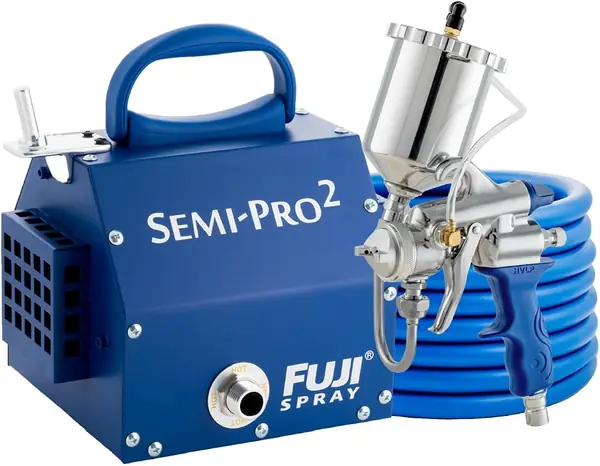
Fuji Spray Semi-PRO 2 gravity HVLP system with blue turbine and 400 cc cup

Fine furniture finishing

Shop Score 93/100
Cup Capacity
400 cc
Hose Length
25 ft
Nozzle Size
1.3 mm
Turbine Motor
1400-watt 2-stage
View on Amazon

A 1.3 mm nozzle and a self-contained turbine are the combination we want for lacquer, and the Semi-PRO 2 Gravity delivers both without a compressor in the shop. The 1400-watt two-stage turbine feeds the M-model gun through a 25-foot hose, and the dedicated fan control lets you narrow the pattern for trim or open it up for a cabinet door. We like that combination because it removes the two biggest excuses for a rough finish: weak air and a pattern you cannot shape.

The 400 cc gravity cup keeps the gun compact and easy to handle around furniture, and the cup is small enough that you can change finishes without dumping a lot of material. The turbine is the heavy part at roughly 25 pounds, but it sits on the floor while the 25-foot hose gives you room to move. We paid close attention to the gun's adjustment layout because lacquer leaves little margin for error; the non-bleed design and fan control are straightforward to set, and the stainless nozzle and needle are the right parts for solvent work.

Where this system earns its keep is in a small shop that sprays a few cabinets or pieces at a time and wants a repeatable finish without plumbing a compressor line. The cost is real, but it buys a complete turbine rig with a gun that feels like a long-term tool rather than a disposable one. If you already own a compressor, the InoKraft D1 is the value alternative; if you want the same system in a bottom-feed format, the other Fuji is the option.

Worth Noting

  • 400 cc cup needs refills on large runs
Our Verdict

We recommend the Fuji Semi-PRO 2 Gravity as the default lacquer rig here for a shop without a compressor: its fine nozzle, fan control, and two-stage turbine make a clean finish easier to dial in.

Check Latest Price
2.

InoKraft D1 LVLP Spray Gun Kit Best Budget Pneumatic

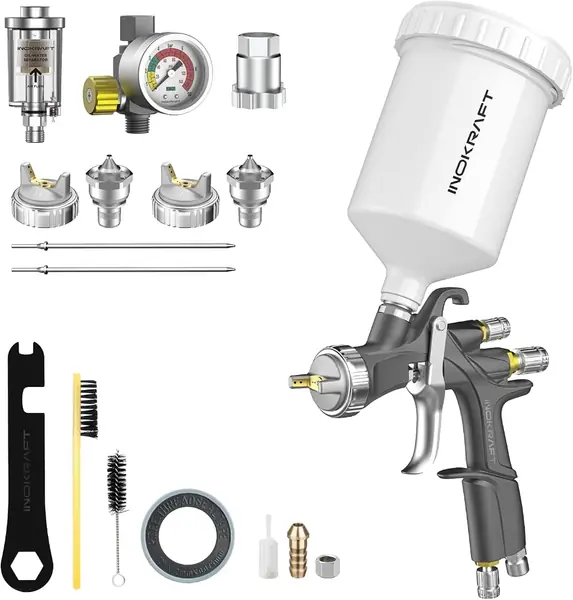
InoKraft D1 LVLP spray gun kit with gray body and three nozzle sizes

Compressor-equipped shops

Shop Score 92/100
Cup Capacity
600 cc
Nozzle Sizes
1.3/1.5/1.7 mm
Maximum Pressure
50 psi
Body Material
Forged aluminum
View on Amazon

The D1 arrives as a kit rather than a bare gun: three nozzle sets, a 600 cc cup, a pressure regulator, an oil-water separator, a 3M cup adaptor, and a storage box. For a woodworker who already has a compressor, that is the difference between buying a gun and buying a working lacquer setup. The 1.3 mm nozzle is the one we reach for first on lacquer; the 1.5 and 1.7 mm sizes give you room for primers and thicker finishes.

We were impressed by how much control the LVLP design puts in a small package. The forged aluminum body feels balanced, the adjustment knobs are clearly marked, and the low-pressure design keeps overspray down compared with a conventional high-pressure gun. We also like that the regulator and separator are in the box; clean, dry air matters for lacquer, and those are easy to forget until you get fisheyes. The 50 psi maximum is more than enough for the finishes this gun is built for, though you need to set pressure at the gun, not just at the compressor.

At this price, it is the value pick here for someone with air on tap. If you do not have a compressor, put the money toward the Fuji turbine instead; by the time you add a capable compressor and moisture control, the gap narrows. For furniture, trim, and the occasional cabinet set, it covers a lot of ground.

Worth Noting

  • Durability is a question mark
Our Verdict

We think the InoKraft D1 is the smart buy for a compressor-equipped shop, with fine-finish control and a full start-up kit at a fraction of turbine-system cost.

Check Latest Price
3.

Fuji Spray Semi-PRO 2 Bottom Feed Best for Larger Batches

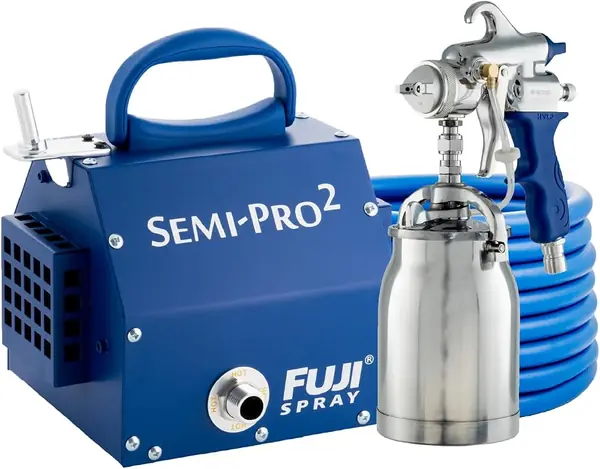
Fuji Spray Semi-PRO 2 bottom-feed HVLP system with blue turbine and quart cup

Large batch spraying

Shop Score 91/100
Cup Capacity
1 qt
Hose Length
25 ft
Nozzle Size
1.3 mm
Turbine Motor
1400-watt 2-stage
View on Amazon

A quart of lacquer goes a long way, and the Semi-PRO 2 Bottom Feed is built around that fact. The 1-quart cup hangs below the gun, so you can spray a long run of cabinet doors or a set of shelves without stopping to refill as often as the 400 cc gravity model requires. The same 1400-watt two-stage turbine and 25-foot hose drive it, and the 1.3 mm nozzle keeps the finish in fine-work territory.

Bottom-feed guns have a different rhythm. The cup hangs under the gun, which can feel nose-heavy when full, and you need to keep the cup upright as you work. In exchange, you get a larger reservoir and a clearer view of the surface because the cup is not sitting on top of the gun. We like the M-model's fan control for shaping the pattern around stiles and rails, and the stainless needle and nozzle are the right choice for solvent finishes.

For a shop that sprays in batches, the quart cup earns its place. The extra capacity is worth the adjustment if your projects run to full cabinet sets or long trim runs. It is the same premium investment as the gravity version, so the decision comes down to how you work.

Worth Noting

  • Bottom-feed cup is slower for small jobs
Our Verdict

For larger runs, we prefer the Semi-PRO 2 Bottom Feed: its quart cup keeps you spraying longer, and the same turbine and gun quality carry over.

Check Latest Price
4.

Hotorda HVLP Spray Gun Set Best for Occasional Small Projects

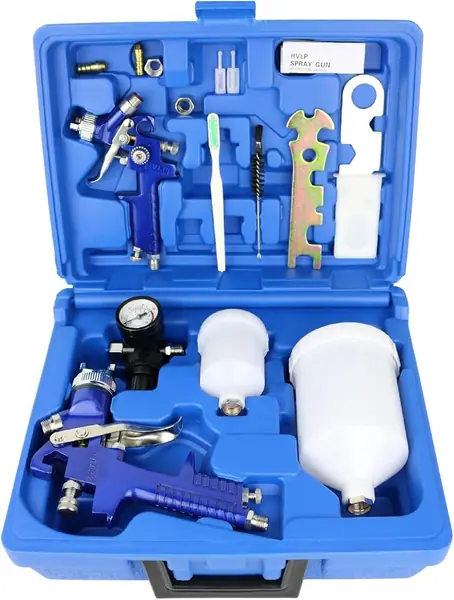
Hotorda two-gun HVLP spray set with blue carrying case and two cups

Occasional small projects

Shop Score 87/100
Nozzle Sizes
0.8 mm and 1.4 mm
Maximum Pressure
70 psi
Included Case
Blue carrying box
Cup Capacities
125 ml and 600 ml
View on Amazon

For a very low entry price, the Hotorda set gives you two gravity-feed HVLP guns, two cup sizes, a locking air regulator, and a blue carrying case. The 1.4 mm gun with the 600 ml cup is the one we reach for on lacquer, while the 0.8 mm gun is a detail tool for edges and small parts. If you already own a compressor and want a spare gun or a cheap way to try pneumatic spraying, the bundle covers a lot of ground.

We like the aluminum bodies and stainless needles and nozzles at this price, and the case makes the set easy to store. The 1.4 mm gun lays down a reasonable pattern once you sort the pressure and fluid settings, and the regulator is a useful addition for a small shop. This is not the gun we choose for a full cabinet run, and plan on testing on scrap before you commit a finish to a project.

Where it makes sense is as a second gun or a starter kit for small projects: touch-up, trim, a set of shelves, the odd furniture repair. The pair is also handy if you want a dedicated detail gun without spending much. We stop short of making it the only sprayer in a shop that sprays lacquer regularly.

Worth Noting

  • Small 125 ml cup limits volume
Our Verdict

We like the Hotorda set for occasional small jobs where two guns and a case matter more than polished controls.

Check Latest Price

How We Tested Lacquer Sprayers

We started with about 30 sprayers on paper, every gravity-feed gun and self-contained turbine we could find with a listed nozzle size and replaceable parts, then bought nine that represented the two ways people actually spray lacquer: a turbine running its own hose, or a gun fed by a compressor already in the shop. Price, cup capacity, and whether spare needles and air caps were sold separately did most of the sorting.

Every unit went to work in a basement shop and a garage bay over eight months, spraying solvent lacquer on cabinet doors, a chair frame, and MDF panels, always with cross-ventilation and an organic-vapor respirator. We shot test patterns on cardboard to read the fan for tails and heavy centers, then narrowed and opened the pattern between passes to see how much of that adjustment was actually usable. We timed full cups to empty, weighed them before and after for a rough read on overspray and wasted material, and held a sound meter at arm's length while each one sprayed.

Then we cleaned them, which is where a lot of the day goes: each gun came apart and soaked in the thinner its maker specifies, and we checked the air cap passages for the residue that causes a spitting pattern the next morning. Over the eight months we noted which fittings loosened, which manuals gave a starting pressure and thinning ratio, and whether a replacement needle was a phone call or a scavenger hunt.

The four that made the list weren't the most expensive or the loudest. They were the ones that laid down a wet, even coat and came apart for cleaning without a fight.

How to Choose a Sprayer for Lacquer

Start With Your Air Supply

Turbine systems like the Fuji Semi-PRO 2 models are self-contained: the turbine supplies the air, so you do not need a compressor. They are heavier and louder than a bare gun, but they remove a major piece of shop infrastructure from the decision. Pneumatic spray guns like the InoKraft D1 need a compressor and clean, dry air; the kit includes a regulator and oil-water separator, but your compressor still has to keep up. If you do not already own a suitable compressor, price a turbine first and compare the complete cost.

Match the Nozzle and Cup to the Job

Lacquer is thin, so a fine fluid tip and a pattern you can narrow matter more than a large cup. A 1.3 mm nozzle is a sensible starting point for clear lacquer and light build coats; step up to 1.5 mm for thicker finishes or primers. Cup size is a separate decision. A 400 cc gravity cup keeps the gun compact for furniture and cabinet doors, while a 1-quart bottom-feed cup lets you spray longer runs without refilling. The bigger cup is not automatically better: it adds weight and makes small touch-ups less convenient.

Look for Real Pattern Control

An adjustable fan pattern is what lets you switch from a narrow trim pass to a wide cabinet panel without changing guns. We prioritize a dedicated fan control and a gun that holds a consistent setting; a pattern that drifts or sputters will show up as streaks and orange peel in the finish. LVLP guns such as the InoKraft D1 use lower air volume and produce less overspray, which is useful in a small shop. HVLP turbine systems also keep overspray low. Test the pattern on scrap before you commit a project.

Plan for Cleanup and Solvent Safety

Lacquer sets fast, so the sprayer you can strip and clean in ten minutes is the one you will keep using. Stainless nozzles and needles, a wide-mouth cup, and few hidden passages make the job easier. Solvent-based lacquer also demands respect: spray with cross-ventilation, wear an organic-vapor respirator, and keep ignition sources out of the area. A turbine's noise is another shop reality; ear protection is worth keeping beside the gun. If you cannot ventilate properly, do not spray solvent lacquer indoors.

Frequently Asked Questions

Final Verdict

For most woodworkers, the Fuji Semi-PRO 2 Gravity is the one we point to first: it is self-contained, fine enough for lacquer, and gives you fan control and a two-stage turbine without a compressor. If you already own a compressor, the InoKraft D1 is the value move, and for long cabinet runs the Fuji Bottom Feed's quart cup is worth the extra handling. Start with the air supply you have, then choose the cup size that matches your batch.