↑↓ navigate ↵ open Esc close All results →

Best Brushes for Shellac of 2026

Shellac flashes off in minutes, giving woodworkers almost no open time to tip out a run, smooth a lap mark, or fish out a loose bristle before the film locks solid. An applicator for shellac has to lay a thin, even coat in a single pass and keep every filament intact.

In three months of brushing shellac across cabinet doors, trim, and scrap panels with 16 brushes, bristle chemistry decided how long an applicator stayed usable. Natural bristle absorbs the alcohol carrier and splays by the second coat, whereas synthetic filaments and foam hold their edge through the session — and a low-cost brush that rinses cleanly in denatured alcohol often outlasts a pricier one that gums up at the heel.

From angled sash brushes for rails and edges to paired 1-inch and 2.5-inch sets, flat-panel foam applicators, and disposable chip brushes for quick sealer coats, the six choices ahead fit the way shellac actually goes on.

Our Top Picks

The Best Brushes for Shellac

1.

Wooster Shortcut Angle Sash Brush, 2-Inch Best Overall
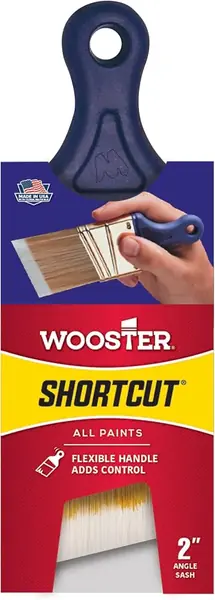
Wooster Shortcut angle sash paintbrush with purple rubberized handle and white synthetic bristles

Trim and edges

Shop Score 96/100
Bristle Type
White nylon and gold polyester blend
Brush Width
2 inches
Ferrule
Brass-plated steel
Handle Length
2 inches
View on Amazon

Two inches of handle is the whole idea. The Shortcut's rubberized grip stops right at the ferrule, so your fingers sit close to the bristles and the brush follows your hand instead of trailing behind it — along a cabinet stile, into the corner where a rail meets a stile, around a window sash. Shellac starts to skin over almost the moment it touches bare wood, and that closeness is the difference between a coat you can still brush out and one you can't.

We made it our main shellac brush and kept reaching for it on trim and furniture edges. The white nylon and gold polyester blend tapers to a fine, flagged tip that releases a thin film instead of dumping it at the end of a stroke, and the synthetic filaments come through a jar of denatured alcohol unchanged. It also dries straight, which sounds like a small thing until you've spent twenty minutes chasing a fluke that curled overnight.

Where it gives ground is speed on big flat work. The stubby handle that makes it nimble in a corner gives you less leverage across a tabletop, so a 2.5-inch brush with a longer handle covers a large panel faster. On cabinets, doors, and trim — the work most shellac actually sees — that trade never comes up.

The detail we came to appreciate most is the ferrule. Brass plating doesn't rust through repeated alcohol rinses the way plain steel does, and after several projects ours still had a tight, square edge with no flaring. Nothing else here has held its shape that well through the same handling.

Worth Noting

  • Wide 2-inch head is clumsy in tight moldings
Our Verdict

Our default shellac brush: a 2-inch synthetic angle sash that lays a thin, even film and keeps your hand close to the work on trim and cabinet edges.

Check Latest Price
2.

Bates 6-Piece Paint Brush Set Best Set for Size Variety

Bates six-piece paint brush set with treated wood handles and angled and flat bristles

Whole-project work

Shop Score 94/100
Handle
Treated wood
Brush Sizes
Six brushes from 1 to 2.5 inches
Bristle Blend
Natural bristle and synthetic filaments
Shapes Included
Three flat and three angled
View on Amazon

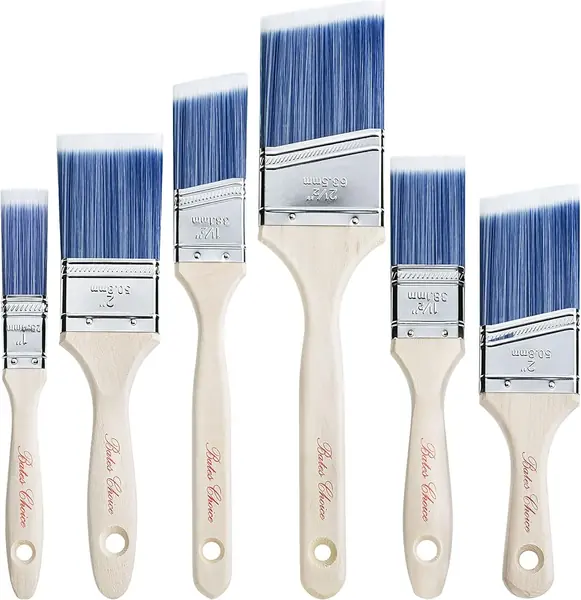
Six brushes, from a 1-inch flat to a 2.5-inch angle, for about what a single premium finishing brush costs. That arithmetic is the pitch, and it holds up when you're sealing a run of shelves or brushing shellac onto furniture that has a lot of edges and not much flat field to cover.

The bristles are a natural and synthetic blend, and they load a thin shellac film the way natural hair is supposed to: the brush picks up finish, carries it through the stroke, and lets it go evenly instead of flooding at the end. We spent a session with the 2-inch angle on face frames and the 1-inch flat on touch-up, and the light wooden handles never became the reason to stop.

As a set to keep on the bench, we rate it above what it costs — with the caveat that it's a workhorse, not a precision instrument. The tips don't taper as finely as our top pick's, so a show surface takes an extra pass or two to lay flat. What surprised us is the 2.5-inch angle: it covers a shelf board in a couple of strokes and still cuts a reasonably straight line at the edge, and it's the one that stays out when the rest go back in the drawer.

Worth Noting

  • Bristles shed on some brushes in the pack
Our Verdict

We like this six-brush set for the size range it puts on the bench cheaply, and the natural bristle blend loads a thin shellac film the way the old books describe.

Check Latest Price
3.

Bates Foam Paint Brushes, 2-Inch Best Foam Applicator

Bates foam paint brushes with wooden handles and black foam heads

Flat panels

Shop Score 93/100
Handle
Wooden
Pack Count
16
Brush Width
2 inches
Head Material
Absorbent foam
View on Amazon

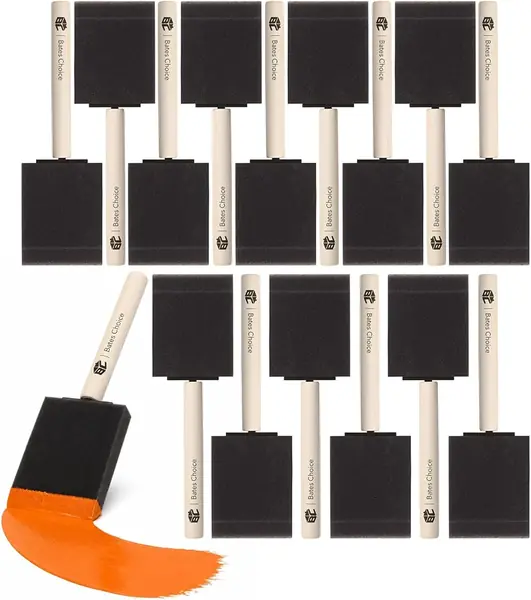
Foam has a reputation as the brush you hand someone who doesn't know better, and with shellac that reputation is wrong. The open cells meter out a thin, even film and there's no bristle to leave a mark or shed into the coat, which is precisely what a fast-drying finish wants on a flat panel. We got a smoother first coat from one of these than we expected to.

Where foam stops is at a line. The edge is soft and square, so it can't cut in along a stile or follow a molding the way an angle sash does — mask the edge or switch brushes for those few inches. What it does do is cover area: a 2-inch head is about right for shelf boards and cabinet sides, and the foam carries enough shellac that you aren't re-dipping on every stroke.

Sixteen of them changes how a session runs. You can load a brush, lay a coat, and set it aside rather than stop and rinse while the finish tacks up, and the ones that come through a denatured-alcohol rinse go back in the bag for the next coat. That's the case for keeping a pack on the shelf instead of one brush in a jar.

Worth Noting

  • Foam heads can pull off mid-project
Our Verdict

We keep these for flat panels: foam lays shellac out streak-free with nothing to shed, and a sixteen-pack is cheap enough that you toss a loaded brush instead of cleaning it.

Check Latest Price
4.

Pro Grade 5-Piece Paint Brush Set Best Synthetic Set

Pro Grade five-piece paint brush set with wooden handles and soft synthetic bristles

Multi-step bench work

Shop Score 92/100
Handle
Solid wood
Pack Count
5
Bristle Type
SRT synthetic filaments
Brush Sizes
Five brushes from 1 to 2.5 inches
View on Amazon

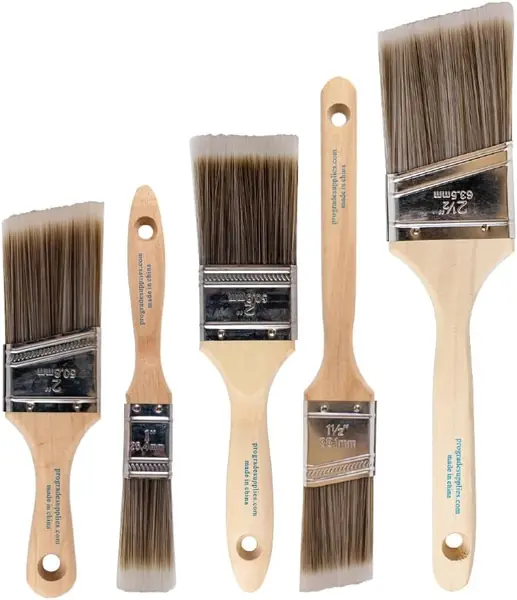
Five brushes, from a 1-inch flat to a 2.5-inch angle, for roughly what the Wooster costs on its own. If you want one excellent brush, buy the Wooster. If you want a brush for shellac, a second for sealer, and a spare you don't have to baby, this set gets you there for less.

The synthetic filaments are soft, and on a thin finish that softness is forgiving: the brush spreads shellac instead of scrubbing it, so open grain doesn't get pushed full of finish. The 2-inch angle stubby earns its place in a cabinet carcass where a full-length handle won't fit, and the 1-inch flat has turned into our glue and wax brush — a job we don't give the Wooster.

Our reservations are about consistency rather than design. The maker's zero-shed claim didn't hold across every brush we handled, and a stray filament in a coat that dries in minutes costs you a sanding pass. Work each new brush across your palm before the first dip and watch the first coat closely. As a set to keep for messy, multi-step work, though, it has stayed within arm's reach of the bench.

Worth Noting

  • You replace all five when one wears out
Our Verdict

We treat this set as bench supply: five soft synthetic brushes for shellac, sealer, and messy jobs, with the stubby angle brush earning its place inside cabinets.

Check Latest Price
5.

Pro Grade 2-Inch Chip Brushes, 36-Pack Best for Disposable Sealing

Pro Grade two-inch natural-bristle chip brushes with light poplar handles in a bulk pack

Disposable sealing

Shop Score 91/100
Handle
Poplar with hanging hole
Pack Count
36
Bristle Type
Natural bristle
Brush Width
2 inches
View on Amazon

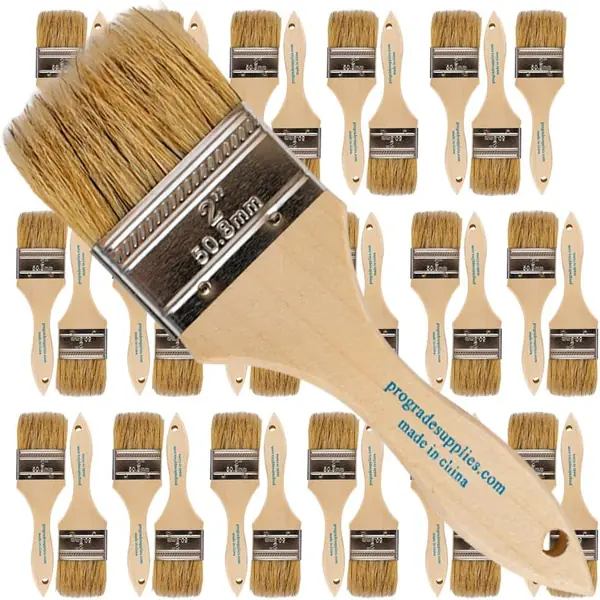
Picture a run of built-in shelves, or a stack of cabinet doors, and a finish that will be dry to the touch before you've finished rinsing a brush. That's the job chip brushes were invented for: natural bristle, a plain wood handle, and a price that makes throwing one away the sensible end of the session rather than a waste.

On flat work they earn their keep. The natural bristles carry a thin shellac film and brush it out reasonably clean, and because they're stiff they push finish into open grain and along an edge instead of skating over it. What we didn't expect was how much the shedding varies from brush to brush: work each new one hard against your palm before the first dip, and keep tweezers within reach for the first coat.

The handle deserves a mention. It's poplar, it's light, and there's a hole drilled at the top so a rinsed brush can hang dry instead of standing in a jar, which is how most brushes actually get ruined. Thirty-six of them will outlast a kitchen's worth of cabinets, and the ones you don't use keep in a drawer until the next job.

Worth Noting

  • Coarse tips leave marks on topcoats
Our Verdict

For a long run of shelves or a stack of doors, we treat these as the throwaway brush that still lays an acceptable coat and never has to be rinsed.

Check Latest Price
6.

Chalk and Wax Paint Brushes, 2-Pack

Two round natural-bristle wax brushes with beech wood handles and stainless steel ferrules

Wax over shellac

Shop Score 90/100
Handle
Beech wood
Pack Count
2
Bristle Type
Natural animal hair
Large Brush Width
2.5 inches
View on Amazon

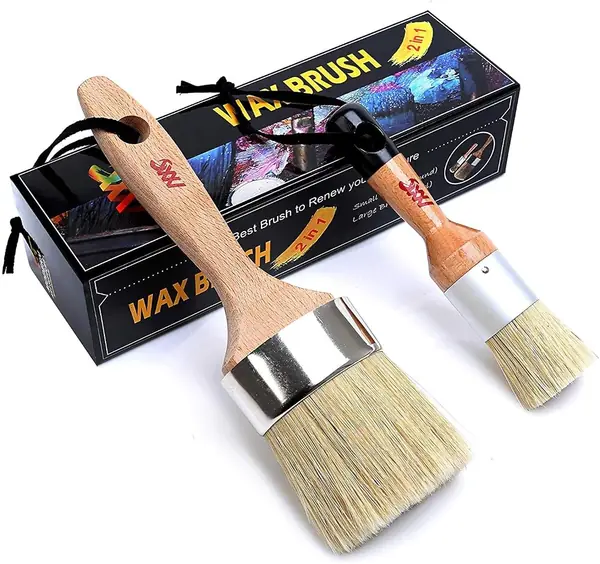
These are wax brushes, and that's the frame that makes them useful to a shellac project rather than redundant with it. Round, densely packed animal hair, a beech handle, a stainless ferrule — the shape is built to carry a heavy load of wax or chalk paint and work it into a surface, which is the opposite of what a thin shellac coat wants. We reach for them after the shellac, not for it.

Over a cured shellac base they do a genuinely good job. The dense head spreads furniture wax evenly, the bristles don't streak, and the smaller brush in the pair gets into reeded legs and inside corners where a flat brush can't follow. Animal hair does shed, especially when new, so work the head out on scrap and watch the first pass.

Buying the pair rather than one makes more sense than it sounds: a wax brush stays a wax brush, so a second head lets you keep chalk paint and clear wax apart. Ours have kept their shape and their ferrules tight through several waxings, and the hair has softened in a way that suits wax and would not suit a brushing finish.

Worth Noting

  • Too much bristle for thin shellac coats
Our Verdict

We reach for these over a cured shellac base, not for laying the shellac itself: the dense animal hair carries wax beautifully and loads far too much for a thin coat.

Check Latest Price

How We Tested the Best Brushes for Shellac

We started by gathering every brush sold for shellac, varnish, or stain work, then narrowed the field by what actually matters for a finish that dries in minutes: filament or applicator type, width and shape, whether it comes as a single brush or a pack, and cost per brush. That left 16, from 1-inch angled sashes and sets running up to 2.5 inches to foam pads and contractor packs of chip brushes.

For three months we kept them on the bench, brushing shellac onto cabinet doors laid flat, window and door trim, furniture panels, and rails, with a first pass on scrap boards for any unfamiliar brush. After each coat we counted what stayed behind — flagged filaments, whole bristles, foam crumbs — and noted whether the tips laid the coat flat or dragged ridges into it.

We watched how each brush loaded from a small cup and whether it released a thin, even coat or dumped it in one spot. Cleanup got timed the same way every round: swirled in denatured alcohol, combed out, dried, and returned to rotation to see whether it came back for a second session. Anything that shed, splayed, or softened was out.

Throughout, we decanted only what we needed for the coat at hand, kept the can closed, and worked clear of ignition sources. At the end we set cost per brush against how many a real project burned through.

How to Choose a Brush for Shellac

Natural Bristle, Synthetic Filaments, or Foam

All three apply shellac, and the surface decides which you want. Natural bristle — hog hair in a traditional brush, animal hair in a wax brush — loads and releases a thin film beautifully, but a new natural brush sheds more than any other kind. Synthetic nylon and polyester filaments shed less, come through an alcohol rinse without softening, and taper to a tip fine enough to cut a straight line in a corner. Foam lays the flattest, most uniform film of the three and cannot shed at all.

The trap is assuming any foam brush is solvent-proof. Some are sold with an explicit warning against shellac and lacquer because the alcohol attacks the foam or the adhesive holding it to the handle, so read the wrapper before you load one. We reach for a synthetic angle sash for trim and edges, natural bristle for a traditionally brushed panel, and foam when a big flat surface needs an even coat fast.

Shedding Is the Failure That Ruins a Coat

A bristle dragged through shellac is worse than it sounds. The finish skins over in minutes, so by the time you spot the hair it's set in place and you're sanding back a coat you were happy with. Work any new brush hard across your palm or a scrap of wood before its first dip, comb natural bristle straight, and pull stragglers with tweezers.

After that, judge a brush by what it does over several sessions. A synthetic that never drops a filament is worth more than a nicer-feeling natural brush that sheds on every third coat, which is why we weight shedding above almost everything else here.

Width and Shape Decide Where You Can Reach

Two inches is the workhorse width for furniture and trim: wide enough to cover a rail or a panel edge in one pass, narrow enough to control. An angle sash adds a tapered tip that lets you cut along a stile or a molding line without masking. Step down to 1 or 1.5 inches for narrow profiles, small drawers, and the inside corners of a carcass, and up to 2.5 inches only for flat fields like shelf boards and tabletops.

The mistake runs both ways. Too wide a brush floods a molding and pushes finish into the wrong corner; too narrow a brush means you're still laying finish on a panel when the first stroke has started to set.

Loading and Brushing Out a Fast Finish

Shellac rewards a loaded brush and a light hand. Dip no more than a third of the bristle, tap the excess off against the rim instead of wiping it on the can, and lay the coat in one direction with the brush barely flexed — every extra stroke on a fast finish shows. Keep a wet edge and don't go back over a pass that has started to tack.

Consistency matters as much as technique. Most shellac is sold as a three-pound cut and is thinned with denatured alcohol to roughly a two-pound cut for brushing, which buys a little more open time. Two brushes — a 2-inch for panels and rails, a 1-inch for moldings and touch-up — keep you from rinsing mid-coat.

Frequently Asked Questions

Final Verdict

For most people brushing shellac onto furniture and trim, the Wooster Shortcut is the brush to buy. Two inches of angle sash covers rails, stiles, and panel edges, the synthetic filaments come through alcohol cleanups unchanged, and ours has held a fine edge without shedding into a coat — the one failure that costs you a sanding pass on a finish that dries this fast.

When the work is mostly flat panels, reach for the Bates foam pack instead: an even film with no bristle to shed, and cheap enough that you toss a loaded brush rather than rinse it. If the job is a run of shelves you don't want to clean up after, the Pro Grade chip brushes are the ones to sacrifice.