↑↓ navigate ↵ open Esc close All results →

Best CA Glues for Woodworking of 2026

Grabbing the highest-strength cyanoacrylate bottle off the shelf is a common mistake when what actually saves a woodworking repair is matching viscosity to the gap. Water-thin CA wicks deep into hairline splits, medium glue gives a few seconds to align a joint, and thick gel bridges loose fits or open voids without running.

In five months of testing 16 glues and activator kits on split chair rungs, walnut and maple checks, knot fills, and chipped edges, open working time and tip design mattered as much as bond strength. Leaving capped bottles idle on the bench for weeks quickly showed which nozzles weld shut and which dispense cleanly on the next repair.

Opened CA thickens well ahead of its printed shelf date, meaning oversized economy bottles only save money in high-volume shops. Stored upright in a cool spot, the eight formulas and kits below stay usable through real bench repairs without gluing the cap shut.

Our Top Picks

The Best CA Glues for Woodworking

1.

FastCap 2P-10 SoloKit Best Overall
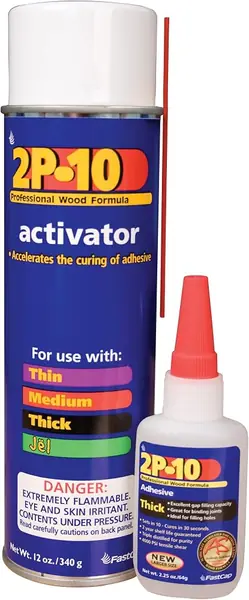
FastCap 2P-10 SoloKit thick CA glue with 12-ounce activator spray can

Clamp-free wood assembly

Shop Score 96/100
Full Cure
30 seconds
Tensile Strength
4,000 psi
Bond Time
10 seconds with activator
Kit Includes
12 oz activator and 2 oz adhesive
View on Amazon

Ten seconds and then let go — that is the whole pitch, and it undersells the kit. Spray the activator on one face, press the parts together, and the joint is already holding its own weight; the listed tensile strength is 4,000 psi and the full cure about thirty seconds. On a cabinet crown or a chair rung where a clamp has nowhere to sit, that changes what one person can do alone in a shop.

The adhesive half is thick enough to stay where you put it, so it works on a vertical face and bridges small gaps instead of draining away into the wood. We tacked trim and jigs with it before driving fasteners, and the joint held while the screw went home — the sort of thing that turns a two-person job into a one-person job.

What you get is 2 ounces of adhesive against 12 ounces of activator, so the spray outlasts the glue several times over. Replacement adhesive, not activator, is the running cost here, and it is worth ordering a spare bottle with the kit rather than discovering the ratio halfway through a run of crown molding. The generous activator also means you can be liberal with the spray on a big assembly without running dry mid-project.

The cured bond behaves less like glass than plain super glue does, which matters on trim that takes a knock in a house with kids or dogs. We keep the small bottle in the bench drawer for furniture repair now: a split table leg or a broken rung goes back together in the time it takes to find a clamp, and without one.

Worth Noting

  • Won't wick into hairline cracks
Our Verdict

We tell anyone building a shop kit to buy this first: activator-driven bonds in ten seconds, a thick body that fills small gaps, and a cure you can sand flush.

Check Latest Price
2.

Starbond Super Fast Thin CA Glue Best for Wicking Into Cracks

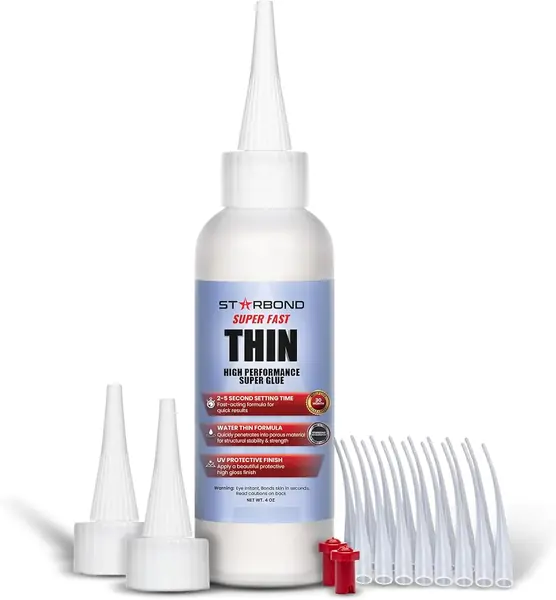
Starbond Super Fast Thin CA glue bottle with spare caps and microtips

Cracks and turnings

Shop Score 95/100
Viscosity
Water-thin, 2-3 cPs
Bottle Size
4 fluid ounces
Included
3 spare caps and microtips
Shelf Life
30 months stored under 40°F
View on Amazon

A hairline crack in a turning cannot be clamped, and that is the situation this bottle was built for. At 2-3 cPs the glue is closer to water than to oil, so it travels into the crack by capillary action instead of sitting on top of it. You watch the line drink the drop, and you come back to a hard, clear repair.

We use it where the joint is tight and the damage is fine: stabilizing a checked bowl blank before the finish cut, hardening punky spalted maple so it stops tearing out under the gouge, and locking a lifted splinter back down. The listed full cure is three seconds, and a drop on a tight joint grabs well before you have capped the bottle again.

The extras are why it stays on the bench. Three spare applicator caps, two clog-free stoppers, and a bag of microtips mean a clogged nozzle is a two-minute swap; we have had a cap set itself shut in the drawer and had the bottle back in service faster than we could find a pin. Four ounces goes a long way at a drop per crack, and the quoted 30-month shelf life means the last of it is still good if you store it cool and upright.

Worth Noting

  • Soaks away in loose joints and wide gaps
Our Verdict

For damage you can't clamp, we reach for this one: the water-thin formula wicks into hairline cracks and hardens punky wood before a finish cut.

Check Latest Price
3.

Starbond Light Brown Medium CA Glue Best for Color-Matched Repairs

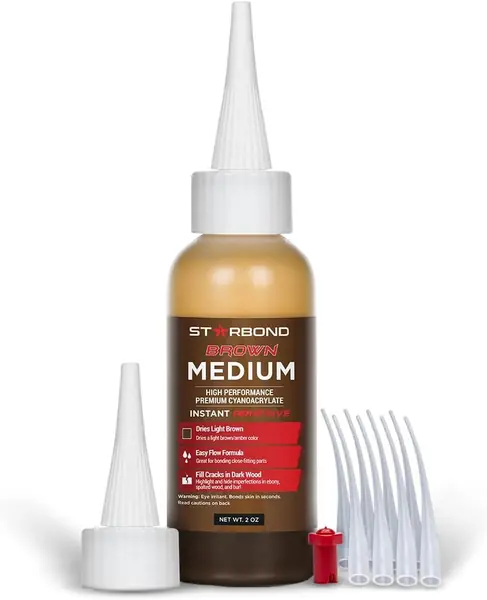
Starbond Light Brown Medium CA glue bottle for tinted wood repairs

Visible light-wood repairs

Shop Score 94/100
Viscosity
Medium
Bottle Size
2 fluid ounces
Full Cure
40 seconds
Color
Light brown tint
View on Amazon

A repair in maple or ash fails on color long before it fails on strength. Clear glue in a knot reads as a dark, glassy line under finish; this bottle is tinted light amber-brown and mixed for pale and mid-tone woods, so the patch sits closer to the wood around it instead of announcing itself.

The body is medium, which is the useful middle for filling. It is thin enough to work down into a crack and thick enough to build in layers inside a void without draining out the bottom. Drop, let it cure, drop again, then sand flush — quicker than mixing epoxy for a flaw the size of a pencil tip.

Where it earns its place is the repair you can see: nail holes and small checks in trim before the topcoat, a splintered shelf edge, knot voids in oak and cherry. The tint is the reason to choose this over a clear medium, and two ounces covers dozens of small fills. The quoted full cure is 40 seconds; deep fills take longer, so build them in thin layers and give each one a little time before the next.

Worth Noting

  • Tint suits light and mid-tone woods only
Our Verdict

We like it for repairs you'll see: the light amber tint blends into maple, oak, and ash so a filled crack stops reading as a dark, glassy line.

Check Latest Price
4.

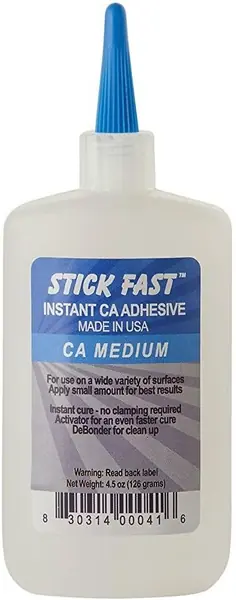
Stick Fast Quick-Set Medium CA Glue Best General-Purpose Medium

Stick Fast Quick-Set Medium CA glue in a clear four-ounce bottle

Positionable general joinery

Shop Score 93/100
Viscosity
Medium
Bottle Size
4 fluid ounces
Purity
99.5% triple distilled
Bonds
Wood, metal, glass, plastic, ceramic
View on Amazon

Not every joint wants to be permanent on contact. A plain medium CA gives back the thing activator kits take away: a minute to slide a part into alignment before the glue grabs, so you place the piece and then leave it alone.

The four-ounce bottle is the one that lives on our bench. Triple distilled to 99.5% purity, the formula is clear and consistent, and it works into pores and fine cracks as readily as it sits on a smooth face. Splines, miter keys, inlay, and small frame repairs are what it gets used for here — anywhere we want to set the part by eye and walk away.

We reach for it over a fast kit when an activator's mist would drift onto a finished surface nearby, and on any assembly that needs two hands and a nudge. Set against the two-part kits, the slower grab is the feature: one joint done properly instead of one joint done instantly. Four ounces at a midrange price is the sensible restock for a bench that goes through medium CA steadily, and the clear cure leaves no witness line on light wood.

Worth Noting

  • Slower grab is not instant like two-part activator kits
Our Verdict

Our pick when a joint needs to be positioned by eye: this medium gives you a slower grab and a clean, clear cure in a four-ounce bottle.

Check Latest Price
5.

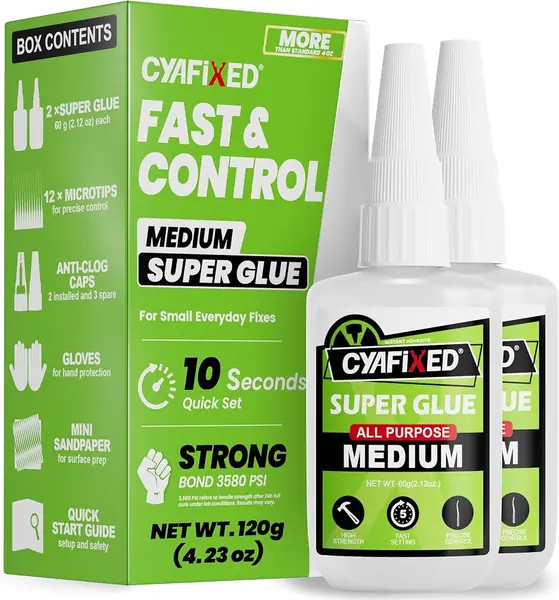
CYAFIXED Fast & Control Medium CA Glue Best Value Kit

CYAFIXED Fast and Control medium CA glue bottle with microtips and caps

Mixed-material small repairs

Shop Score 92/100
Viscosity
100 cPs medium
Set Time
5 to 30 seconds
Tensile Strength
3,580 psi
Kit
20-piece accessory set with microtips
View on Amazon

Twelve microtips, three anti-clog caps, two gloves, and three grits of sanding paper come in the box alongside a four-ounce bottle of medium CA. For a first bottle, that bundle does more for your results than another few hundred psi of tensile strength would.

The glue itself is 100 cPs — roughly the consistency of cooking oil — with a listed tensile strength of 3,580 psi. Set time is quoted at 5 to 30 seconds depending on how thick the film is and what you are bonding, which is quick enough to fixture a part and slow enough that you can shift it with a fingertip before it grabs.

It is the accessories that changed how we use it. On a snapped plastic tab or a 3D-printed bracket, a microtip puts the drop exactly on the break instead of flooding the joint, and the gloves stop you gluing two fingers together while you hold the piece still. The sanding papers are a nice touch for knocking the cured squeeze-out back level without hunting through the drawer.

We think it is the best first bottle here for someone whose repairs are small, mixed-material, and occasional — wood one day, a plastic knob the next. On serious cabinet work a specialist medium will feel better in the hand, but for one bottle that covers the household list without much outlay, this is the one we hand over.

Worth Noting

  • Not a gap filler for open voids
Our Verdict

We think it's the best value here: a four-ounce medium plus microtips, gloves, and caps that make small, awkward repairs neat.

Check Latest Price
6.

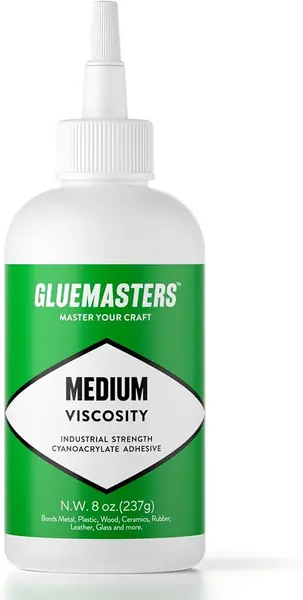
Glue Masters Medium CA Glue Best for High-Volume Shops

Glue Masters eight-ounce medium viscosity CA glue squeeze bottle

High-volume shop use

Shop Score 91/100
Viscosity
Medium
Bottle Size
8 fluid ounces
Full Cure
24 hours
Water Resistance
Waterproof
View on Amazon

Eight ounces is two to four times the bottle most of these picks come in, and the size is the entire argument. For a shop that treats CA glue as a daily fastener rather than an occasional fix, the big bottle is the one still half full when the little ones have gone solid in a drawer.

We like the squeeze bottle and the medium body for general bench work. It flows smoothly enough to place a bead where you want it and holds on a vertical face long enough to press a part home, and it cures waterproof, which several picks here cannot claim. It is the bottle for production runs, jig building, and anyone tired of reordering.

Buying in bulk puts a clock on it: CA glue goes stale once the bottle is opened, so eight ounces only pays off if you are into it most weeks. Store it cool and upright, and decant what you need into a small bench bottle so the main supply is not opened every day. That habit is what keeps a big bottle a bargain instead of a lump.

Worth Noting

  • Body thickness varies between bottles
Our Verdict

We keep the eight-ounce bottle for volume work: it lasts through a run of jigs and repairs, and it cures waterproof where a small bottle would already be empty.

Check Latest Price
7.

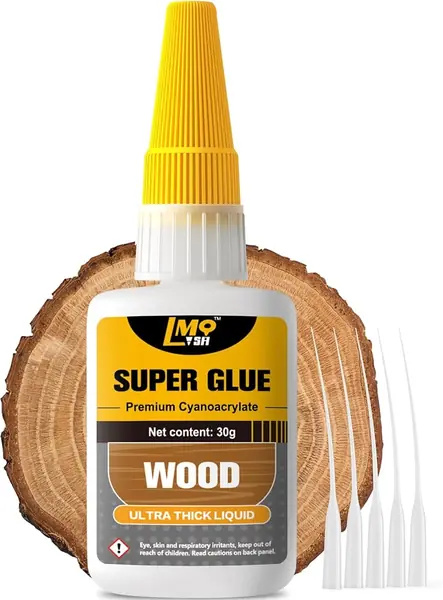
LMQ LASH Wood Super Glue

LMQ LASH clear instant CA glue one-ounce bottle with precision tip

Budget first bottle

Shop Score 90/100
Bottle Size
1 fluid ounce
Full Cure
24 hours
Set Time
30 to 60 seconds
Cap
Anti-clog precision tip
View on Amazon

One ounce is the least expensive way into this category, and at that size there is not much to lose. It sets in 30 to 60 seconds, cures fully within a day, and the anti-clog cap is the feature we care about most at this end of the market — a bottle still liquid in three weeks is worth more than a bigger one that isn't. It cures clear and is rated waterproof, which is more than you expect from a bottle this size.

The body is thin enough to wick along a splintered edge or into a loose dowel, which suits furniture repairs and craft work more than structural joinery. Buy the first bottle as a test: if the flow suits your work, step up to one of the larger mediums here, and if you need gap filling, choose a thick instead.

Worth Noting

  • One-ounce bottle runs out fast
Our Verdict

We recommend one for the drawer: it sets in under a minute, asks little of your budget, and the anti-clog cap means it is still usable the next time you reach for it.

Check Latest Price
8.

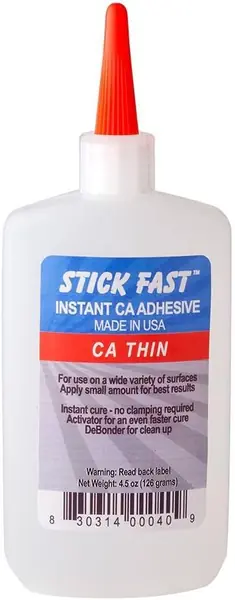
Stick Fast CA Thin Best for Turnings and Finishes

Stick Fast CA Thin four-and-a-half-ounce bottle of clear adhesive

Turnings and finishes

Shop Score 89/100
Viscosity
Thin
Bottle Size
4.5 fluid ounces
Purity
99.5% triple distilled
View on Amazon

This is the runniest glue in the group — closer to water than to oil — and that is the design brief rather than a fault. Stick Fast triple distills it to 99.5% purity, so it cures crystal clear and leaves nothing cloudy behind in a crack or on a pen barrel.

Where it belongs is soaking work: hardening the end grain of a jig so screws stop tearing out, stabilizing a soft spot in a bowl blank before the final pass, and building a CA finish on a pen in many thin coats, sanded and polished between. Run a drop along a fine crack and it is inside the wood before you have set the bottle down.

The 4.5-ounce bottle is the value case among the thin glues here, and since it goes on a drop at a time, it lasts a long while. It arrives as a bare bottle, without the microtips and spare stoppers that come with the Starbond thin, so if you want precision placement you are buying tips separately or choosing that kit instead.

We use it for finishing more than assembly. Keep it for surfaces, end grain, and stabilizing rather than structural repairs, and pair it with a medium when a joint needs any gap tolerance. In a turning shop this bottle empties; in a trim carpenter's kit it sits — and that division is the reason to own it alongside a medium rather than instead of one.

Worth Noting

  • Watery body is hard to meter drop by drop
Our Verdict

We use this one for finishing rather than assembly: the thin body hardens end grain and builds a CA finish that polishes to a gloss.

Check Latest Price

How We Tested CA Glue for Woodworking

We began by researching the things that actually change a purchase: viscosity, whether an activator comes in the box, clear versus tinted resin, bottle size, and whether spare caps or microtips are included. From that pool we bought 16 bottles and kits to test, favoring sizes a hobbyist or small shop would realistically finish before the glue goes stale.

Testing ran five months across a garage workbench and a cabinet shop bench, on the jobs CA glue gets reached for: end grain to long grain, tight joints and gappy ones, split chair rungs, knots on turnings, inlay, and a pile of mixed-material repairs.

Every session started a stopwatch at clamp-up. We wiggled joints by hand to find the moment they stopped moving, then later broke the cured pieces with a chisel to see whether the wood failed before the glue line — on porous stock, that's the result that matters. We ran activator on half of each matched pair to see how much positioning time the mist took away, wicked thin formulas into hairline cracks to watch how far they traveled, and laid tinted glue on light maple to judge whether the repair disappeared. Between sessions bottles sat capped and upright in a cool cabinet, so we could see which tips clogged and whether the extra nozzles earned their place.

Nitrile gloves and eye protection went on before any bottle was opened, and the cabinet sat well above a child's reach. Activator was sprayed with the shop door open and a fan running, never near a finished panel. We also weighed what was left in each bottle against its cost per ounce — a big jug is only a value if you finish it. A bottle that set solid in its cap was retired, not argued with.

How to Choose CA Glue for Woodworking

Match Viscosity to the Job

Thin formulas around 2-3 cPs wick into cracks and harden end grain; mediums around 100-200 cPs sit where you put them and handle most joinery; thicks at 2,000 cPs and up bridge gaps and stay put on a vertical face. What a brand calls medium is not standardized, though — we have opened bottles labeled medium that ran like water and others that had to be squeezed hard.

Where a cPs figure is quoted, trust it over the word. Where it isn't, buy small first. We prefer one bottle of each grade over a big bottle of the wrong one.

Activator Buys Speed and Costs You Adjustment

An activator spray cures the glue in seconds instead of a minute or more, which is what makes CA usable on assemblies you cannot clamp. The trade is positioning: once the parts touch under activator, the bond has set, so dry-fit first and mark your alignment before you spray anything.

Keep the mist away from finished surfaces you are not bonding, and switch to a plain medium when a joint needs a nudge after contact.

On Wood, Fit Beats the Strength Number

Tensile figures such as 4,000 psi are measured on prepared surfaces. On real wood, the joint's fit and the glue's ability to wet the surface decide the outcome. Thin glue on end grain drinks in and starves the joint, while a thick body on a tight miter leaves a glue line that will not close.

Size the viscosity to the gap, and clamp structural joints anyway while the glue cures. CA cures hard and glassy, so repairs, trim, and fixturing are its territory rather than a whole panel glue-up.

Buy a Size You'll Actually Finish

CA glue has a shelf life — 20 to 30 months is what the makers here quote, stored cool — and a bottle left open on a summer bench falls well short of that. A small bottle you finish beats a large one that sets solid. If you do buy big, decant a working supply so the main bottle is not opened daily.

Keep spare caps and microtips on hand. A clogged nozzle is what actually kills these bottles, and a spare cap costs far less than a replacement bottle.

Tinted Glue for Repairs You'll See

Clear glue in a crack reads as a dark or glassy line under finish. Tinted formulas — light amber-brown for maple and oak, dark brown or black for walnut — make the same repair nearly vanish. Tint only pays on visible work, so buy clear for joints and save the tinted bottle for surfaces.

Build fills in layers rather than one deep pour, and sand flush once cured.

Frequently Asked Questions

Final Verdict

FastCap's 2P-10 kit is where we start anyone building a woodworking kit. The activator turns a two-part assembly into a ten-second job, and the thick body fills the small gaps that a plain super glue cannot hold — which is most of what actually breaks in a house.

If your work is turning, crack repair, or a CA finish, choose the Starbond thin formula instead; it reaches damage no thick glue can. And if you want a plain bottle that lets you slide a joint into place before it grabs, take the Stick Fast medium.