↑↓ navigate ↵ open Esc close All results →

Best Wood Glues of 2026

Every bottle of wood glue asks for a trade-off between assembly time and environmental toughness: fast-setting formulas lock up wide panels mid-clamp, whereas slower or waterproof grades demand longer clamp schedules or stricter cleanup. Choosing the right rating prevents a seam from creeping open days later or letting go after a damp night outdoors.

Gluing hardwoods and softwoods across indoor panels, cutting boards, and outdoor test pieces with 14 formulas over five months showed open time limiting more projects than shear strength; fast-grabbing glue locks up wide panel glue-ups long before clamps seat evenly. Even squeeze-out along the entire seam remains the clearest safeguard against a starved joint.

Covering exterior waterproof work, food-contact cutting boards, bulk shop jugs, and quick household fixes, four formulas proved their worth a week after the clamps came off.

Our Top Picks

The Best Wood Glues

1.

Titebond III Ultimate Wood Glue Best Overall
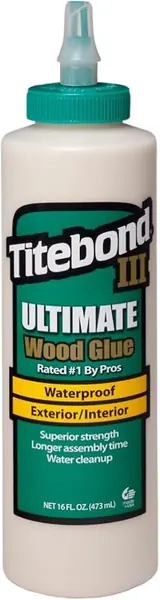
Titebond III Ultimate wood glue in a tan 16-ounce squeeze bottle

Exterior woodworking

Shop Score 97/100
Water-resistance Grade
ANSI/HPVA Type I waterproof
Tensile Strength
4000 psi
Open Time
8 minutes
Bottle Size
16 fluid ounces
View on Amazon

Wood glue only has to answer one question before any other: will this joint get wet? Titebond III is one of two glues here that clears ANSI/HPVA Type I, the waterproof grade, and it's the bottle we reach for first — outdoor chairs, planters, a mailbox post, a cutting board that ends up in the sink. The 4000 psi tensile figure is the highest of the glues here that publish one, but the approval for indirect food contact is the detail that settles more projects for us.

Eight minutes of open time shapes how you work. That's enough to run a bead around a cabinet carcass and get clamps on without racing, though on a complicated glue-up with a dozen loose joints you'll want a dry-fit rehearsal and a second pair of hands; the Ultimate Gorilla bottle gives you nearly twice as long when that's the job in front of you. It's also unaffected by most finishes, so a glue line that has been sanded back takes stain and topcoat the same as the wood around it.

Cleanup is the other reason it stays on the bench. Squeeze-out wipes off with a damp rag while it's wet, there's no solvent smell to clear out of the shop, and the squeeze bottle lays down a bead narrow enough for a repair without a glue pot and a brush. For cutting boards, serving pieces and anything else that meets food, the indirect food contact approval means you don't have to keep a separate bottle for kitchen work.

Worth Noting

  • Small bottle costs more per ounce than the gallons
Our Verdict

We reach for this one first: it's waterproof, approved for indirect food contact, and rated at 4000 psi, with squeeze-out that wipes off with water.

Check Latest Price
2.

Titebond II Premium Wood Glue Best Gallon for Mixed Indoor and Outdoor Work

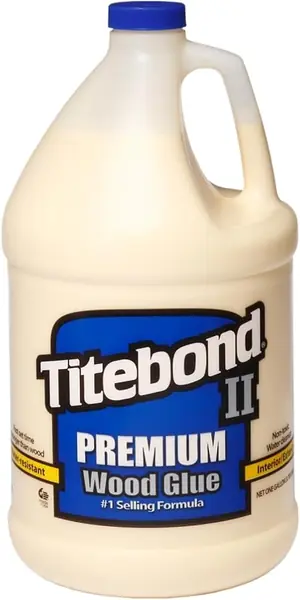
Titebond II Premium wood glue in a honey-cream one-gallon jug

Food-safe shop gallon

Shop Score 96/100
Water-resistance Grade
ANSI/HPVA Type II water-resistant
Volume
128 fluid ounces (1 gallon)
Tensile Strength
3750 psi
Food Contact
Approved for indirect food contact
View on Amazon

A gallon jug is a different purchase from a squeeze bottle. You buy it because the work is steady — a run of shop cabinets, a set of outdoor chairs, a stack of cutting boards for holiday gifts — and because running out mid-assembly is worse than storing a jug. Titebond II is the gallon we point a general shop toward, and it earns that on the label rather than on the size of the container.

What makes this the gallon we recommend over the other one here is the combination it carries: ANSI/HPVA Type II water resistance, a 3750 psi tensile rating, and approval for indirect food contact. That covers the two jobs most shops actually have, exterior furniture that sees rain and kitchen pieces that see a knife, without keeping two products on the shelf. Only the waterproof rating of our top pick goes further, and that only matters for pieces that will soak.

The handling is what we noticed first. Initial tack is strong enough that a vertical piece stops sliding before the clamp reaches it, and the set is quick, so a twelve-part assembly doesn't eat an afternoon. It sands to a powder instead of gumming up the paper, and it takes a finish without a halo around the joint. Decanting into a squeeze bottle is worth the two minutes for small work; for spreading across a panel, a jug and a brush is fine.

Worth Noting

  • Dries a golden tone that shows on pale woods
Our Verdict

We buy this by the gallon for shop work that spans indoors and out: Type II water resistance, cutting-board approval, and strong tack in one jug.

Check Latest Price
3.

Gorilla Wood Glue Best Budget Gallon

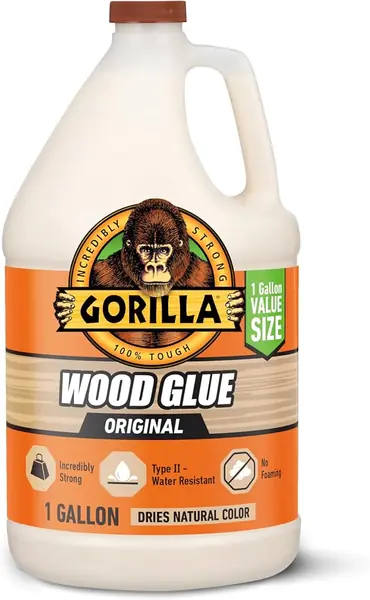
Gorilla Wood Glue gallon bottle of natural tan water-resistant adhesive

Budget shop stock-up

Shop Score 95/100
Water-resistance Grade
ANSI/HPVA Type II water-resistant
Volume
1 gallon
Full Cure
24 hours
Clamp Time
20-30 minutes
View on Amazon

This is the least expensive gallon of the four picks, and we think it's the best value of the group for general shop work. It passes ANSI/HPVA Type II, so outdoor furniture, garage shelving and damp basements are all fair game, and it cures to a natural tan that sits close to the wood tone instead of shouting from the joint.

Twenty to thirty minutes of clamp time is the number that shapes a session. It's short enough to glue up a set of frames in an afternoon and long enough that you're not sprinting between clamps, and the formula is sandable and paintable with no foaming at the joint. Cleanup is warm soap and water on your hands, and a little water, which Gorilla caps at five percent by weight, thins the glue for a longer bead when you're spreading across a wide panel.

The jug runs close to ten pounds, so we decant into a squeeze bottle for anything small; hauling a gallon up a ladder is nobody's idea of a good time. It's the right buy for a shop that goes through glue steadily. If you build two pieces a year, a gallon is more glue than you'll work through, and that's a reason to look at a smaller bottle rather than a reason to skip this one.

Worth Noting

  • Glue cakes around the cap between uses
Our Verdict

Stock the shop with this if volume matters more than a perfect bottle: it's the lowest-priced gallon here and holds through damp weather.

Check Latest Price
4.

Gorilla Ultimate Waterproof Wood Glue Best for Small Waterproof Repairs

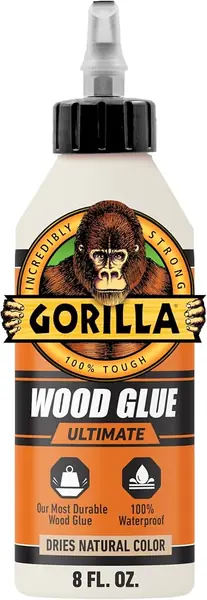
Gorilla Ultimate waterproof wood glue in a small 8-ounce squeeze bottle

Small waterproof repairs

Shop Score 93/100
Water-resistance Grade
ANSI/HPVA Type I waterproof
Volume
8 fluid ounces
Full Cure
24 hours
Working Time
15 minutes
View on Amazon

The glue in this bottle is thick, listed as medium-to-high viscosity, and you feel it the moment you tip the bottle out. On a small repair that's an asset: the bead sits where you put it and doesn't run down a vertical face. On anything larger it's a liability, and the directions themselves tell you to pull the applicator tip and clean out the buildup, which tells you what to expect if the bottle sits between sessions.

What keeps it on our list is the grade. This is ANSI/HPVA Type I waterproof in an eight-ounce bottle, matching our top pick on water resistance, and it gives you fifteen minutes of working time, nearly double the Titebond III, which is genuine help when a repair has several pieces and no jig to hold them. For a loose exterior rail, a planter box or a garden bench that has to survive a winter, that combination earns its place in the drawer.

It also cures without foaming and sands and paints like the wood around it, both of which matter on a repair you hope nobody notices. Set against the Titebond III bottle, the difference is working time against convenience: this one gives you longer to fiddle a joint into place, and it asks for a clean tip in return.

Worth Noting

  • Eight ounces goes fast on a full assembly
Our Verdict

For a small repair that has to survive rain, this is genuine waterproof glue with a generous working time, as long as you keep the tip clean.

Check Latest Price

How We Tested Wood Glue

We narrowed a shelf's worth of options down to 14 formulas by reading labels rather than marketing copy: an ANSI/HPVA water-resistance grade, a stated open time and clamp time, a food-contact statement where one existed, and cost per ounce. Then we bought them at retail and worked them for five months at a home bench, in a garage that drops near freezing in winter, and on a porch railing that gets rained on.

Each glue got matched blocks cut from the same boards, spread at the rate the label suggested and clamped with a stopwatch running. We timed how long we had before a bead started skinning over, how many boards we could reasonably get through in one assembly, and how much glue a running foot of joint actually used. After curing, we broke every joint and recorded whether the wood fibers tore or the seam popped clean; the ones that stayed in rotation failed in the wood.

Outdoor samples were soaked, frozen, and left in the weather to check for creep at the seam. We sanded squeeze-out flat and stained over it to see how visible the bond line stayed and whether the glue took finish evenly. We opened and closed every cap a few dozen times, because a clogged tip or a crusted gallon rim is the difference between a two-minute repair and a twenty-minute one. Cutting-board glue-ups only ever used glue labeled for indirect food contact, spread and clamped inside the temperature range printed on the bottle.

How to Choose a Wood Glue

Match the Grade to Where the Piece Will Live

Wood glues are graded, not marketed. ANSI/HPVA Type I is waterproof, Type II is water-resistant, and a glue carrying no rating at all is for interior work only. Type I is the right call for anything that sits in the weather or gets washed: planters, outdoor chairs, a cutting board that goes in the sink. Type II handles occasional dampness and a wiped-down surface. Interior-only glue is fine for cabinets, furniture and anything that never leaves the house, and buying stronger than the project needs just costs more.

The trap is a label that says water resistant in large type with no ANSI/HPVA line anywhere on it, which is a marketing phrase rather than a grade. Look for the Type I or Type II specification.

Open Time, Clamp Time, and How Much You Can Glue at Once

Open time is how long you have to spread glue, close the joint and get a clamp on before the surface skins over. Our top pick gives you about eight minutes; the Ultimate Gorilla bottle gives fifteen. Eight is plenty for a chair or a drawer. Fifteen is what you want on a case with a dozen parts, a curved lamination, or a repair you can't dry-fit first. Clamp time is the shorter number, twenty to thirty minutes on the Gorilla jugs, and the piece then needs its full cure before it takes load.

Neither number rescues a joint that doesn't fit. PVA glue needs two surfaces in close contact and enough clamp pressure to bring them together, and no grade in this guide fills a gap. Check the dry fit first; if you can see daylight through the joint, the glue is not the problem to solve.

Bottles, Jugs, and Buying the Right Amount

Glue comes in squeeze bottles and in gallons, and cost per ounce falls sharply as the container grows. A gallon makes sense for a shop that glues something most weeks; a small bottle makes sense for repairs and for anyone who won't work through a jug before it sits. If you buy the gallon, decant a squeeze bottle's worth and leave the jug capped and upright, so the container you open every day is the small one. Store either format above freezing.

Food Contact, Bond Line, and Finish

Cutting boards, serving boards and anything else that meets food should use a glue labeled for indirect food contact; Titebond III and Titebond II both carry that approval, and any other bottle needs its label checked first. The bond line is also a finish question. Tan and honey-cream glues can dry darker than pale maple or ash, so wipe squeeze-out while it's wet rather than sanding it later, and sand off any film before you stain, because a glue-sized patch takes finish unevenly.

Frequently Asked Questions

Final Verdict

Titebond III is the bottle we tell most people to buy. It's waterproof, approved for indirect food contact, rated at 4000 psi, and it cleans up with water, which covers outdoor furniture and kitchen pieces without a second product on the shelf.

When the work is steady and the volume is real, the Titebond II gallon does the same job in a bigger format at a lower cost per ounce, and it adds cutting-board approval to the deal. If the price of the jug is what decides it, the Gorilla gallon is the budget route to the same Type II water resistance.